
Downstream Processing Know the Characteristics of Your Protein

- Slides: 48
Downstream Processing
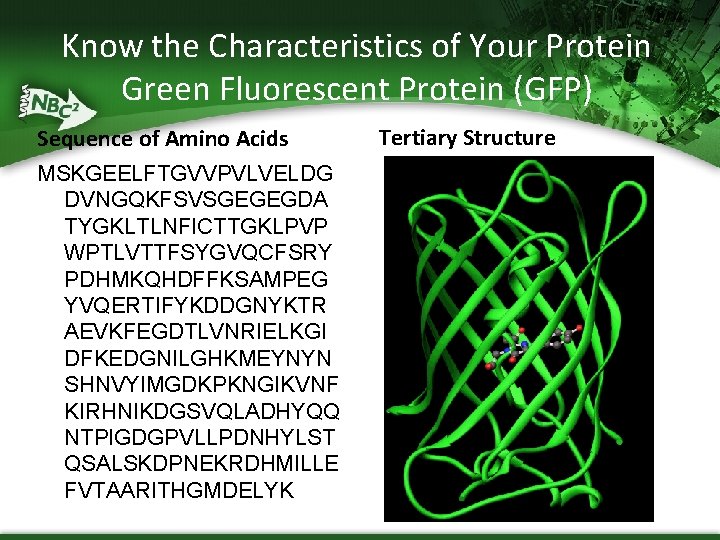
Know the Characteristics of Your Protein Green Fluorescent Protein (GFP) Sequence of Amino Acids MSKGEELFTGVVPVLVELDG DVNGQKFSVSGEGEGDA TYGKLTLNFICTTGKLPVP WPTLVTTFSYGVQCFSRY PDHMKQHDFFKSAMPEG YVQERTIFYKDDGNYKTR AEVKFEGDTLVNRIELKGI DFKEDGNILGHKMEYNYN SHNVYIMGDKPKNGIKVNF KIRHNIKDGSVQLADHYQQ NTPIGDGPVLLPDNHYLST QSALSKDPNEKRDHMILLE FVTAARITHGMDELYK Tertiary Structure
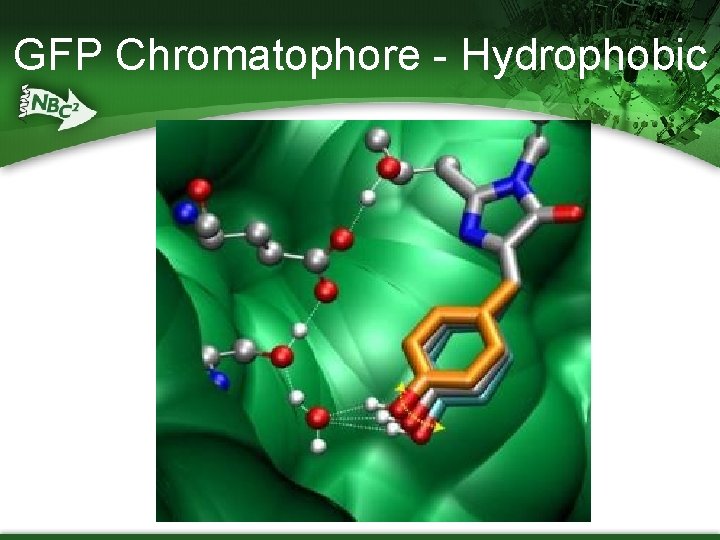
Know the Characteristics of Your Protein Green Fluorescent Protein (GFP) § MW (molecular weight = 27, 000 Daltons (27 k. D) § p. I (isoelectric point) = 4. 8 § Hydropathicity (=hydrophobicity) = hydrophobic amino acids make up GFP’s fluorophore; amino acids associated with the fluorophore also hydrophobic
GFP Chromatophore - Hydrophobic
Downstream Processing in Biopharmaceutical Manufacturing Protein Purification Harvest by Centrifugation Clarification by Depth Filtration Sterile Filtration (MF) Tangential Flow Filtration (UF/DF) Low Pressure Liquid Column Chromatography
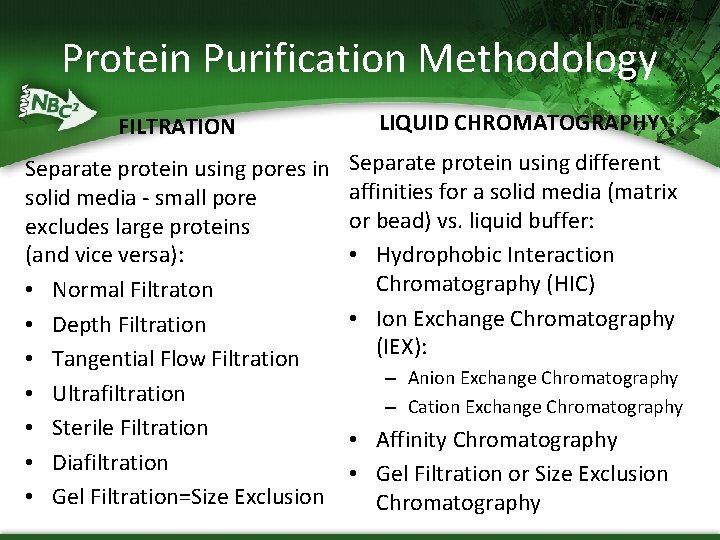
Protein Purification Methodology FILTRATION LIQUID CHROMATOGRAPHY Separate protein using pores in solid media - small pore excludes large proteins (and vice versa): • Normal Filtraton • Depth Filtration • Tangential Flow Filtration • Ultrafiltration • Sterile Filtration • Diafiltration • Gel Filtration=Size Exclusion Separate protein using different affinities for a solid media (matrix or bead) vs. liquid buffer: • Hydrophobic Interaction Chromatography (HIC) • Ion Exchange Chromatography (IEX): – Anion Exchange Chromatography – Cation Exchange Chromatography • Affinity Chromatography • Gel Filtration or Size Exclusion Chromatography
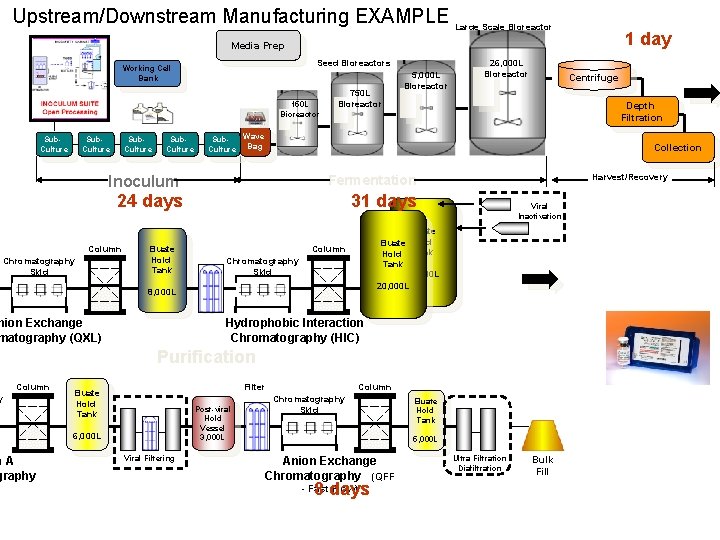
Upstream/Downstream Manufacturing EXAMPLE Large Scale Bioreactor 1 day Media Prep Seed Bioreactors Working Cell Bank 150 L Bioreactor Sub. Culture Collection 24 days 31 days Harvest/Recovery Viral Inactivation Eluate Hold Tank 20, 000 L Column Chromatography Skid 8, 000 L nion Exchange matography (QXL) Centrifuge Wave Sub. Culture Bag Fermentation Eluate Hold Tank 26, 000 L Bioreactor Depth Filtration Inoculum Column Chromatography Skid Sub. Culture 750 L Bioreactor 5, 000 L Bioreactor Hydrophobic Interaction Chromatography (HIC) Purification Column y n. A graphy Filter Eluate Hold Tank Post-viral Hold Vessel 3, 000 L 6, 000 L Viral Filtering Column Chromatography Skid Eluate Hold Tank 5, 000 L Anion Exchange Chromatography (QFF 8 days - Fast Flow) Ultra Filtration Diafiltration Bulk Fill
Clarification or Removal of Cells and Cell Debris Using Centrifugation Using Depth Filtration
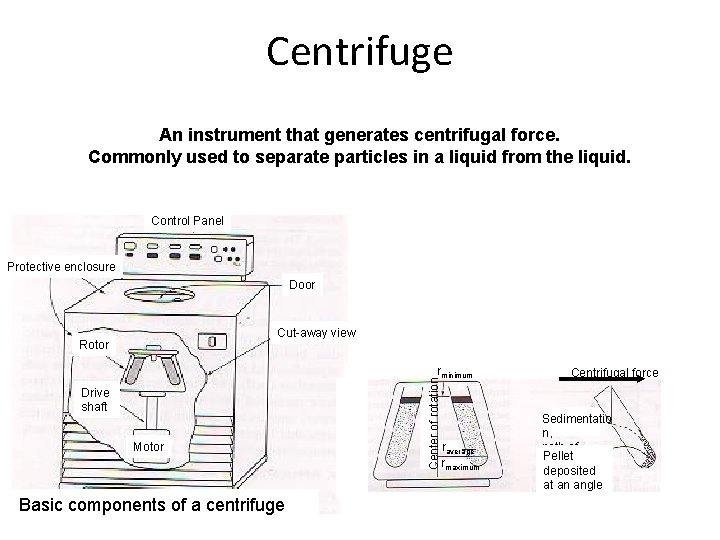
Centrifuge An instrument that generates centrifugal force. Commonly used to separate particles in a liquid from the liquid. Control Panel Protective enclosure Door Cut-away view Rotor Drive shaft Motor Basic components of a centrifuge Center of rotation rminimum raverage rmaximum Centrifugal force Sedimentatio n path of Pellet particles deposited at an angle
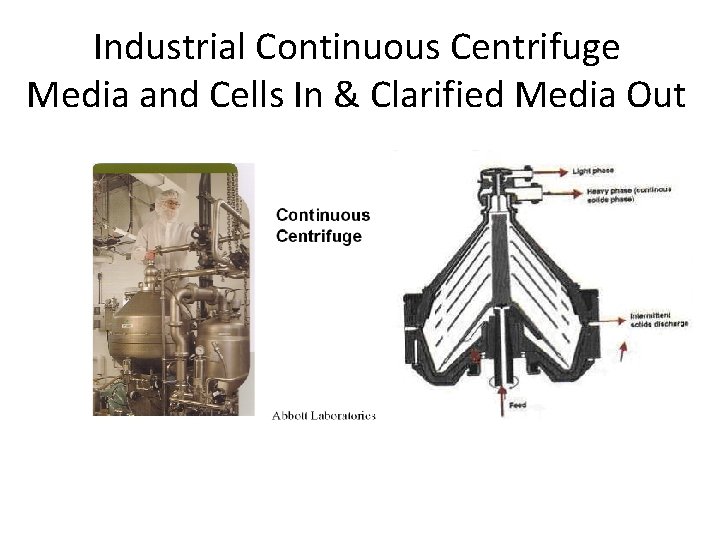
Industrial Continuous Centrifuge Media and Cells In & Clarified Media Out
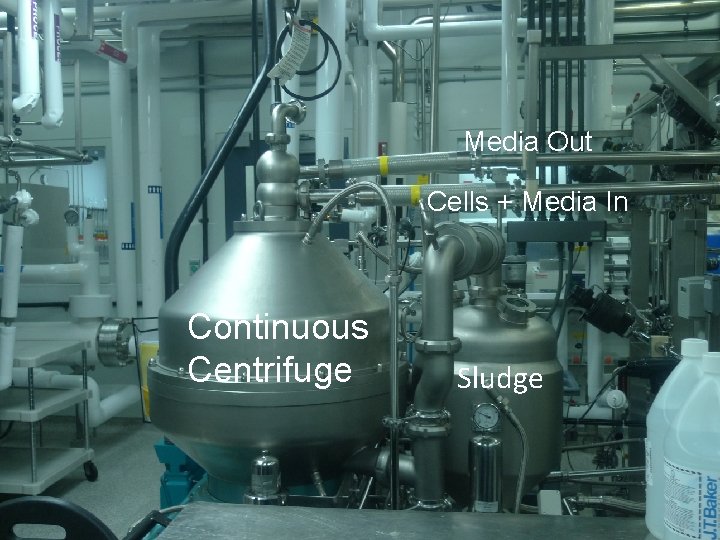
Media Out Cells + Media In Continuous Centrifuge Sludge
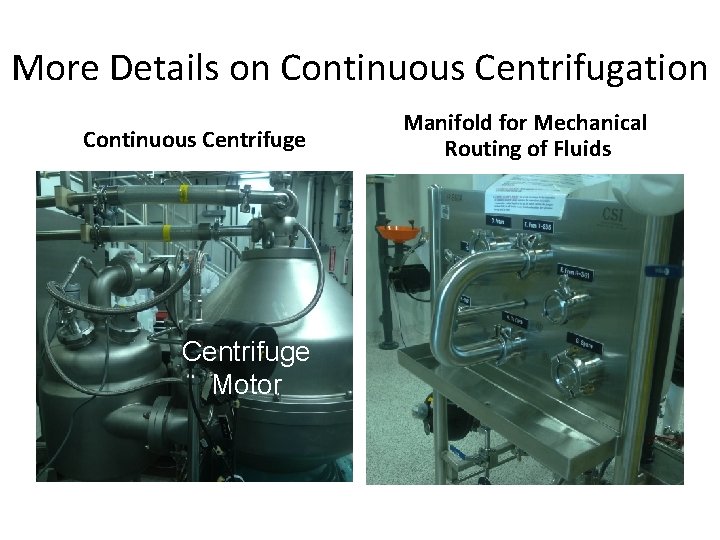
More Details on Continuous Centrifugation Continuous Centrifuge Motor Manifold for Mechanical Routing of Fluids
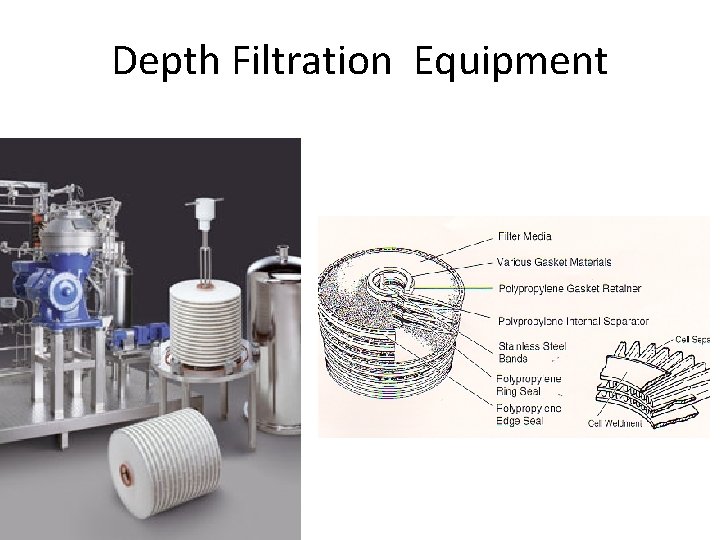
Depth Filtration Equipment
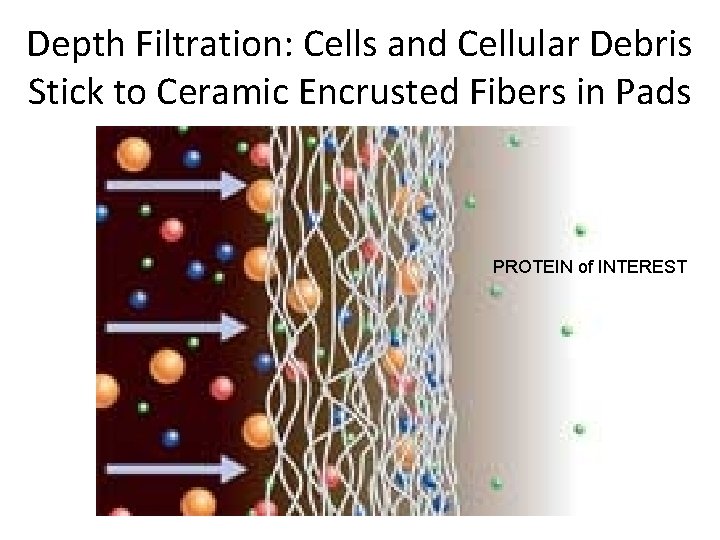
Depth Filtration: Cells and Cellular Debris Stick to Ceramic Encrusted Fibers in Pads PROTEIN of INTEREST
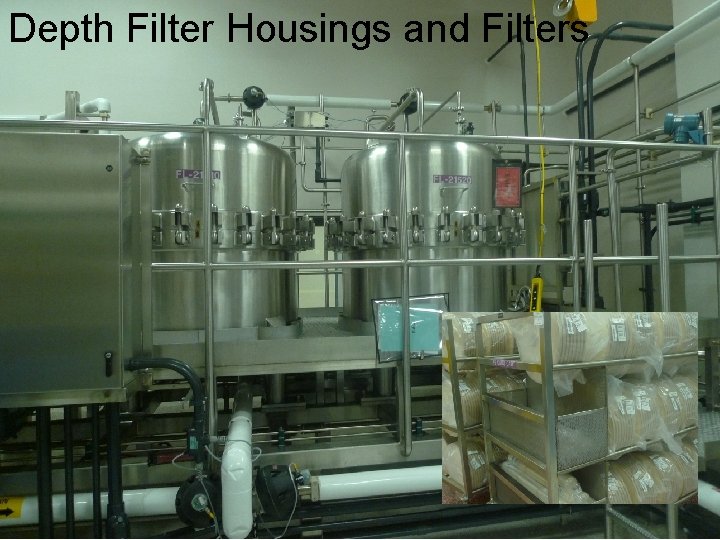
Depth Filter Housings and Filters
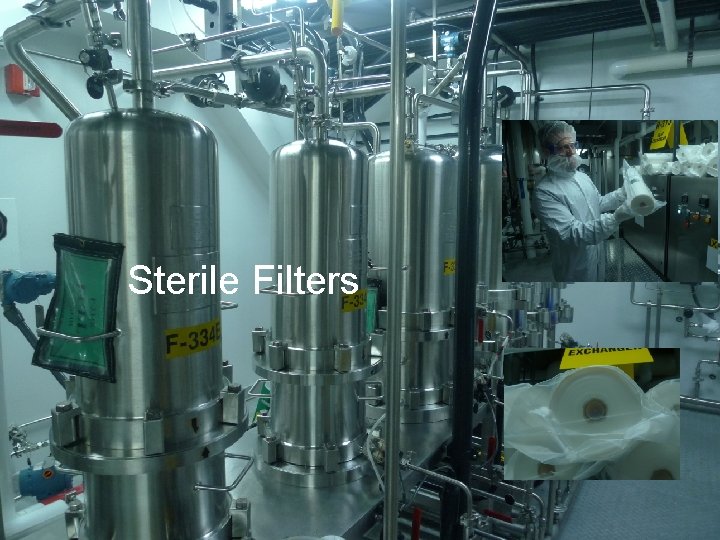
Sterile Filters
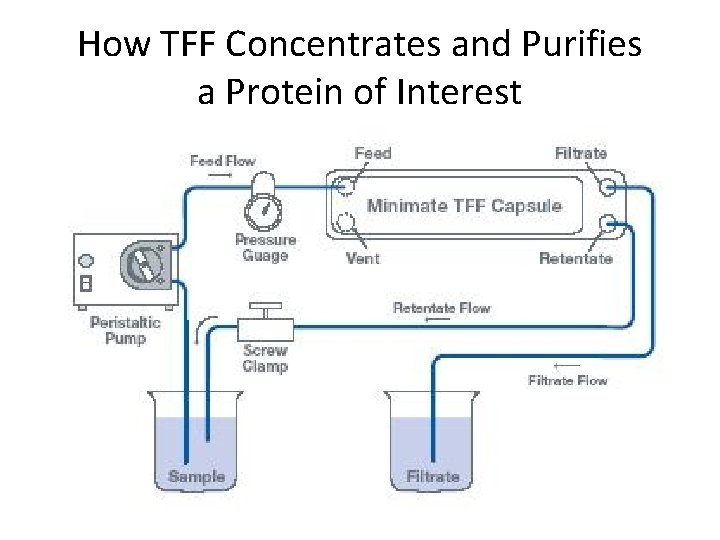
Tangential Flow Filtration – TFF Separation of Protein of Interest Using TFF with the right cut off filters, the protein of interest can be separated from other proteins and molecules in the sterile filtered, clarified medium. For instance HSA has a molecular weight of 69 KD. To make sure that the protein of interest is retained, a 10 KD cut-off filter is used. After ultrafiltration, we can diafilter, adding the phosphate buffer at p. H 7. 1 that we will also use to equilibrate our affinity column to prepare it for affinity chromatography of HSA.
How TFF Concentrates and Purifies a Protein of Interest
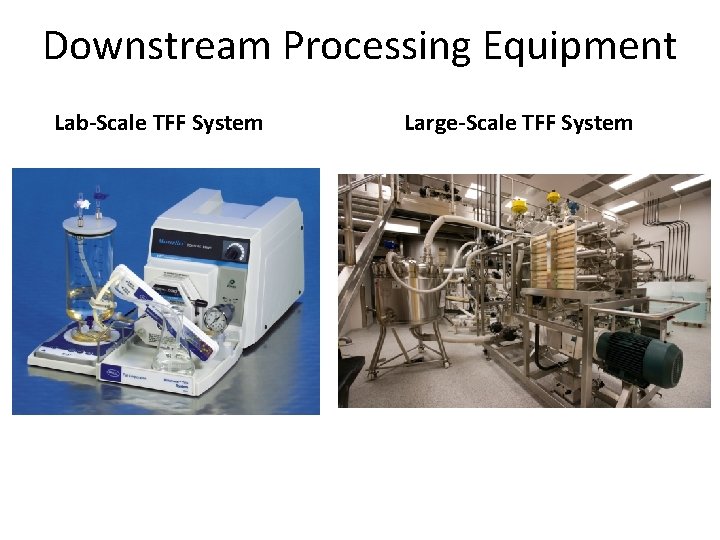
Downstream Processing Equipment Lab-Scale TFF System Large-Scale TFF System
Low Pressure Liquid (Production) Chromatography The Media: Hydrophobic Interaction (HIC) Ion Exchange (Anion AEX and Cation CEX Exchange) Gel Filtration (=Size Exclusion) Affinity The System: Components and Processes
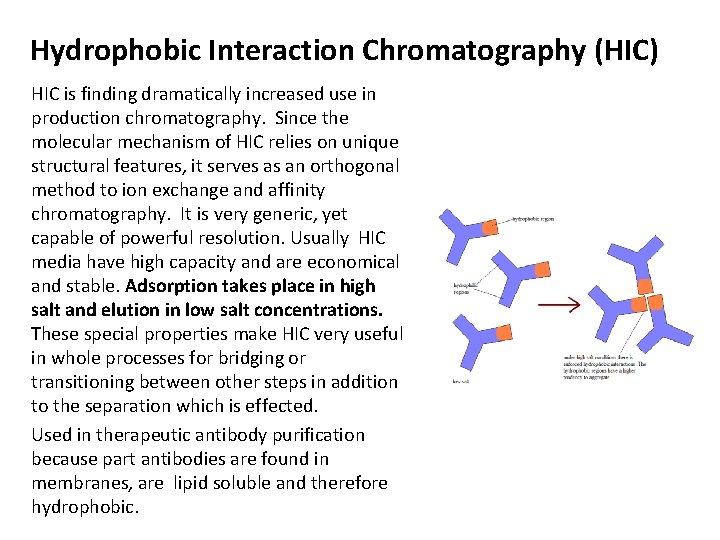
Hydrophobic Interaction Chromatography (HIC) HIC is finding dramatically increased use in production chromatography. Since the molecular mechanism of HIC relies on unique structural features, it serves as an orthogonal method to ion exchange and affinity chromatography. It is very generic, yet capable of powerful resolution. Usually HIC media have high capacity and are economical and stable. Adsorption takes place in high salt and elution in low salt concentrations. These special properties make HIC very useful in whole processes for bridging or transitioning between other steps in addition to the separation which is effected. Used in therapeutic antibody purification because part antibodies are found in membranes, are lipid soluble and therefore hydrophobic.
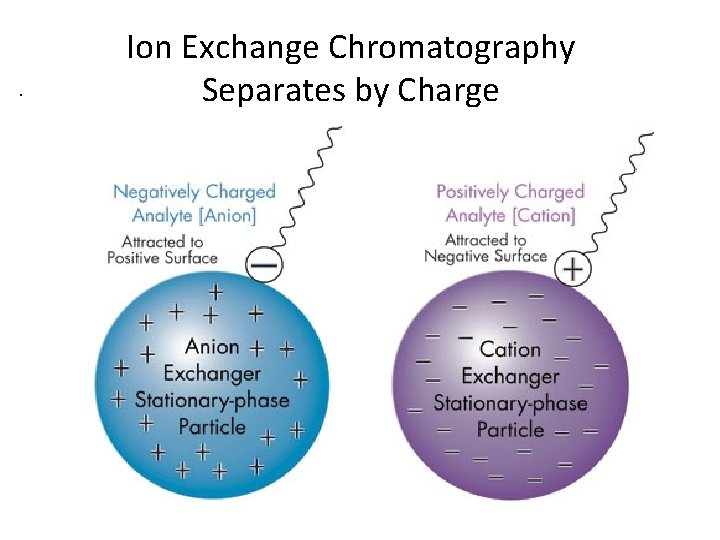
. Ion Exchange Chromatography Separates by Charge
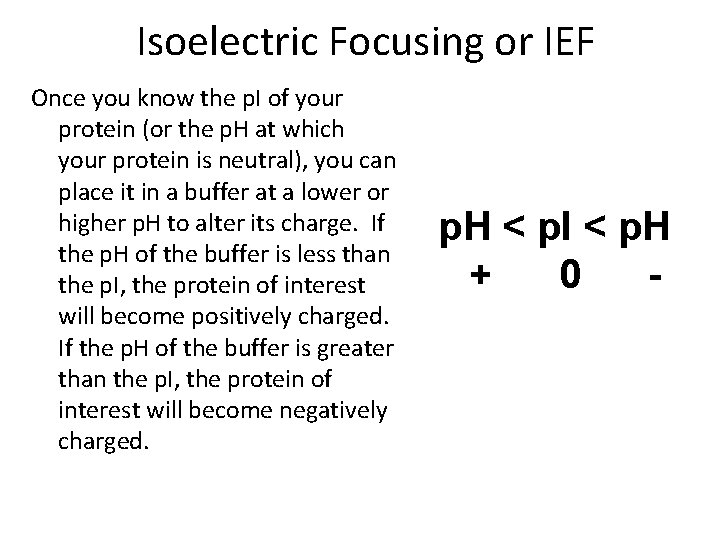
Isoelectric Focusing or IEF Once you know the p. I of your protein (or the p. H at which your protein is neutral), you can place it in a buffer at a lower or higher p. H to alter its charge. If the p. H of the buffer is less than the p. I, the protein of interest will become positively charged. If the p. H of the buffer is greater than the p. I, the protein of interest will become negatively charged. p. H < p. I < p. H + 0 -
GFP Ion Exchage Separation Strategy § GFP has a p. I of 4. 8 § The E. coli supernatate containing GFP is put into p. H 8. 3 buffer, giving it a negative charge. § GFP will stick to the positively charged AEX beads. It will be eluted with high salt. § GFP will not be attracted to the negatively charged CEX beads and will be found in the flow through. Positively charged proteins will attatch to the beads and will be eluted with high salt.
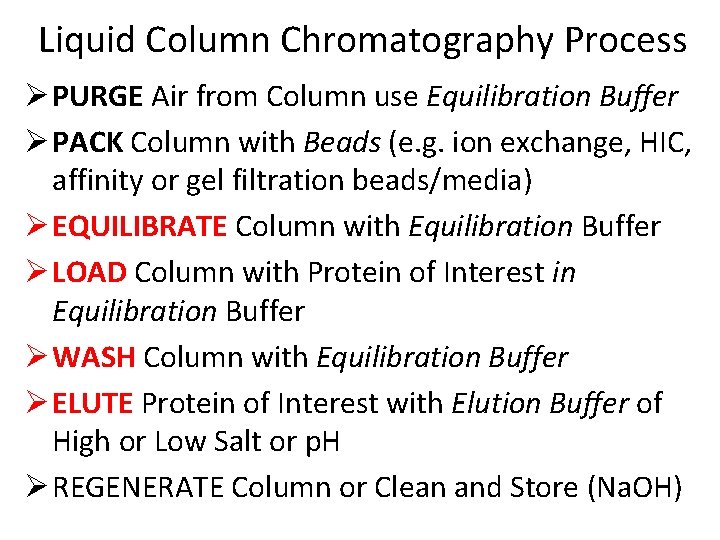
Liquid Column Chromatography Process Ø PURGE Air from Column use Equilibration Buffer Ø PACK Column with Beads (e. g. ion exchange, HIC, affinity or gel filtration beads/media) Ø EQUILIBRATE Column with Equilibration Buffer Ø LOAD Column with Protein of Interest in Equilibration Buffer Ø WASH Column with Equilibration Buffer Ø ELUTE Protein of Interest with Elution Buffer of High or Low Salt or p. H Ø REGENERATE Column or Clean and Store (Na. OH)
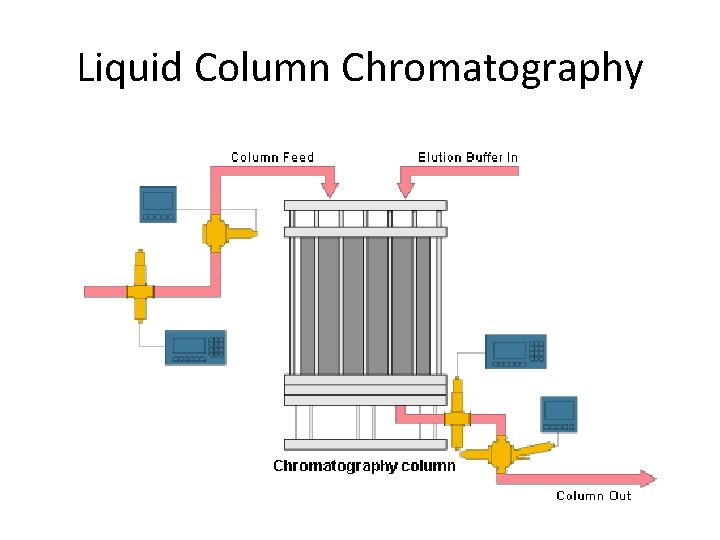
Liquid Column Chromatography
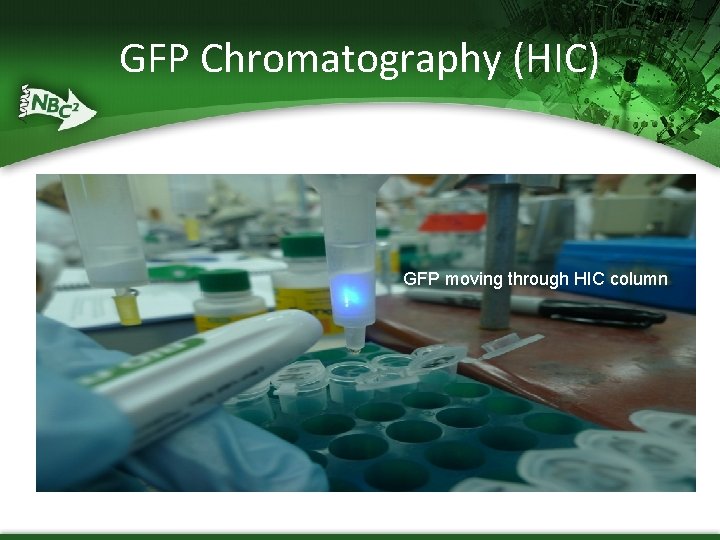
GFP Chromatography (HIC) GFP moving through HIC column
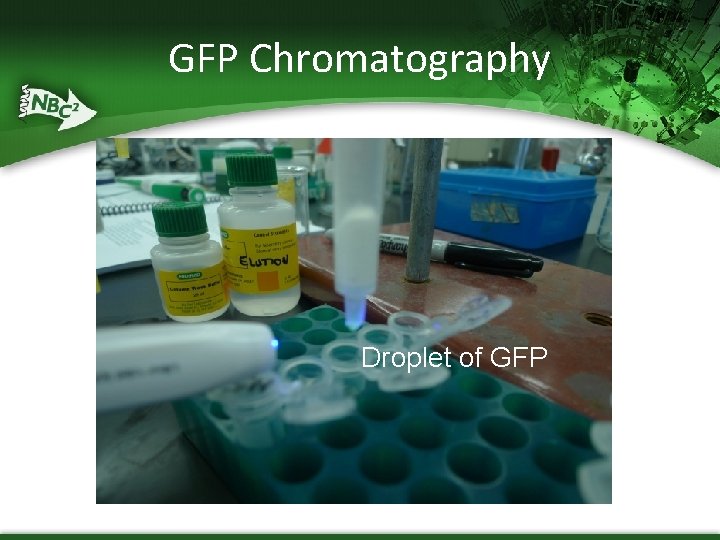
GFP Chromatography Droplet of GFP
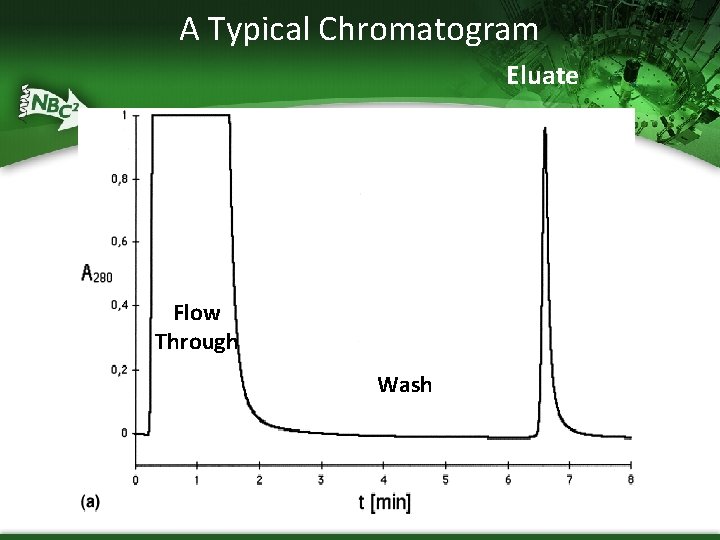
A Typical Chromatogram Eluate Flow Through Wash
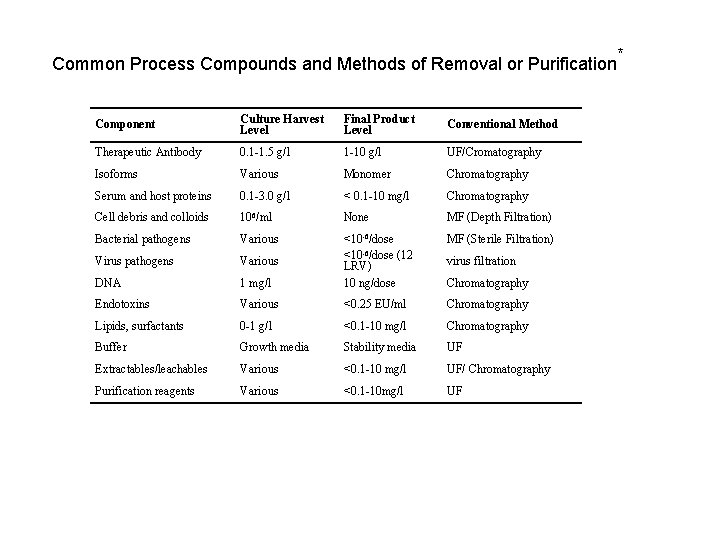
Common Process Compounds and Methods of Removal or Purification* Component Culture Harvest Level Final Product Level Conventional Method Therapeutic Antibody 0. 1 -1. 5 g/l 1 -10 g/l UF/Cromatography Isoforms Various Monomer Chromatography Serum and host proteins 0. 1 -3. 0 g/l < 0. 1 -10 mg/l Chromatography Cell debris and colloids 106/ml None MF (Depth Filtration) Bacterial pathogens Various MF (Sterile Filtration) Virus pathogens Various DNA 1 mg/l <10 -6/dose (12 LRV) 10 ng/dose Endotoxins Various <0. 25 EU/ml Chromatography Lipids, surfactants 0 -1 g/l <0. 1 -10 mg/l Chromatography Buffer Growth media Stability media UF Extractables/leachables Various <0. 1 -10 mg/l UF/ Chromatography Purification reagents Various <0. 1 -10 mg/l UF virus filtration Chromatography
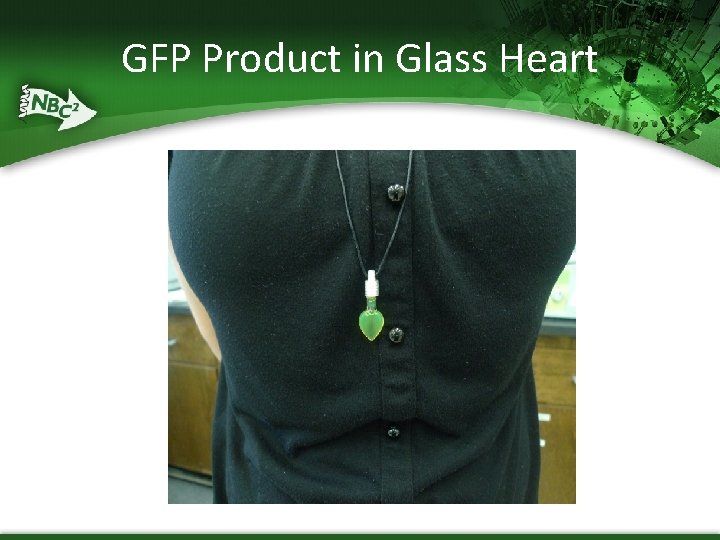
GFP Product in Glass Heart
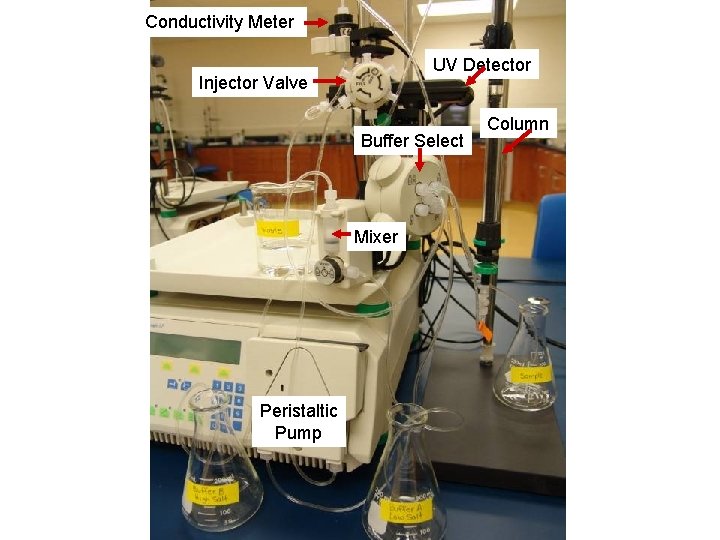
LP LC System Components • Mixer for Buffers, Filtrate with Protein of Interest, Cleaning Solutions • Peristaltic Pump • Chromatography Column and Media (Beads) • Conductivity Meter • UV Detector
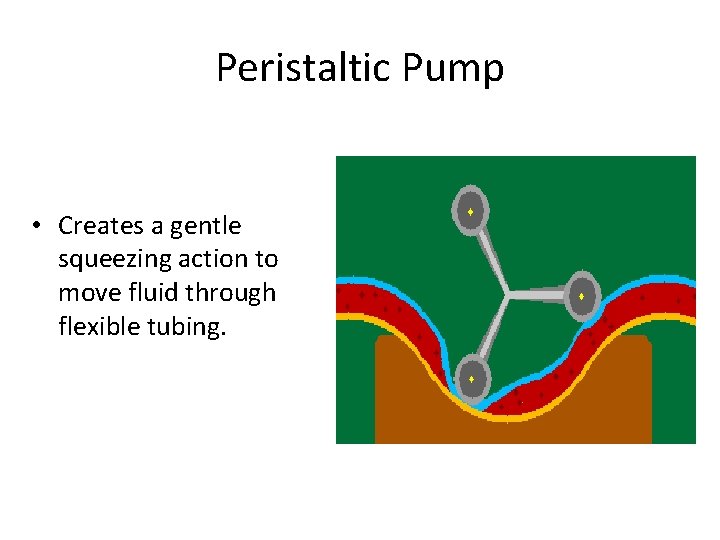
Peristaltic Pump • Creates a gentle squeezing action to move fluid through flexible tubing.
UV Detector Detects proteins coming out of the column by measuring absorbance at 280 nm
Conductivity Meter Measures the amount of salt in the buffers coming out of the columns – high salt or low salt are often used to elute the protein of interest from the chromatography beads.
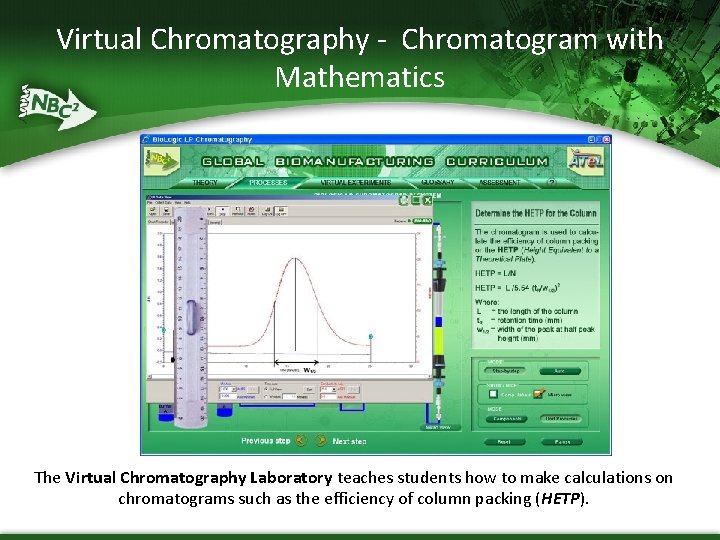
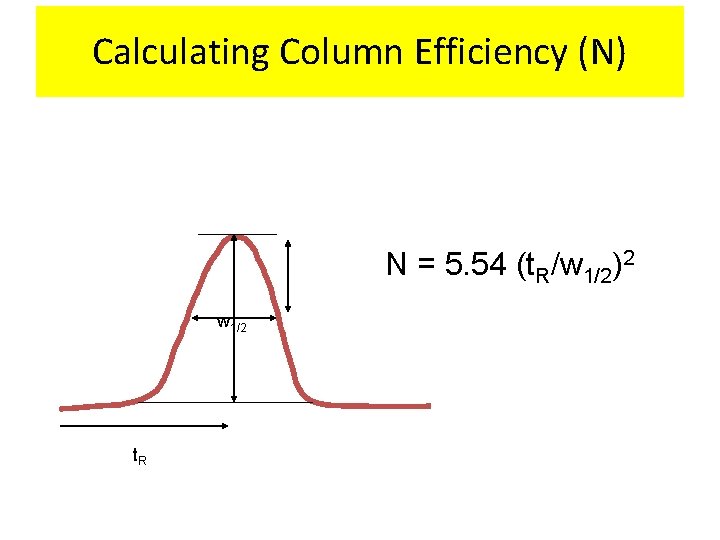
Virtual Chromatography – The Power of Interactive Visualization in Understanding a STEM Field of Study Ø Understanding the physics, chemistry and biology of the chromatographic system and the binding of the protein of interest to the chromatographic matrix or beads (Science) Ø Understanding the design and operation of chromatography components and of the chromatographic process (Technology and Engineering). Ø Understanding the calculations needed to run the chromatographic system (column volume) and the measurements on chromatograms needed to calculate the HETP, number of theoretical plates, retention time, and resolution (Mathematics).
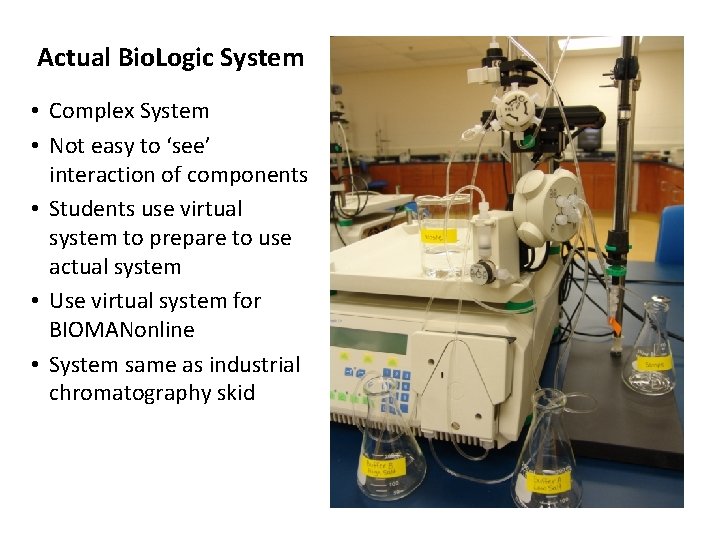
Actual Bio. Logic System • Complex System • Not easy to ‘see’ interaction of components • Students use virtual system to prepare to use actual system • Use virtual system for BIOMANonline • System same as industrial chromatography skid
Conductivity Meter UV Detector Injector Valve Buffer Select Mixer Peristaltic Pump Column
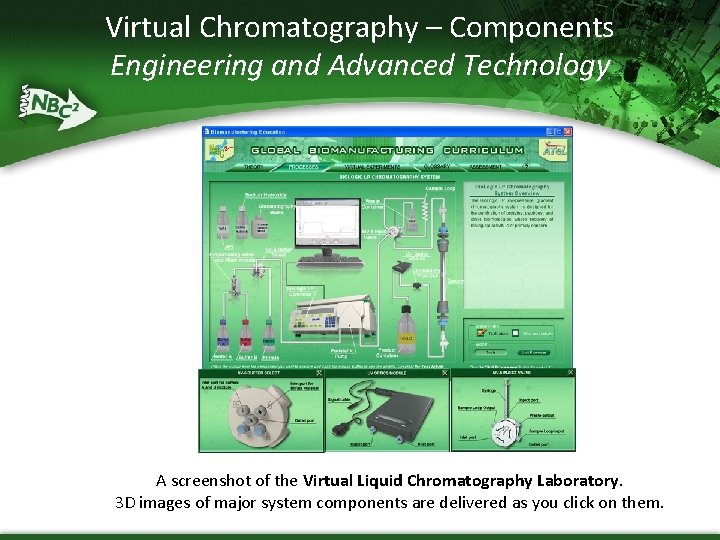
Virtual Chromatography – Components Engineering and Advanced Technology A screenshot of the Virtual Liquid Chromatography Laboratory. 3 D images of major system components are delivered as you click on them.
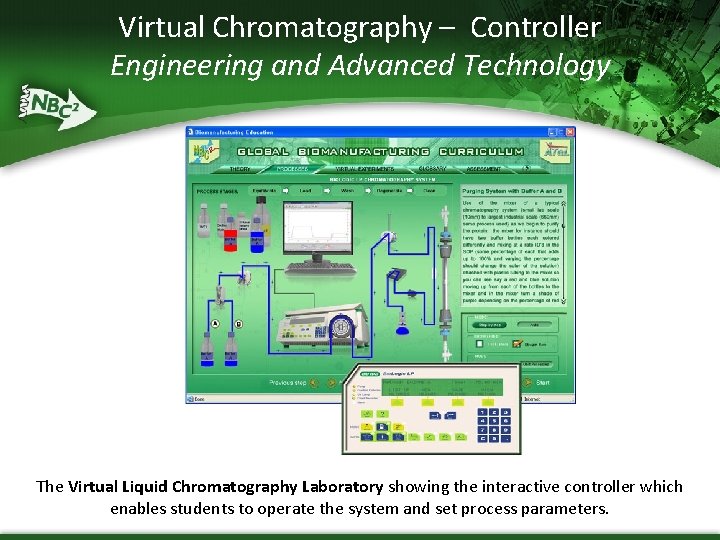
Virtual Chromatography – Controller Engineering and Advanced Technology The Virtual Liquid Chromatography Laboratory showing the interactive controller which enables students to operate the system and set process parameters.
Virtual Chromatography - Chromatogram with Mathematics The Virtual Chromatography Laboratory teaches students how to make calculations on chromatograms such as the efficiency of column packing (HETP).
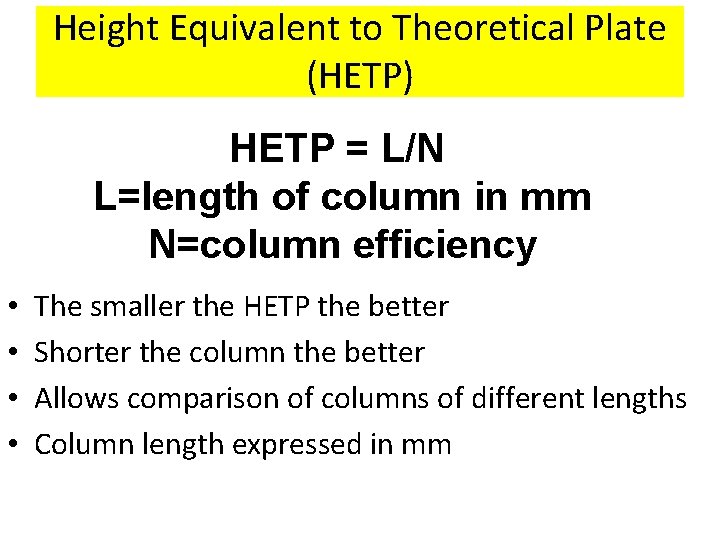
Height Equivalent to Theoretical Plate (HETP) HETP = L/N L=length of column in mm N=column efficiency • • The smaller the HETP the better Shorter the column the better Allows comparison of columns of different lengths Column length expressed in mm
Calculating Column Efficiency (N) N = 5. 54 (t. R/w 1/2)2 w 1/2 t. R
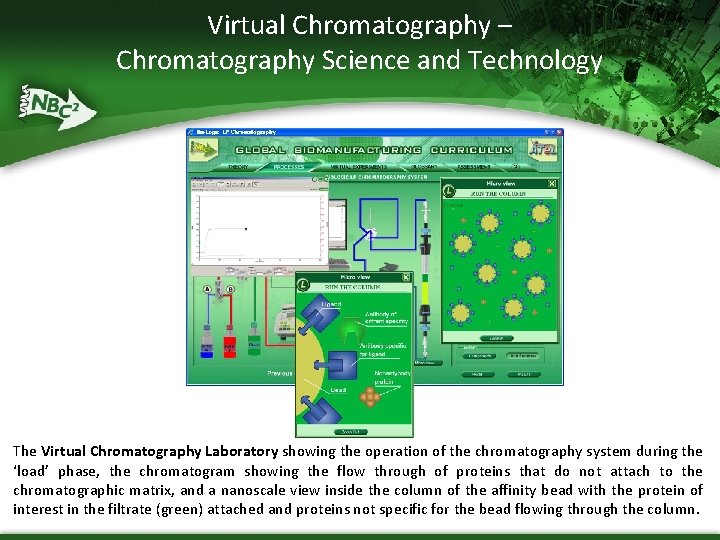
Virtual Chromatography – Chromatography Science and Technology The Virtual Chromatography Laboratory showing the operation of the chromatography system during the ‘load’ phase, the chromatogram showing the flow through of proteins that do not attach to the chromatographic matrix, and a nanoscale view inside the column of the affinity bead with the protein of interest in the filtrate (green) attached and proteins not specific for the bead flowing through the column.
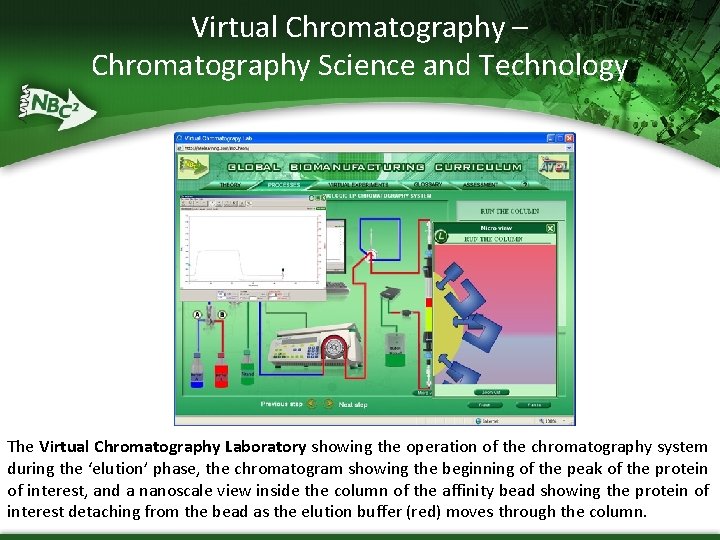
Virtual Chromatography – Chromatography Science and Technology The Virtual Chromatography Laboratory showing the operation of the chromatography system during the ‘elution’ phase, the chromatogram showing the beginning of the peak of the protein of interest, and a nanoscale view inside the column of the affinity bead showing the protein of interest detaching from the bead as the elution buffer (red) moves through the column.
The Virtual Chromatography Laboratory URL: http: //ATe. Learning. com/Bio. Chrom/ To login enter your email address and the password: teachbio
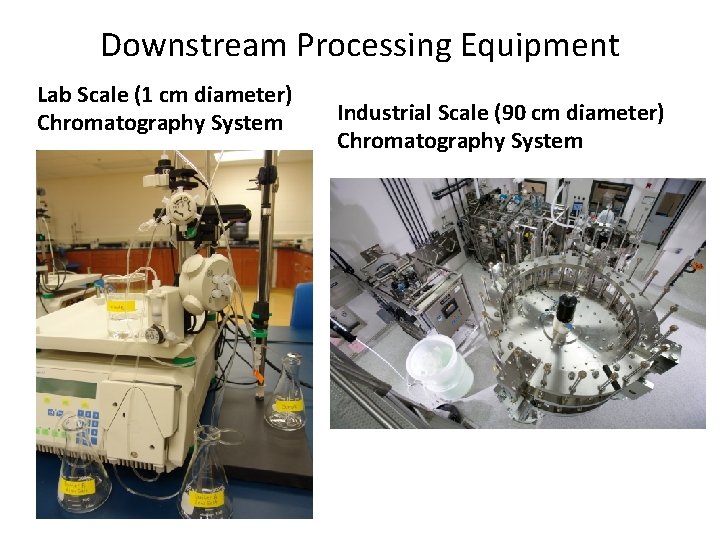
Downstream Processing Equipment Lab Scale (1 cm diameter) Chromatography System Industrial Scale (90 cm diameter) Chromatography System
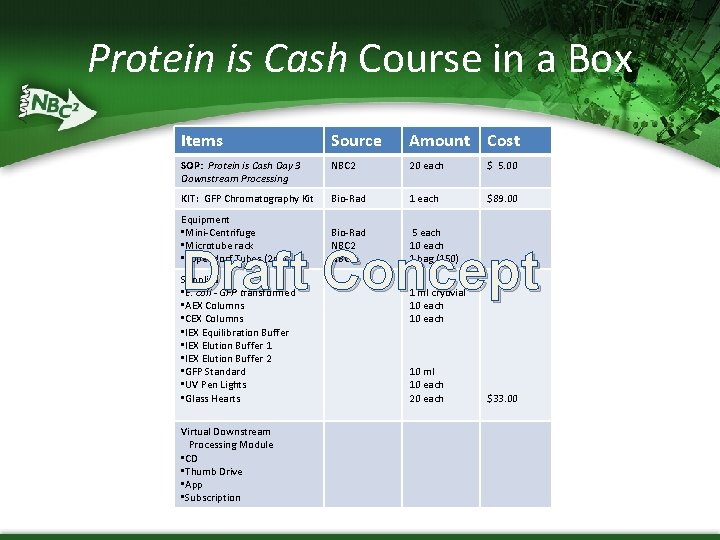
Protein is Cash Course in a Box Protein is Cash - Day. Source 3: Downstream Processing Items Amount Cost SOP: Protein is Cash Day 3 Downstream Processing NBC 2 20 each $ 5. 00 KIT: GFP Chromatography Kit Bio-Rad 1 each $89. 00 Equipment • Mini-Centrifuge • Microtube rack • Eppendorf Tubes (2 ml) Bio-Rad NBC 2 5 each 10 each 1 bag (150) Draft Concept Supplies • E. coli - GFP transformed • AEX Columns • CEX Columns • IEX Equilibration Buffer • IEX Elution Buffer 1 • IEX Elution Buffer 2 • GFP Standard • UV Pen Lights • Glass Hearts Virtual Downstream Processing Module • CD • Thumb Drive • App • Subscription 1 ml cryovial 10 each 10 ml 10 each 20 each $33. 00