
DOWNLOAD KATA POWERPOINT SLIDES s e d u


- Slides: 85
DOWNLOAD KATA POWERPOINT SLIDES s e d u l Inc eos 5 Vid Includ IK Cardes For creating your own KATA presentations and training
About These Kata Slides & Graphics v 4. 1, March 2016 This collection of Improvement Kata / Coaching Kata slides is for use by anyone. You can incorporate any of these Power. Point format slides into your own training and presentations, and adjust them however you like. Also included are links to five short videos that help make key points in IK/CK presentations and training. You'll find many more videos on the IK/CK You. Tube channel at www. youtube. com/user/734 mike. Please post your Kata presentations on Slide. Share (www. slideshare. net) and on You. Tube, so we can learn from you. Include some keywords like those listed below so other Kata practitioners can find and learn from your efforts! Suggested keywords: IK, CK, Kata, Improvement Kata, Coaching Kata, Toyota Kata, Scientific Thinking
A NOTE ABOUT "KATA" Kata are structured routines that you practice deliberately, especially at the beginning, so their pattern becomes a habit and leaves you with new abilities. Kata are a way of learning fundamental skills that you can build on. The word comes from the martial arts, where Kata are used to train combatants in fundamental moves. But the idea of a Kata can be applied in a much broader sense. The Improvement Kata and Coaching Kata are for training managers and leaders in a new way of doing their jobs. At first you should try to practice each Kata exactly as described, until its pattern becomes somewhat automatic and habitual for you. That can take several months of practice. When you reach that point and have learned through practice to understand the "why" behind that Kata's routine, then you can start to deviate from it by evolving your own version or style of the pattern. . . as long as its core principles remain intact. Practice Kata to Find Your Way. No one can show you precisely how your management system should look and function. That would be impossible since each organization has unique characteristics and exists in unique conditions. Developing an organization's managerial system is not about copying the tools and techniques that another organization has come up with, which would be jumping to solutions. You can and should start with some already-existing basics, like in sports and music, but then it's an iterative process of trial and adjustment. The routines of the Improvement Kata and Coaching Kata help you develop and build your own 21 st Century management approach via a well-proven set of "Starter Kata" to practice daily. They come from the Toyota Kata research and have been used for practice at thousands of organizations around the world. Begin with the Starter Kata and then, as you gain skill and understanding, add to or adjust them to fit your situation as needed. Then you’ll be developing your own way. Best wishes for your practicing! Mike Rother 5
Here are the slides Remember. . . it’s about you and your story! Use these slides as some building blocks.
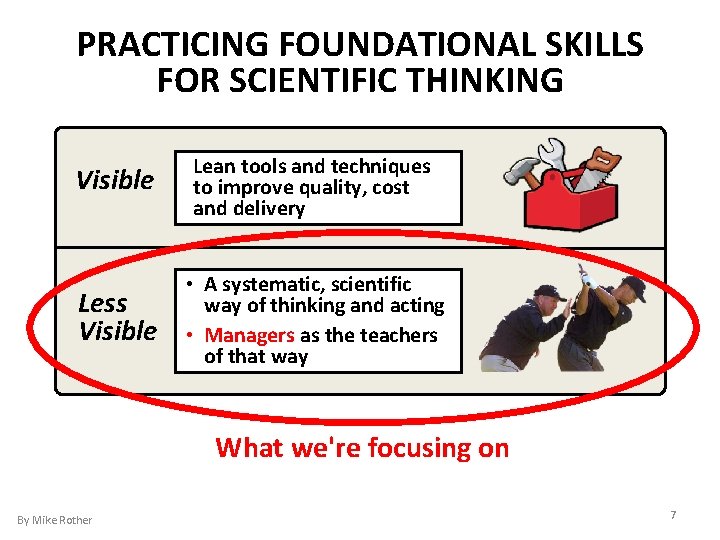
PRACTICING FOUNDATIONAL SKILLS FOR SCIENTIFIC THINKING Visible Lean tools and techniques to improve quality, cost and delivery Less Visible • A systematic, scientific way of thinking and acting • Managers as the teachers of that way What we're focusing on By Mike Rother 7
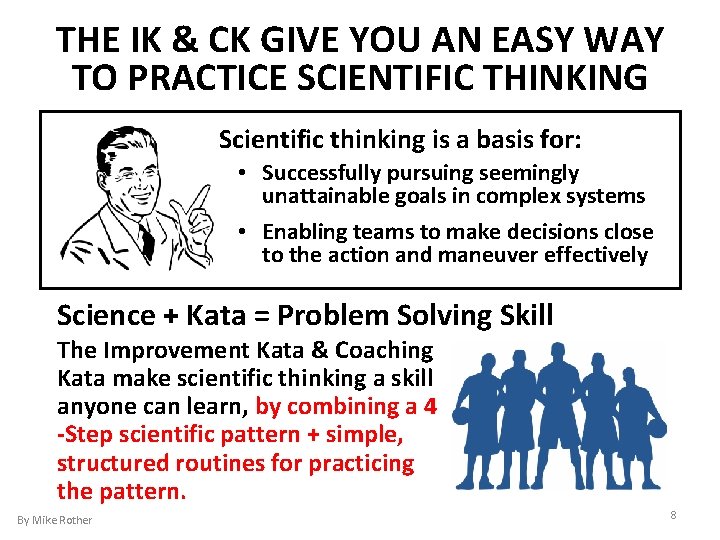
THE IK & CK GIVE YOU AN EASY WAY TO PRACTICE SCIENTIFIC THINKING Scientific thinking is a basis for: • Successfully pursuing seemingly unattainable goals in complex systems • Enabling teams to make decisions close to the action and maneuver effectively Science + Kata = Problem Solving Skill The Improvement Kata & Coaching Kata make scientific thinking a skill anyone can learn, by combining a 4 -Step scientific pattern + simple, structured routines for practicing the pattern. By Mike Rother 8
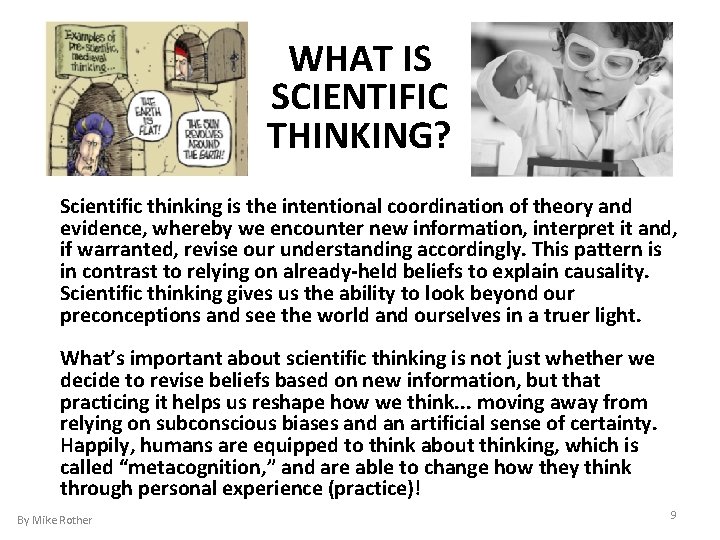
WHAT IS SCIENTIFIC THINKING? Scientific thinking is the intentional coordination of theory and evidence, whereby we encounter new information, interpret it and, if warranted, revise our understanding accordingly. This pattern is in contrast to relying on already-held beliefs to explain causality. Scientific thinking gives us the ability to look beyond our preconceptions and see the world and ourselves in a truer light. Whatʼs important about scientific thinking is not just whether we decide to revise beliefs based on new information, but that practicing it helps us reshape how we think. . . moving away from relying on subconscious biases and an artificial sense of certainty. Happily, humans are equipped to think about thinking, which is called “metacognition, ” and are able to change how they think through personal experience (practice)! By Mike Rother 9
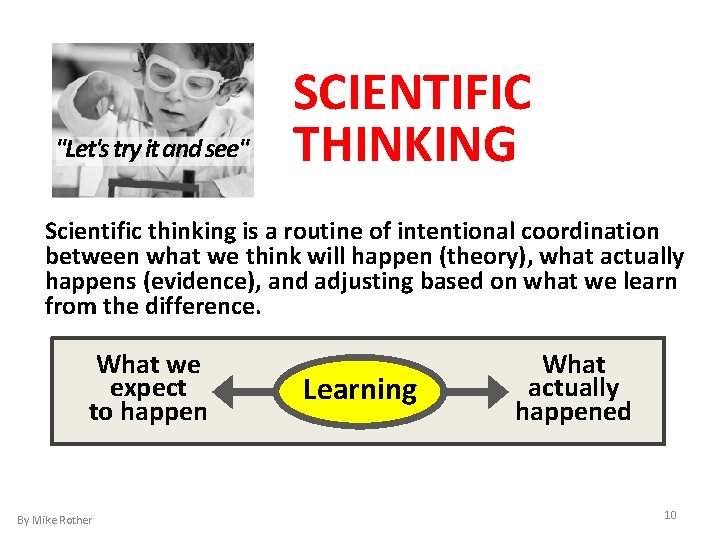
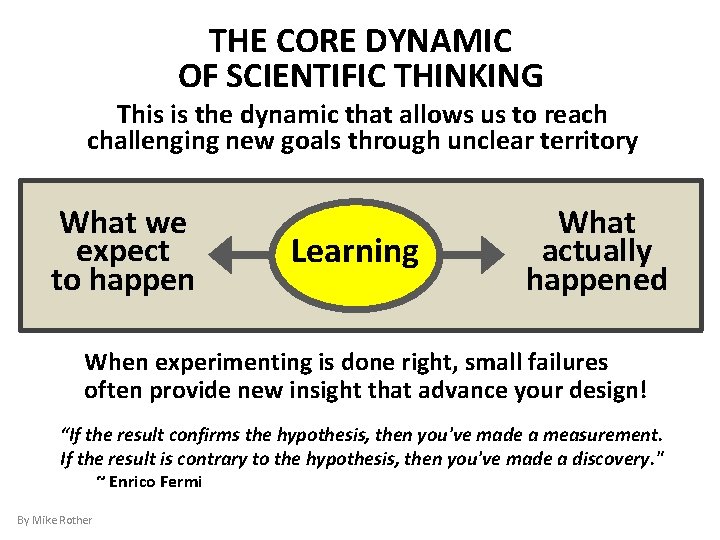
"Let's try it and see" SCIENTIFIC THINKING Scientific thinking is a routine of intentional coordination between what we think will happen (theory), what actually happens (evidence), and adjusting based on what we learn from the difference. What we expect to happen By Mike Rother Learning What actually happened 10
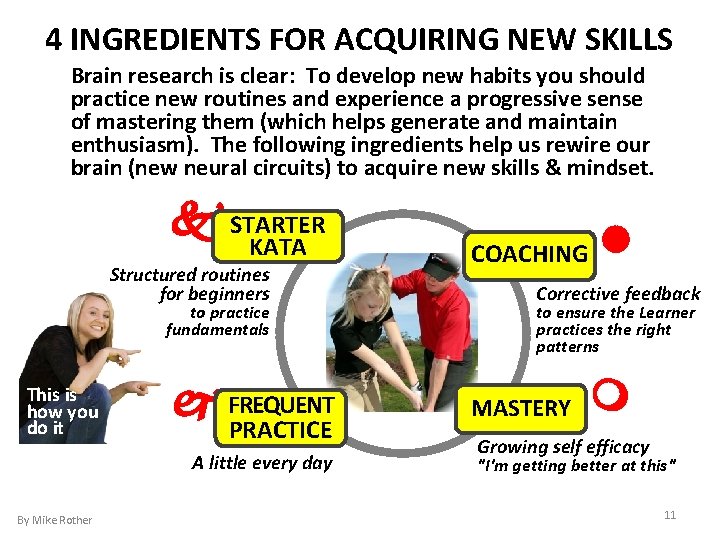
4 INGREDIENTS FOR ACQUIRING NEW SKILLS Brain research is clear: To develop new habits you should practice new routines and experience a progressive sense of mastering them (which helps generate and maintain enthusiasm). The following ingredients help us rewire our brain (new neural circuits) to acquire new skills & mindset. k STARTER KATA Structured routines for beginners to practice fundamentals This is how you do it j FREQUENT PRACTICE A little every day By Mike Rother COACHING l Corrective feedback to ensure the Learner practices the right patterns MASTERY m Growing self efficacy "I'm getting better at this" 11
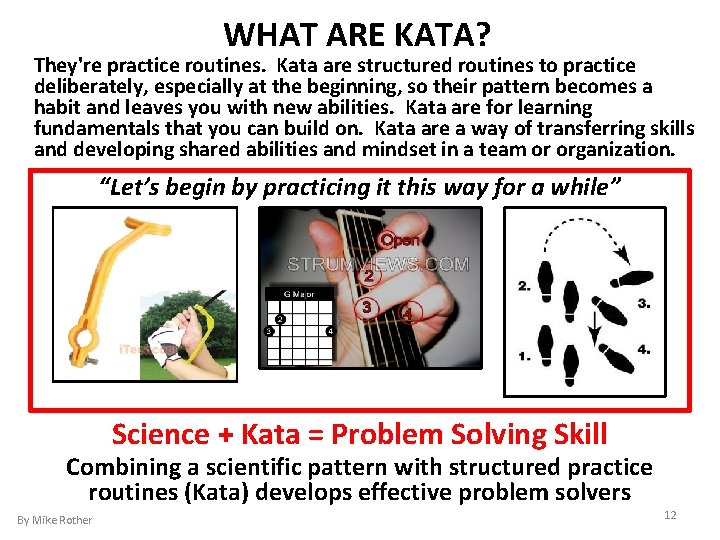
WHAT ARE KATA? They're practice routines. Kata are structured routines to practice deliberately, especially at the beginning, so their pattern becomes a habit and leaves you with new abilities. Kata are for learning fundamentals that you can build on. Kata are a way of transferring skills and developing shared abilities and mindset in a team or organization. “Let’s begin by practicing it this way for a while” Science + Kata = Problem Solving Skill Combining a scientific pattern with structured practice routines (Kata) develops effective problem solvers By Mike Rother 12
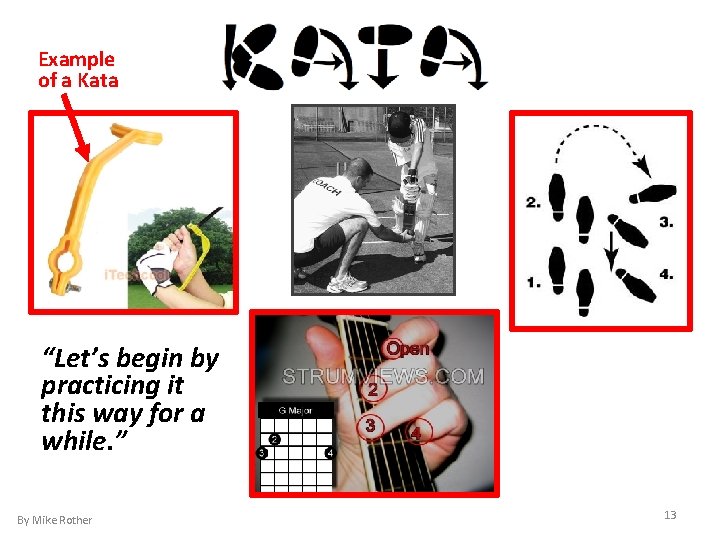
Example of a Kata “Let’s begin by practicing it this way for a while. ” By Mike Rother 13
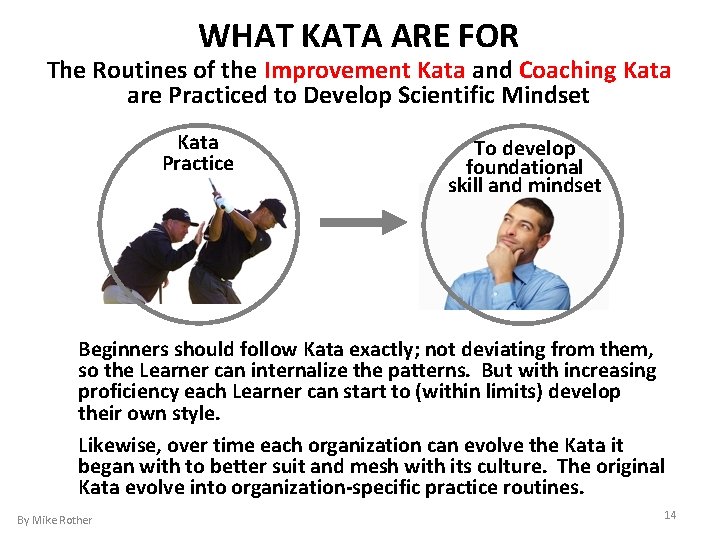
WHAT KATA ARE FOR The Routines of the Improvement Kata and Coaching Kata are Practiced to Develop Scientific Mindset Kata Practice To develop foundational skill and mindset Beginners should follow Kata exactly; not deviating from them, so the Learner can internalize the patterns. But with increasing proficiency each Learner can start to (within limits) develop their own style. Likewise, over time each organization can evolve the Kata it began with to better suit and mesh with its culture. The original Kata evolve into organization-specific practice routines. By Mike Rother 14
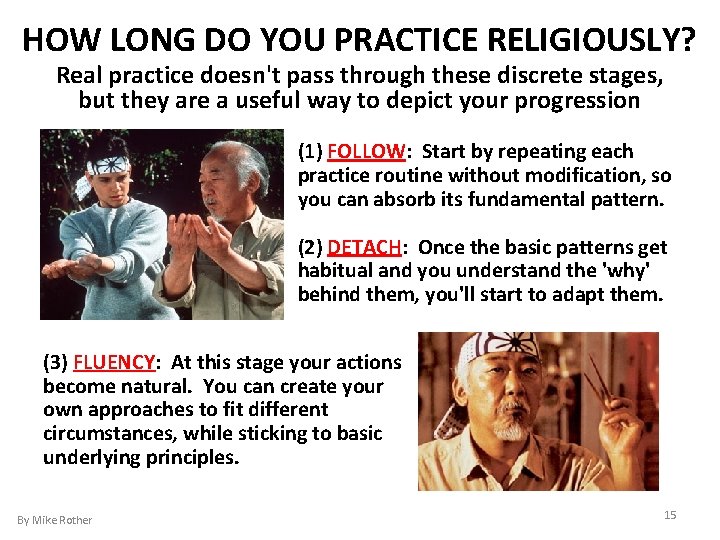
HOW LONG DO YOU PRACTICE RELIGIOUSLY? Real practice doesn't pass through these discrete stages, but they are a useful way to depict your progression (1) FOLLOW: Start by repeating each practice routine without modification, so you can absorb its fundamental pattern. (2) DETACH: Once the basic patterns get habitual and you understand the 'why' behind them, you'll start to adapt them. (3) FLUENCY: At this stage your actions become natural. You can create your own approaches to fit different circumstances, while sticking to basic underlying principles. By Mike Rother 15
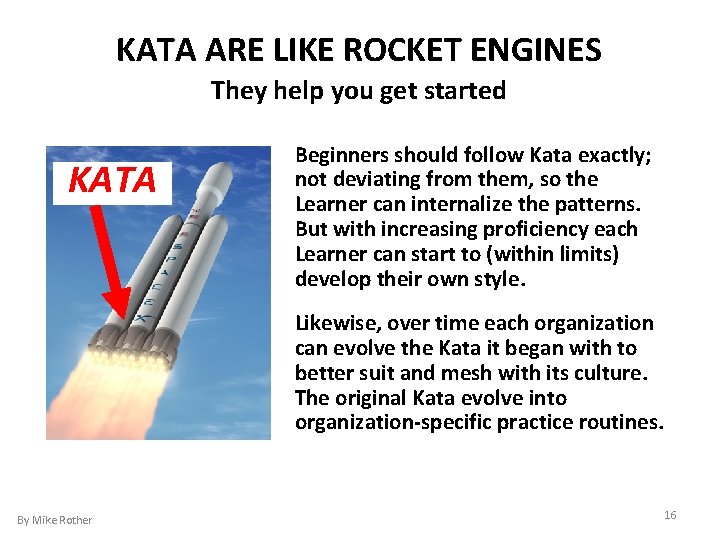
KATA ARE LIKE ROCKET ENGINES They help you get started KATA Beginners should follow Kata exactly; not deviating from them, so the Learner can internalize the patterns. But with increasing proficiency each Learner can start to (within limits) develop their own style. Likewise, over time each organization can evolve the Kata it began with to better suit and mesh with its culture. The original Kata evolve into organization-specific practice routines. By Mike Rother 16
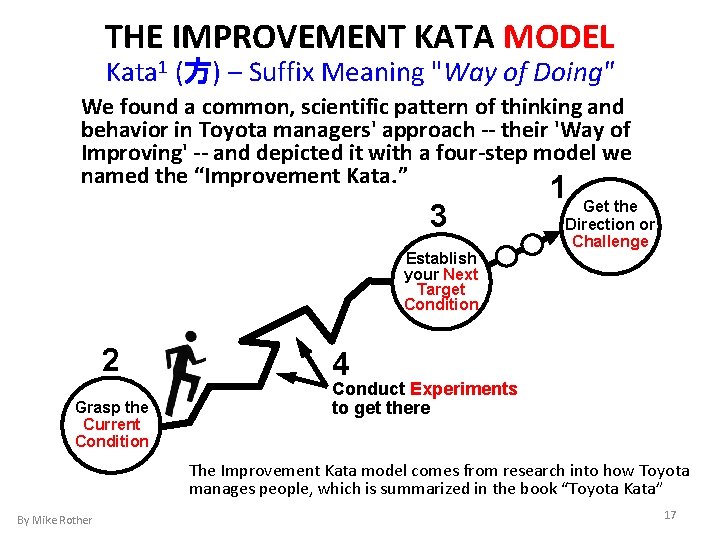
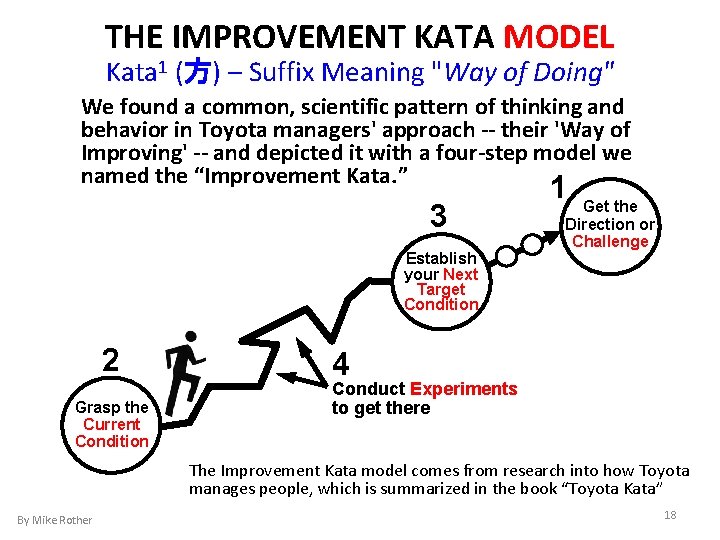
THE IMPROVEMENT KATA MODEL Kata 1 (方) – Suffix Meaning "Way of Doing" We found a common, scientific pattern of thinking and behavior in Toyota managers' approach -- their 'Way of Improving' -- and depicted it with a four-step model we named the “Improvement Kata. ” 3 Establish your Next Target Condition 2 Grasp the Current Condition 1 Get the Direction or Challenge 4 Conduct Experiments to get there The Improvement Kata model comes from research into how Toyota manages people, which is summarized in the book “Toyota Kata” By Mike Rother 17
THE IMPROVEMENT KATA MODEL Kata 1 (方) – Suffix Meaning "Way of Doing" We found a common, scientific pattern of thinking and behavior in Toyota managers' approach -- their 'Way of Improving' -- and depicted it with a four-step model we named the “Improvement Kata. ” 3 Establish your Next Target Condition 2 Grasp the Current Condition 1 Get the Direction or Challenge 4 Conduct Experiments to get there The Improvement Kata model comes from research into how Toyota manages people, which is summarized in the book “Toyota Kata” By Mike Rother 18
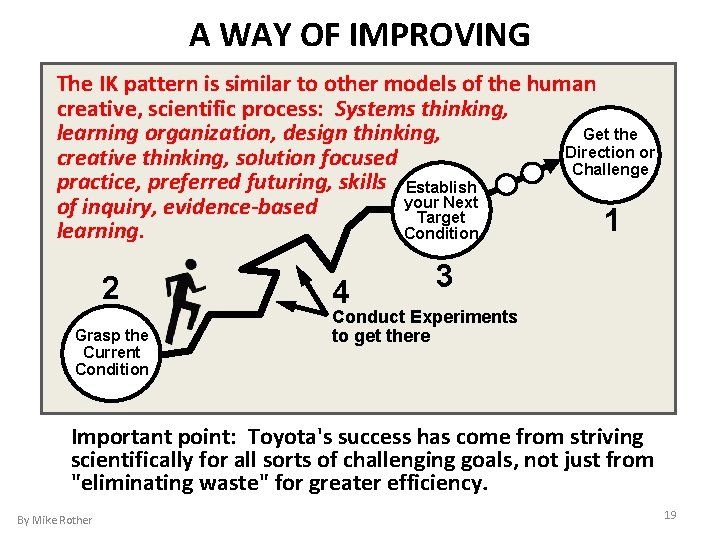
A WAY OF IMPROVING The IK pattern is similar to other models of the human creative, scientific process: Systems thinking, learning organization, design thinking, Get the Direction or creative thinking, solution focused Challenge practice, preferred futuring, skills Establish your Next of inquiry, evidence-based Target 1 learning. Condition 2 Grasp the Current Condition 4 3 Conduct Experiments to get there Important point: Toyota's success has come from striving scientifically for all sorts of challenging goals, not just from "eliminating waste" for greater efficiency. By Mike Rother 19
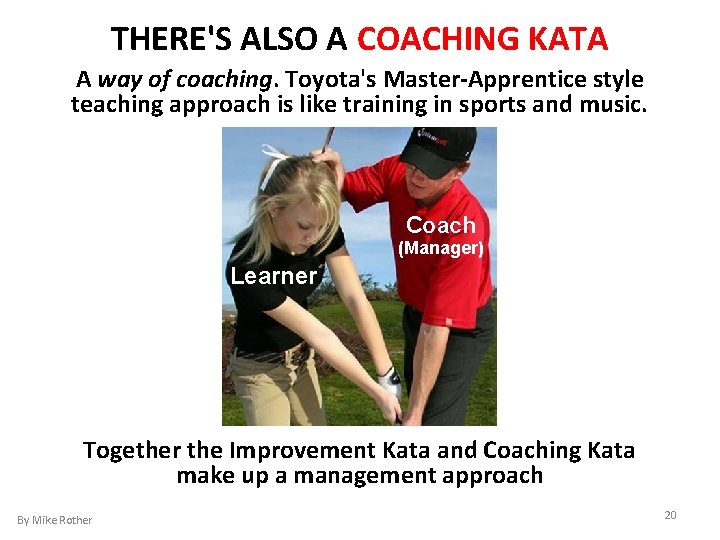
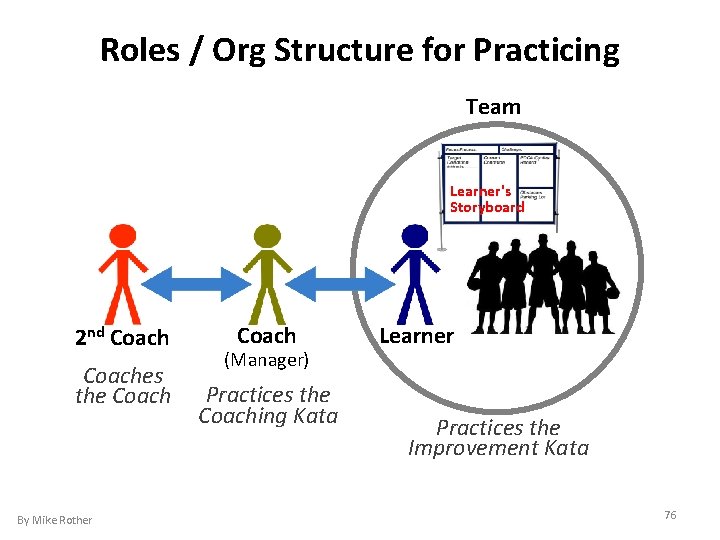
THERE'S ALSO A COACHING KATA A way of coaching. Toyota's Master-Apprentice style teaching approach is like training in sports and music. Coach (Manager) Learner Together the Improvement Kata and Coaching Kata make up a management approach By Mike Rother 20
BUT THERE IS A PROBLEM No matter how good it is, just explaining a model doesn't generate new ways of thinking and acting. Hoping to create different behavior by explaining or trying to convince generally doesn't work. By Mike Rother 21
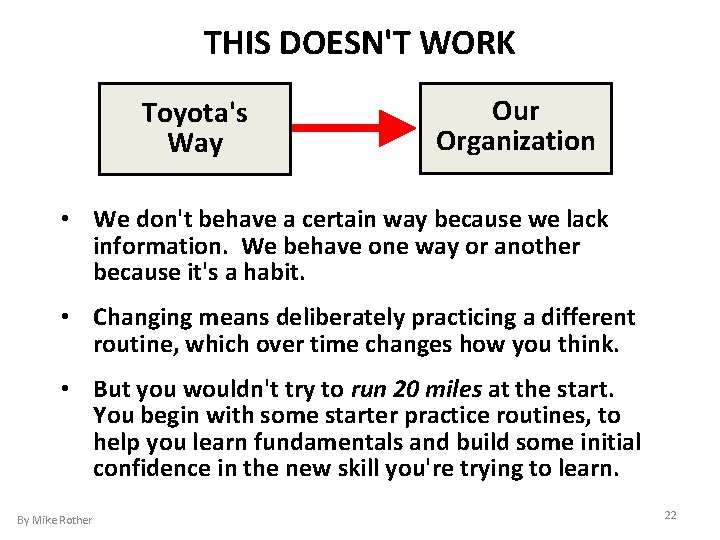
THIS DOESN'T WORK Toyota's Way Our Organization • We don't behave a certain way because we lack information. We behave one way or another because it's a habit. • Changing means deliberately practicing a different routine, which over time changes how you think. • But you wouldn't try to run 20 miles at the start. You begin with some starter practice routines, to help you learn fundamentals and build some initial confidence in the new skill you're trying to learn. By Mike Rother 22
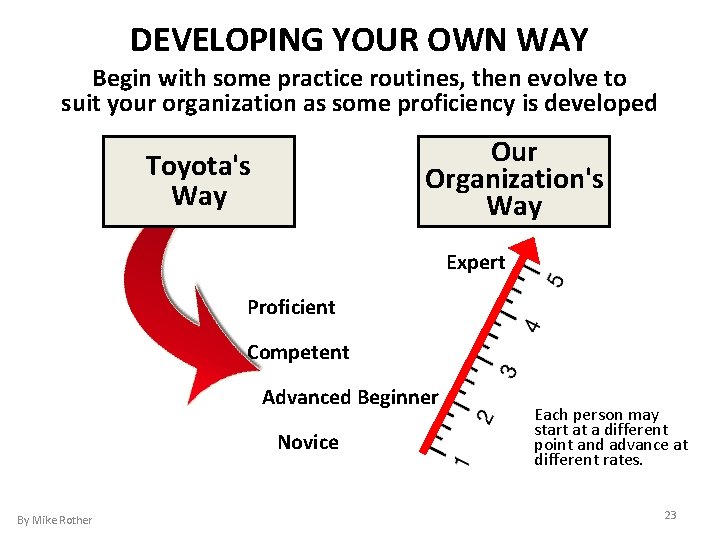
DEVELOPING YOUR OWN WAY Begin with some practice routines, then evolve to suit your organization as some proficiency is developed Toyota's Way By Mike Rother Our Organization's Way Expert Proficient Competent Advanced Beginner Novice Each person may start at a different point and advance at different rates. 23
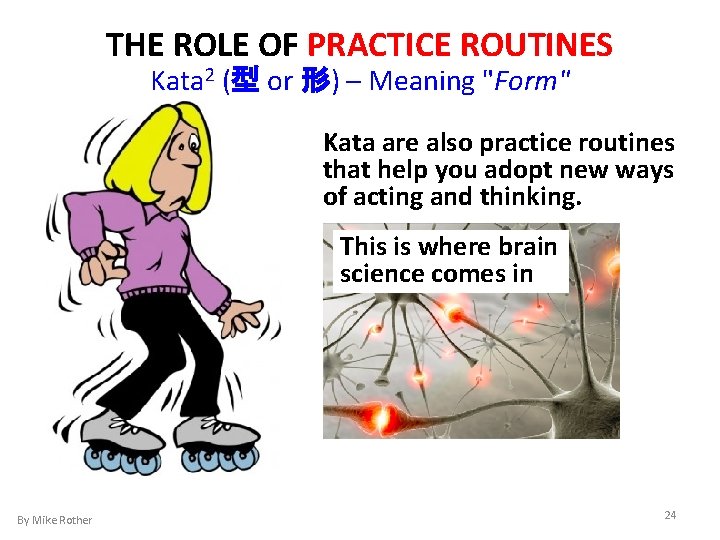
THE ROLE OF PRACTICE ROUTINES Kata 2 (型 or 形) – Meaning "Form" Kata are also practice routines that help you adopt new ways of acting and thinking. This is where brain science comes in By Mike Rother 24
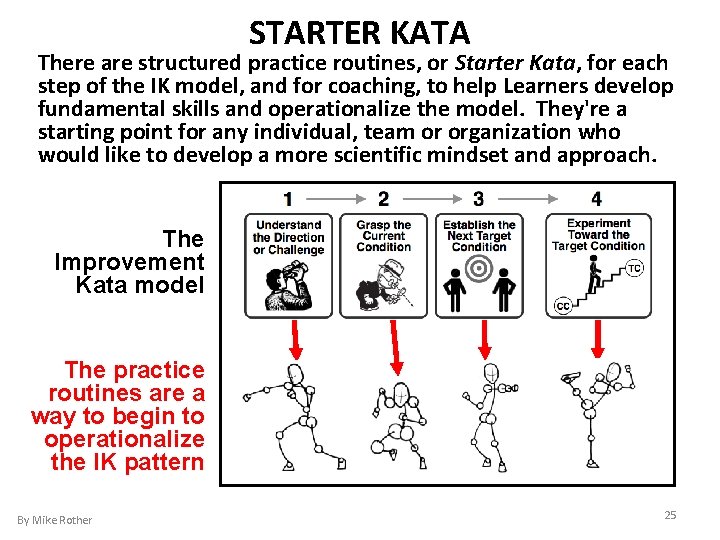
STARTER KATA There are structured practice routines, or Starter Kata, for each step of the IK model, and for coaching, to help Learners develop fundamental skills and operationalize the model. They're a starting point for any individual, team or organization who would like to develop a more scientific mindset and approach. The Improvement Kata model The practice routines are a way to begin to operationalize the IK pattern By Mike Rother 25
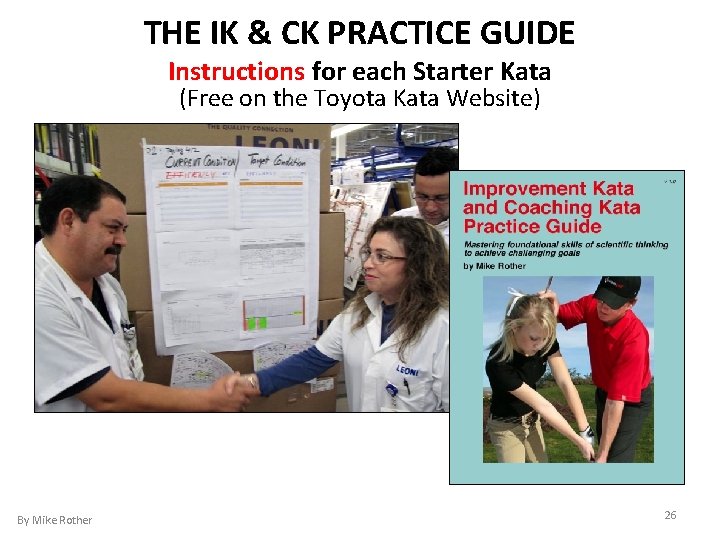
THE IK & CK PRACTICE GUIDE Instructions for each Starter Kata (Free on the Toyota Kata Website) By Mike Rother 26
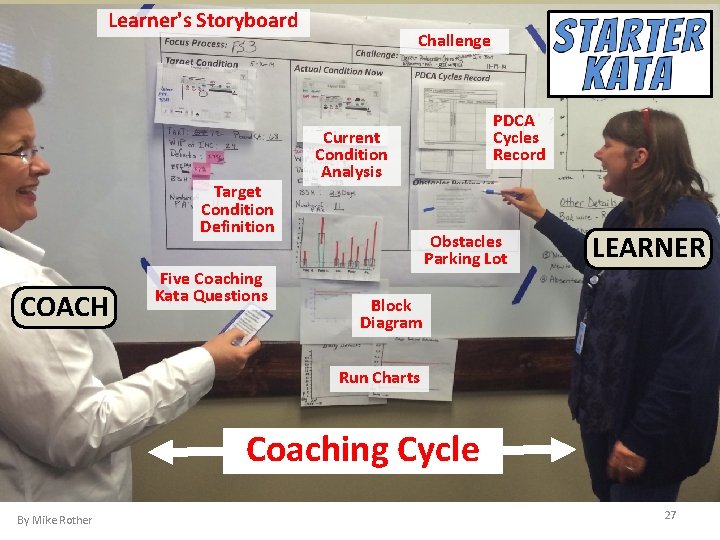
Learner's Storyboard Target Condition Definition COACH Five Coaching Kata Questions Challenge PDCA Cycles Record Current Condition Analysis Obstacles Parking Lot LEARNER Block Diagram Run Charts Coaching Cycle By Mike Rother 27
VIDEO 1: What We Know About How People Learn (2 minutes) https: //www. youtube. com/watch? v=ELpf. YCZa 87 g Also available on the IK/CK You. Tube Channel 28
VIDEO 2: Practicing in Small Steps (4 minutes) https: //www. youtube. com/watch? v=cf. AQ 8 o. JIGo. A Also available on the IK/CK You. Tube Channel 29
QUICK DEFINITIONS The Improvement Kata: A practical four-step model of scientific of thinking and acting, for achieving challenging goals. The Improvement Kata includes practice routines for each step, for learning through practice how to work scientifically when you pursue goals in complex systems. The Coaching Kata: Is a pattern for teaching the Improvement Kata pattern of thinking and acting. The Coaching Kata includes practice routines for anyone who wants to teach the Improvement Kata pattern. By Mike Rother
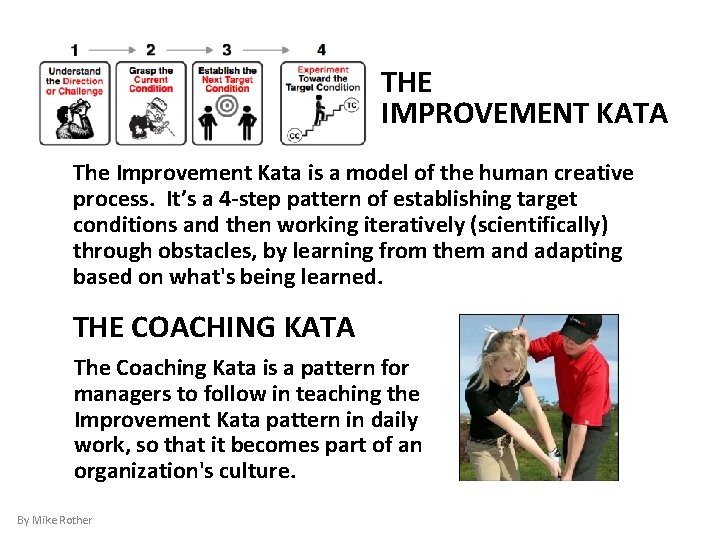
THE IMPROVEMENT KATA The Improvement Kata is a model of the human creative process. It’s a 4 -step pattern of establishing target conditions and then working iteratively (scientifically) through obstacles, by learning from them and adapting based on what's being learned. THE COACHING KATA The Coaching Kata is a pattern for managers to follow in teaching the Improvement Kata pattern in daily work, so that it becomes part of an organization's culture. By Mike Rother
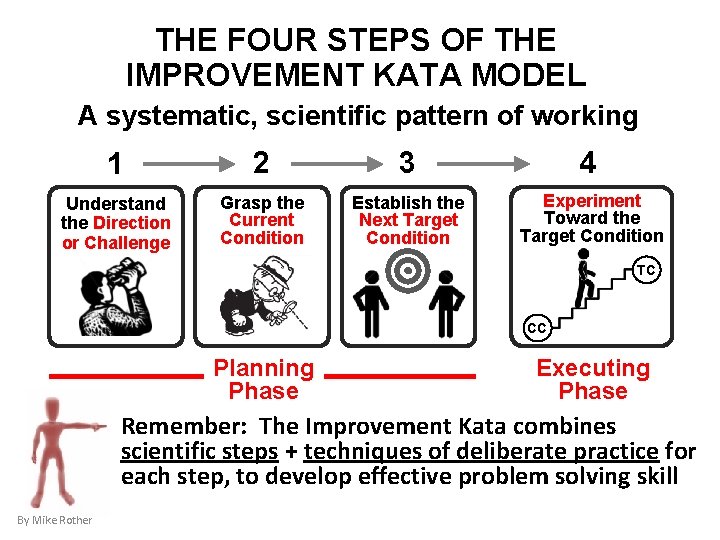
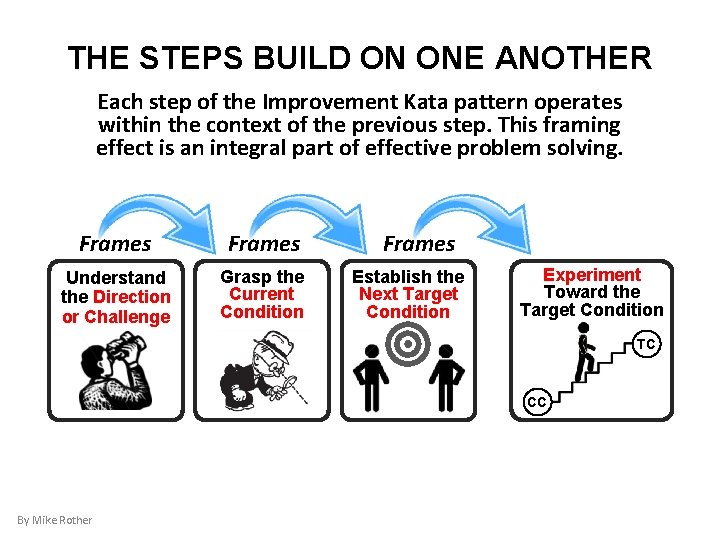
THE FOUR STEPS OF THE IMPROVEMENT KATA MODEL A systematic, scientific pattern of working 1 2 3 4 Understand the Direction or Challenge Grasp the Current Condition Establish the Next Target Condition Experiment Toward the Target Condition TC CC Planning Phase Executing Phase Remember: The Improvement Kata combines scientific steps + techniques of deliberate practice for each step, to develop effective problem solving skill By Mike Rother
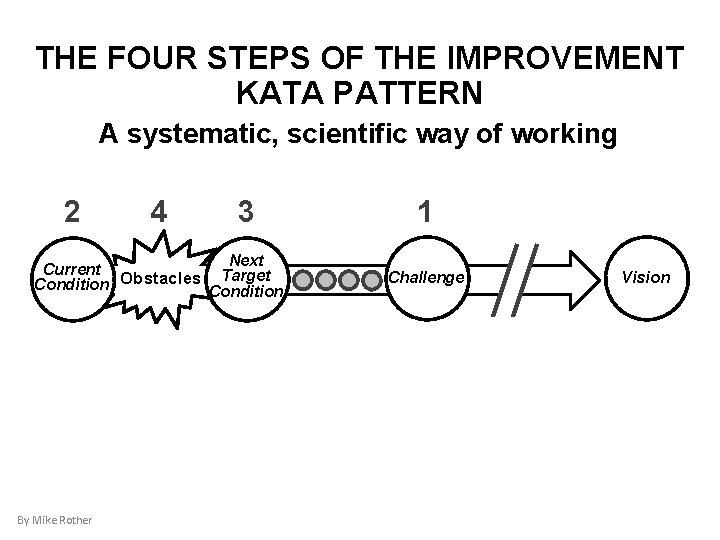
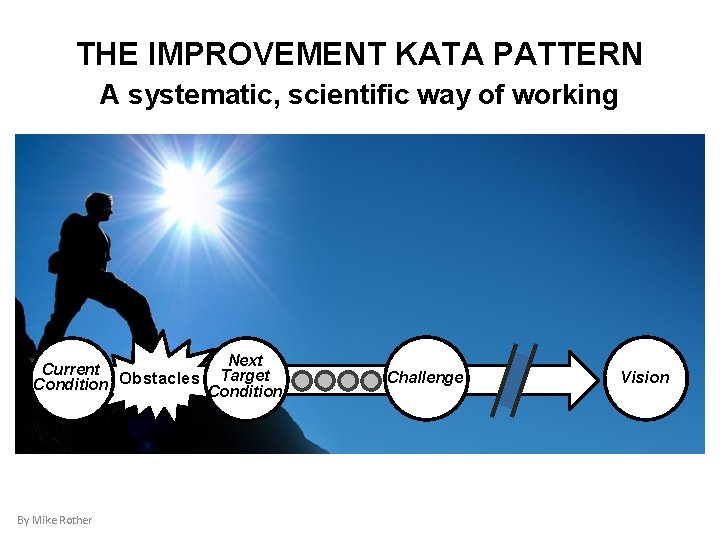
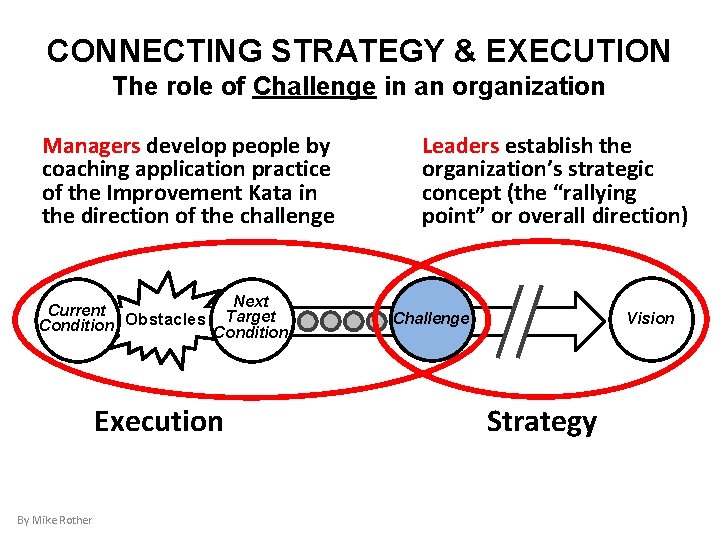
THE FOUR STEPS OF THE IMPROVEMENT KATA PATTERN A systematic, scientific way of working 2 4 3 Next Current Target Condition Obstacles Condition By Mike Rother 1 Challenge Vision
THE IMPROVEMENT KATA PATTERN A systematic, scientific way of working Next Current Target Condition Obstacles Condition By Mike Rother Challenge Vision
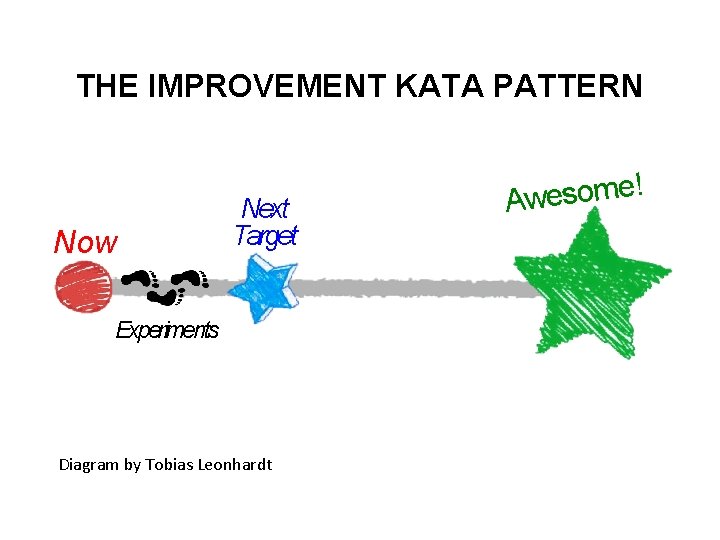
THE IMPROVEMENT KATA PATTERN Now Next Target Experiments Diagram by Tobias Leonhardt ! e m o s e w A
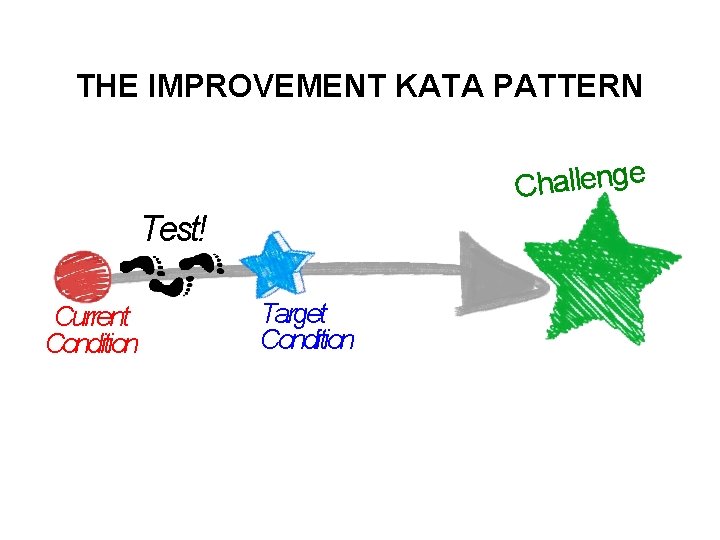
THE IMPROVEMENT KATA PATTERN e g n e l l a h C Test! Current Condition Target Condition
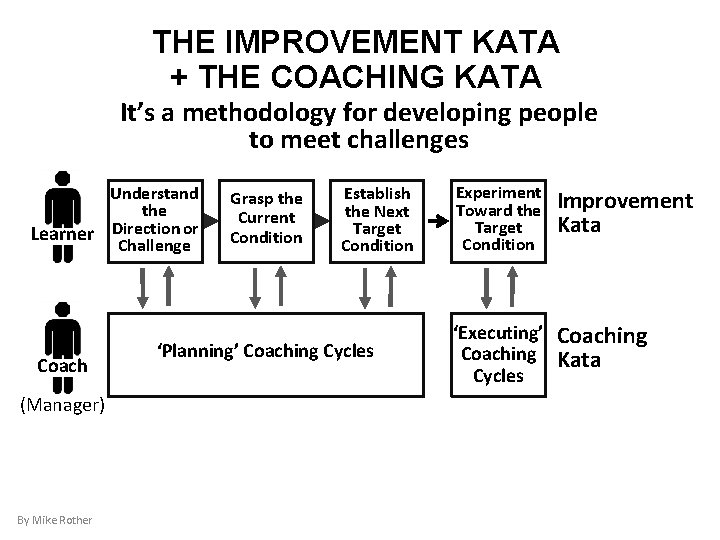
THE IMPROVEMENT KATA + THE COACHING KATA It’s a methodology for developing people to meet challenges Understand the Learner Direction or Challenge Coach (Manager) By Mike Rother Grasp the Current Condition Establish the Next Target Condition ‘Planning’ Coaching Cycles Experiment Toward the Target Condition Improvement Kata ‘Executing’ Coaching Cycles Coaching Kata
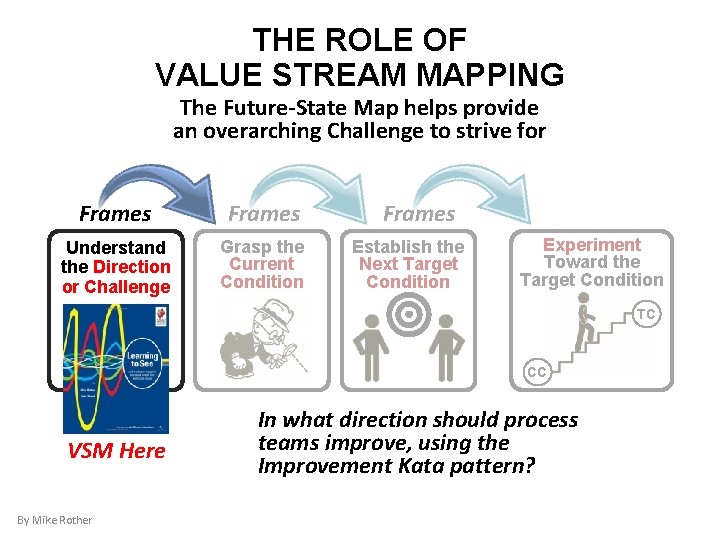
THE STEPS BUILD ON ONE ANOTHER Each step of the Improvement Kata pattern operates within the context of the previous step. This framing effect is an integral part of effective problem solving. Frames Understand the Direction or Challenge Grasp the Current Condition Frames Establish the Next Target Condition Experiment Toward the Target Condition TC CC By Mike Rother
CONNECTING STRATEGY & EXECUTION The role of Challenge in an organization Managers develop people by coaching application practice of the Improvement Kata in the direction of the challenge Next Current Target Condition Obstacles Condition Execution By Mike Rother Leaders establish the organizationʼs strategic concept (the “rallying point” or overall direction) Challenge Vision Strategy
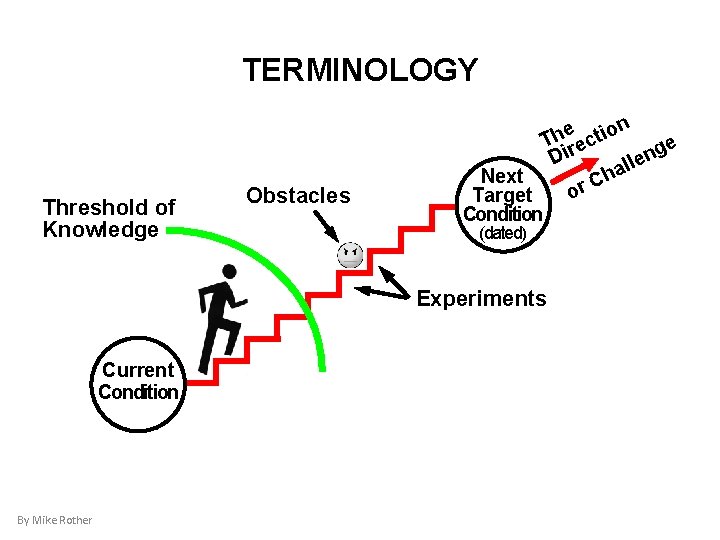
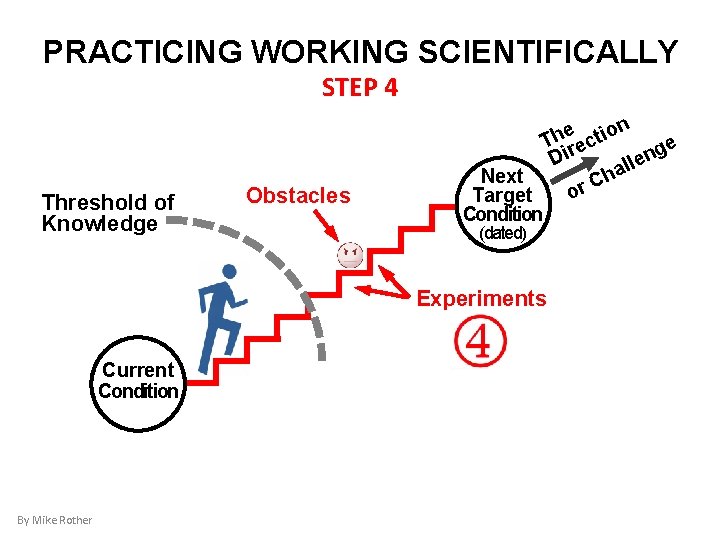
TERMINOLOGY Threshold of Knowledge Obstacles e tion h T rec e g i n D lle a Next Ch r o Target Condition (dated) Experiments Current Condition By Mike Rother
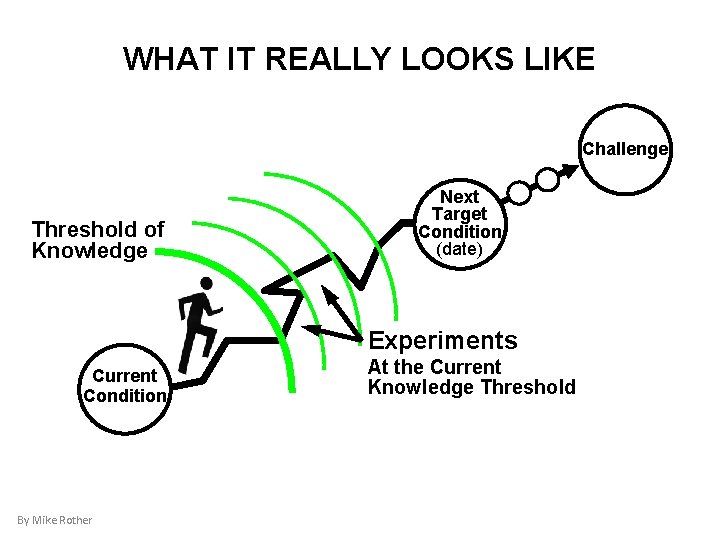
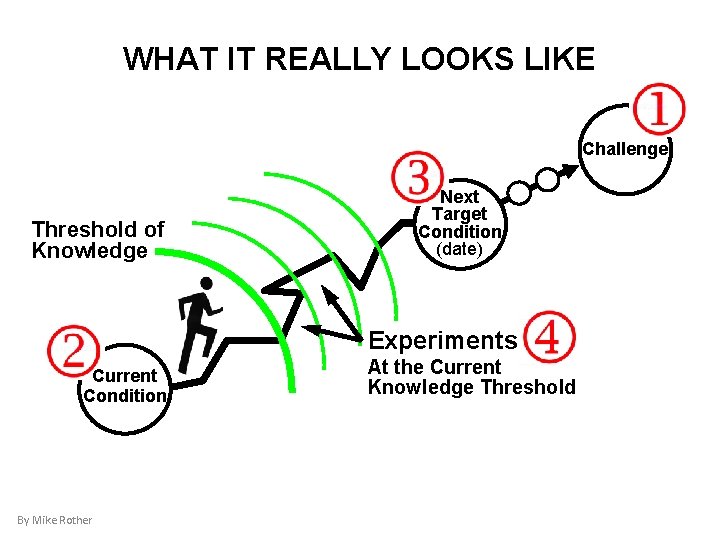
WHAT IT REALLY LOOKS LIKE Challenge Threshold of Knowledge Next Target Condition (date) Experiments Current Condition By Mike Rother At the Current Knowledge Threshold
WHAT IT REALLY LOOKS LIKE Challenge Threshold of Knowledge Next Target Condition (date) Experiments Current Condition By Mike Rother At the Current Knowledge Threshold
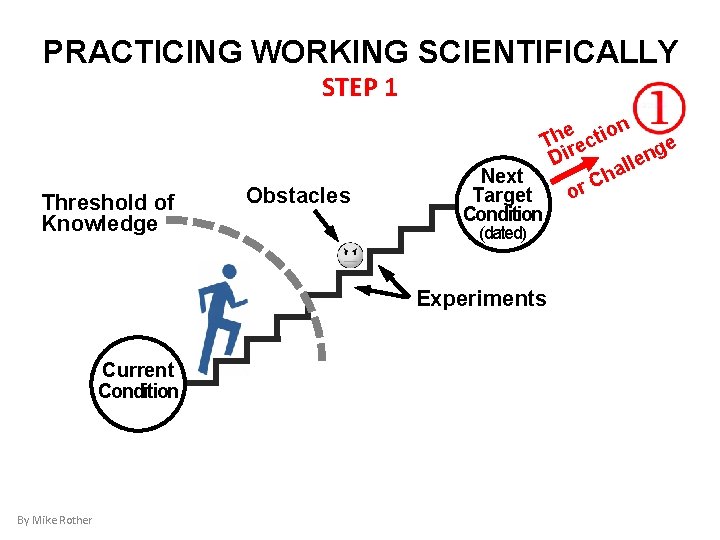
PRACTICING WORKING SCIENTIFICALLY STEP 1 Threshold of Knowledge Obstacles e tion h T rec e g i n D lle a Next Ch r o Target Condition (dated) Experiments Current Condition By Mike Rother
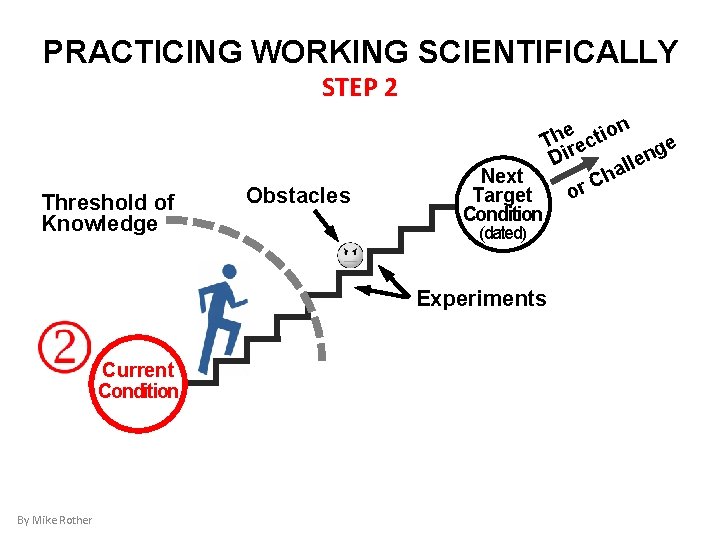
PRACTICING WORKING SCIENTIFICALLY STEP 2 Threshold of Knowledge Obstacles e tion h T rec e g i n D lle a Next Ch r o Target Condition (dated) Experiments Current Condition By Mike Rother
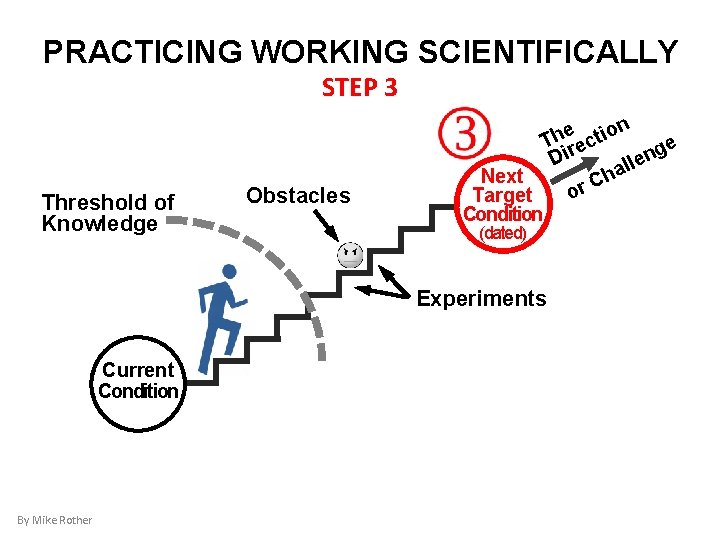
PRACTICING WORKING SCIENTIFICALLY STEP 3 Threshold of Knowledge Obstacles e tion h T rec e g i n D lle a Next Ch r o Target Condition (dated) Experiments Current Condition By Mike Rother
PRACTICING WORKING SCIENTIFICALLY STEP 4 Threshold of Knowledge Obstacles e tion h T rec e g i n D lle a Next Ch r o Target Condition (dated) Experiments Current Condition By Mike Rother
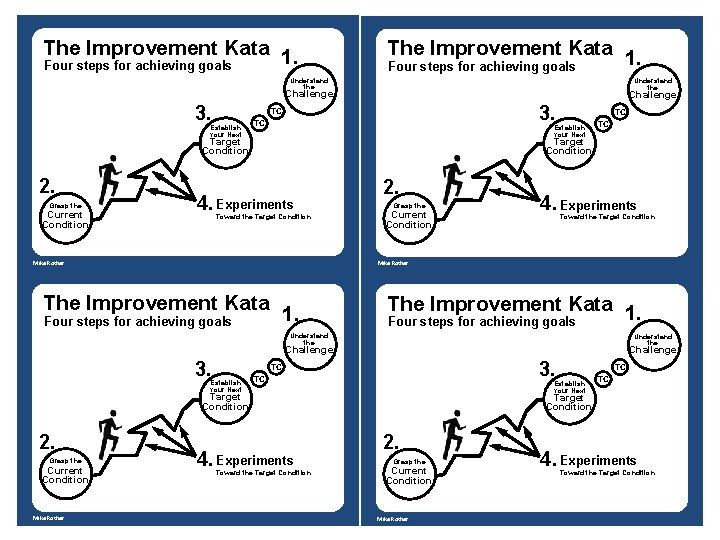
The Improvement Kata 1. Four steps for achieving goals Understand the Challenge 3. Establish Your Next TC Challenge 3. TC Establish Your Next Target Condition 2. Grasp the Current Condition TC Target Condition 4. Experiments Toward the Target Condition Mike Rother 2. Grasp the Current Condition 4. Experiments Toward the Target Condition Mike Rother The Improvement Kata 1. Four steps for achieving goals The Improvement Kata 1. Four steps for achieving goals Understand the Challenge 3. Establish Your Next TC Challenge 3. TC Establish Your Next Target Condition 2. Grasp the Current Condition Mike Rother 4. Experiments Toward the Target Condition TC Target Condition 2. Grasp the Current Condition Mike Rother 4. Experiments Toward the Target Condition
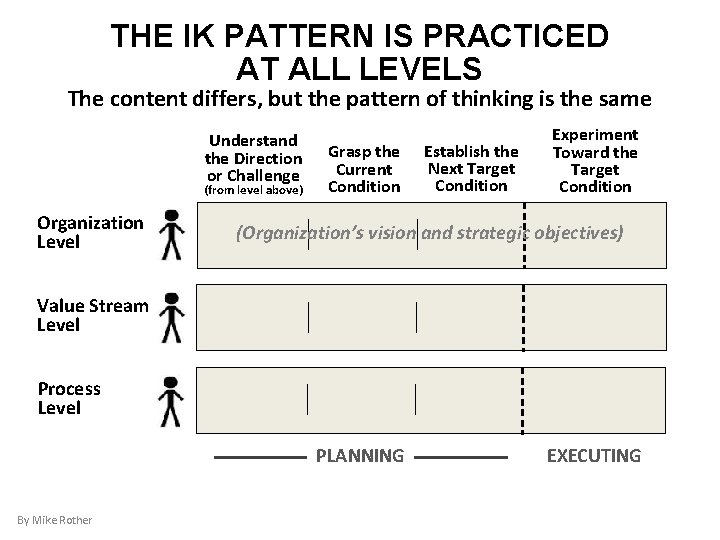
THE IK PATTERN IS PRACTICED AT ALL LEVELS The content differs, but the pattern of thinking is the same Understand the Direction or Challenge (from level above) Organization Level Grasp the Current Condition Establish the Next Target Condition Experiment Toward the Target Condition (Organization’s vision and strategic objectives) Value Stream Level Process Level PLANNING By Mike Rother EXECUTING
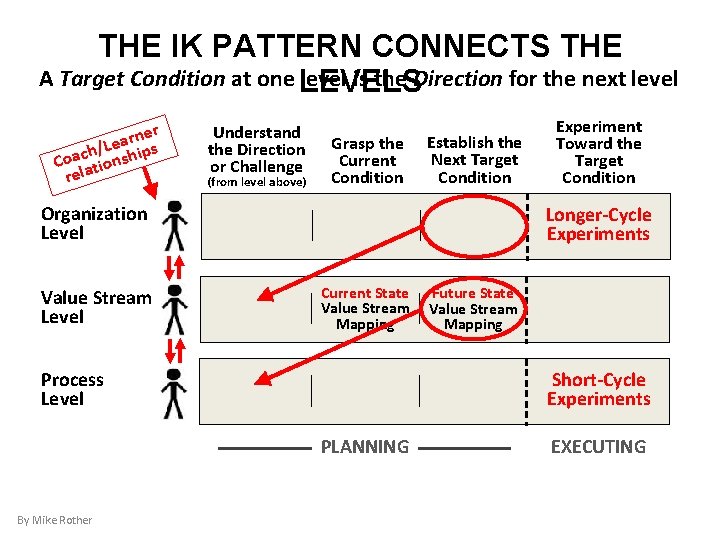
THE IK PATTERN CONNECTS THE A Target Condition at one level is the Direction for the next level LEVELS rner a e L h/ ships c a o C ation rel Understand the Direction or Challenge (from level above) Grasp the Current Condition Establish the Next Target Condition Organization Level Value Stream Level Longer-Cycle Experiments Current State Future State Value Stream Mapping Short-Cycle Experiments Process Level PLANNING By Mike Rother Experiment Toward the Target Condition EXECUTING
THE ROLE OF VALUE STREAM MAPPING The Future-State Map helps provide an overarching Challenge to strive for Frames Understand the Direction or Challenge Grasp the Current Condition Frames Establish the Next Target Condition Experiment Toward the Target Condition TC CC VSM Here By Mike Rother In what direction should process teams improve, using the Improvement Kata pattern?
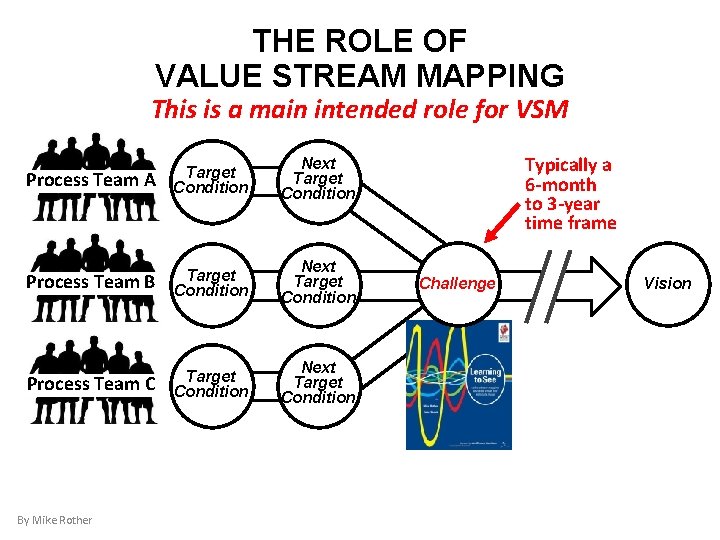
THE ROLE OF VALUE STREAM MAPPING This is a main intended role for VSM Process Team A Target Condition Next Target Condition Process Team B Target Condition Next Target Condition Process Team C Target Condition Next Target Condition By Mike Rother Typically a 6 -month to 3 -year time frame Challenge Vision
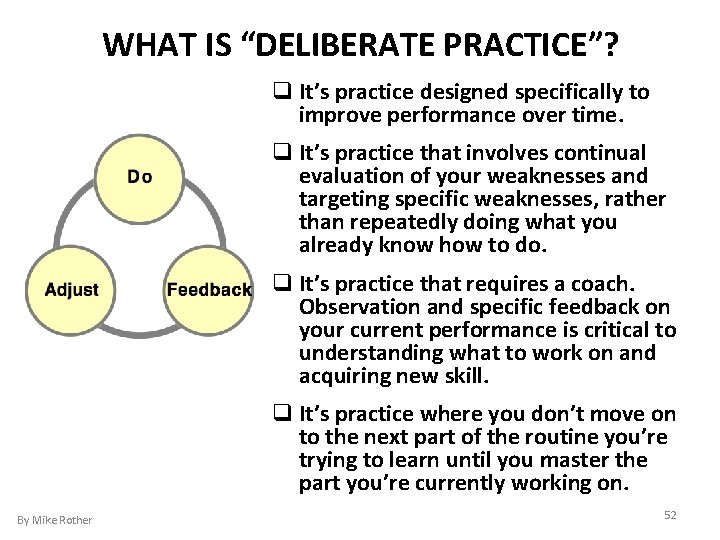
WHAT IS “DELIBERATE PRACTICE”? q Itʼs practice designed specifically to improve performance over time. q Itʼs practice that involves continual evaluation of your weaknesses and targeting specific weaknesses, rather than repeatedly doing what you already know how to do. q Itʼs practice that requires a coach. Observation and specific feedback on your current performance is critical to understanding what to work on and acquiring new skill. q Itʼs practice where you donʼt move on to the next part of the routine youʼre trying to learn until you master the part youʼre currently working on. By Mike Rother 52
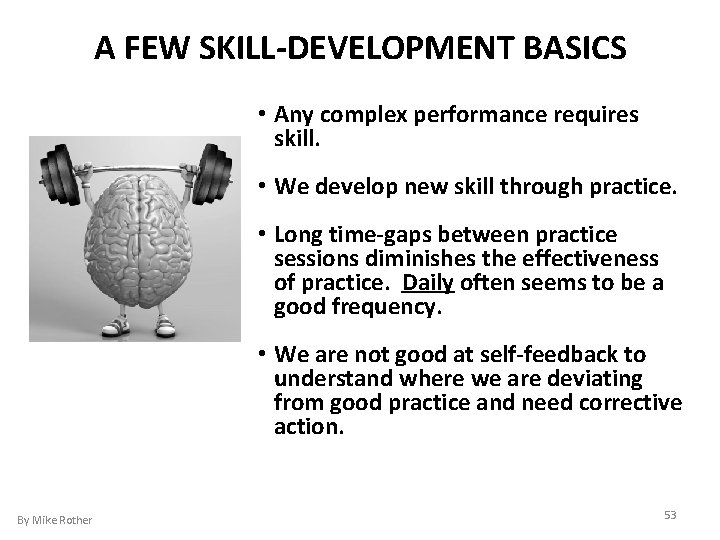
A FEW SKILL-DEVELOPMENT BASICS • Any complex performance requires skill. • We develop new skill through practice. • Long time-gaps between practice sessions diminishes the effectiveness of practice. Daily often seems to be a good frequency. • We are not good at self-feedback to understand where we are deviating from good practice and need corrective action. By Mike Rother 53
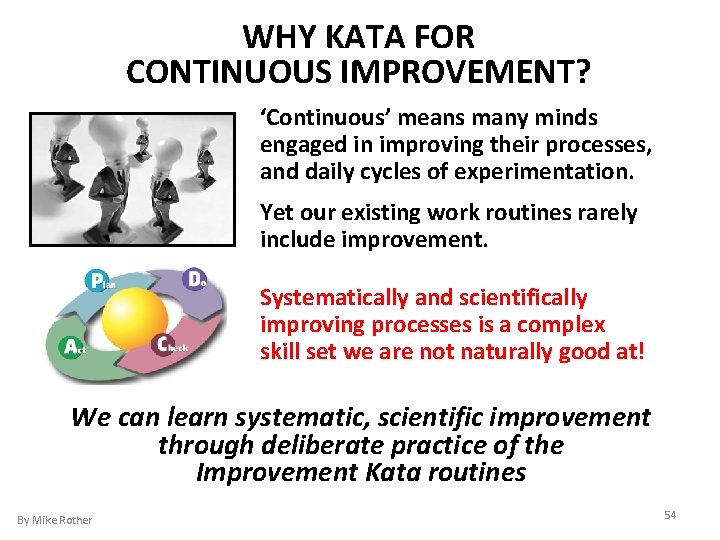
WHY KATA FOR CONTINUOUS IMPROVEMENT? ‘Continuous’ means many minds engaged in improving their processes, and daily cycles of experimentation. Yet our existing work routines rarely include improvement. Systematically and scientifically improving processes is a complex skill set we are not naturally good at! We can learn systematic, scientific improvement through deliberate practice of the Improvement Kata routines By Mike Rother 54
THE IK & CK INCLUDE PRACTICE ROUTINES Practical Application The Improvement Kata & Coaching Kata don't just model a way of working, they also include structured practice routines for each step, to make their pattern teachable and transferrable. Coached practice of these routines, especially at the start, is a way to build improvement capability into an organization and make effective empowerment possible. A team or organization that’s pursuing continuous improvement will do well to use some structured practice routines -- Kata -- for developing new behavior, habits and culture, especially at the beginning. By Mike Rother
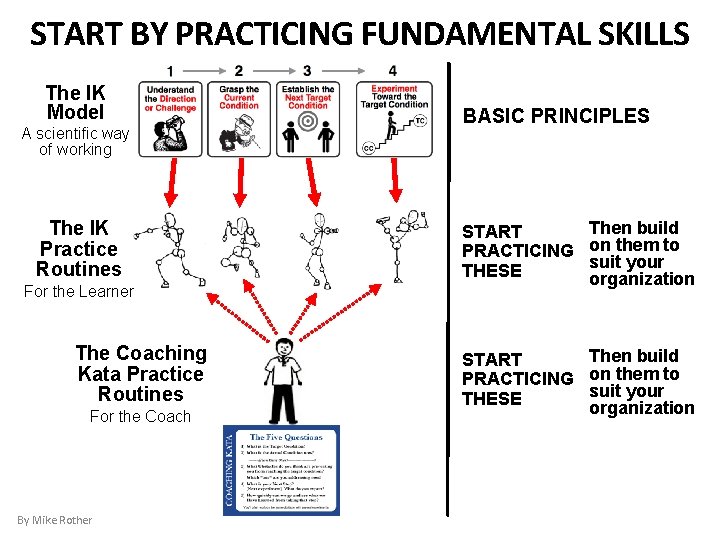
START BY PRACTICING FUNDAMENTAL SKILLS The IK Model A scientific way of working The IK Practice Routines For the Learner The Coaching Kata Practice Routines For the Coach By Mike Rother BASIC PRINCIPLES START PRACTICING THESE Then build on them to suit your organization Then build START PRACTICING on them to suit your THESE organization
The Improvement Kata and Coaching Kata have starter practice routines that help anyone develop scientificthinking skills and mindset. Deliberate, coached IK/CK practice is a way of creating a scientific-thinking 'culture' in an individual, a team or an organization. Ultimately, though, the Kata are not the important thing, but rather the skills and mindset that practicing them leaves behind. As in music, sports and with other complex skills, you begin by practicing some fundamental Kata until their pattern becomes somewhat routine. Then you can move beyond rigidly practicing the Kata to develop your own style and focus on the sound of the 'music' you are making. . . as long as the basic principles & patterns of the Kata remain. By Mike Rother 57
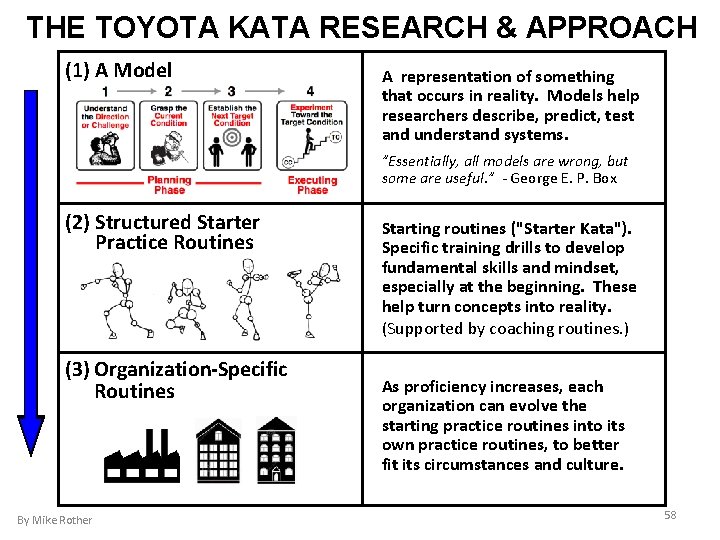
THE TOYOTA KATA RESEARCH & APPROACH (1) A Model A representation of something that occurs in reality. Models help researchers describe, predict, test and understand systems. ”Essentially, all models are wrong, but some are useful. ” - George E. P. Box (2) Structured Starter Practice Routines (3) Organization-Specific Routines By Mike Rother Starting routines ("Starter Kata"). Specific training drills to develop fundamental skills and mindset, especially at the beginning. These help turn concepts into reality. (Supported by coaching routines. ) As proficiency increases, each organization can evolve the starting practice routines into its own practice routines, to better fit its circumstances and culture. 58
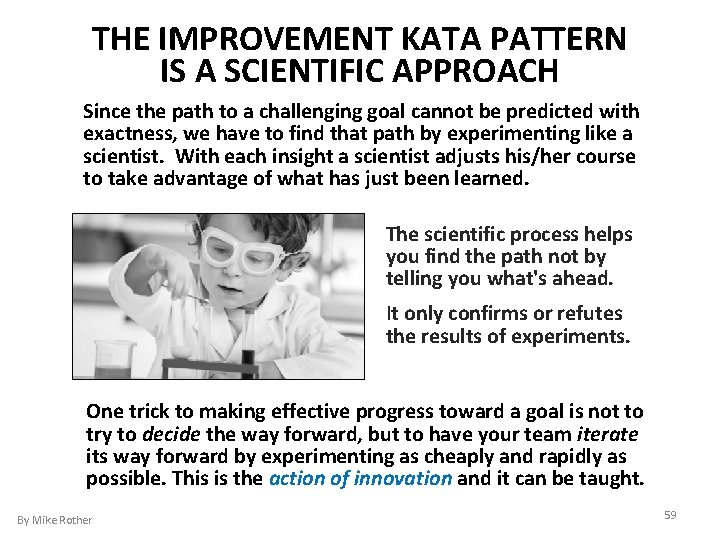
THE IMPROVEMENT KATA PATTERN IS A SCIENTIFIC APPROACH Since the path to a challenging goal cannot be predicted with exactness, we have to find that path by experimenting like a scientist. With each insight a scientist adjusts his/her course to take advantage of what has just been learned. The scientific process helps you find the path not by telling you what's ahead. It only confirms or refutes the results of experiments. One trick to making effective progress toward a goal is not to try to decide the way forward, but to have your team iterate its way forward by experimenting as cheaply and rapidly as possible. This is the action of innovation and it can be taught. By Mike Rother 59
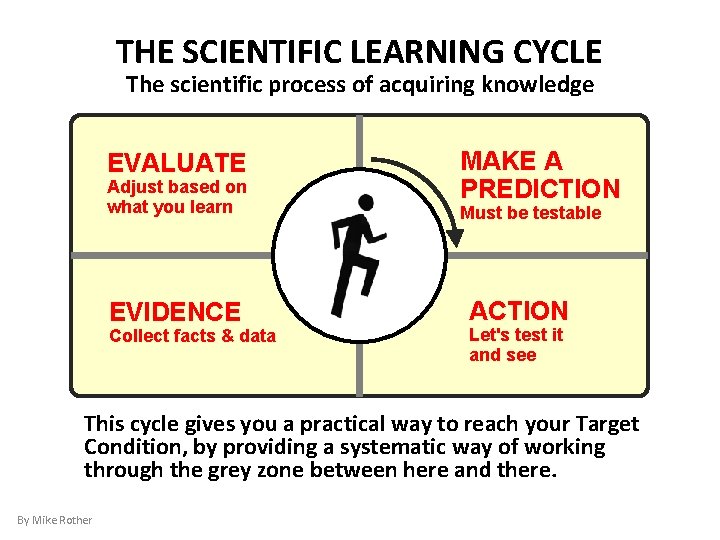
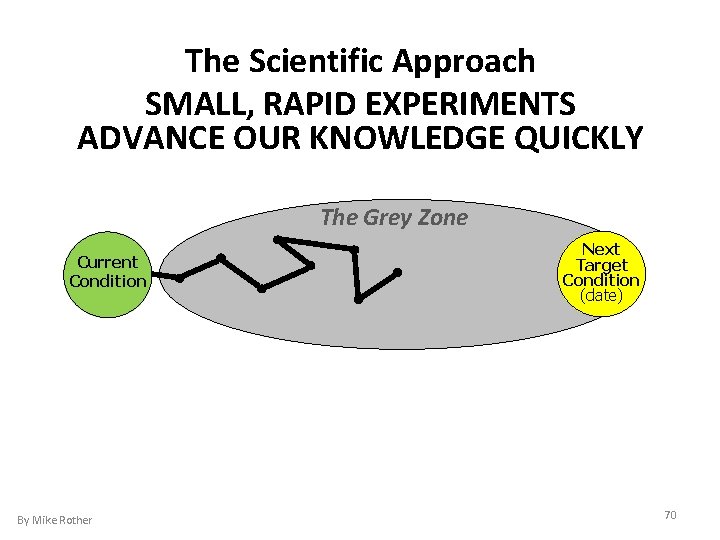
THE SCIENTIFIC LEARNING CYCLE The scientific process of acquiring knowledge MAKE A PREDICTION EVALUATE Adjust based on what you learn Interpret the evidence EVIDENCE Collect facts and data Collect facts & data Testable Must be testable 4 1 3 2 ACTION Conduct theit Let's test experiment and see This cycle gives you a practical way to reach your Target Condition, by providing a systematic way of working through the grey zone between here and there. By Mike Rother
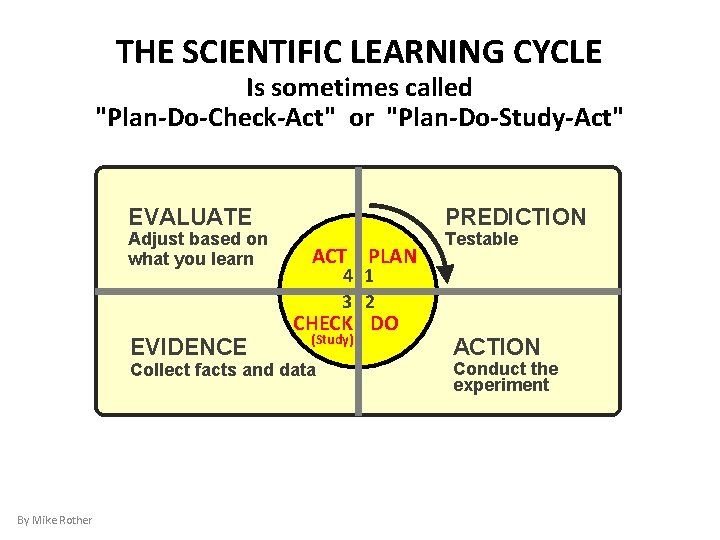
THE SCIENTIFIC LEARNING CYCLE Is sometimes called "Plan-Do-Check-Act" or "Plan-Do-Study-Act" EVALUATE Adjust based on what you learn EVIDENCE PREDICTION ACT PLAN 4 1 3 2 CHECK DO (Study) Collect facts and data By Mike Rother Testable ACTION Conduct the experiment
THE CORE DYNAMIC OF SCIENTIFIC THINKING This is the dynamic that allows us to reach challenging new goals through unclear territory What we expect to happen Learning What actually happened When experimenting is done right, small failures often provide new insight that advance your design! “If the result confirms the hypothesis, then you've made a measurement. If the result is contrary to the hypothesis, then you've made a discovery. " ~ Enrico Fermi By Mike Rother
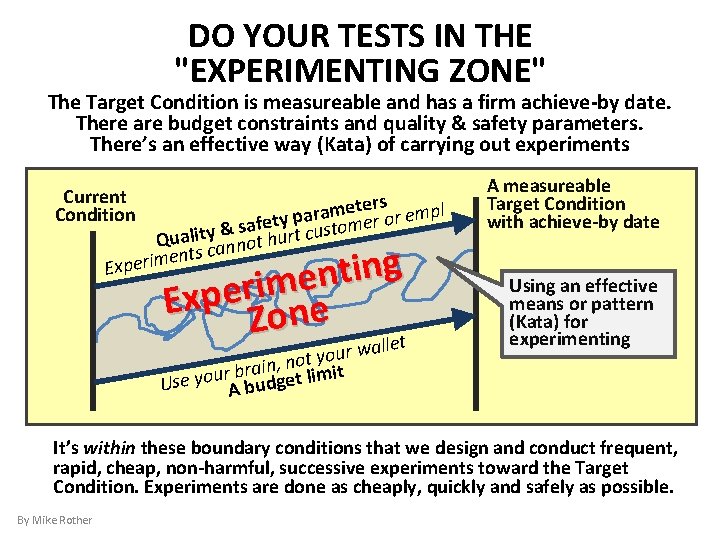
DO YOUR TESTS IN THE "EXPERIMENTING ZONE" The Target Condition is measureable and has a firm achieve-by date. There are budget constraints and quality & safety parameters. There’s an effective way (Kata) of carrying out experiments Current Condition eters r empl m a r a p fety customer o a s & y t Quali cannot hurt nts e m i r e p Ex g n i t n e m i r e Exp Zone allet w r u o y , not it n i a r b r Use you A budget lim A measureable Target Condition with achieve-by date Using an effective means or pattern (Kata) for experimenting Itʼs within these boundary conditions that we design and conduct frequent, rapid, cheap, non-harmful, successive experiments toward the Target Condition. Experiments are done as cheaply, quickly and safely as possible. By Mike Rother
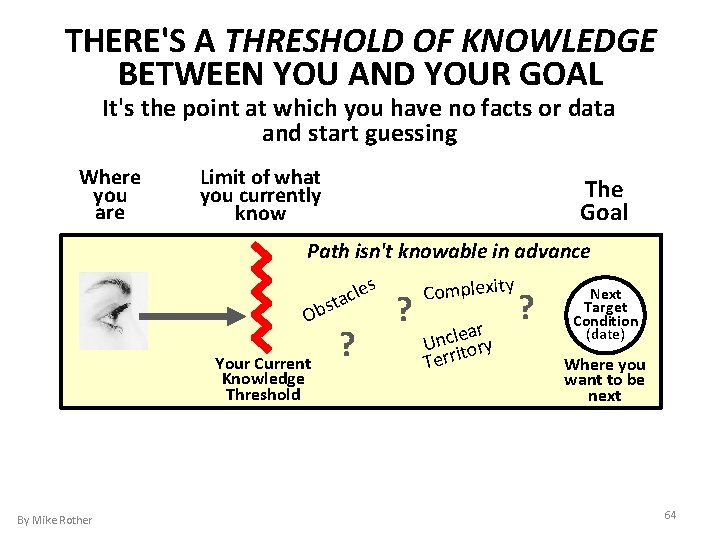
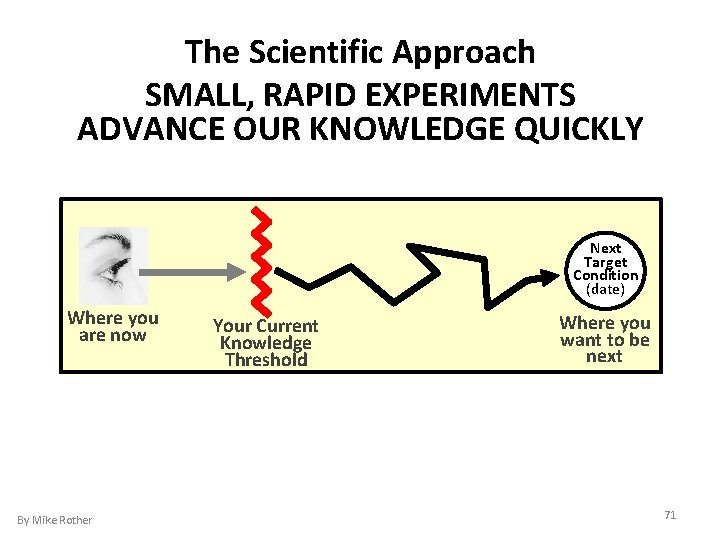
THERE'S A THRESHOLD OF KNOWLEDGE BETWEEN YOU AND YOUR GOAL It's the point at which you have no facts or data and start guessing Where you are Limit of what you currently know The Goal Path isn't knowable in advance s le c a st Ob Your Current Knowledge Threshold By Mike Rother ? ? Complexity ar e l c n U itory Terr ? Next Target Condition (date) Where you want to be next 64
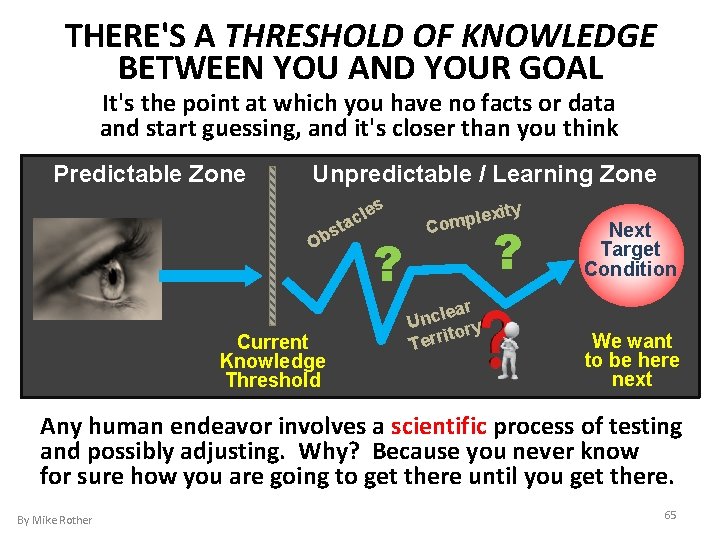
THERE'S A THRESHOLD OF KNOWLEDGE BETWEEN YOU AND YOUR GOAL It's the point at which you have no facts or data and start guessing, and it's closer than you think Predictable Zone Unpredictable / Learning Zone s le c a st Ob Current Knowledge Threshold ? lexity p m o C ? lear c n U ory t i r r Te Next Target Condition We want to be here next Any human endeavor involves a scientific process of testing and possibly adjusting. Why? Because you never know for sure how you are going to get there until you get there. By Mike Rother 65
VIDEO 3: You're in the unpredictable Learning Zone! (2 minutes) https: //www. youtube. com/watch? v=Sa. TOASsr. HFs Also available on the IK/CK You. Tube Channel 66
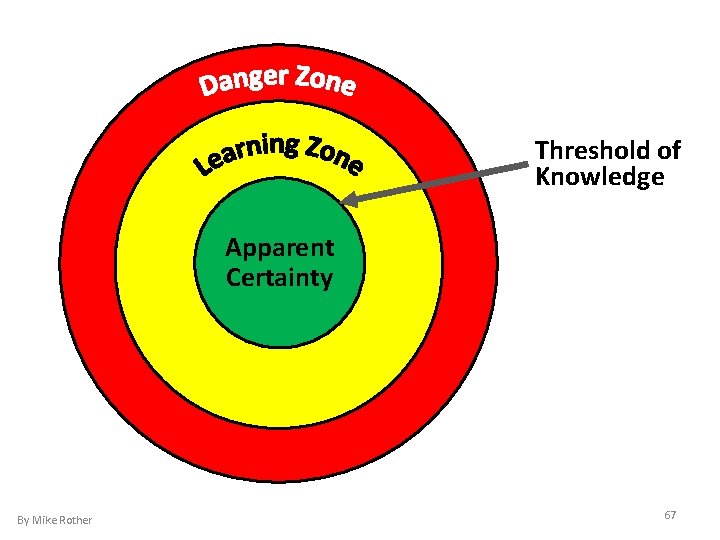
Threshold of Knowledge Apparent Certainty By Mike Rother 67
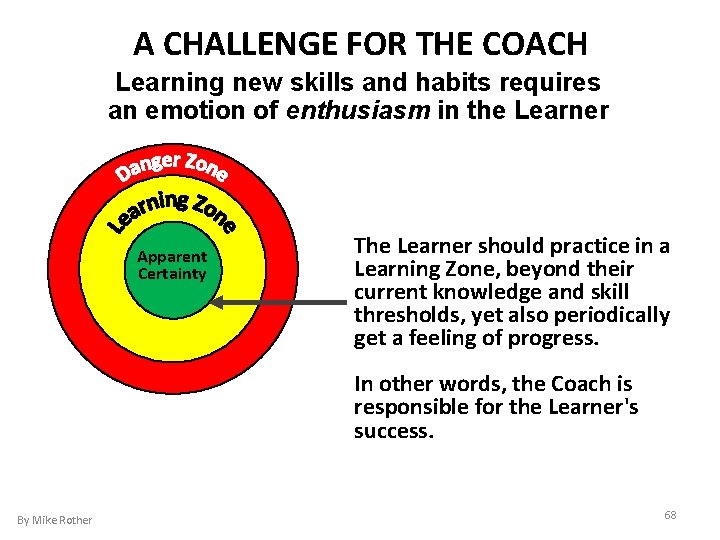
A CHALLENGE FOR THE COACH Learning new skills and habits requires an emotion of enthusiasm in the Learner Apparent Certainty The Learner should practice in a Learning Zone, beyond their current knowledge and skill thresholds, yet also periodically get a feeling of progress. In other words, the Coach is responsible for the Learner's success. By Mike Rother 68
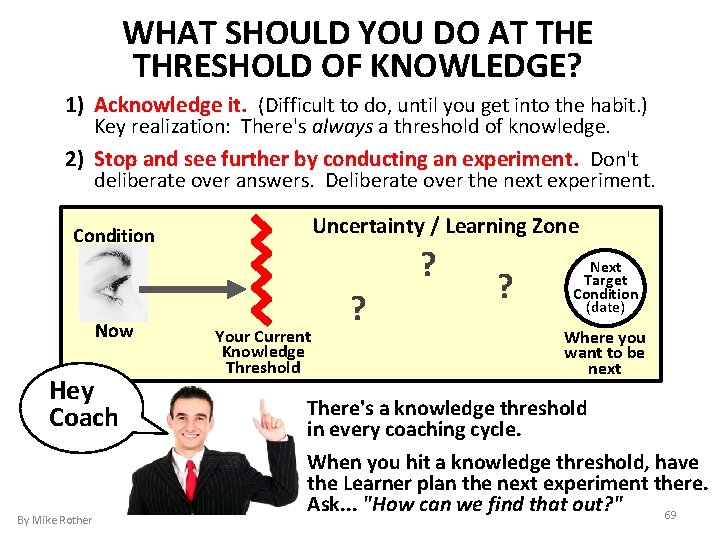
WHAT SHOULD YOU DO AT THE THRESHOLD OF KNOWLEDGE? 1) Acknowledge it. (Difficult to do, until you get into the habit. ) Key realization: There's always a threshold of knowledge. 2) Stop and see further by conducting an experiment. Don't deliberate over answers. Deliberate over the next experiment. Uncertainty / Learning Zone Condition Now Hey Coach By Mike Rother Your Current Knowledge Threshold ? ? ? Next Target Condition (date) Where you want to be next There's a knowledge threshold in every coaching cycle. When you hit a knowledge threshold, have the Learner plan the next experiment there. Ask. . . "How can we find that out? " 69
The Scientific Approach SMALL, RAPID EXPERIMENTS ADVANCE OUR KNOWLEDGE QUICKLY The Grey Zone Current Condition By Mike Rother Next Target Condition (date) 70
The Scientific Approach SMALL, RAPID EXPERIMENTS ADVANCE OUR KNOWLEDGE QUICKLY Next Target Condition (date) Where you are now By Mike Rother Your Current Knowledge Threshold Where you want to be next 71
VIDEO 4: Working Iteratively (3 minutes) https: //www. youtube. com/watch? v=COKqi. Fa. Hm 1 s Also available on the IK/CK You. Tube Channel 72
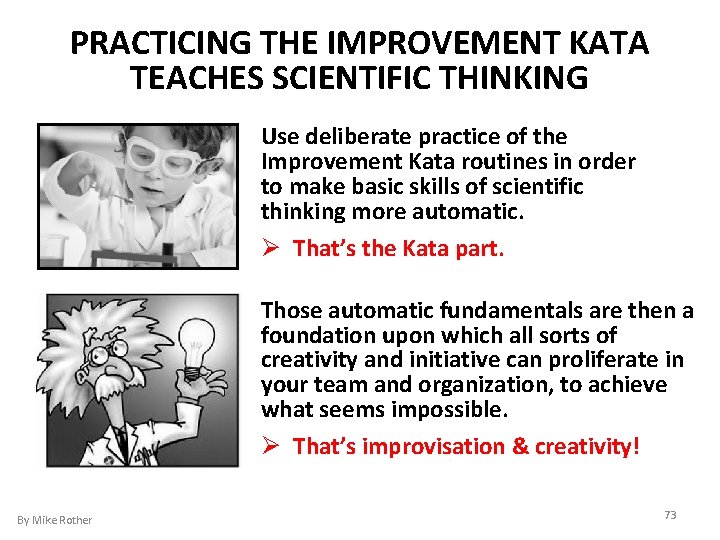
PRACTICING THE IMPROVEMENT KATA TEACHES SCIENTIFIC THINKING Use deliberate practice of the Improvement Kata routines in order to make basic skills of scientific thinking more automatic. Ø That’s the Kata part. Those automatic fundamentals are then a foundation upon which all sorts of creativity and initiative can proliferate in your team and organization, to achieve what seems impossible. Ø That’s improvisation & creativity! By Mike Rother 73
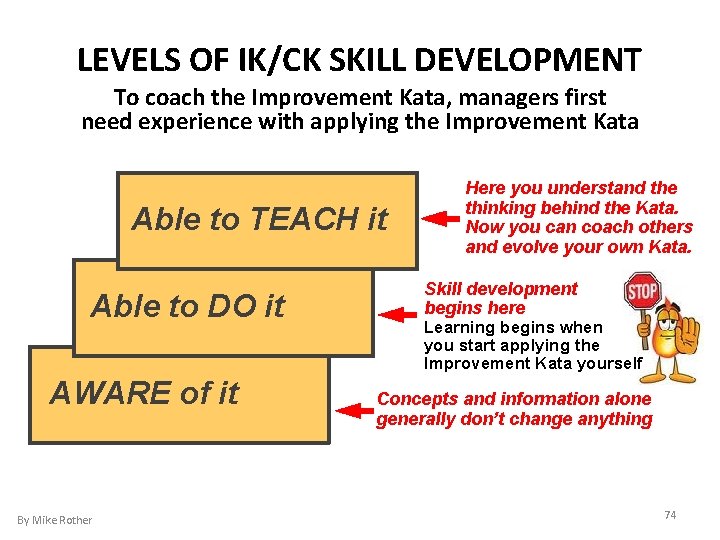
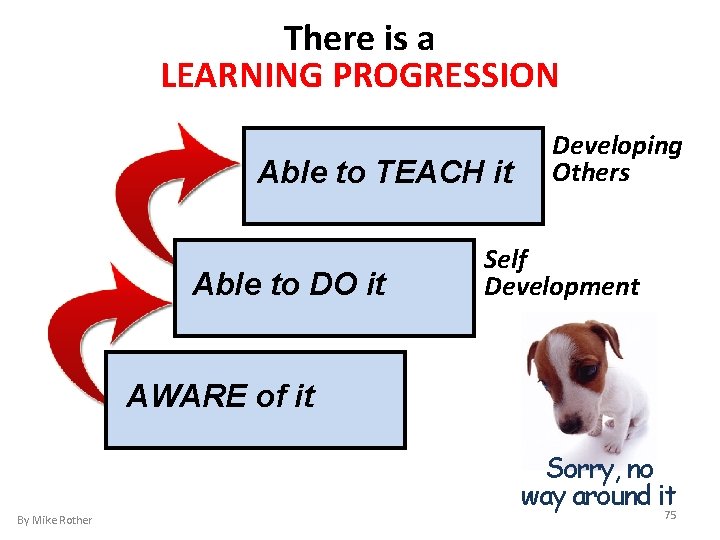
LEVELS OF IK/CK SKILL DEVELOPMENT To coach the Improvement Kata, managers first need experience with applying the Improvement Kata Able to TEACH it Able to DO it AWARE of it By Mike Rother Here you understand the thinking behind the Kata. Now you can coach others and evolve your own Kata. Skill development begins here Learning begins when you start applying the Improvement Kata yourself Concepts and information alone generally don’t change anything 74
There is a LEARNING PROGRESSION Able to TEACH it Able to DO it Developing Others Self Development AWARE of it By Mike Rother Sorry, no way around it 75
Roles / Org Structure for Practicing Team Learner's Storyboard 2 nd Coaches the Coach By Mike Rother Coach (Manager) Practices the Coaching Kata Learner Practices the Improvement Kata 76
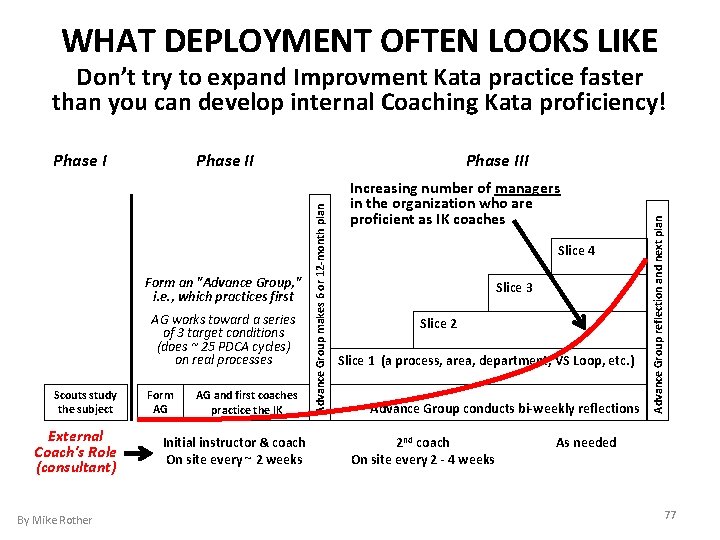
WHAT DEPLOYMENT OFTEN LOOKS LIKE Don’t try to expand Improvment Kata practice faster than you can develop internal Coaching Kata proficiency! Form an "Advance Group, " i. e. , which practices first AG works toward a series of 3 target conditions (does ~ 25 PDCA cycles) on real processes Scouts study the subject External Coach's Role (consultant) By Mike Rother Form AG AG and first coaches practice the IK Initial instructor & coach On site every ~ 2 weeks Phase III Increasing number of managers in the organization who are proficient as IK coaches Slice 4 Slice 3 Slice 2 Slice 1 (a process, area, department, VS Loop, etc. ) Advance Group conducts bi-weekly reflections 2 nd coach On site every 2 - 4 weeks Advance Group reflection and next plan Phase II Advance Group makes 6 or 12 -month plan Phase I As needed 77
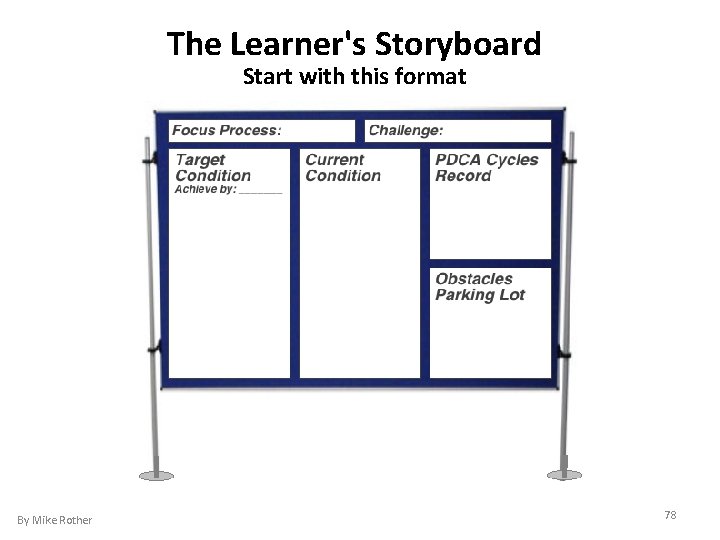
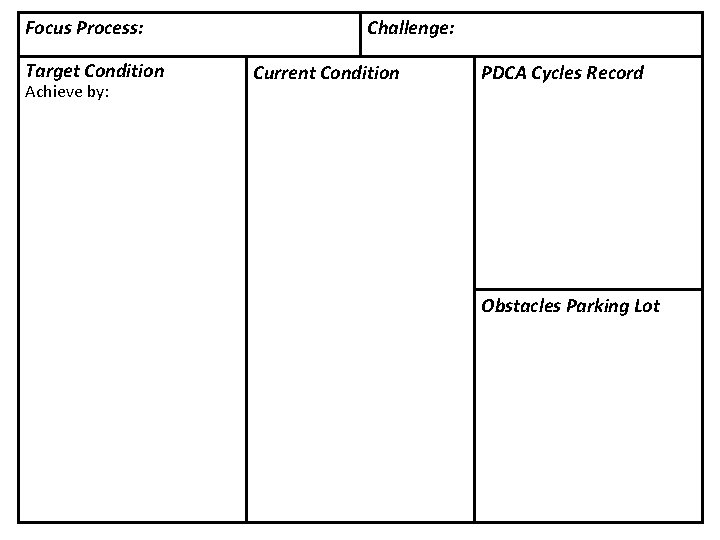
The Learner's Storyboard Start with this format By Mike Rother 78
Focus Process: Target Condition Achieve by: Challenge: Current Condition PDCA Cycles Record Obstacles Parking Lot
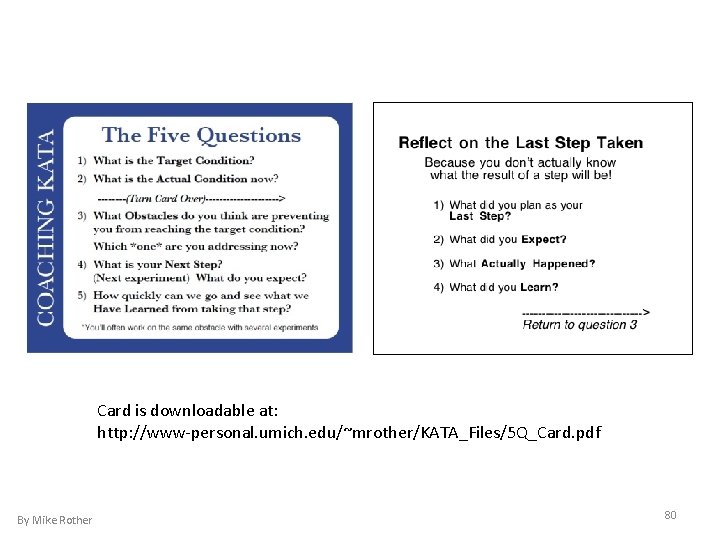
Card is downloadable at: http: //www-personal. umich. edu/~mrother/KATA_Files/5 Q_Card. pdf By Mike Rother 80
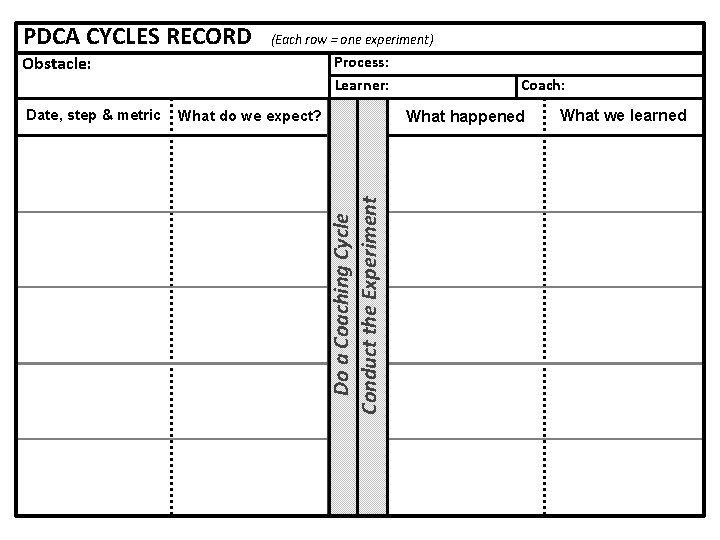
PDCA CYCLES RECORD (Each row = one experiment) Obstacle: Coach: What happened What do we expect? Do a Coaching Cycle Conduct the Experiment Date, step & metric Process: Learner: What we learned
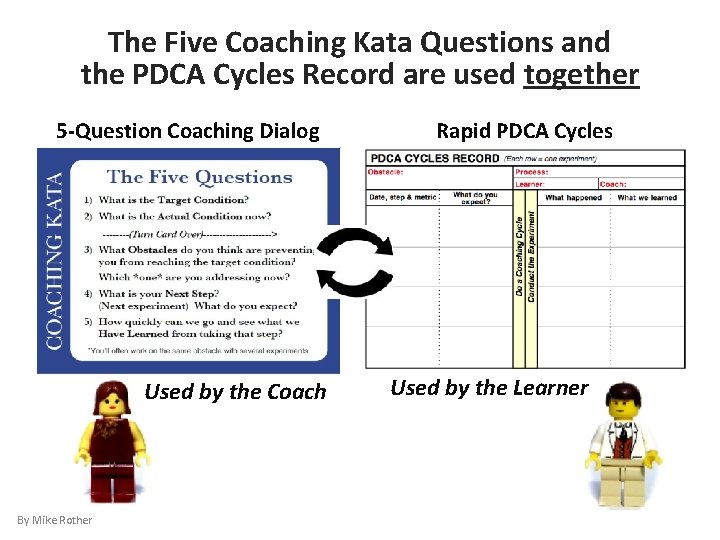
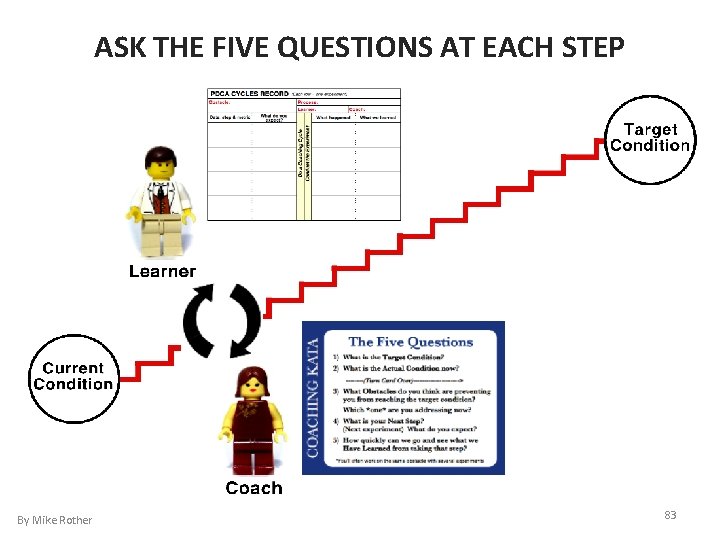
The Five Coaching Kata Questions and the PDCA Cycles Record are used together 5 -Question Coaching Dialog Used by the Coach By Mike Rother Rapid PDCA Cycles Used by the Learner
ASK THE FIVE QUESTIONS AT EACH STEP By Mike Rother 83
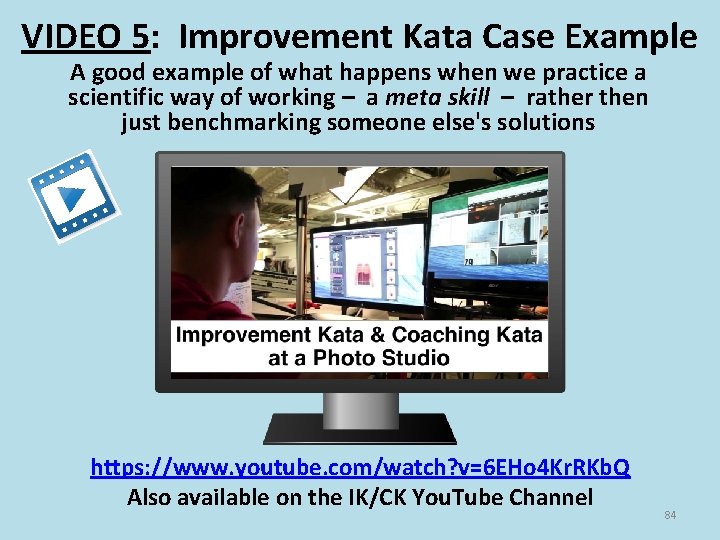
VIDEO 5: Improvement Kata Case Example A good example of what happens when we practice a scientific way of working – a meta skill – rather then just benchmarking someone else's solutions https: //www. youtube. com/watch? v=6 EHo 4 Kr. RKb. Q Also available on the IK/CK You. Tube Channel 84
By Mike Rother 85