
Doubly charmed mesons from hadronic molecules KEK S
Doubly charmed mesons from hadronic molecules KEK S. Yasui Future Prospects of Hadron Physics at J-PARC and Large Scale Computational Physics @Ibaraki Quantum Beam Research Center 9 -11 Feb. 2012
Contents 1. Introduction 2. Doubly charmed mesons (Tcc) S. H. Lee, S. Y. , W. Liu, C. M. Ko, Eur. Phys. C 54, 259 (2008) S. H. Lee, S. Y. , Eur. Phys. C 64, 283 (2009) S. Ohkoda, Y. Yamaguchi, S. Y. , K. Sudoh, A. Hosaka, ar. Xiv: 1202. 0760 3. Other exotic heavy hadrons (→ poster session) S. Y. , K. Sudoh, Phys. Rev. D 80, 034008 (2009) Y. Yamaguchi, S. Ohkoda, S. Y. , A. Hosaka, Phys. Rev. D 84, 014032 (2011) Y. Yamaguchi, S. Ohkoda, S. Y. , A. Hosaka, ar. Xiv: 111. 2691 (appear in PRD) S. Ohkoda, Y. Yamaguchi, S. Y. , K. Sudoh, A. Hosaka, ar. Xiv: 1111. 2921 4. Summary
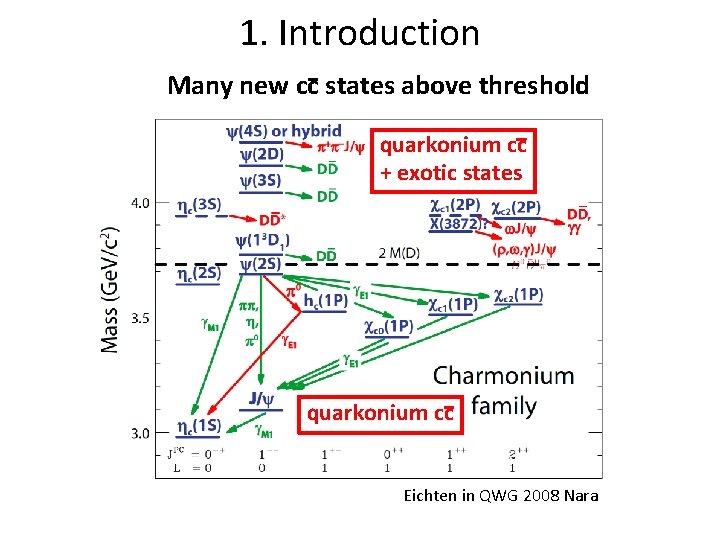
1. Introduction Many new cc states above threshold quarkonium cc + exotic states quarkonium cc Eichten in QWG 2008 Nara
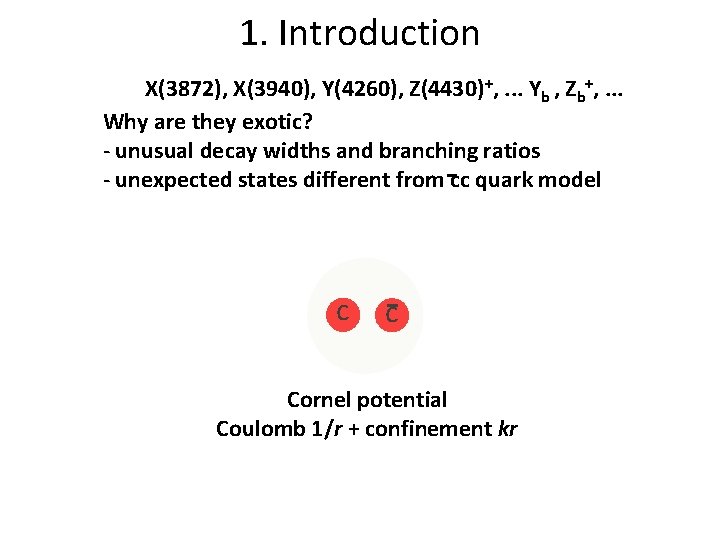
1. Introduction X(3872), X(3940), Y(4260), Z(4430)+, . . . Yb , Zb+, . . . Why are they exotic? - unusual decay widths and branching ratios - unexpected states different from cc quark model c c Cornel potential Coulomb 1/r + confinement kr
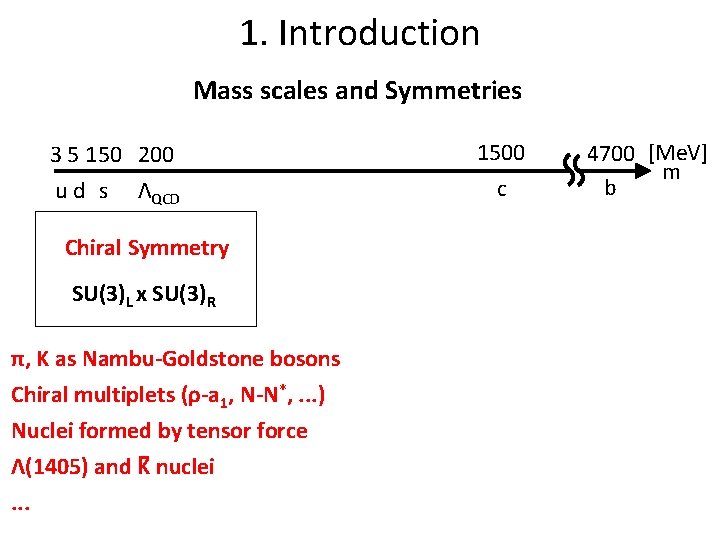
1. Introduction Mass scales and Symmetries 3 5 150 200 ud s ΛQCD Chiral Symmetry SU(3)L x SU(3)R π, K as Nambu-Goldstone bosons Chiral multiplets (ρ-a 1, N-N*, . . . ) Nuclei formed by tensor force Λ(1405) and K nuclei. . . 1500 c 4700 [Me. V] m b
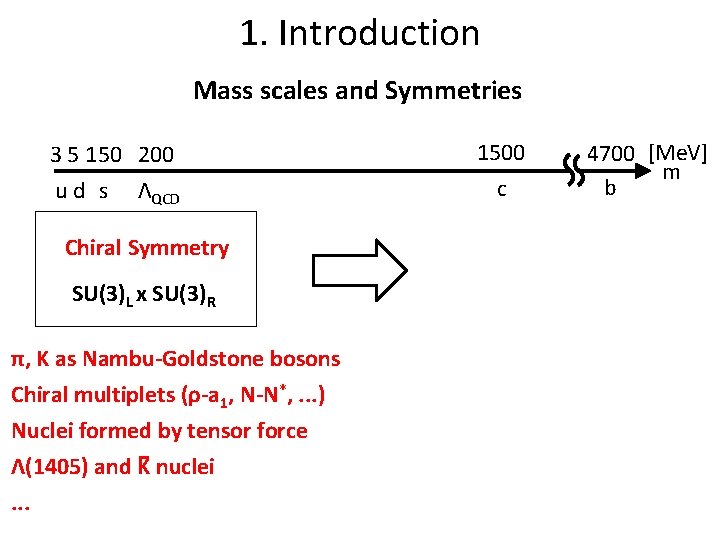
1. Introduction Mass scales and Symmetries 3 5 150 200 ud s ΛQCD Chiral Symmetry SU(3)L x SU(3)R π, K as Nambu-Goldstone bosons Chiral multiplets (ρ-a 1, N-N*, . . . ) Nuclei formed by tensor force Λ(1405) and K nuclei. . . 1500 c 4700 [Me. V] m b
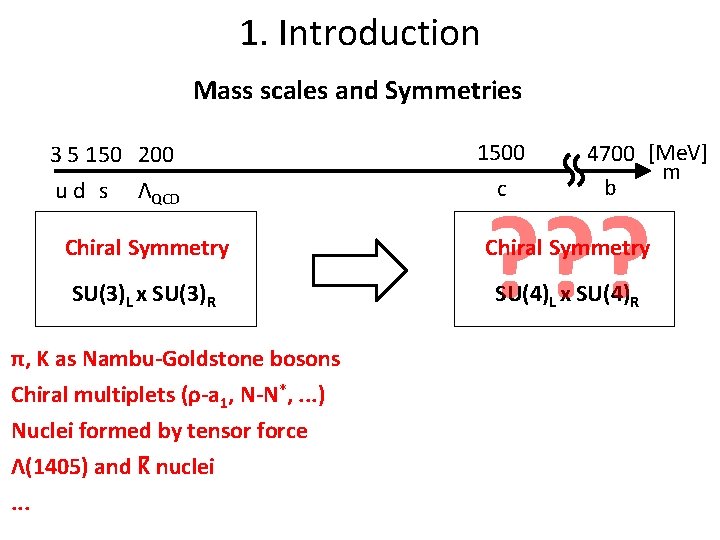
1. Introduction Mass scales and Symmetries 3 5 150 200 ud s ΛQCD Chiral Symmetry SU(3)L x SU(3)R π, K as Nambu-Goldstone bosons Chiral multiplets (ρ-a 1, N-N*, . . . ) Nuclei formed by tensor force Λ(1405) and K nuclei. . . 1500 c 4700 [Me. V] m b ? ? ? Chiral Symmetry SU(4)L x SU(4)R
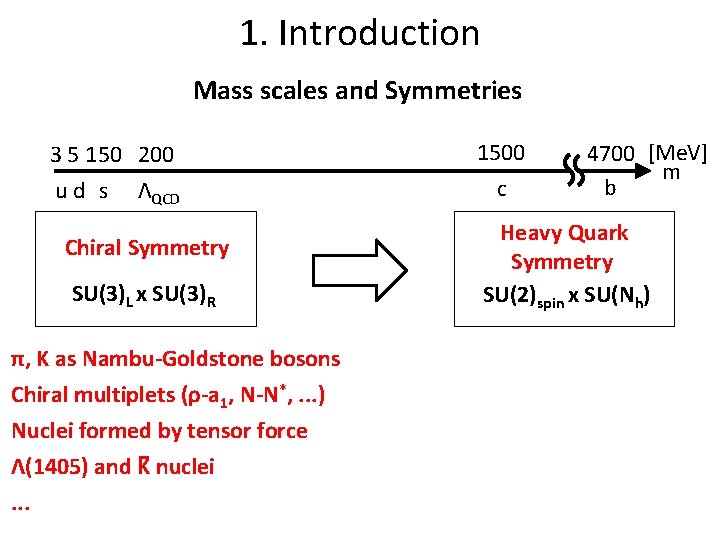
1. Introduction Mass scales and Symmetries 3 5 150 200 ud s ΛQCD Chiral Symmetry SU(3)L x SU(3)R π, K as Nambu-Goldstone bosons Chiral multiplets (ρ-a 1, N-N*, . . . ) Nuclei formed by tensor force Λ(1405) and K nuclei. . . 1500 c 4700 [Me. V] m b Heavy Quark Symmetry SU(2)spin x SU(Nh)
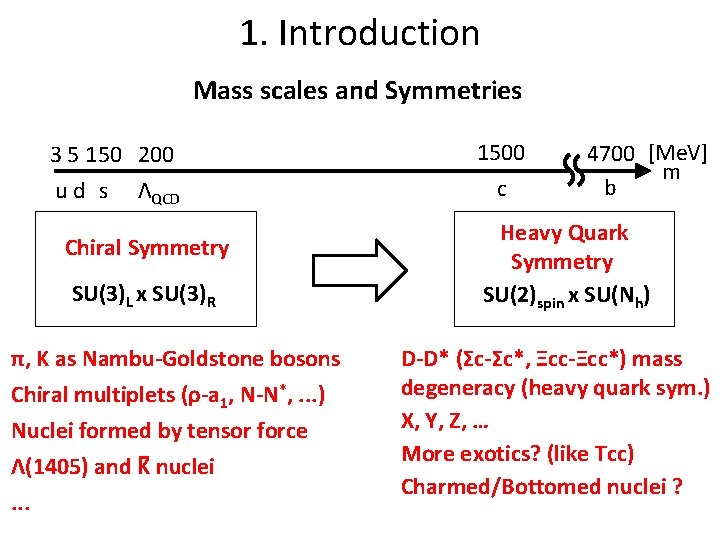
1. Introduction Mass scales and Symmetries 3 5 150 200 ud s ΛQCD Chiral Symmetry SU(3)L x SU(3)R π, K as Nambu-Goldstone bosons Chiral multiplets (ρ-a 1, N-N*, . . . ) Nuclei formed by tensor force Λ(1405) and K nuclei. . . 1500 c 4700 [Me. V] m b Heavy Quark Symmetry SU(2)spin x SU(Nh) D-D* (Σc-Σc*, Ξcc-Ξcc*) mass degeneracy (heavy quark sym. ) X, Y, Z, … More exotics? (like Tcc) Charmed/Bottomed nuclei ?
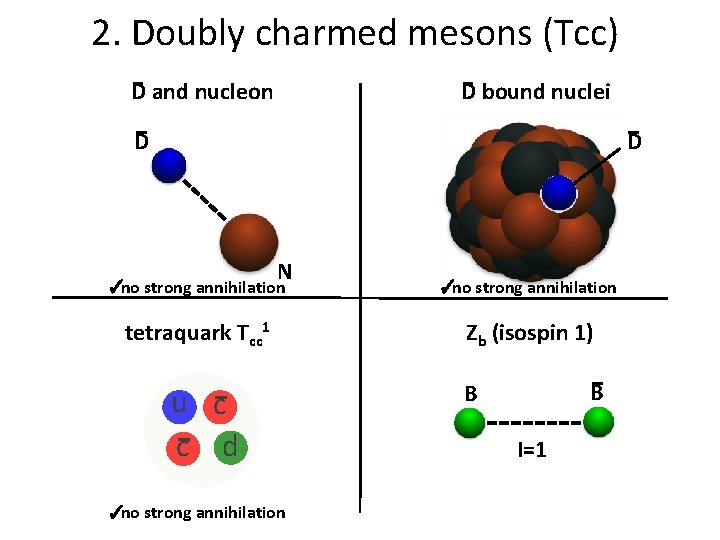
2. Doubly charmed mesons (Tcc) D and nucleon D bound nuclei D D N ✓no strong annihilation tetraquark Tcc 1 Zb (isospin 1) u c c d ✓no strong annihilation B B I=1
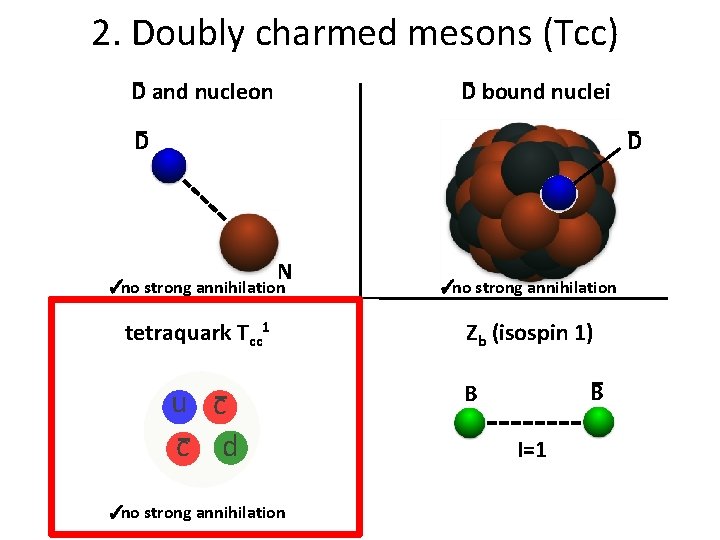
2. Doubly charmed mesons (Tcc) D and nucleon D bound nuclei D D N ✓no strong annihilation tetraquark Tcc 1 Zb (isospin 1) u c c d ✓no strong annihilation B B I=1
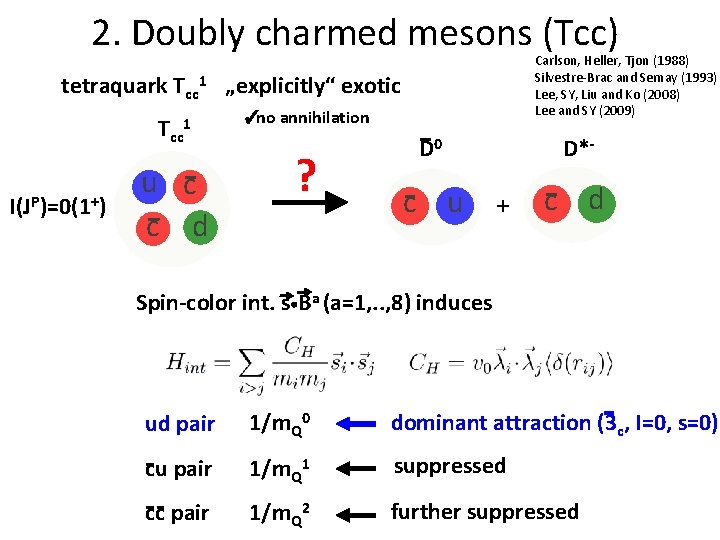
2. Doubly charmed mesons (Tcc) Carlson, Heller, Tjon (1988) Silvestre-Brac and Semay (1993) Lee, SY, Liu and Ko (2008) Lee and SY (2009) tetraquark Tcc 1 „explicitly“ exotic Tcc I(JP)=0(1+) 1 u c c d ✓no annihilation ? D 0 c u + D*- c d Spin-color int. s Ba (a=1, . . , 8) induces ud pair 1/m. Q 0 dominant attraction (3 c, I=0, s=0) cu pair 1/m. Q 1 suppressed cc pair 1/m. Q 2 further suppressed
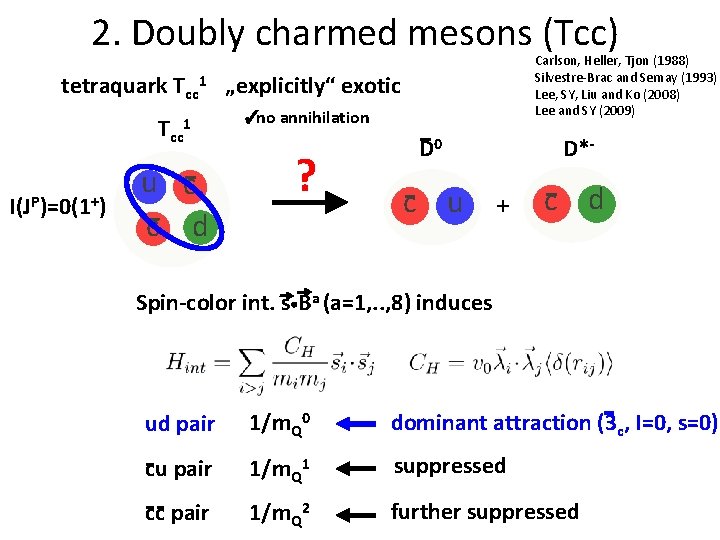
2. Doubly charmed mesons (Tcc) Carlson, Heller, Tjon (1988) Silvestre-Brac and Semay (1993) Lee, SY, Liu and Ko (2008) Lee and SY (2009) tetraquark Tcc 1 „explicitly“ exotic Tcc I(JP)=0(1+) 1 u c c d ✓no annihilation ? D 0 c u + D*- c d Spin-color int. s Ba (a=1, . . , 8) induces ud pair 1/m. Q 0 dominant attraction (3 c, I=0, s=0) cu pair 1/m. Q 1 suppressed cc pair 1/m. Q 2 further suppressed
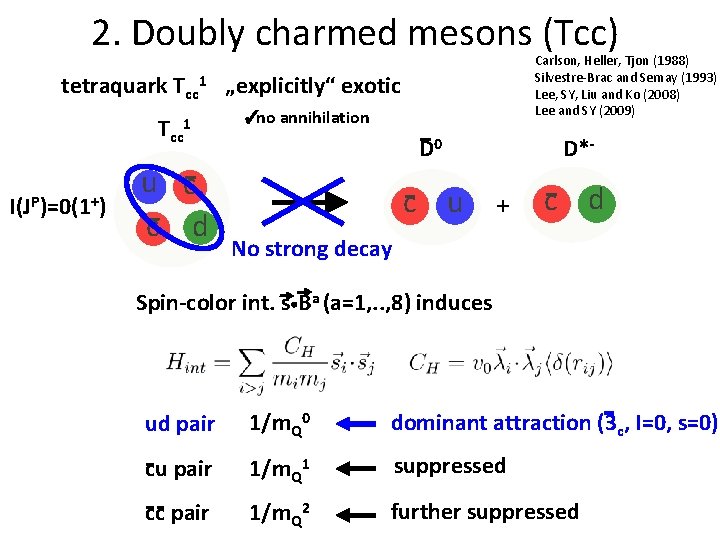
2. Doubly charmed mesons (Tcc) Carlson, Heller, Tjon (1988) Silvestre-Brac and Semay (1993) Lee, SY, Liu and Ko (2008) Lee and SY (2009) tetraquark Tcc 1 „explicitly“ exotic Tcc I(JP)=0(1+) 1 u c c d ✓no annihilation D 0 c u + D*- c d No strong decay Spin-color int. s Ba (a=1, . . , 8) induces ud pair 1/m. Q 0 dominant attraction (3 c, I=0, s=0) cu pair 1/m. Q 1 suppressed cc pair 1/m. Q 2 further suppressed
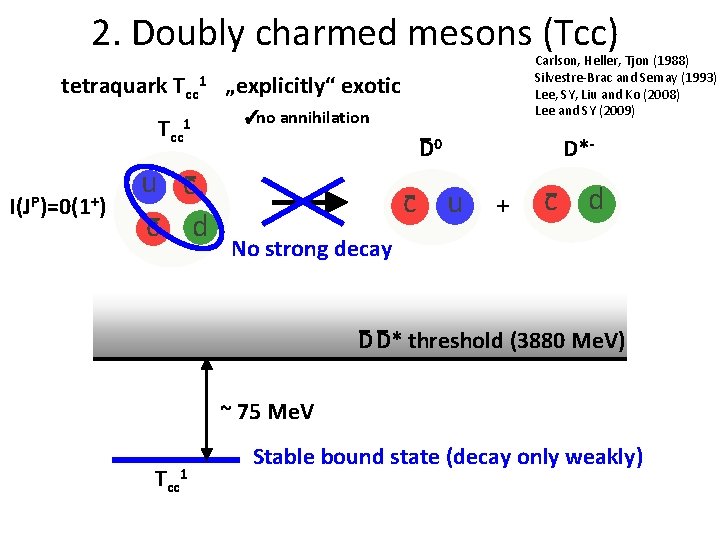
2. Doubly charmed mesons (Tcc) Carlson, Heller, Tjon (1988) Silvestre-Brac and Semay (1993) Lee, SY, Liu and Ko (2008) Lee and SY (2009) tetraquark Tcc 1 „explicitly“ exotic Tcc I(JP)=0(1+) 1 u c c d ✓no annihilation D 0 c u + D*- c d No strong decay D D* threshold (3880 Me. V) ~ 75 Me. V Tcc 1 Stable bound state (decay only weakly)
2. Doubly charmed mesons (Tcc)
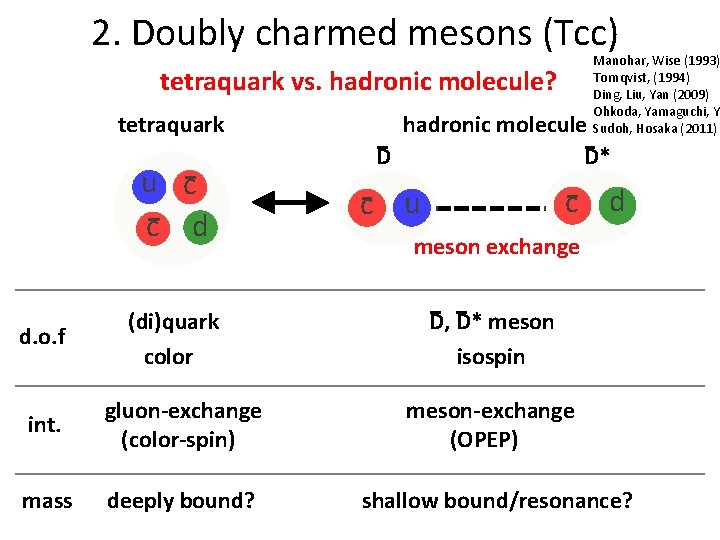
2. Doubly charmed mesons (Tcc) Manohar, Wise (1993) Tornqvist, (1994) Ding, Liu, Yan (2009) Ohkoda, Yamaguchi, Y, Sudoh, Hosaka (2011) tetraquark vs. hadronic molecule? tetraquark u c c d d. o. f (di)quark color hadronic molecule D D* c d c u meson exchange D, D* meson isospin int. gluon-exchange (color-spin) meson-exchange (OPEP) mass deeply bound? shallow bound/resonance?
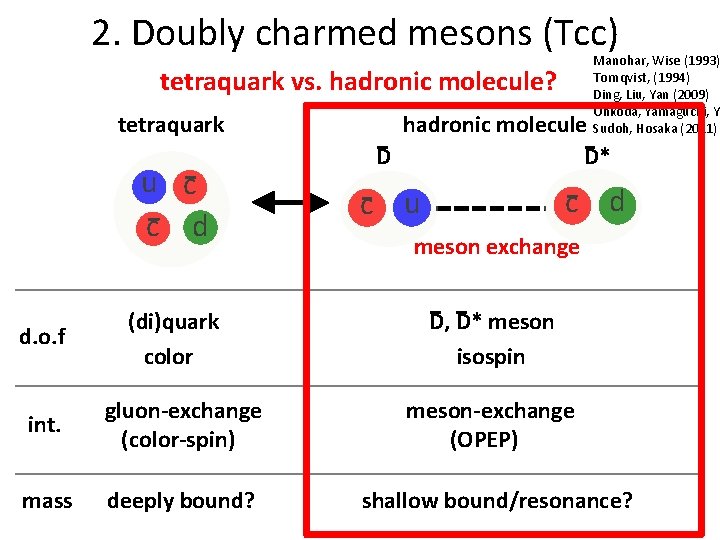
2. Doubly charmed mesons (Tcc) Manohar, Wise (1993) Tornqvist, (1994) Ding, Liu, Yan (2009) Ohkoda, Yamaguchi, Y, Sudoh, Hosaka (2011) tetraquark vs. hadronic molecule? tetraquark u c c d d. o. f (di)quark color hadronic molecule D D* c d c u meson exchange D, D* meson isospin int. gluon-exchange (color-spin) meson-exchange (OPEP) mass deeply bound? shallow bound/resonance?
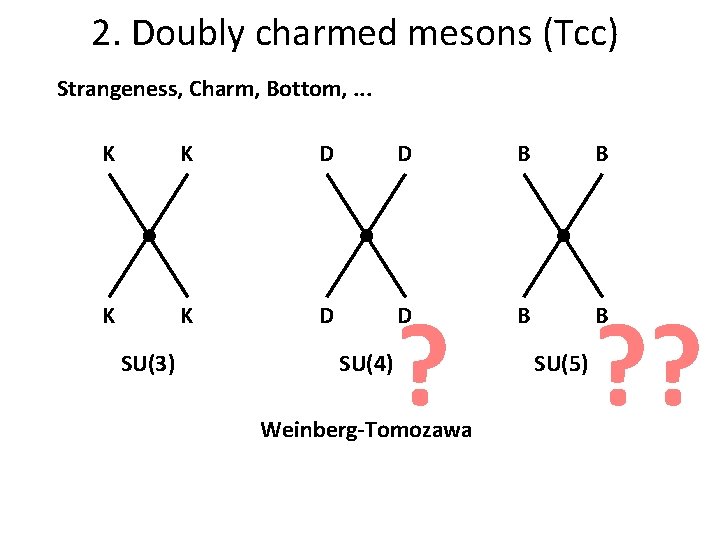
2. Doubly charmed mesons (Tcc) Strangeness, Charm, Bottom, . . . K K D D B B K K D ? B ? ? SU(3) D SU(4) Weinberg-Tomozawa B SU(5)
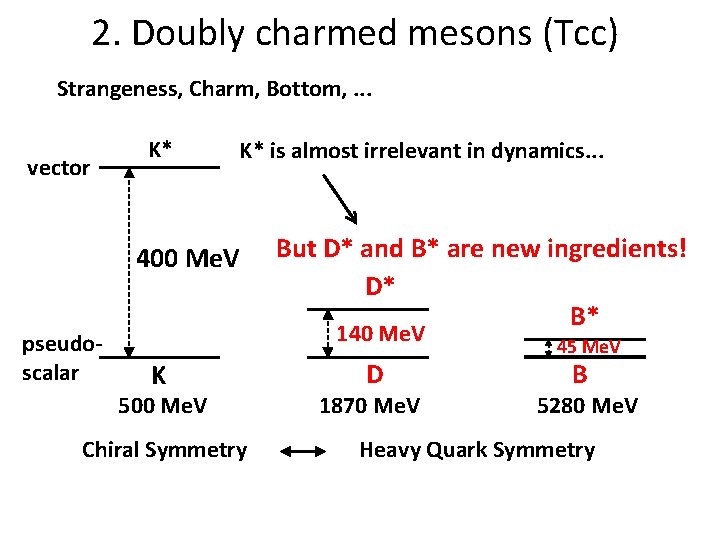
2. Doubly charmed mesons (Tcc) Strangeness, Charm, Bottom, . . . vector K* K* is almost irrelevant in dynamics. . . 400 Me. V pseudoscalar But D* and B* are new ingredients! D* B* 140 Me. V K 500 Me. V Chiral Symmetry D 1870 Me. V 45 Me. V B 5280 Me. V Heavy Quark Symmetry
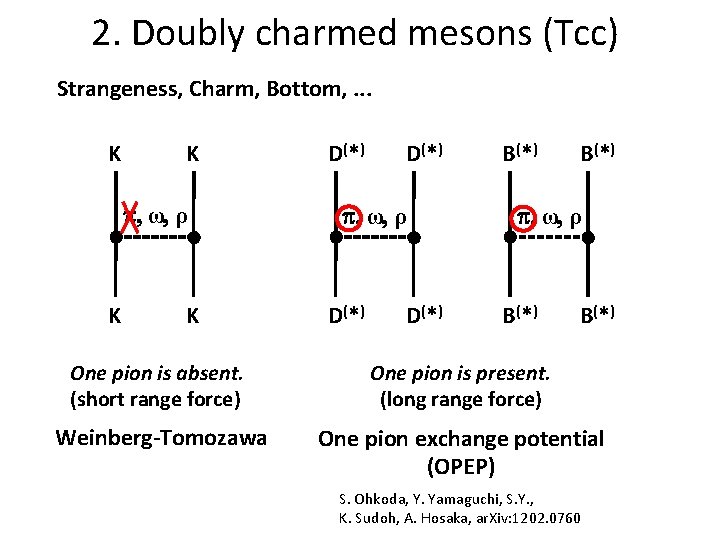
2. Doubly charmed mesons (Tcc) Strangeness, Charm, Bottom, . . . K K p, ω, ρ K K D ( *) p, ω, ρ D ( *) B ( *) p, ω, ρ B ( *) One pion is absent. (short range force) One pion is present. (long range force) Weinberg-Tomozawa One pion exchange potential (OPEP) S. Ohkoda, Y. Yamaguchi, S. Y. , K. Sudoh, A. Hosaka, ar. Xiv: 1202. 0760
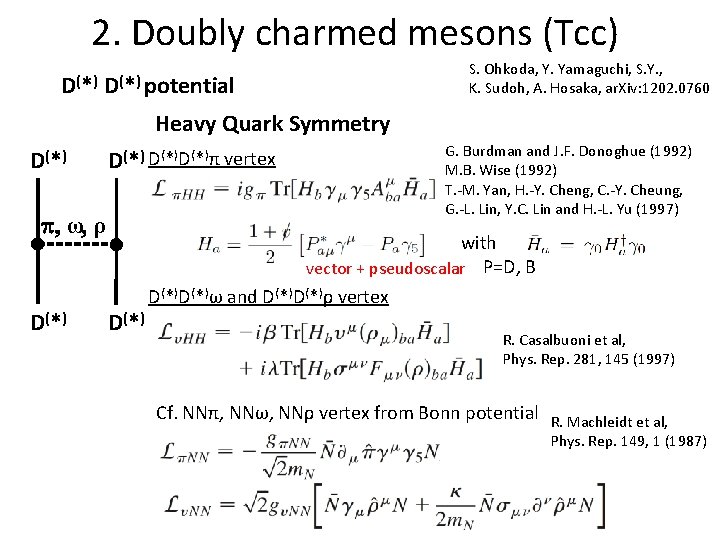
2. Doubly charmed mesons (Tcc) D ( *) S. Ohkoda, Y. Yamaguchi, S. Y. , K. Sudoh, A. Hosaka, ar. Xiv: 1202. 0760 D(*) potential Heavy Quark Symmetry D ( *) p, ω, ρ D ( *) G. Burdman and J. F. Donoghue (1992) M. B. Wise (1992) T. -M. Yan, H. -Y. Cheng, C. -Y. Cheung, G. -L. Lin, Y. C. Lin and H. -L. Yu (1997) D(*)D(*)π vertex with vector + pseudoscalar P=D, B D ( *) D(*)ω and D(*)ρ vertex R. Casalbuoni et al, Phys. Rep. 281, 145 (1997) Cf. NNπ, NNω, NNρ vertex from Bonn potential R. Machleidt et al, Phys. Rep. 149, 1 (1987)
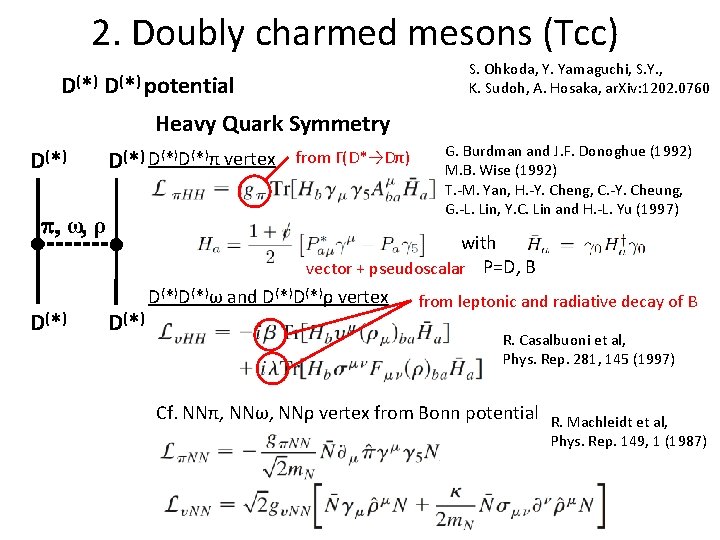
2. Doubly charmed mesons (Tcc) D ( *) S. Ohkoda, Y. Yamaguchi, S. Y. , K. Sudoh, A. Hosaka, ar. Xiv: 1202. 0760 D(*) potential Heavy Quark Symmetry D ( *) D(*)D(*)π vertex p, ω, ρ D ( *) from Γ(D*→Dπ) G. Burdman and J. F. Donoghue (1992) M. B. Wise (1992) T. -M. Yan, H. -Y. Cheng, C. -Y. Cheung, G. -L. Lin, Y. C. Lin and H. -L. Yu (1997) with vector + pseudoscalar P=D, B D ( *) D(*)ω and D(*)ρ vertex from leptonic and radiative decay of B R. Casalbuoni et al, Phys. Rep. 281, 145 (1997) Cf. NNπ, NNω, NNρ vertex from Bonn potential R. Machleidt et al, Phys. Rep. 149, 1 (1987)
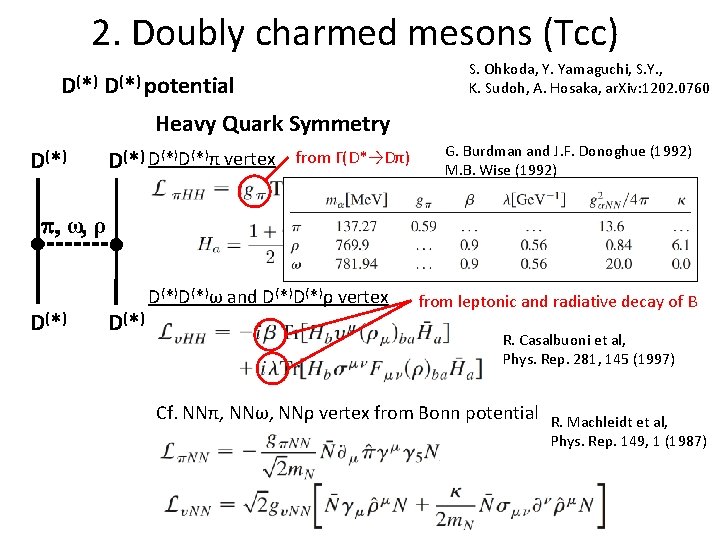
2. Doubly charmed mesons (Tcc) D ( *) S. Ohkoda, Y. Yamaguchi, S. Y. , K. Sudoh, A. Hosaka, ar. Xiv: 1202. 0760 D(*) potential Heavy Quark Symmetry D ( *) D(*)D(*)π vertex p, ω, ρ D ( *) from Γ(D*→Dπ) G. Burdman and J. F. Donoghue (1992) M. B. Wise (1992) T. -M. Yan, H. -Y. Cheng, C. -Y. Cheung, G. -L. Lin, Y. C. Lin and H. -L. Yu (1997) with vector + pseudoscalar P=D, B D ( *) D(*)ω and D(*)ρ vertex from leptonic and radiative decay of B R. Casalbuoni et al, Phys. Rep. 281, 145 (1997) Cf. NNπ, NNω, NNρ vertex from Bonn potential R. Machleidt et al, Phys. Rep. 149, 1 (1987)
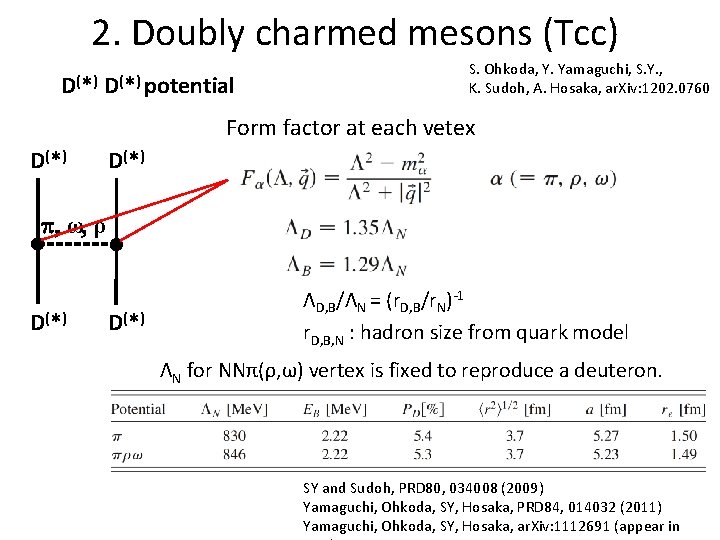
2. Doubly charmed mesons (Tcc) D ( *) D(*) potential S. Ohkoda, Y. Yamaguchi, S. Y. , K. Sudoh, A. Hosaka, ar. Xiv: 1202. 0760 Form factor at each vetex D ( *) p, ω, ρ D ( *) ΛD, B/ΛN = (r. D, B/r. N)-1 r. D, B, N : hadron size from quark model ΛN for NNπ(ρ, ω) vertex is fixed to reproduce a deuteron. SY and Sudoh, PRD 80, 034008 (2009) Yamaguchi, Ohkoda, SY, Hosaka, PRD 84, 014032 (2011) Yamaguchi, Ohkoda, SY, Hosaka, ar. Xiv: 1112691 (appear in
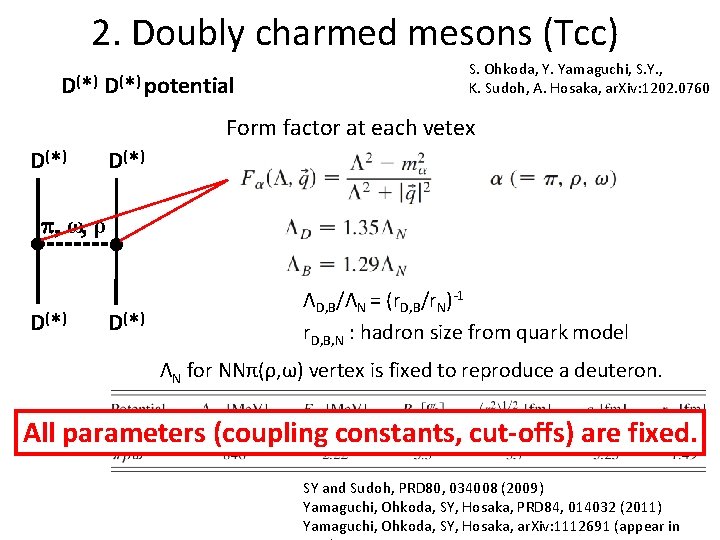
2. Doubly charmed mesons (Tcc) D ( *) D(*) potential S. Ohkoda, Y. Yamaguchi, S. Y. , K. Sudoh, A. Hosaka, ar. Xiv: 1202. 0760 Form factor at each vetex D ( *) p, ω, ρ D ( *) ΛD, B/ΛN = (r. D, B/r. N)-1 r. D, B, N : hadron size from quark model ΛN for NNπ(ρ, ω) vertex is fixed to reproduce a deuteron. All parameters (coupling constants, cut-offs) are fixed. SY and Sudoh, PRD 80, 034008 (2009) Yamaguchi, Ohkoda, SY, Hosaka, PRD 84, 014032 (2011) Yamaguchi, Ohkoda, SY, Hosaka, ar. Xiv: 1112691 (appear in
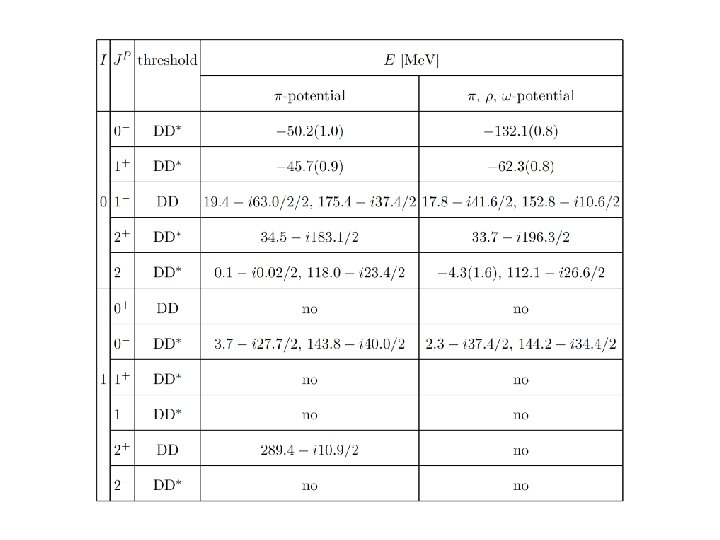
2. Doubly charmed mesons (Tcc) I(JP) (J≤ 2) in D(*) states S. Ohkoda, Y. Yamaguchi, S. Y. , K. Sudoh, A. Hosaka, ar. Xiv: 1202. 0760
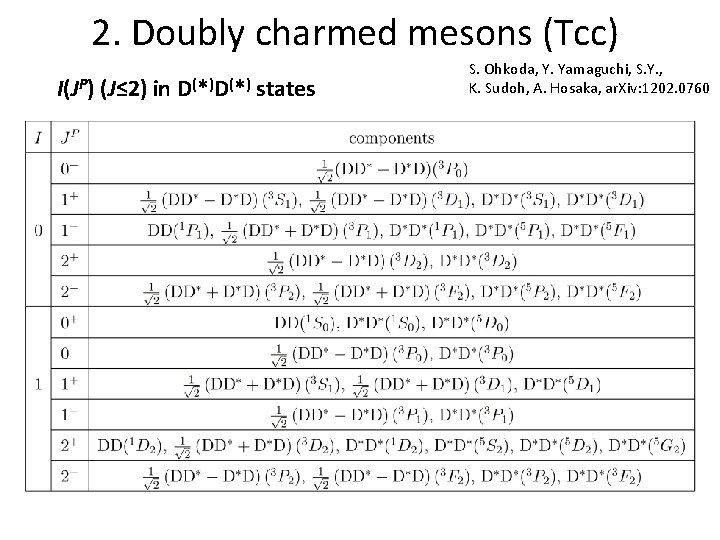
2. Doubly charmed mesons (Tcc) I(JP) (J≤ 2) in D(*) states S. Ohkoda, Y. Yamaguchi, S. Y. , K. Sudoh, A. Hosaka, ar. Xiv: 1202. 0760
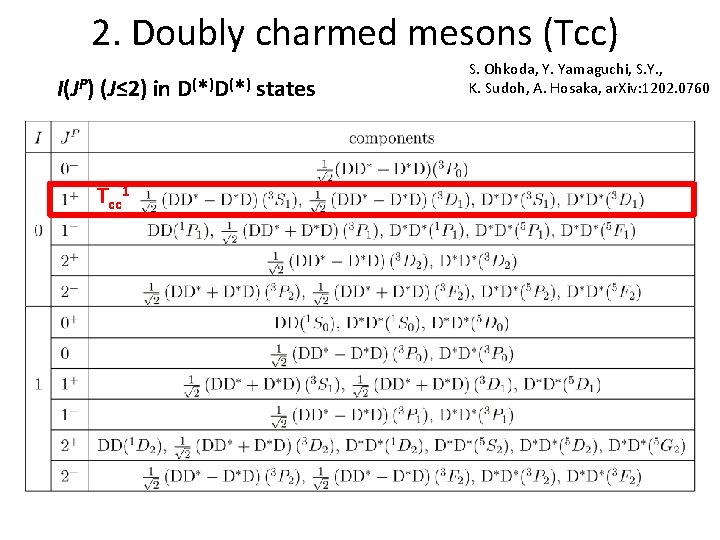
2. Doubly charmed mesons (Tcc) I(JP) (J≤ 2) in D(*) states Tcc 1 S. Ohkoda, Y. Yamaguchi, S. Y. , K. Sudoh, A. Hosaka, ar. Xiv: 1202. 0760
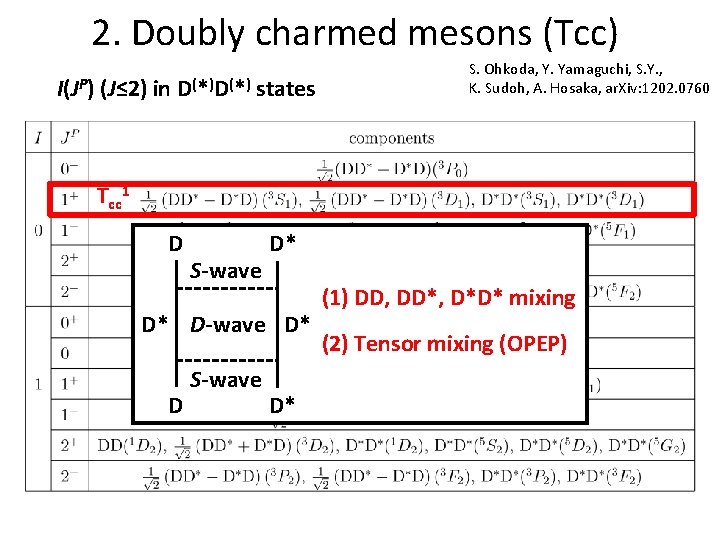
2. Doubly charmed mesons (Tcc) I(JP) (J≤ 2) in D(*) states S. Ohkoda, Y. Yamaguchi, S. Y. , K. Sudoh, A. Hosaka, ar. Xiv: 1202. 0760 Tcc 1 D S-wave D* D* D-wave D* D S-wave D* (1) DD, DD*, D*D* mixing (2) Tensor mixing (OPEP)
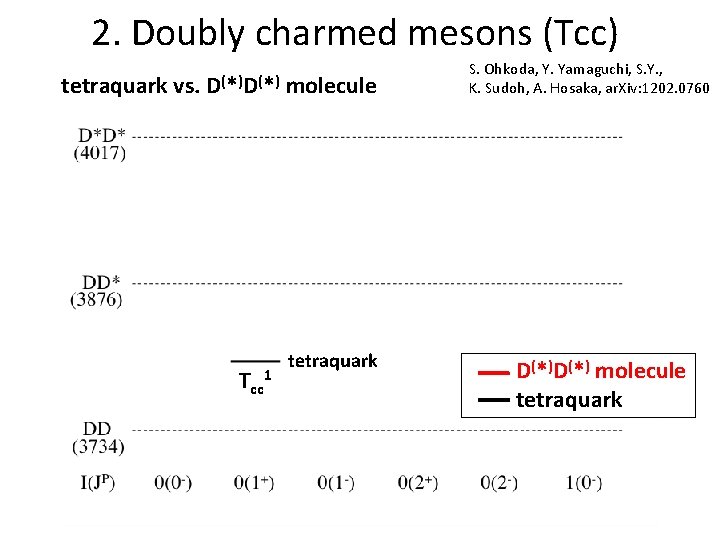
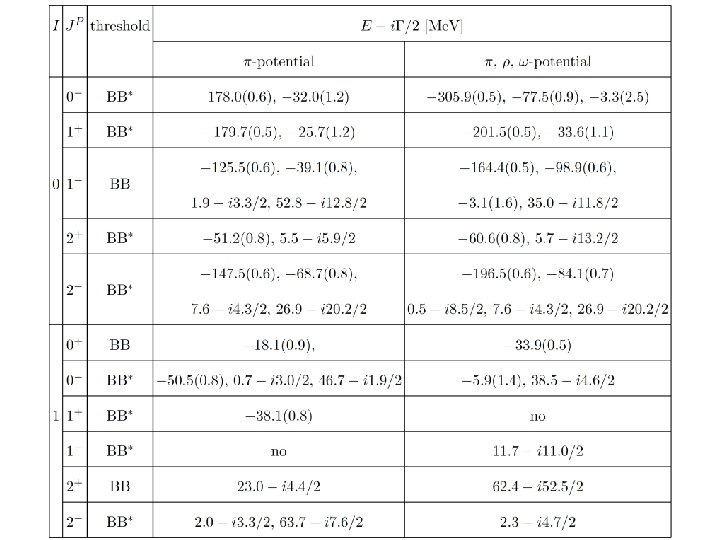
2. Doubly charmed mesons (Tcc) tetraquark vs. D ( *) Tcc 1 molecule tetraquark S. Ohkoda, Y. Yamaguchi, S. Y. , K. Sudoh, A. Hosaka, ar. Xiv: 1202. 0760 D(*) molecule tetraquark
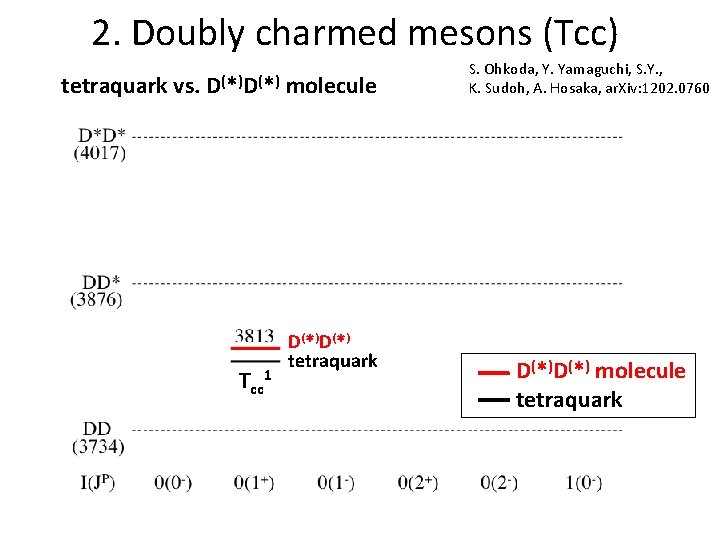
2. Doubly charmed mesons (Tcc) tetraquark vs. D ( *) Tcc 1 molecule D ( *) tetraquark S. Ohkoda, Y. Yamaguchi, S. Y. , K. Sudoh, A. Hosaka, ar. Xiv: 1202. 0760 D(*) molecule tetraquark
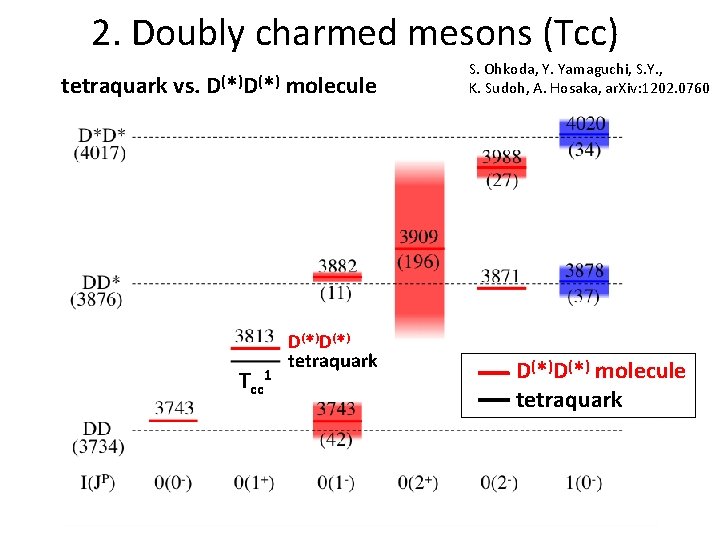
2. Doubly charmed mesons (Tcc) tetraquark vs. D ( *) Tcc 1 molecule D ( *) tetraquark S. Ohkoda, Y. Yamaguchi, S. Y. , K. Sudoh, A. Hosaka, ar. Xiv: 1202. 0760 D(*) molecule tetraquark
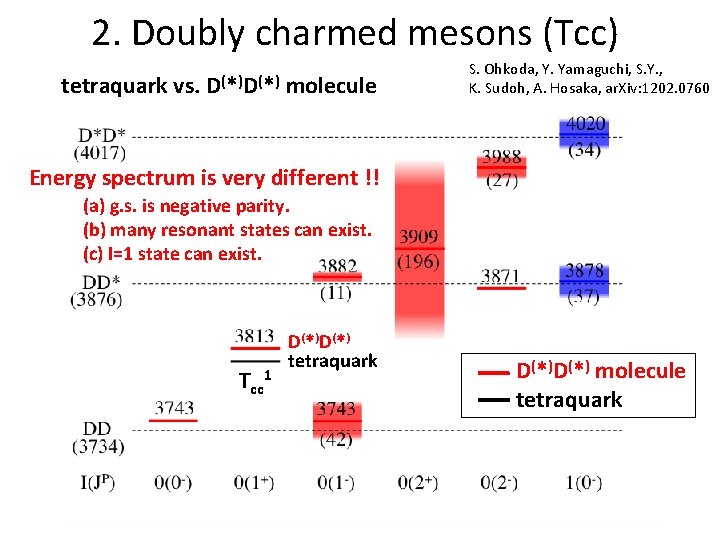
2. Doubly charmed mesons (Tcc) tetraquark vs. D ( *) molecule S. Ohkoda, Y. Yamaguchi, S. Y. , K. Sudoh, A. Hosaka, ar. Xiv: 1202. 0760 Energy spectrum is very different !! (a) g. s. is negative parity. (b) many resonant states can exist. (c) I=1 state can exist. Tcc 1 D ( *) tetraquark D(*) molecule tetraquark
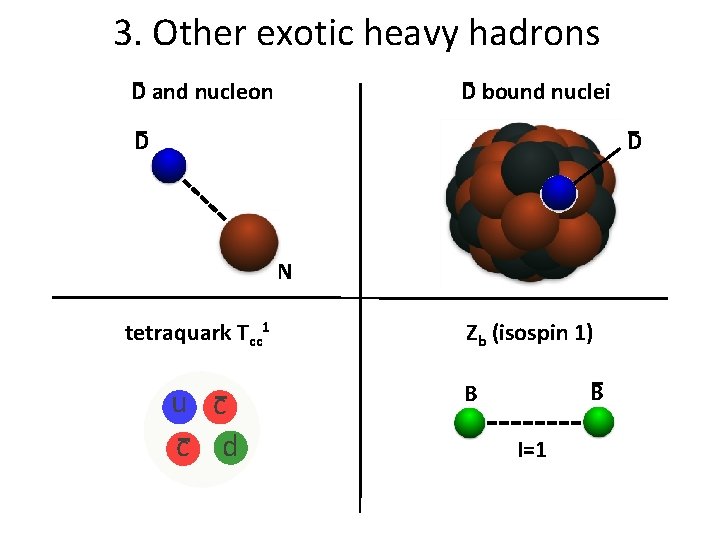
3. Other exotic heavy hadrons D and nucleon D bound nuclei D D N tetraquark Tcc 1 u c c d Zb (isospin 1) B B I=1
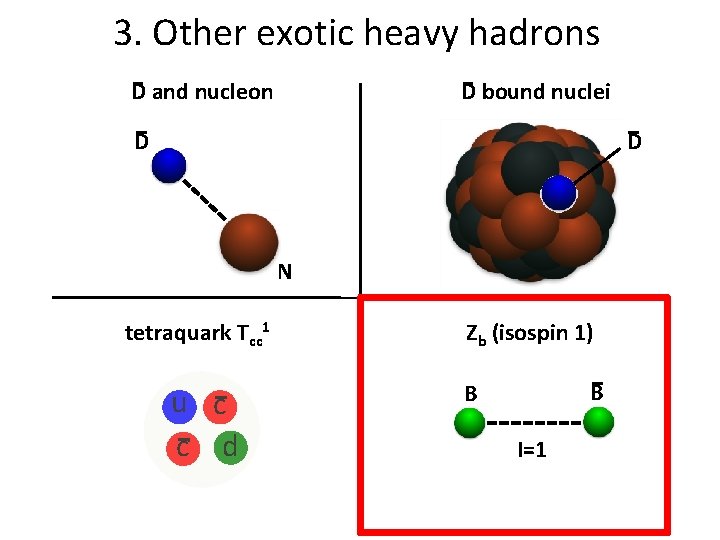
3. Other exotic heavy hadrons D and nucleon D bound nuclei D D N tetraquark Tcc 1 u c c d Zb (isospin 1) B B I=1
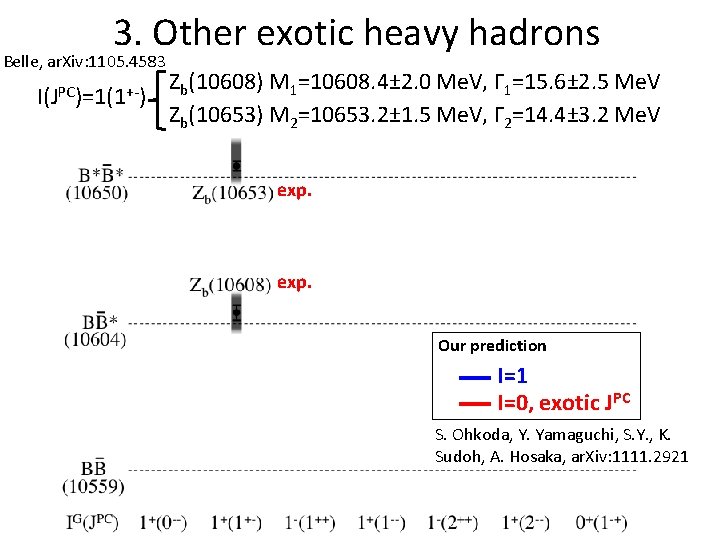
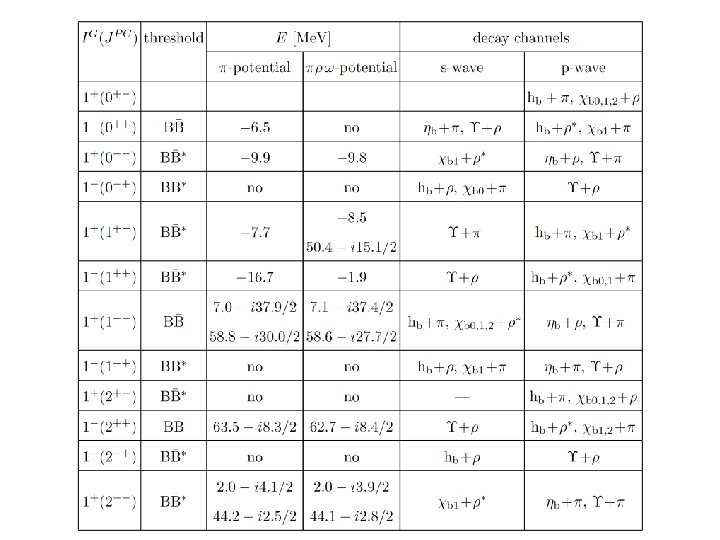
3. Other exotic heavy hadrons Belle, ar. Xiv: 1105. 4583 I(JPC)=1(1+-) Zb(10608) M 1=10608. 4± 2. 0 Me. V, Γ 1=15. 6± 2. 5 Me. V Zb(10653) M 2=10653. 2± 1. 5 Me. V, Γ 2=14. 4± 3. 2 Me. V exp. Our prediction I=1 I=0, exotic JPC S. Ohkoda, Y. Yamaguchi, S. Y. , K. Sudoh, A. Hosaka, ar. Xiv: 1111. 2921
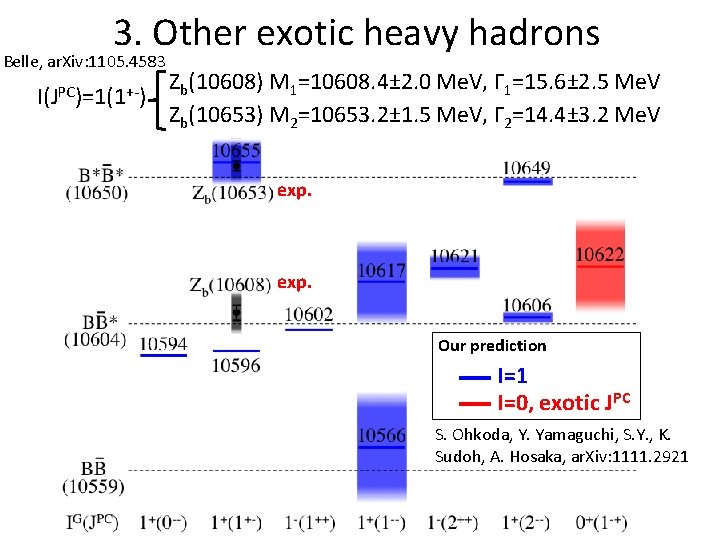
3. Other exotic heavy hadrons Belle, ar. Xiv: 1105. 4583 I(JPC)=1(1+-) Zb(10608) M 1=10608. 4± 2. 0 Me. V, Γ 1=15. 6± 2. 5 Me. V Zb(10653) M 2=10653. 2± 1. 5 Me. V, Γ 2=14. 4± 3. 2 Me. V exp. Our prediction I=1 I=0, exotic JPC S. Ohkoda, Y. Yamaguchi, S. Y. , K. Sudoh, A. Hosaka, ar. Xiv: 1111. 2921
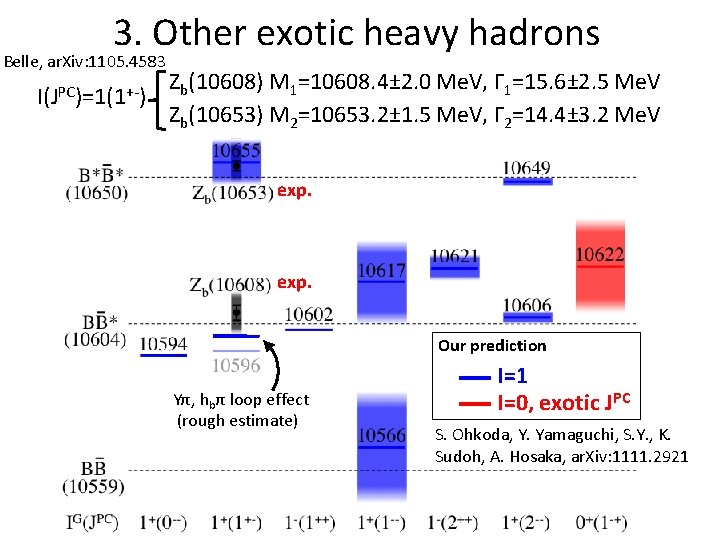
3. Other exotic heavy hadrons Belle, ar. Xiv: 1105. 4583 I(JPC)=1(1+-) Zb(10608) M 1=10608. 4± 2. 0 Me. V, Γ 1=15. 6± 2. 5 Me. V Zb(10653) M 2=10653. 2± 1. 5 Me. V, Γ 2=14. 4± 3. 2 Me. V exp. Our prediction Υπ, hbπ loop effect (rough estimate) I=1 I=0, exotic JPC S. Ohkoda, Y. Yamaguchi, S. Y. , K. Sudoh, A. Hosaka, ar. Xiv: 1111. 2921
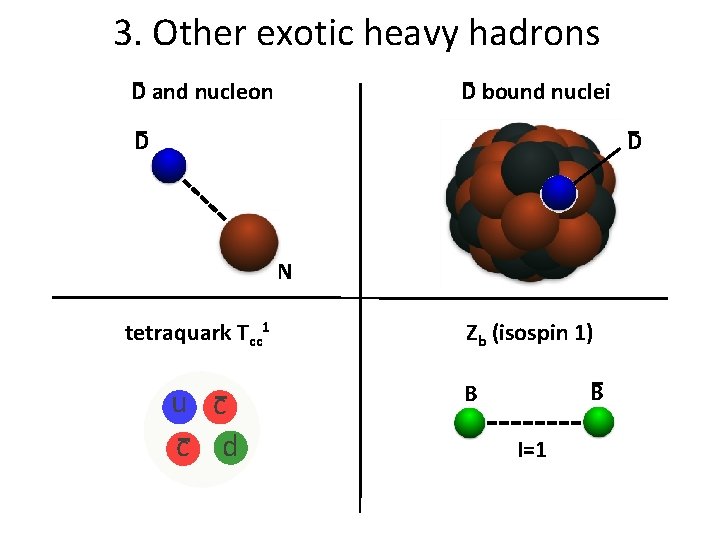
3. Other exotic heavy hadrons D and nucleon D bound nuclei D D N tetraquark Tcc 1 u c c d Zb (isospin 1) B B I=1
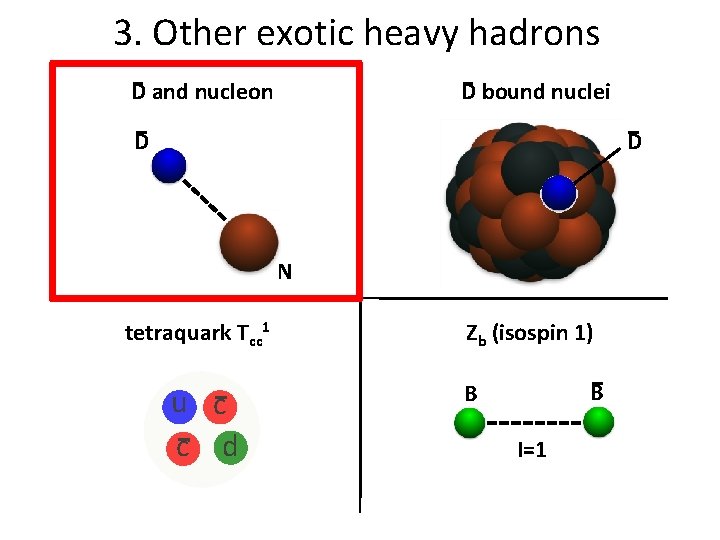
3. Other exotic heavy hadrons D and nucleon D bound nuclei D D N tetraquark Tcc 1 u c c d Zb (isospin 1) B B I=1
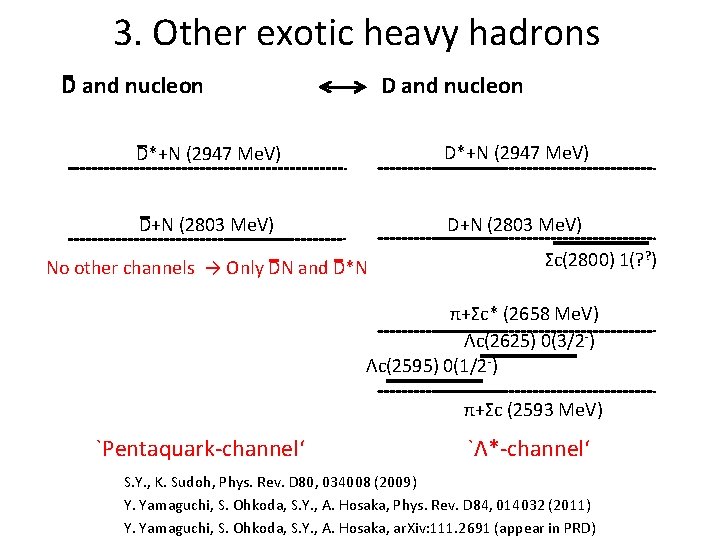
3. Other exotic heavy hadrons D and nucleon D*+N (2947 Me. V) D+N (2803 Me. V) No other channels → Only DN and D*N Σc(2800) 1(? ? ) π+Σc* (2658 Me. V) Λc(2625) 0(3/2 -) Λc(2595) 0(1/2 -) π+Σc (2593 Me. V) `Pentaquark-channel‘ `Λ*-channel‘ S. Y. , K. Sudoh, Phys. Rev. D 80, 034008 (2009) Y. Yamaguchi, S. Ohkoda, S. Y. , A. Hosaka, Phys. Rev. D 84, 014032 (2011) Y. Yamaguchi, S. Ohkoda, S. Y. , A. Hosaka, ar. Xiv: 111. 2691 (appear in PRD)
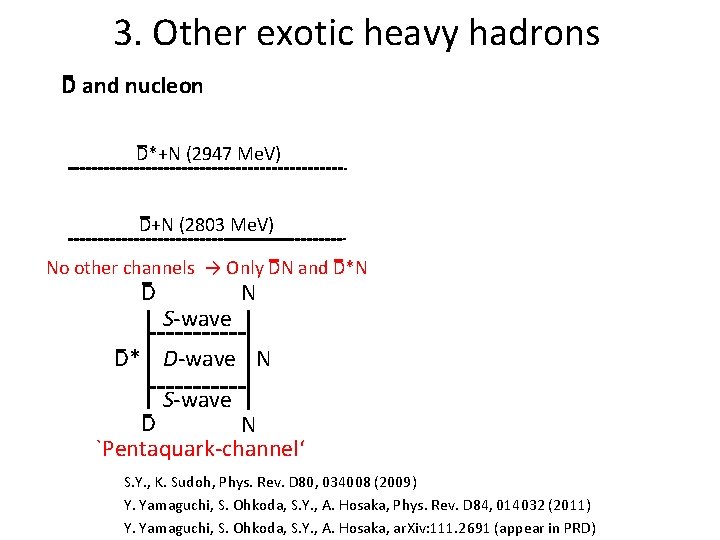
3. Other exotic heavy hadrons D and nucleon D*+N (2947 Me. V) D+N (2803 Me. V) No other channels → Only DN and D*N D S-wave N D* D-wave N S-wave D N `Pentaquark-channel‘ S. Y. , K. Sudoh, Phys. Rev. D 80, 034008 (2009) Y. Yamaguchi, S. Ohkoda, S. Y. , A. Hosaka, Phys. Rev. D 84, 014032 (2011) Y. Yamaguchi, S. Ohkoda, S. Y. , A. Hosaka, ar. Xiv: 111. 2691 (appear in PRD)
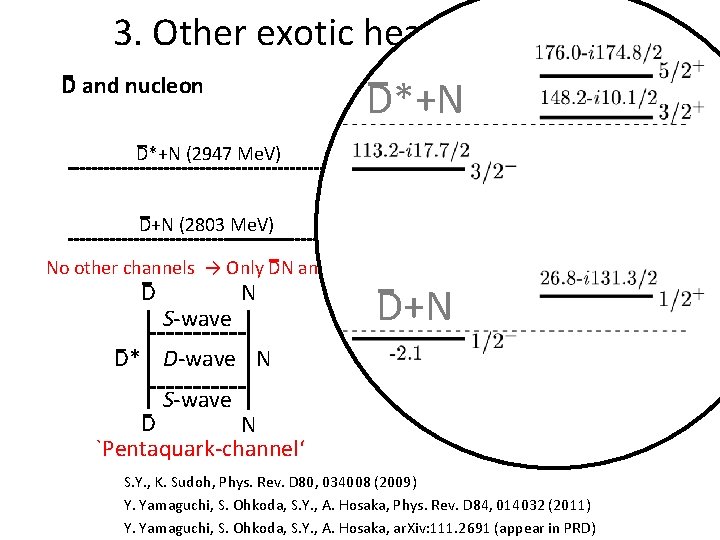
3. Other exotic heavy hadrons D and nucleon D*+N (2947 Me. V) D+N (2803 Me. V) No other channels → Only DN and D*N D S-wave N D+N D* D-wave N S-wave D N `Pentaquark-channel‘ S. Y. , K. Sudoh, Phys. Rev. D 80, 034008 (2009) Y. Yamaguchi, S. Ohkoda, S. Y. , A. Hosaka, Phys. Rev. D 84, 014032 (2011) Y. Yamaguchi, S. Ohkoda, S. Y. , A. Hosaka, ar. Xiv: 111. 2691 (appear in PRD)
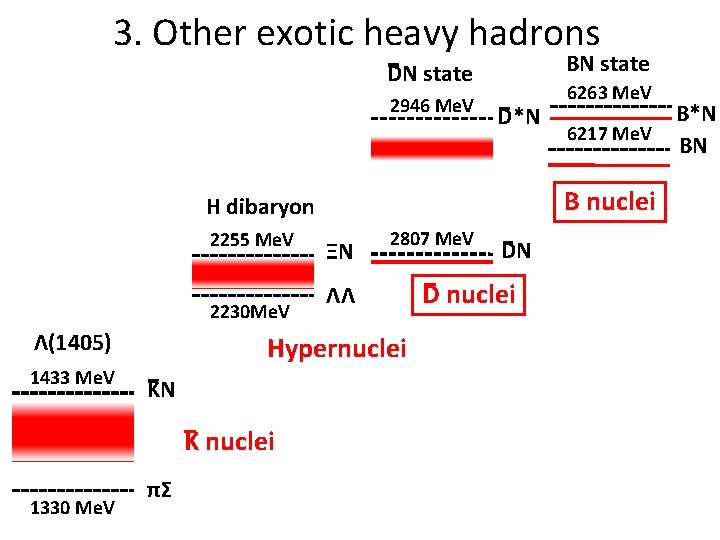
3. Other exotic heavy hadrons BN state DN state 2946 Me. V D*N 2230 Me. V Λ(1405) 1433 Me. V K nuclei 1330 Me. V ΞN 2807 Me. V ΛΛ Hypernuclei KN πΣ 6217 Me. V B nuclei H dibaryon 2255 Me. V 6263 Me. V DN D nuclei B*N BN
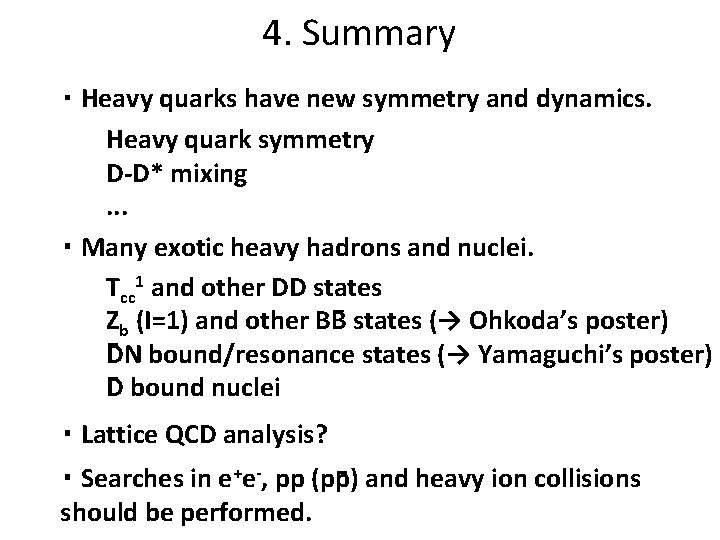
4. Summary ・ Heavy quarks have new symmetry and dynamics. Heavy quark symmetry D-D* mixing. . . ・ Many exotic heavy hadrons and nuclei. Tcc 1 and other DD states Zb (I=1) and other BB states (→ Ohkoda’s poster) DN bound/resonance states (→ Yamaguchi’s poster) D bound nuclei ・ Lattice QCD analysis? ・ Searches in e+e-, pp (pp) and heavy ion collisions should be performed.
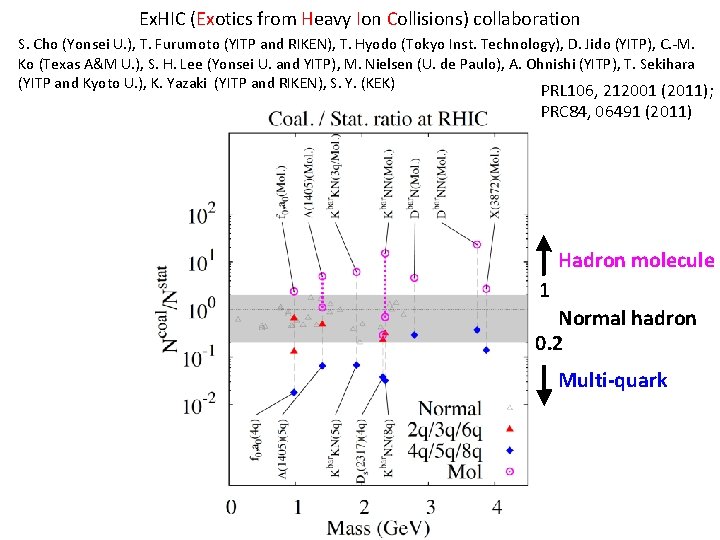
Ex. HIC (Exotics from Heavy Ion Collisions) collaboration S. Cho (Yonsei U. ), T. Furumoto (YITP and RIKEN), T. Hyodo (Tokyo Inst. Technology), D. Jido (YITP), C. -M. Ko (Texas A&M U. ), S. H. Lee (Yonsei U. and YITP), M. Nielsen (U. de Paulo), A. Ohnishi (YITP), T. Sekihara (YITP and Kyoto U. ), K. Yazaki (YITP and RIKEN), S. Y. (KEK) PRL 106, 212001 (2011); PRC 84, 06491 (2011) Hadron molecule 1 Normal hadron 0. 2 Multi-quark

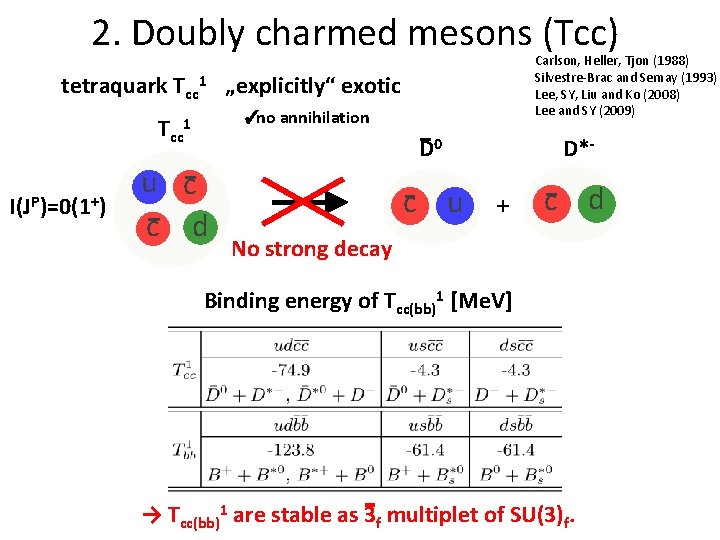
2. Doubly charmed mesons (Tcc) Carlson, Heller, Tjon (1988) Silvestre-Brac and Semay (1993) Lee, SY, Liu and Ko (2008) Lee and SY (2009) tetraquark Tcc 1 „explicitly“ exotic Tcc I(JP)=0(1+) ✓no annihilation 1 u c c d D 0 c u + D*- c d No strong decay Binding energy of Tcc(bb)1 [Me. V] → Tcc(bb)1 are stable as 3 f multiplet of SU(3)f.

3. Experimental researches Yields of exotic hadrons at RHIC and LHC S. Cho et al. (the Ex. HIC collaboration), PRL 106, 212001 (2011) Ex. HIC (Exotics from Heavy Ion Collisions) collaboration S. Cho (Yonsei U. ), T. Furumoto (YITP and RIKEN), T. Hyodo (Tokyo Inst. Technology), D. Jido (YITP), C. -M. Ko (Texas A&M U. ), S. H. Lee (Yonsei U. and YITP), M. Nielsen (U. de Paulo), A. Ohnishi (YITP), T. Sekihara (YITP and Kyoto U. ), K. Yazaki (YITP and RIKEN), S. Y. (KEK)
- Slides: 53