
DoubleEnded Priority Queues Primary operations Insert Remove Max

Double-Ended Priority Queues • Primary operations § Insert § Remove Max § Remove Min • Note that a single-ended priority queue supports just one of the above remove operations.
General Methods • Dual min and max single-ended priority queues. • Correspondence based min and max singleended priority queues.
Specialized Structures • Symmetric min-max heaps. • Min-max heaps. • Deaps. üInterval heaps.

Dual Single-Ended Priority Queues • Each element is in both a min and a max single-ended priority queue. • Single-ended priority queue also must support an arbitrary remove. • Each node in a priority queue has a pointer to the node in the other priority queue that has the same element.
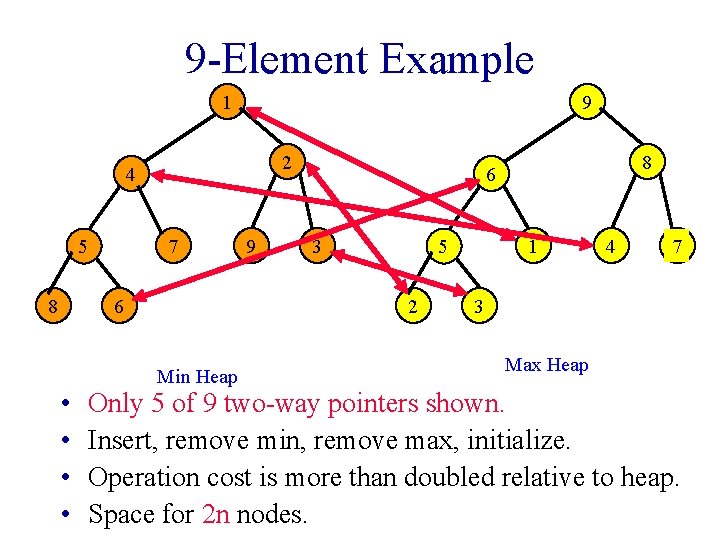
9 -Element Example 9 1 2 4 7 5 8 6 • • 9 3 1 5 2 Min Heap 8 6 4 7 3 Max Heap Only 5 of 9 two-way pointers shown. Insert, remove min, remove max, initialize. Operation cost is more than doubled relative to heap. Space for 2 n nodes.
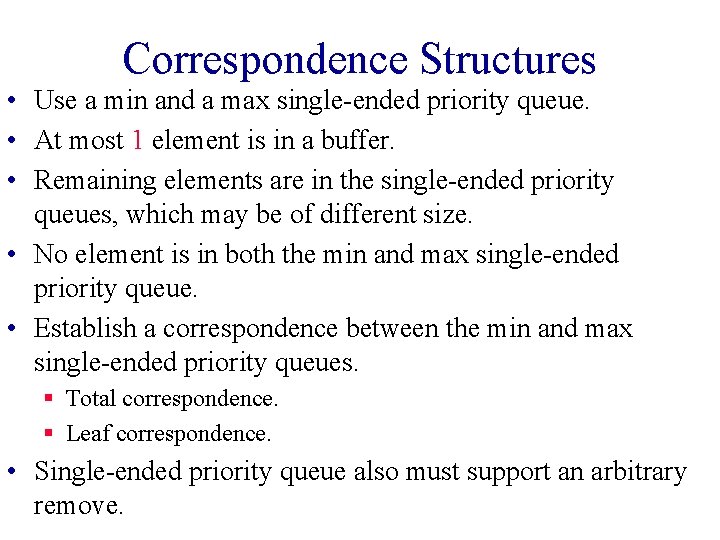
Correspondence Structures • Use a min and a max single-ended priority queue. • At most 1 element is in a buffer. • Remaining elements are in the single-ended priority queues, which may be of different size. • No element is in both the min and max single-ended priority queue. • Establish a correspondence between the min and max single-ended priority queues. § Total correspondence. § Leaf correspondence. • Single-ended priority queue also must support an arbitrary remove.
Total Correspondence • The min- and max-priority queues are of the same size. • Each element of the min priority queue is paired with a different and >= element in the max priority queue.
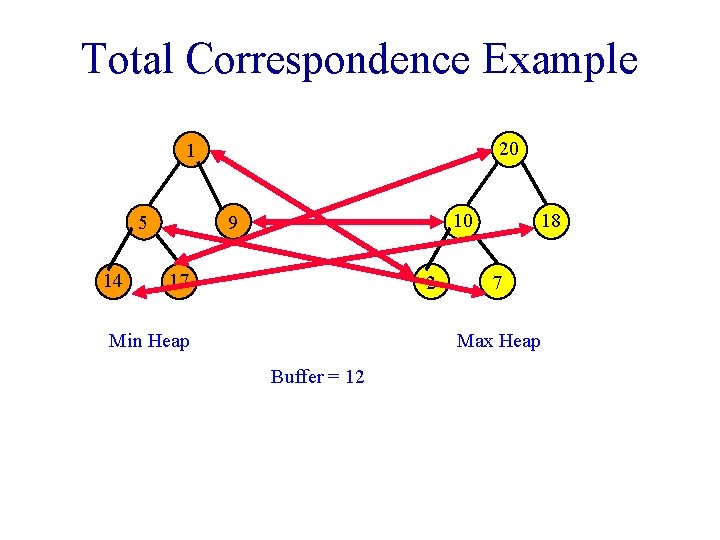
Total Correspondence Example 20 1 14 10 9 5 17 2 Min Heap 18 7 Max Heap Buffer = 12
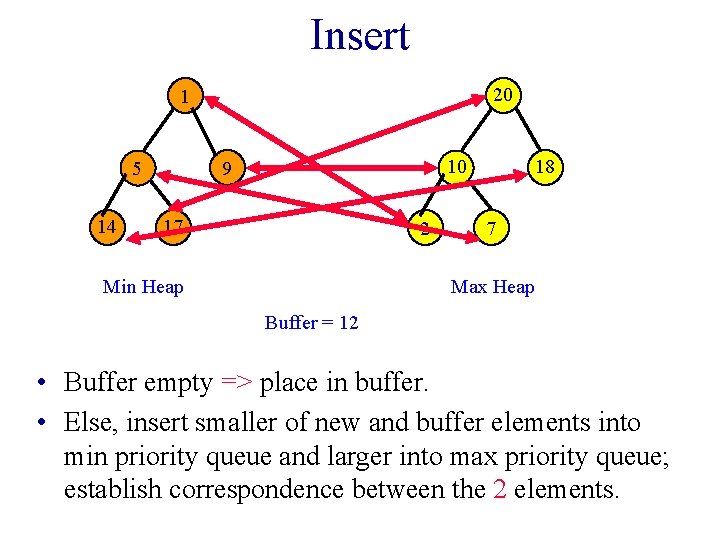
Insert 20 1 14 10 9 5 17 2 Min Heap 18 7 Max Heap Buffer = 12 • Buffer empty => place in buffer. • Else, insert smaller of new and buffer elements into min priority queue and larger into max priority queue; establish correspondence between the 2 elements.
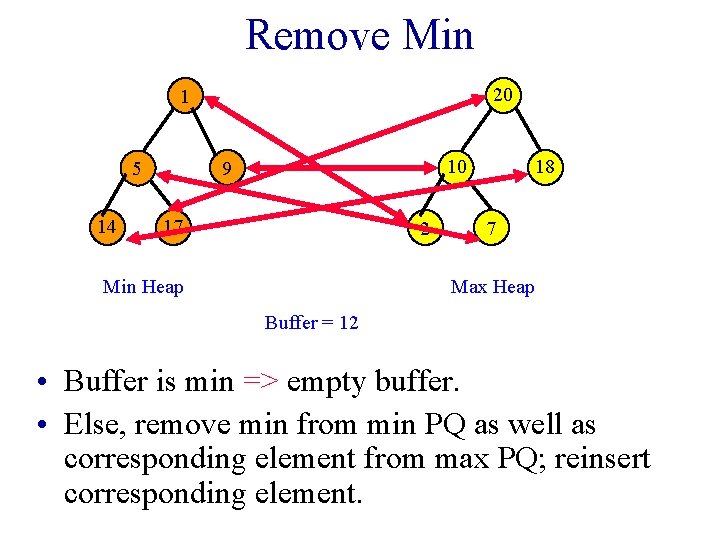
Remove Min 20 1 14 10 9 5 17 2 Min Heap 18 7 Max Heap Buffer = 12 • Buffer is min => empty buffer. • Else, remove min from min PQ as well as corresponding element from max PQ; reinsert corresponding element.
Leaf Correspondence • Min- and max-priority queues may have different size. • Each leaf element of the min priority queue is paired with a different and >= element in the max priority queue. • Each leaf element of the max priority queue is paired with a different and <= element in the min priority queue.
Added Restrictions • When an element is inserted into a single-ended PQ, only the newly inserted element can become a new leaf. • When an element is deleted from a single-ended PQ, only the parent of the deleted element can become a new leaf. • Min and max heaps do not satisfy these restrictions. So, leaf correspondence is harder to implement using min and max heaps.
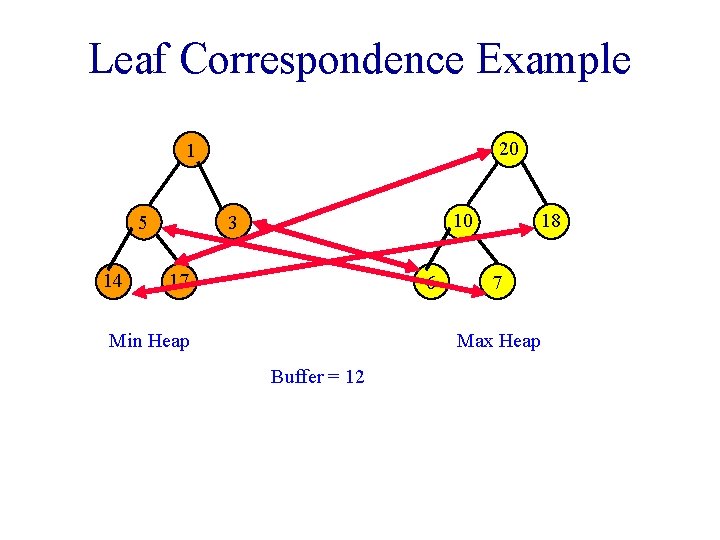
Leaf Correspondence Example 20 1 14 10 3 5 17 6 Min Heap 18 7 Max Heap Buffer = 12
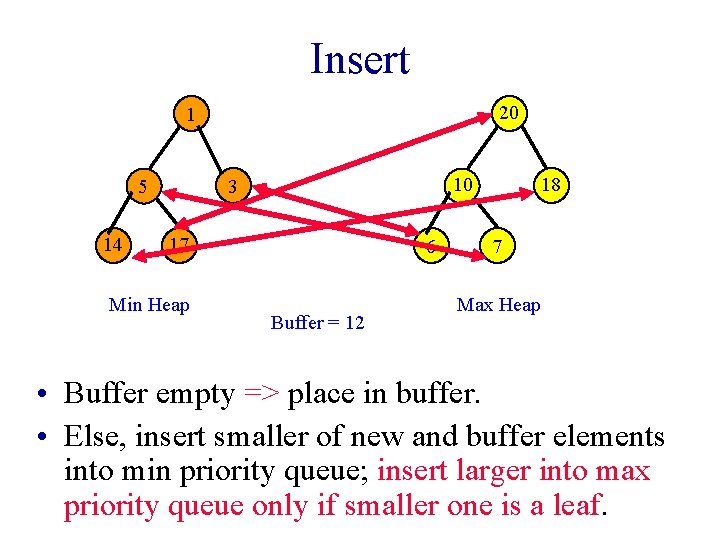
Insert 20 1 14 10 3 5 17 Min Heap 6 Buffer = 12 18 7 Max Heap • Buffer empty => place in buffer. • Else, insert smaller of new and buffer elements into min priority queue; insert larger into max priority queue only if smaller one is a leaf.
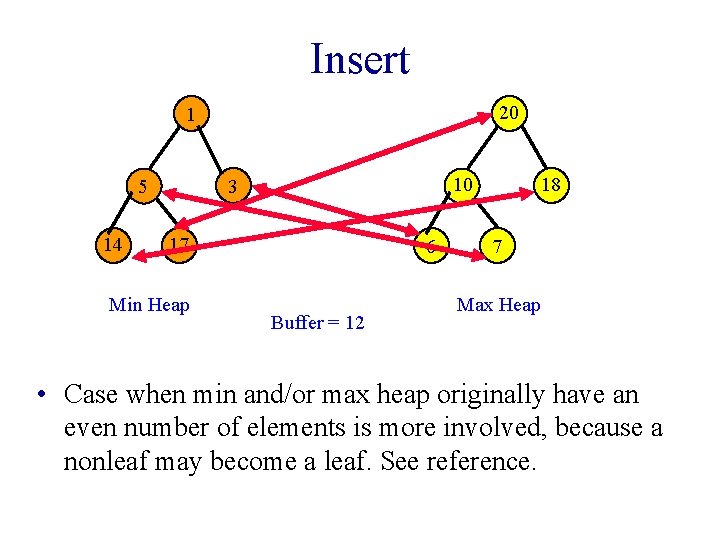
Insert 20 1 14 10 3 5 17 Min Heap 6 Buffer = 12 18 7 Max Heap • Case when min and/or max heap originally have an even number of elements is more involved, because a nonleaf may become a leaf. See reference.
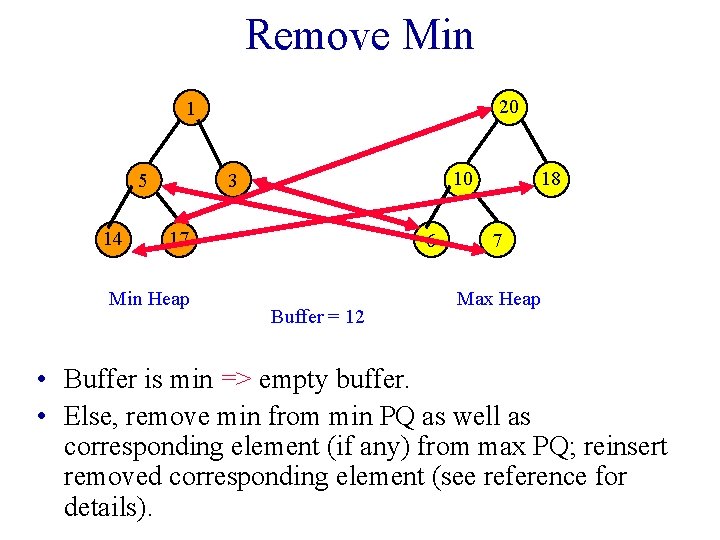
Remove Min 20 1 14 10 3 5 17 Min Heap 6 Buffer = 12 18 7 Max Heap • Buffer is min => empty buffer. • Else, remove min from min PQ as well as corresponding element (if any) from max PQ; reinsert removed corresponding element (see reference for details).
- Slides: 16