
Double Tap on this icon By Sharmistha Mira
Double Tap on this icon By Sharmistha Mira (Faculty, Dept. of Psychology) H. M. M. College for Women Sharmistha Mitra
Definition Health psychology is the branch of applied psychology that is concerned with examining psychological influences on physical health. There a number of aspects to this relationship between psychological considerations and physical health. Double Tap on this icon Health psychology is the aggregate of the specific educational, scientific, and professional contributions of the discipline of psychology to the promotion and maintenance of health, the prevention and treatment of illness, the identification of etiologic and diagnostic correlates of health, illness, and related dysfunction, and the analysis and improvement of the health care system and health policy formation. (Matarazzo, 1980) Sharmistha Mitra

Biomedical Models The biomedical model is theoretical framework that guided medical advances leading to the ability to conquer a number of life-threatening diseases. � � The biomedical model is based on the idea that illness can be completely explained by examining problems in an organism’s biological functioning. � This approach leads us to focus on lower level biological processes (e. g. , cell functioning, biochemical imbalances) rather than to examine health in a broader context that also includes psychological functioning and social influences. (Taylor, 2003). Sharmistha Mitra
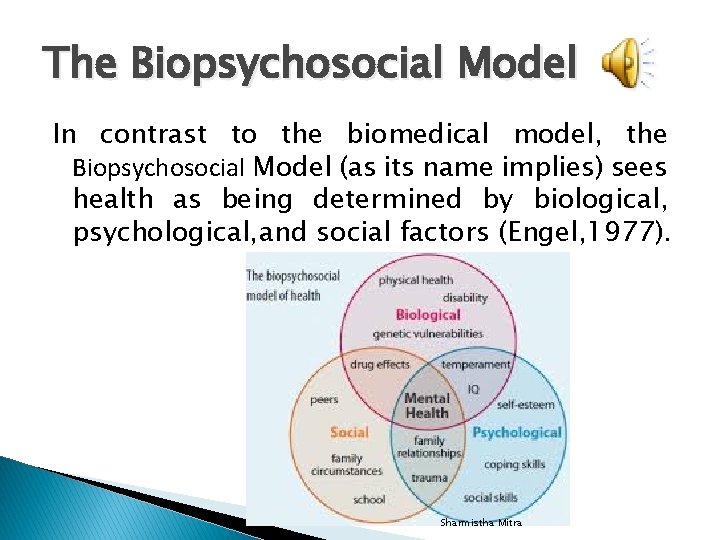
The Biopsychosocial Model In contrast to the biomedical model, the Biopsychosocial Model (as its name implies) sees health as being determined by biological, psychological, and social factors (Engel, 1977). Sharmistha Mitra
Promoting Health promotion refers simply to efforts thatare made to encourage people to engage in healthy behaviors such as eating a healthy and balanced diet, exercising regularly, getting enough rest, and refraining from Smoking and abusing alcohol. Health promotion is a philosophy that guides action to achieve good health. The actions undertaken to achieve optimal health and well-being occur at multiple levels, including the efforts of individuals, medical practitioners, psychologists, community and government health policy makers, and the mass media (Taylor, 2003). Sharmistha Mitra
Preventing Illness Prevention typically refers to more targeted efforts to reduce the probability of getting an illness in the first place or to reduce the severity of an illness or disorder once it does occur. Sharmistha Mitra
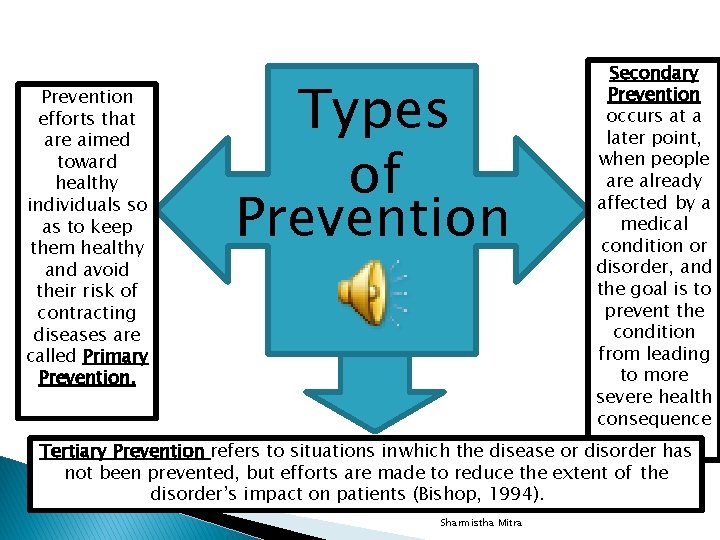
Secondary Prevention occurs at a efforts that later point, are aimed when people toward are already healthy affected by a individuals so medical as to keep condition or them healthy disorder, and avoid the goal is to their risk of prevent the contracting condition diseases are from leading called Primary to more Prevention. severe health consequence s Tertiary Prevention refers to situations in which the disease or disorder has not been prevented, but efforts are made to reduce the extent of the disorder’s impact on patients (Bishop, 1994). Types of Prevention Sharmistha Mitra
Stress and Coping � Stress- Lazarus and Folkman (1984) defined stress as “a particular relationship between the person and the environment that is appraised by the person as taxing or exceeding his or her resources and endangering his or her well-being” Sharmistha Mitra
� Coping – Psychological Coping (or coping strategies) refers to the behavioural and cognitive efforts made by individuals in attempting to deal with stressful situations. Coping refers to thoughts, feelings, andbehaviors that people engage in when trying to reduce stress. Consistent withthe idea that the experience of stress is an individual phenomenon, so too is the way inwhich people cope with particular stressors. Sharmistha Mitra
Coping strategies can be classified into two general types: � Problem-focused coping, people deal directly with the problem that has caused them to be stressed. � Emotion-focused coping involvespeople trying to regulate their emotions so that they can minimize the distress caused by the situation. Sharmistha Mitra

Transactional Model Of Stress � Lazarus and Folkman’s definition reflects their approach, which is referred to as a transactional model of stress. � Thebasic idea of their modelis that the experience of stress results from ongoing transactions between people and the environment. Stressor Appraisal Coping Health Outcome Sharmistha Mitra
� During the course of these transactions, people will encounter particular situations, events, or other people that may or may not induce the feeling of stress. These are referred to as stressors. � Based on their encounters with these potentially stressful events, people make an appraisal, that is, a judgment as to how to respond to the stressors. Do they perceive the stressors as threats (e. g. , something potentially harmful) or as challenges (e. g. , an obstacle to beovercome)? Do they feel stress as a result of their encounter with the stressors? Sharmistha Mitra

Sharmistha Mitra
- Slides: 13