
Double standards and approaches for globalizing food campaigns
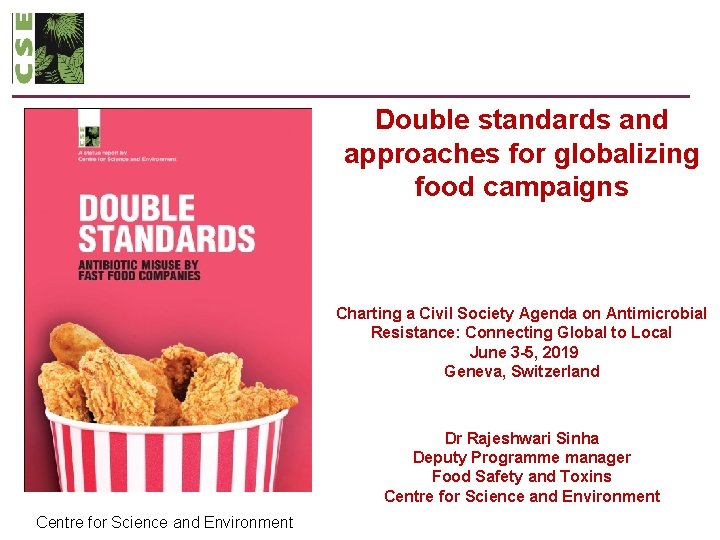
Double standards and approaches for globalizing food campaigns Charting a Civil Society Agenda on Antimicrobial Resistance: Connecting Global to Local June 3 -5, 2019 Geneva, Switzerland Dr Rajeshwari Sinha Deputy Programme manager Food Safety and Toxins Centre for Science and Environment

Centre for Science and Environment, New Delhi, India • The Centre for Science and Environment (CSE) is a public interest research and advocacy organisation based in New Delhi. • It researches into, lobbies for and communicates the urgency of sustainable and equitable development • CSE has helped shape policies and build public awareness to bring change for over three decades; is recognized for its role in capacitating public institutions and regulatory agencies • CSE rated as one of the top global environment policy think tanks – As per the Global Go To Think Tank Index 2017 , CSE has been ranked 1 st in India and 16 th globally among environment policy think tanks CSE plays an important role as a southern think tank that articulates the perspectives and policies of the global south Centre for Science and Environment
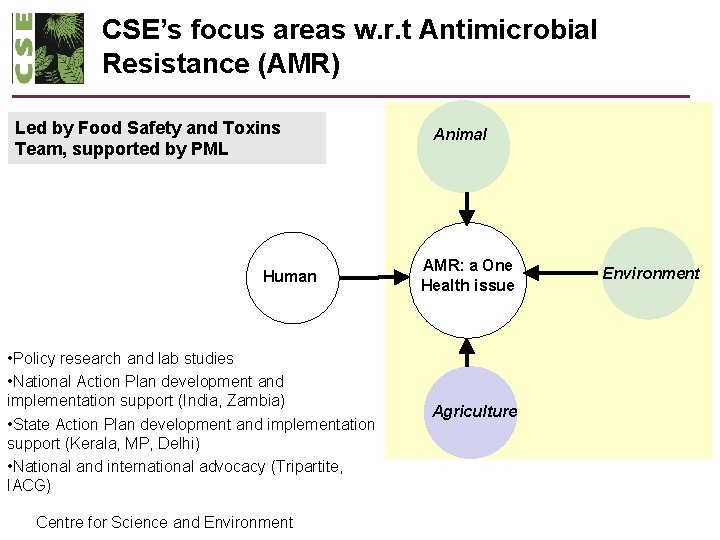
CSE’s focus areas w. r. t Antimicrobial Resistance (AMR) Led by Food Safety and Toxins Team, supported by PML Human • Policy research and lab studies • National Action Plan development and implementation support (India, Zambia) • State Action Plan development and implementation support (Kerala, MP, Delhi) • National and international advocacy (Tripartite, IACG) Centre for Science and Environment Animal AMR: a One Health issue Agriculture Environment
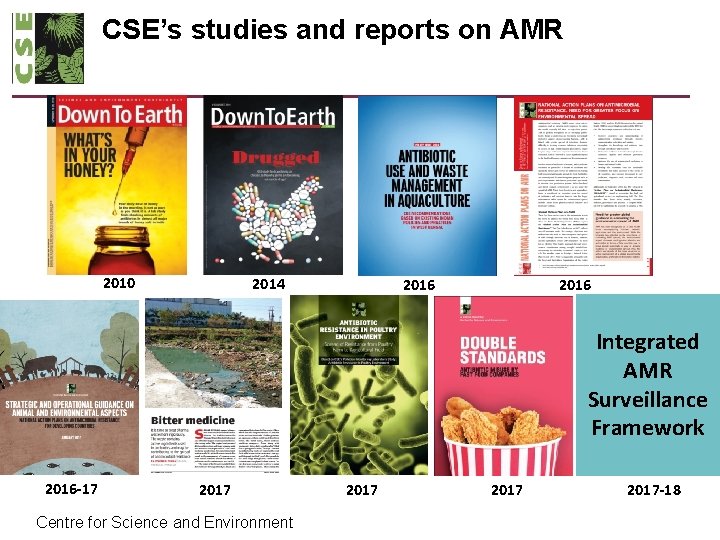
CSE’s studies and reports on AMR 2010 2014 2016 Integrated AMR Surveillance Framework 2016 -17 2017 Centre for Science and Environment 2017 -18
Several global campaigns as part of developed world • Fast food industry, typically sources meat from such intensive farms • Fast food industry, therefore is likely a big contributor to rising AMR • Growing pressure from regulators, consumers, investors on these fast food multinationals has led them to own up the problem – Industry seems to be acting responsibly in developed parts of the world – Several big chains stepped up their antibiotics policies in chicken; announced their commitments to stop use of medically important antibiotics in its poultry meat supply chain – Meaningful impact on industry practices • Mc. Donald’s policy for antibiotics in broiler chicken (2017) and in beef (2018) Status in India? In the backdrop of rising AMR and growing fast food industry which is fuelling greater consumption and production of chicken Centre for Science and Environment
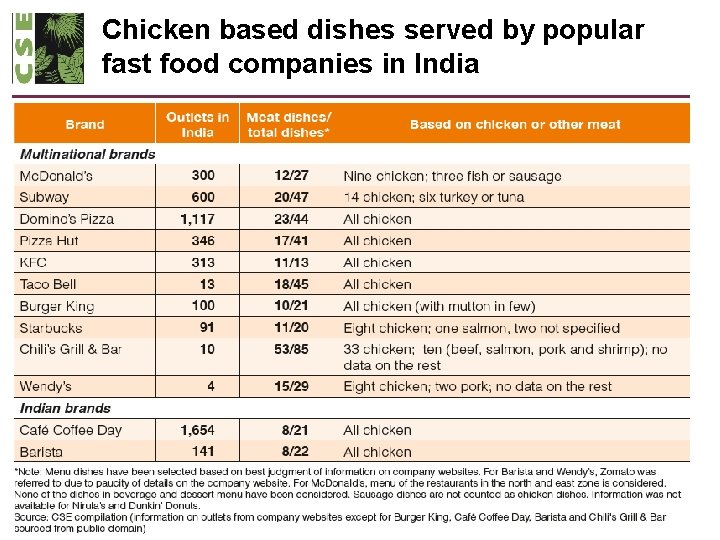
Chicken based dishes served by popular fast food companies in India Centre for Science and Environment
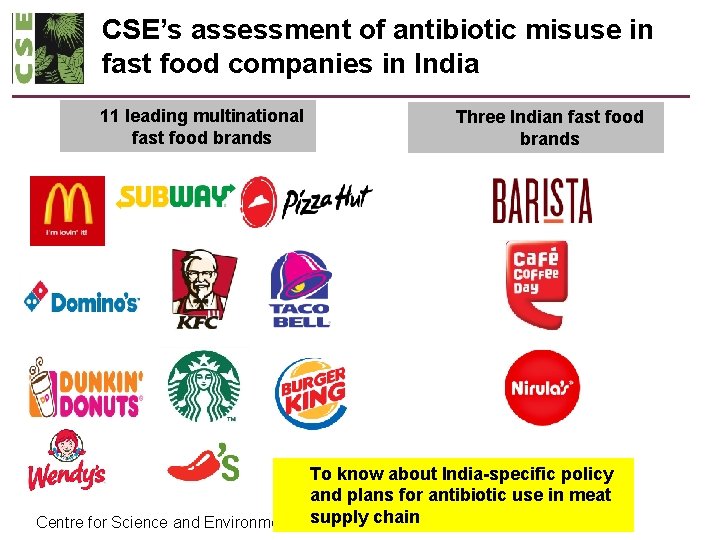
CSE’s assessment of antibiotic misuse in fast food companies in India 11 leading multinational fast food brands Three Indian fast food brands To know about India-specific policy and plans for antibiotic use in meat Centre for Science and Environment supply chain
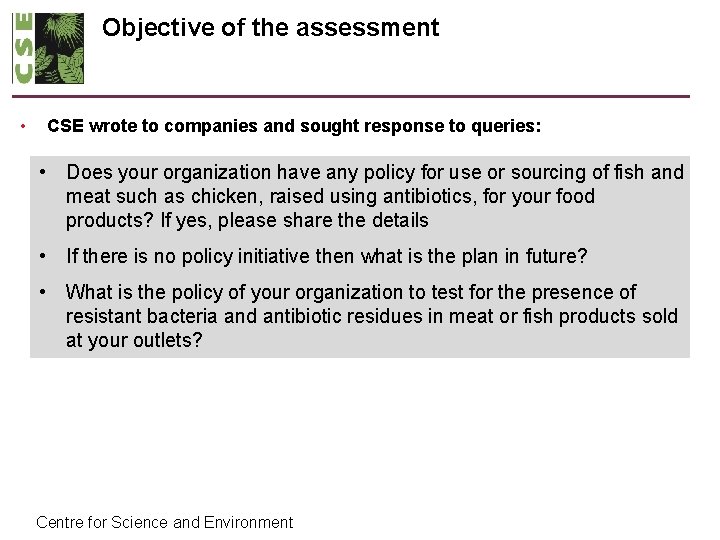
Objective of the assessment • CSE wrote to companies and sought response to queries: • Does your organization have any policy for use or sourcing of fish and meat such as chicken, raised using antibiotics, for your food products? If yes, please share the details • If there is no policy initiative then what is the plan in future? • What is the policy of your organization to test for the presence of resistant bacteria and antibiotic residues in meat or fish products sold at your outlets? Centre for Science and Environment
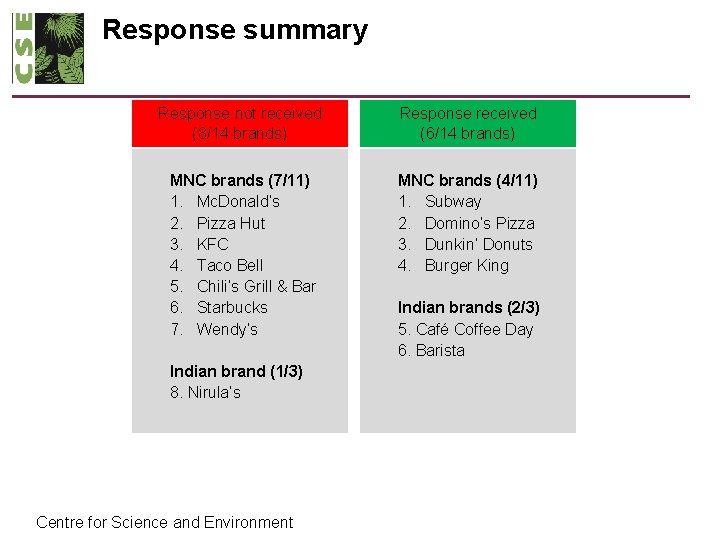
Response summary Response not received (8/14 brands) Response received (6/14 brands) MNC brands (7/11) 1. Mc. Donald’s 2. Pizza Hut 3. KFC 4. Taco Bell 5. Chili’s Grill & Bar 6. Starbucks 7. Wendy’s MNC brands (4/11) 1. Subway 2. Domino’s Pizza 3. Dunkin’ Donuts 4. Burger King Indian brand (1/3) 8. Nirula’s Centre for Science and Environment Indian brands (2/3) 5. Café Coffee Day 6. Barista
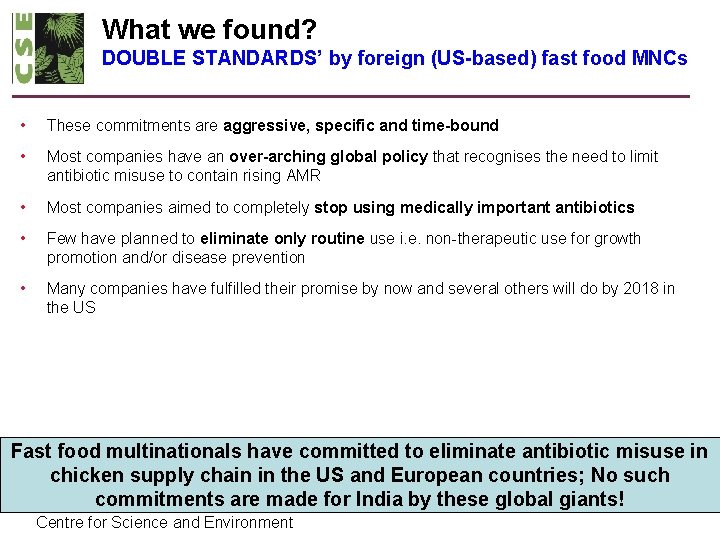
What we found? DOUBLE STANDARDS’ by foreign (US-based) fast food MNCs • These commitments are aggressive, specific and time-bound • Most companies have an over-arching global policy that recognises the need to limit antibiotic misuse to contain rising AMR • Most companies aimed to completely stop using medically important antibiotics • Few have planned to eliminate only routine use i. e. non-therapeutic use for growth promotion and/or disease prevention • Many companies have fulfilled their promise by now and several others will do by 2018 in the US Fast food multinationals have committed to eliminate antibiotic misuse in chicken supply chain in the US and European countries; No such commitments are made for India by these global giants! Centre for Science and Environment
What we found? Few examples Centre for Science and Environment
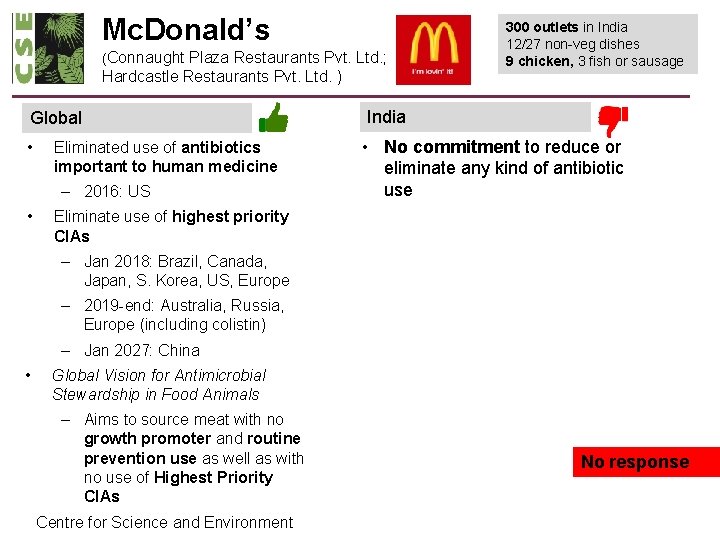
Mc. Donald’s (Connaught Plaza Restaurants Pvt. Ltd. ; Hardcastle Restaurants Pvt. Ltd. ) Global • Eliminated use of antibiotics important to human medicine – 2016: US • 300 outlets in India 12/27 non-veg dishes 9 chicken, 3 fish or sausage India • No commitment to reduce or eliminate any kind of antibiotic use Eliminate use of highest priority CIAs – Jan 2018: Brazil, Canada, Japan, S. Korea, US, Europe – 2019 -end: Australia, Russia, Europe (including colistin) – Jan 2027: China • Global Vision for Antimicrobial Stewardship in Food Animals – Aims to source meat with no growth promoter and routine prevention use as well as with no use of Highest Priority CIAs Centre for Science and Environment No response
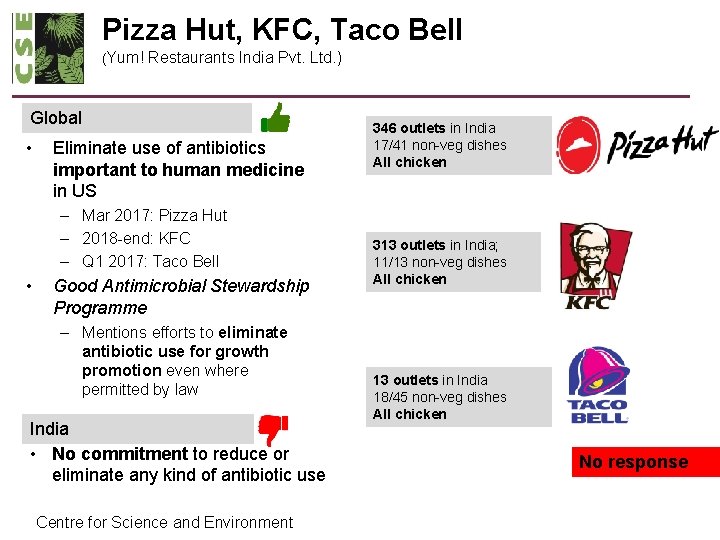
Pizza Hut, KFC, Taco Bell (Yum! Restaurants India Pvt. Ltd. ) Global • Eliminate use of antibiotics important to human medicine in US – Mar 2017: Pizza Hut – 2018 -end: KFC – Q 1 2017: Taco Bell • Good Antimicrobial Stewardship Programme – Mentions efforts to eliminate antibiotic use for growth promotion even where permitted by law India • No commitment to reduce or eliminate any kind of antibiotic use Centre for Science and Environment 346 outlets in India 17/41 non-veg dishes All chicken 313 outlets in India; 11/13 non-veg dishes All chicken 13 outlets in India 18/45 non-veg dishes All chicken No response
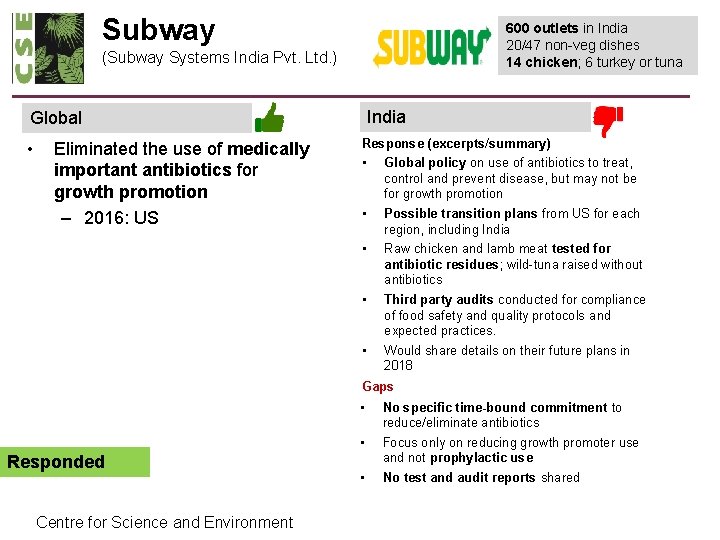
Subway 600 outlets in India 20/47 non-veg dishes 14 chicken; 6 turkey or tuna (Subway Systems India Pvt. Ltd. ) India Global • Eliminated the use of medically important antibiotics for growth promotion – 2016: US Response (excerpts/summary) • Global policy on use of antibiotics to treat, control and prevent disease, but may not be for growth promotion • Possible transition plans from US for each region, including India • Raw chicken and lamb meat tested for antibiotic residues; wild-tuna raised without antibiotics • Third party audits conducted for compliance of food safety and quality protocols and expected practices. • Would share details on their future plans in 2018 Gaps Responded Centre for Science and Environment • No specific time-bound commitment to reduce/eliminate antibiotics • Focus only on reducing growth promoter use and not prophylactic use • No test and audit reports shared
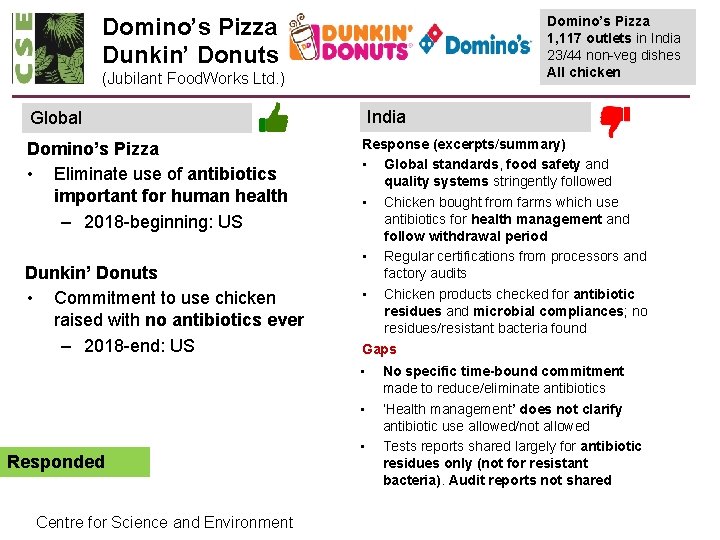
Domino’s Pizza Dunkin’ Donuts Domino’s Pizza 1, 117 outlets in India 23/44 non-veg dishes All chicken (Jubilant Food. Works Ltd. ) India Global Domino’s Pizza • Eliminate use of antibiotics important for human health – 2018 -beginning: US Dunkin’ Donuts • Commitment to use chicken raised with no antibiotics ever – 2018 -end: US Response (excerpts/summary) • Global standards, food safety and quality systems stringently followed • Chicken bought from farms which use antibiotics for health management and follow withdrawal period • Regular certifications from processors and factory audits • Chicken products checked for antibiotic residues and microbial compliances; no residues/resistant bacteria found Gaps • • Responded Centre for Science and Environment • No specific time-bound commitment made to reduce/eliminate antibiotics ‘Health management’ does not clarify antibiotic use allowed/not allowed Tests reports shared largely for antibiotic residues only (not for resistant bacteria). Audit reports not shared
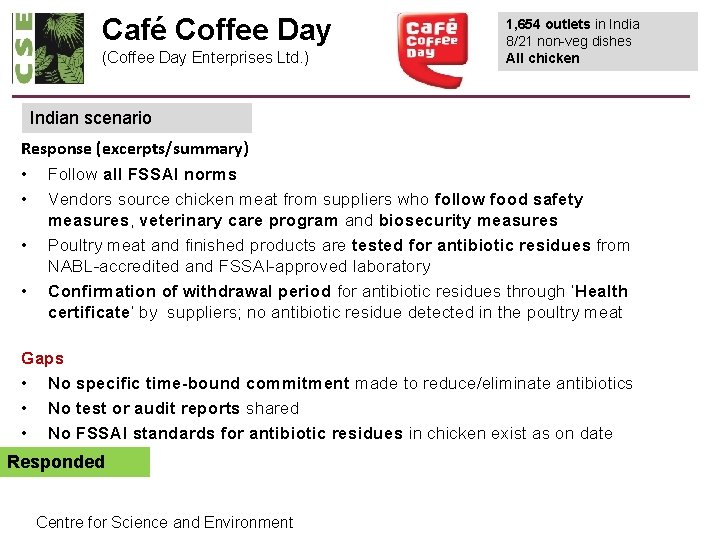
Café Coffee Day (Coffee Day Enterprises Ltd. ) 1, 654 outlets in India 8/21 non-veg dishes All chicken Indian scenario Response (excerpts/summary) • Follow all FSSAI norms • Vendors source chicken meat from suppliers who follow food safety measures, veterinary care program and biosecurity measures • Poultry meat and finished products are tested for antibiotic residues from NABL-accredited and FSSAI-approved laboratory • Confirmation of withdrawal period for antibiotic residues through ‘Health certificate’ by suppliers; no antibiotic residue detected in the poultry meat Gaps • No specific time-bound commitment made to reduce/eliminate antibiotics • No test or audit reports shared • No FSSAI standards for antibiotic residues in chicken exist as on date Responded Centre for Science and Environment
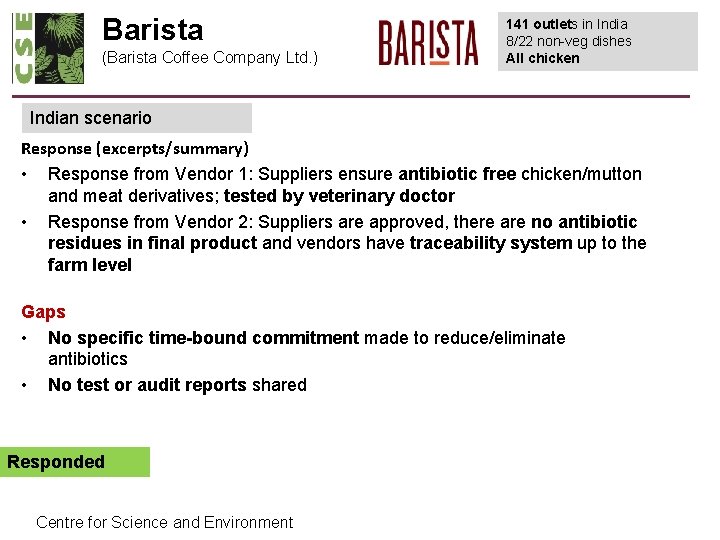
Barista (Barista Coffee Company Ltd. ) 141 outlets in India 8/22 non-veg dishes All chicken Indian scenario Response (excerpts/summary) • Response from Vendor 1: Suppliers ensure antibiotic free chicken/mutton and meat derivatives; tested by veterinary doctor • Response from Vendor 2: Suppliers are approved, there are no antibiotic residues in final product and vendors have traceability system up to the farm level Gaps • No specific time-bound commitment made to reduce/eliminate antibiotics • No test or audit reports shared Responded Centre for Science and Environment
Call for action! • Indian fast food industry is uniquely positioned to effect a substantial reduction in antibiotic use in food-animal production • Besides a social responsibility, there is also strong business case for them to sell food without antibiotic use • Foreign multinational companies know how to do it and must take the lead Centre for Science and Environment
Fast food companies must make aggressive, time-bound India-specific commitments • The commitments must aim to eliminate all non-therapeutic antibiotic use – growth promotion and disease prevention – and clearly indicate timelines • They must also commit to stop any use of critically important antibiotics • The commitments should aim to include products from all food animals (chicken, lamb, fish etc. ) relevant to a company and specify accordingly • Third-party supply chain audits, laboratory testing for antibiotic residues and resistant bacteria and documentation of antibiotic use should be made an integral part of the process • The commitments and reports of audit, compliance and testing should be put up in public domain. Information on AMR and antibiotic use should also feedinto the national-level surveillance databases Centre for Science and Environment
Impact • Jubilant Food. Works’ Limited, managing Domino’s Pizza and Dunkin’ Donuts in India • Policy on usage of antibiotic in poultry birds health management – Phase 1 (2018): Antibiotics not to be used as growth promoters or for group level disease prophylaxis; only for treatment – Phase 2 (2019): Eliminate use of HPCIAs and continuously improve on vaccination programme o prevent the disease – Phase 3 (2020 -2021): Limiting usage of CIA to second line of treatment, working towards reducing/eliminating usage of antibiotics for disease management Centre for Science and Environment
Approaches for globalizing food campaigns • Local context – Analysis of country level scenario: sector(s), food consumption habits, industry presence • Push for awareness – Consumer, industry, policymaker awareness through use of media engagement, reports, advocacy, one-on-one meetings etc. • Consumer and investor pressure • Highlight double standards • Country specific or industry specific interventions • Expand beyond fast food multinationals • Narrative – E. g. , responsible antibiotic use, food safety issue, climate change, animal welfare Centre for Science and Environment
Thank you Amit Khurana Director Food Safety and Toxins Programme Centre for Science and Environment Rajeshwari Sinha Deputy Programme Manager Food Safety and Toxins Programme Centre for Science and Environment Bhavya Khullar Programme Officer Food Safety and Toxins Programme Centre for Science and Environment Divya Khatter Programme Officer Food Safety and Toxins Programme Centre for Science and Environment
- Slides: 22