
Double Replacement Reactions The Basics This type of
Double Replacement Reactions
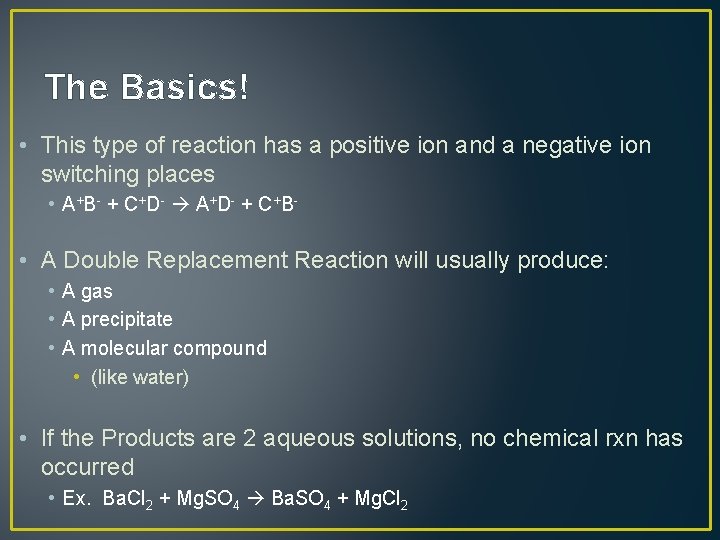
The Basics! • This type of reaction has a positive ion and a negative ion switching places • A + B - + C + D- A + D- + C + B - • A Double Replacement Reaction will usually produce: • A gas • A precipitate • A molecular compound • (like water) • If the Products are 2 aqueous solutions, no chemical rxn has occurred • Ex. Ba. Cl 2 + Mg. SO 4 Ba. SO 4 + Mg. Cl 2
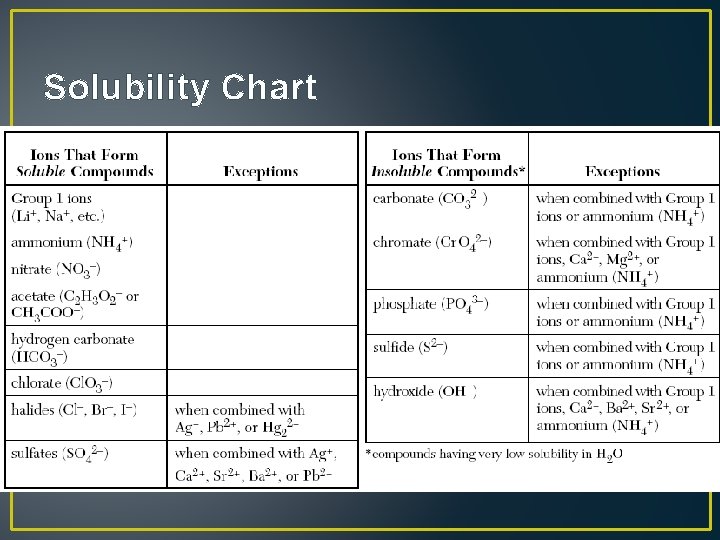
Solubility Chart
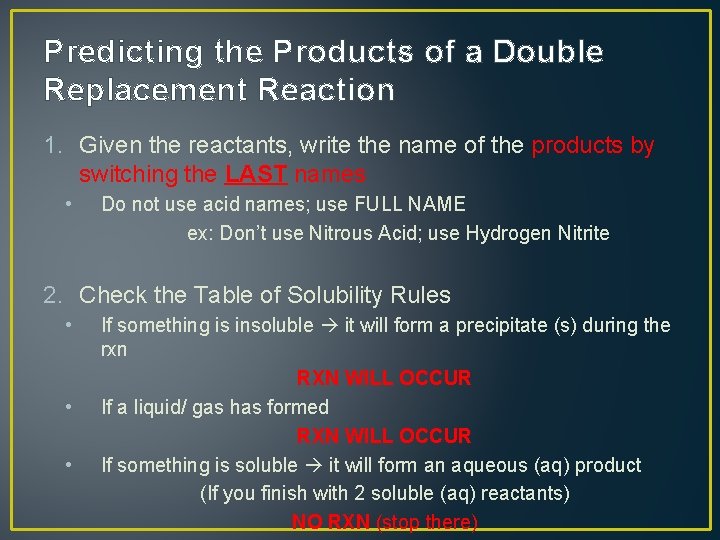
Predicting the Products of a Double Replacement Reaction 1. Given the reactants, write the name of the products by switching the LAST names • Do not use acid names; use FULL NAME ex: Don’t use Nitrous Acid; use Hydrogen Nitrite 2. Check the Table of Solubility Rules • • • If something is insoluble it will form a precipitate (s) during the rxn RXN WILL OCCUR If a liquid/ gas has formed RXN WILL OCCUR If something is soluble it will form an aqueous (aq) product (If you finish with 2 soluble (aq) reactants) NO RXN (stop there)
The Exceptions! • 5 things that may seem soluble, but will actually produce a liquid or a gas a reaction WILL occur • If any of these are a product, there will be a rxn • Hydrogen Carbonate breaks into water and Carbon Dioxide H 2 CO 3 (aq) H 2 O (l) + SO 2 (g) if you make Hydrogen Carbonate, the CO 2 bubbles (gas) produced = rxn • Hydrogen Sulfite breaks into water and Sulfur Dioxide H 2 SO 3 (aq) H 2 O (l) + SO 2 (g) • Ammonium Nitrate breaks into water and Ammonia NH 4 OH (aq) H 2 O (l) + NH 3 (g)
Exceptions (cont. ) • Hydrogen Sulfide - H 2 S • Odor produced (rotten eggs) • Hydrogen Hydroxide – HOH • Water H 2 O (l) (which is a rxn)
- Slides: 6