
DOUBLE OBJECT PRONOUNS Using Direct and Indirect Objects
DOUBLE OBJECT PRONOUNS Using Direct and Indirect Objects together, in the same sentence. Luisa buys it (newspaper) for me.
DOUBLE OBJECT PRONOUNS Using Direct and Indirect Objects together, in the same sentence. Luisa me lo compra. RULE: When D. O. and I. O. ’s are used in the same Spanish sentence, they are placed BEFORE a conjugated verb or ATTACHED to the infinitive. Indirect Objects are placed BEFORE Direct Objects!
DOUBLE OBJECT PRONOUNS Direct Objects and Indirect Objects can be replaced in the same sentence. Try again… Ex. Mateo sends us it (letter). Ex. I buy it (m) for her.
DOUBLE OBJECT PRONOUNS …when both an Indirect AND a Direct Object is used and they both begin with “L”, something magic happens to make it sound better. Ex. I buy it for her. Yo le lo compro. The Indirect Object changes to “se” no matter if it is “le” or “les. ” It does not change meaning, just appearance! The Double “L” Rule! Ex. Yo se lo compro.
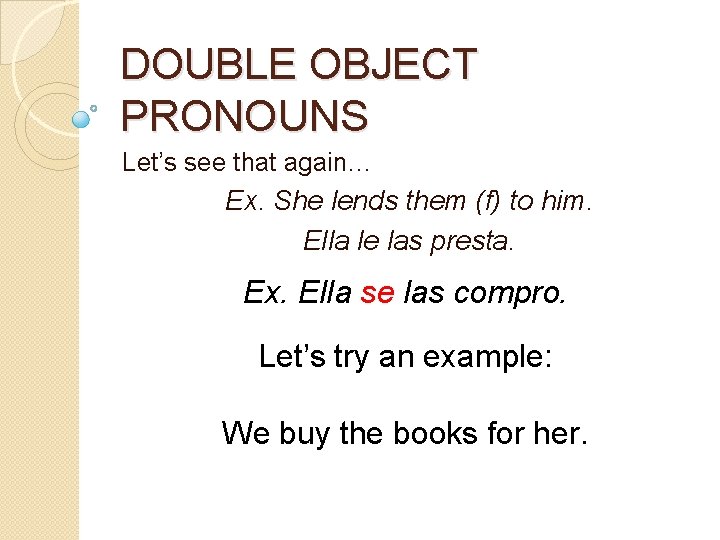
DOUBLE OBJECT PRONOUNS Let’s see that again… Ex. She lends them (f) to him. Ella le las presta. Ex. Ella se las compro. Let’s try an example: We buy the books for her.
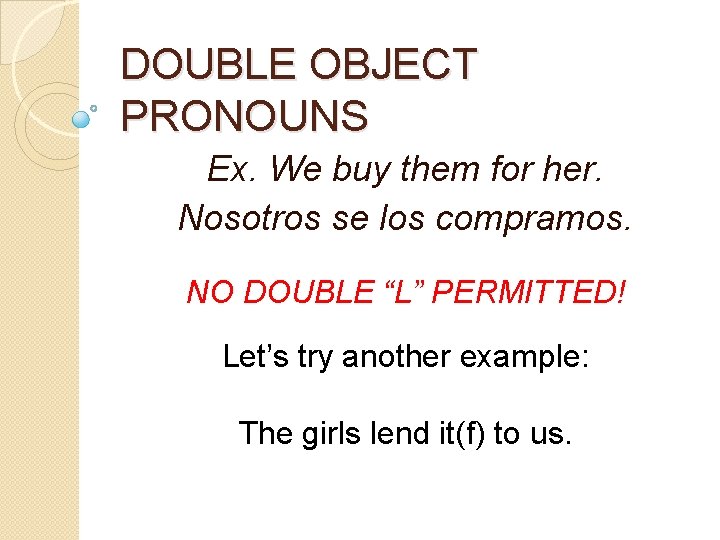
DOUBLE OBJECT PRONOUNS Ex. We buy them for her. Nosotros se los compramos. NO DOUBLE “L” PERMITTED! Let’s try another example: The girls lend it(f) to us.
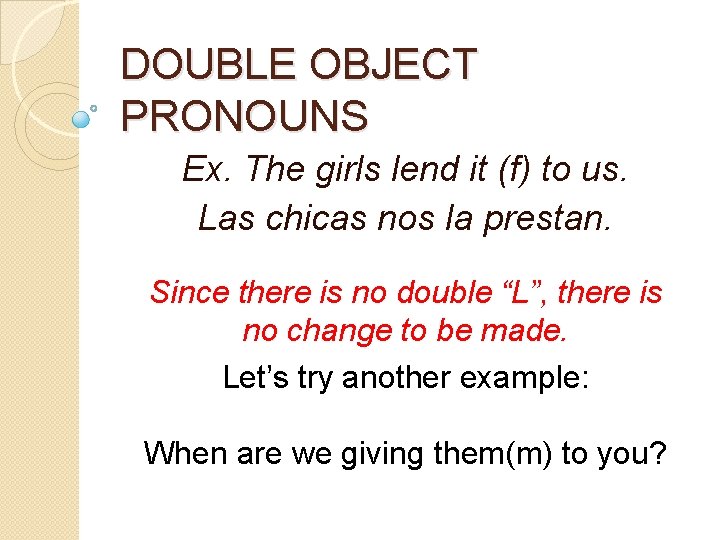
DOUBLE OBJECT PRONOUNS Ex. The girls lend it (f) to us. Las chicas nos la prestan. Since there is no double “L”, there is no change to be made. Let’s try another example: When are we giving them(m) to you?
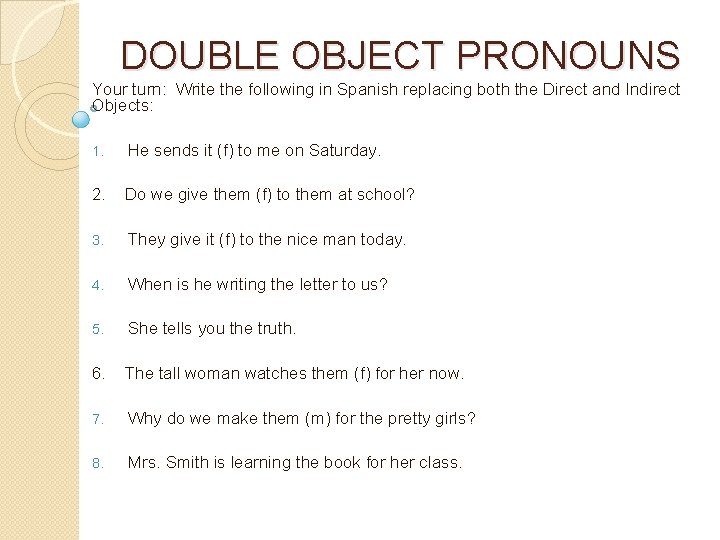
DOUBLE OBJECT PRONOUNS Your turn: Write the following in Spanish replacing both the Direct and Indirect Objects: 1. He sends it (f) to me on Saturday. 2. Do we give them (f) to them at school? 3. They give it (f) to the nice man today. 4. When is he writing the letter to us? 5. She tells you the truth. 6. The tall woman watches them (f) for her now. 7. Why do we make them (m) for the pretty girls? 8. Mrs. Smith is learning the book for her class.
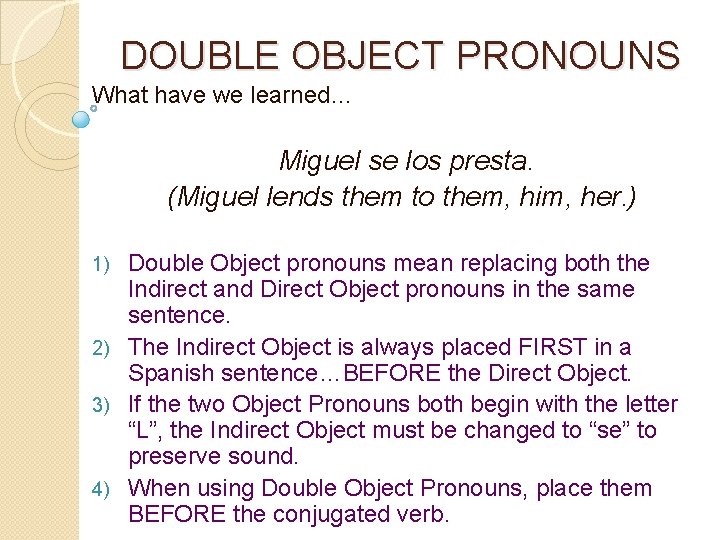
DOUBLE OBJECT PRONOUNS What have we learned… Miguel se los presta. (Miguel lends them to them, him, her. ) Double Object pronouns mean replacing both the Indirect and Direct Object pronouns in the same sentence. 2) The Indirect Object is always placed FIRST in a Spanish sentence…BEFORE the Direct Object. 3) If the two Object Pronouns both begin with the letter “L”, the Indirect Object must be changed to “se” to preserve sound. 4) When using Double Object Pronouns, place them BEFORE the conjugated verb. 1)
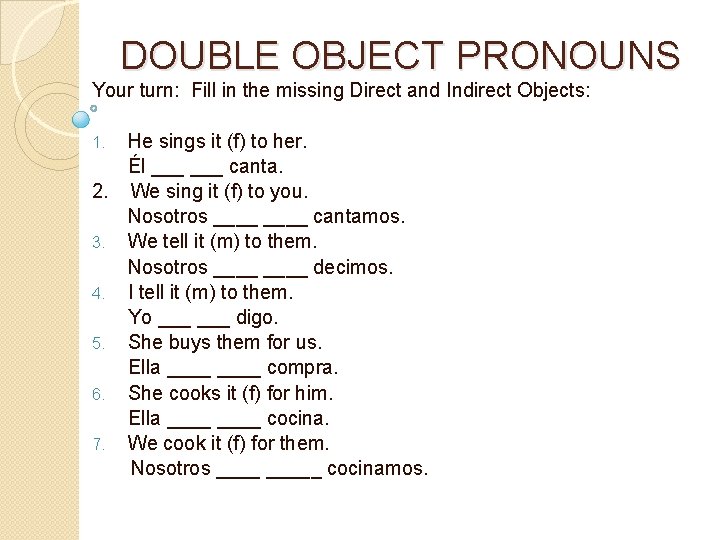
DOUBLE OBJECT PRONOUNS Your turn: Fill in the missing Direct and Indirect Objects: He sings it (f) to her. Él ___ canta. 2. We sing it (f) to you. Nosotros ____ cantamos. 3. We tell it (m) to them. Nosotros ____ decimos. 4. I tell it (m) to them. Yo ___ digo. 5. She buys them for us. Ella ____ compra. 6. She cooks it (f) for him. Ella ____ cocina. 7. We cook it (f) for them. Nosotros _____ cocinamos. 1.
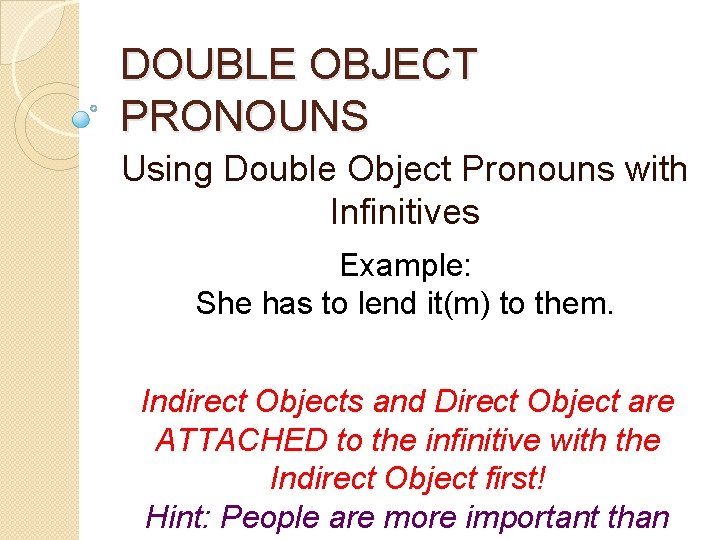
DOUBLE OBJECT PRONOUNS Using Double Object Pronouns with Infinitives Example: She has to lend it(m) to them. Indirect Objects and Direct Object are ATTACHED to the infinitive with the Indirect Object first! Hint: People are more important than
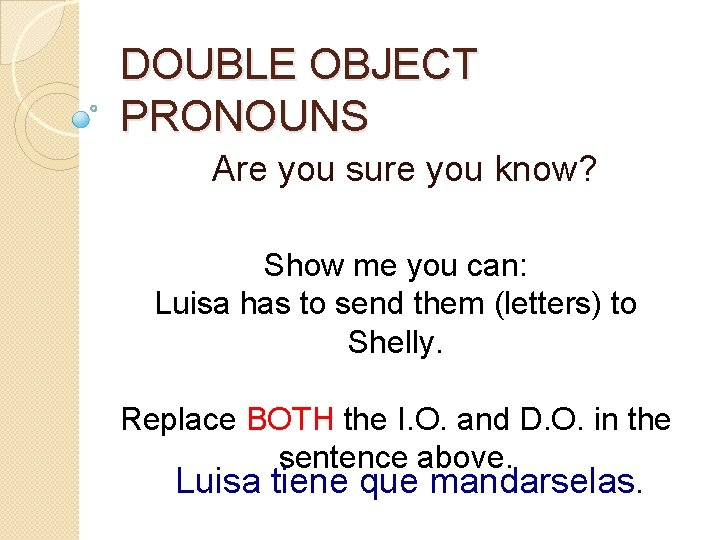
DOUBLE OBJECT PRONOUNS Are you sure you know? Show me you can: Luisa has to send them (letters) to Shelly. Replace BOTH the I. O. and D. O. in the sentence above. Luisa tiene que mandarselas.
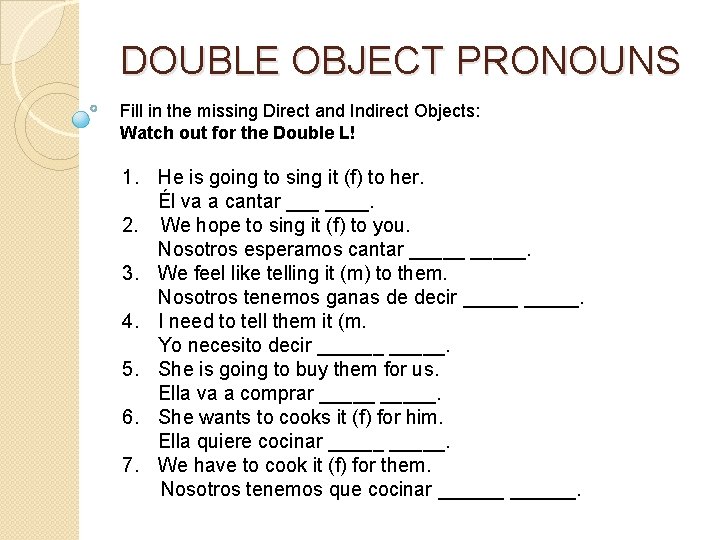
DOUBLE OBJECT PRONOUNS Fill in the missing Direct and Indirect Objects: Watch out for the Double L! 1. He is going to sing it (f) to her. Él va a cantar ____. 2. We hope to sing it (f) to you. Nosotros esperamos cantar _____. 3. We feel like telling it (m) to them. Nosotros tenemos ganas de decir _____. 4. I need to tell them it (m. Yo necesito decir ______. 5. She is going to buy them for us. Ella va a comprar _____. 6. She wants to cooks it (f) for him. Ella quiere cocinar _____. 7. We have to cook it (f) for them. Nosotros tenemos que cocinar ______.
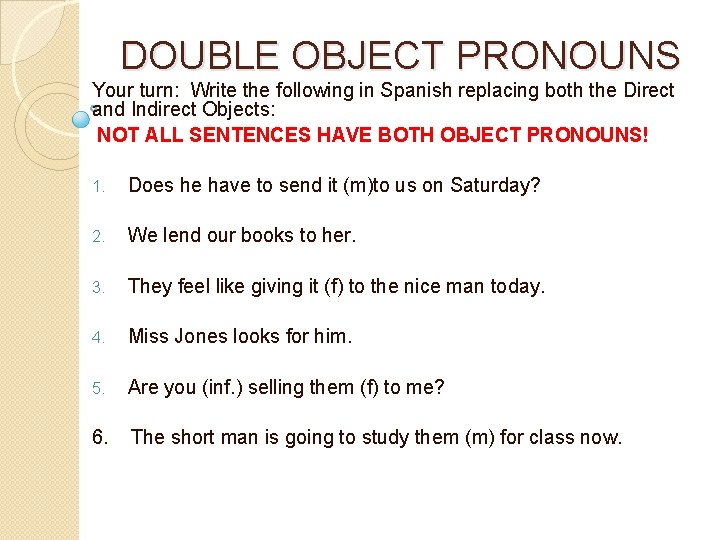
DOUBLE OBJECT PRONOUNS Your turn: Write the following in Spanish replacing both the Direct and Indirect Objects: NOT ALL SENTENCES HAVE BOTH OBJECT PRONOUNS! 1. Does he have to send it (m)to us on Saturday? 2. We lend our books to her. 3. They feel like giving it (f) to the nice man today. 4. Miss Jones looks for him. 5. Are you (inf. ) selling them (f) to me? 6. The short man is going to study them (m) for class now.
- Slides: 14