
Double Entry System DR CR Accounting Equation Assets
Double Entry System DR CR
Accounting Equation
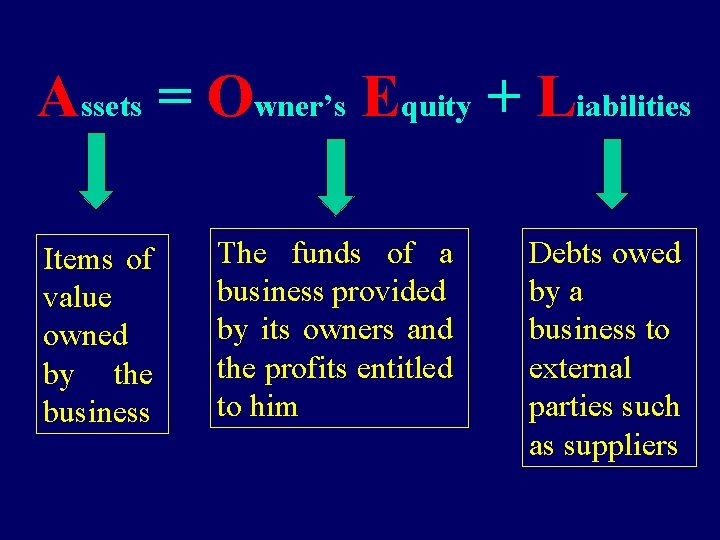
Assets = Owner’s Equity + Liabilities Items of value owned by the business The funds of a business provided by its owners and the profits entitled to him Debts owed by a business to external parties such as suppliers
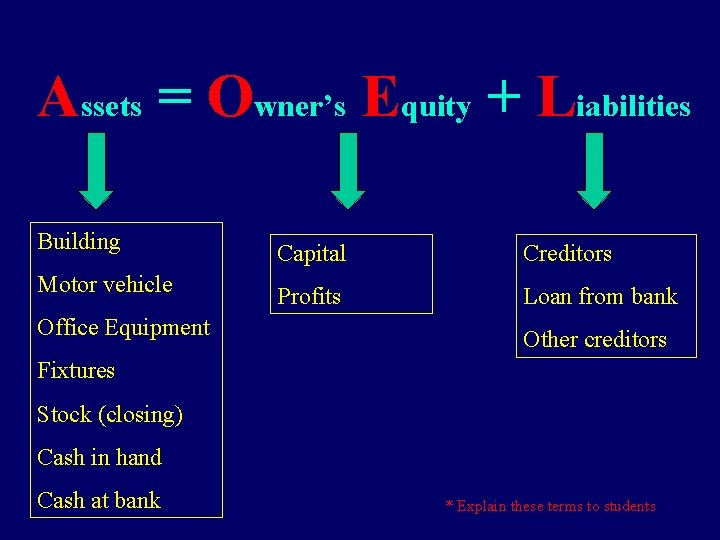
Assets = Owner’s Equity + Liabilities Building Capital Creditors Motor vehicle Profits Loan from bank Office Equipment Other creditors Fixtures Stock (closing) Cash in hand Cash at bank * Explain these terms to students
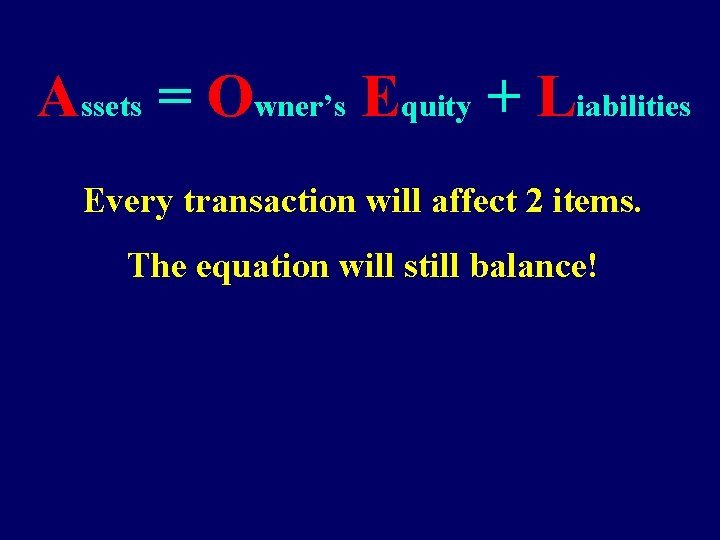
Assets = Owner’s Equity + Liabilities Every transaction will affect 2 items. The equation will still balance!
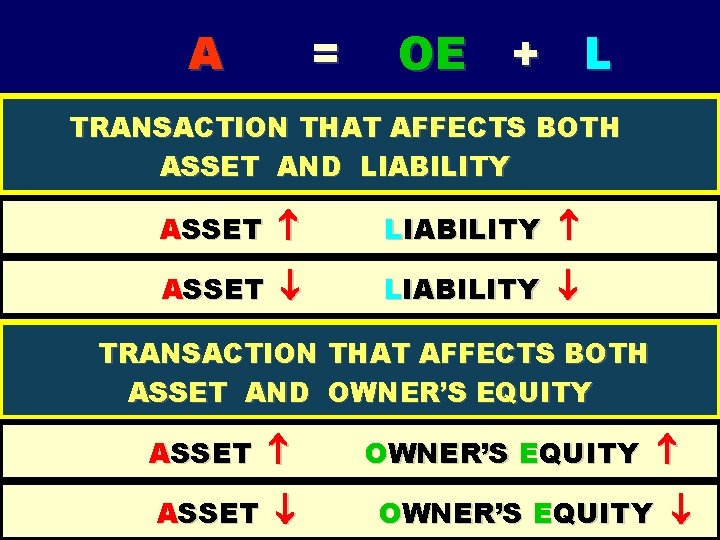
A = OE + L TRANSACTION THAT AFFECTS BOTH ASSET AND LIABILITY ASSET LIABILITY TRANSACTION THAT AFFECTS BOTH ASSET AND OWNER’S EQUITY ASSET OWNER’S EQUITY
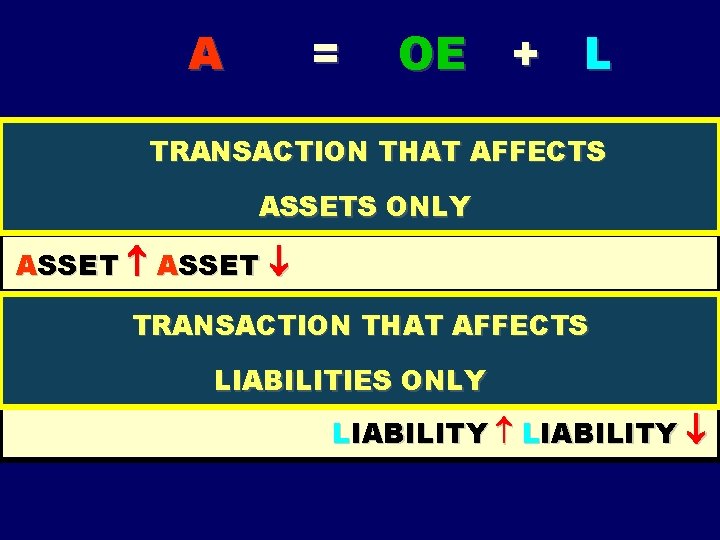
A = OE + L TRANSACTION THAT AFFECTS ASSETS ONLY ASSET TRANSACTION THAT AFFECTS LIABILITIES ONLY LIABILITY
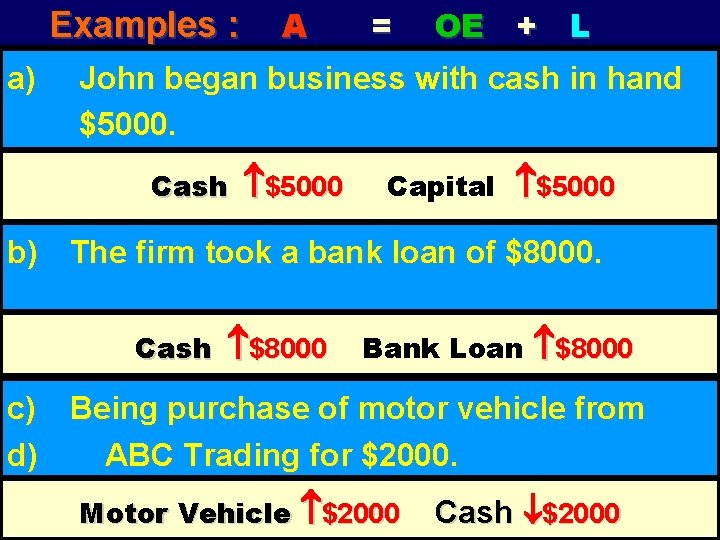
Examples : a) A = OE + L John began business with cash in hand $5000. Cash $5000 Capital $5000 b) The firm took a bank loan of $8000. Cash $8000 Bank Loan $8000 c) Being purchase of motor vehicle from d) ABC Trading for $2000. Motor Vehicle $2000 Cash $2000
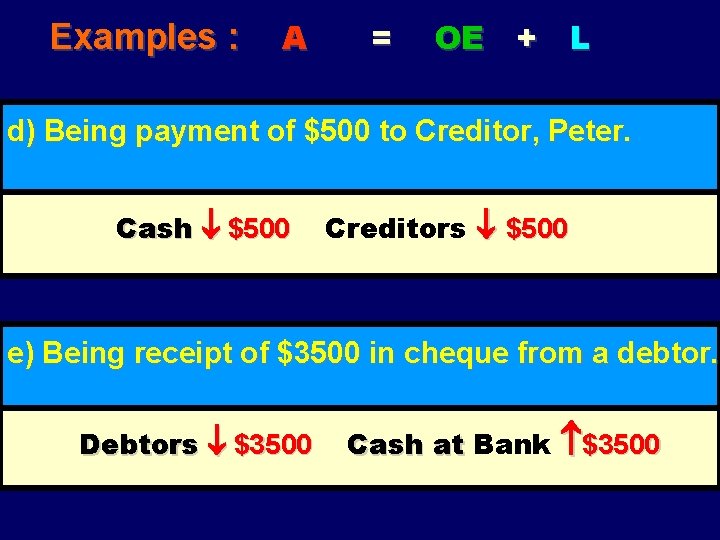
Examples : A = OE + L d) Being payment of $500 to Creditor, Peter. Cash $500 Creditors $500 e) Being receipt of $3500 in cheque from a debtor. Debtors $3500 Cash at Bank $3500
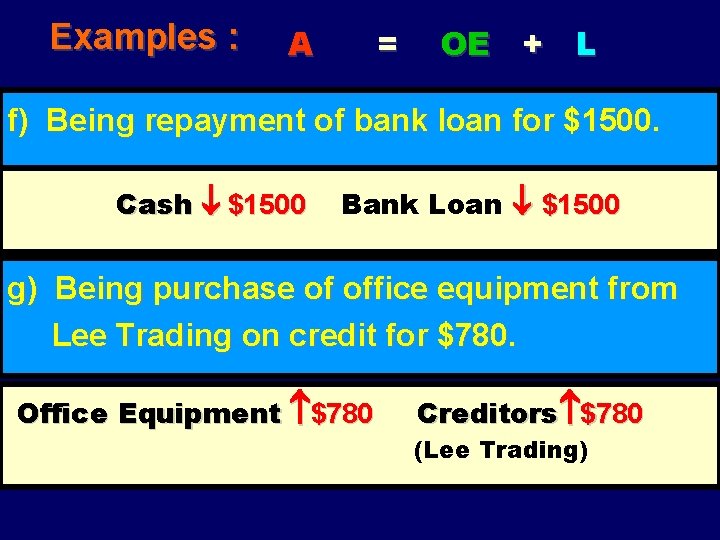
Examples : A = OE + L f) Being repayment of bank loan for $1500. Cash $1500 Bank Loan $1500 g) Being purchase of office equipment from Lee Trading on credit for $780. Office Equipment $780 Creditors $780 (Lee Trading)
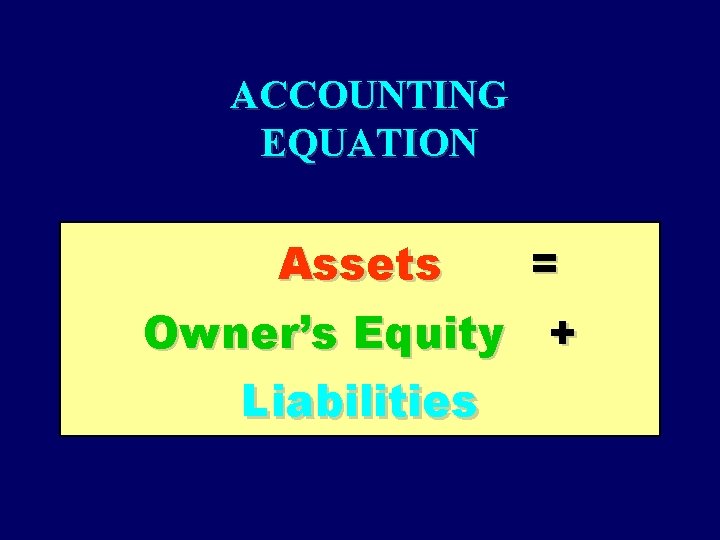
ACCOUNTING EQUATION Assets = Owner’s Equity + Liabilities
What is a Balance Sheet? It is a report that is used to present the Accounting Equation that involves a firm’s total assets, total owner’s equity and total liabilities of an accounting period. It is a report that external parties like investors or bankers look at when making important business decisions. Click me! How does it look like?
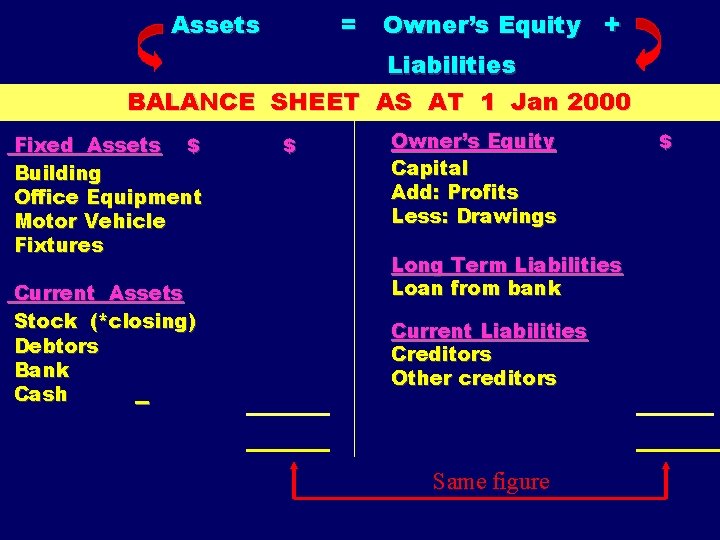
Assets = Owner’s Equity + Liabilities BALANCE SHEET AS AT 1 Jan 2000 Fixed Assets $ Building Office Equipment Motor Vehicle Fixtures Current Assets Stock (*closing) Debtors Bank Cash $ Owner’s Equity Capital Add: Profits Less: Drawings Long Term Liabilities Loan from bank Current Liabilities Creditors Other creditors Same figure $
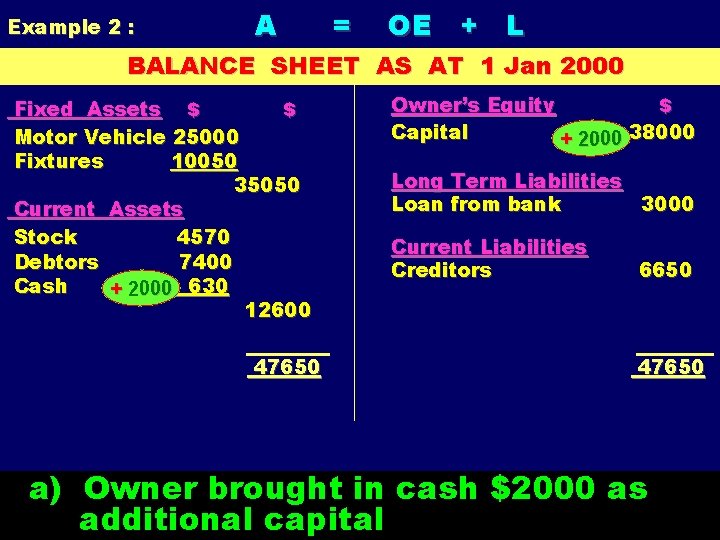
Example 2 : A = OE + L BALANCE SHEET AS AT 1 Jan 2000 Fixed Assets $ $ Motor Vehicle 25000 Fixtures 10050 35050 Current Assets Stock 4570 Debtors 7400 Cash + 2000 630 12600 47650 Owner’s Equity $ Capital + 2000 38000 Long Term Liabilities Loan from bank 3000 Current Liabilities Creditors 6650 47650 a) Owner brought in cash $2000 as additional capital
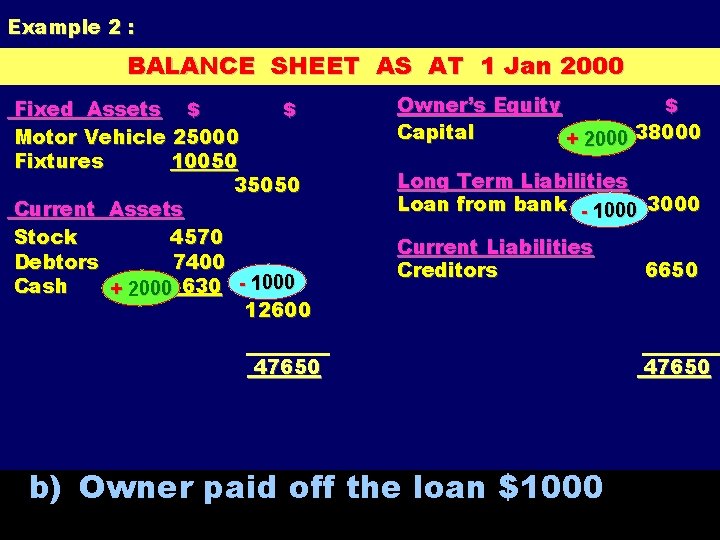
Example 2 : BALANCE SHEET AS AT 1 Jan 2000 Fixed Assets $ $ Motor Vehicle 25000 Fixtures 10050 35050 Current Assets Stock 4570 Debtors 7400 Cash + 2000 630 - 1000 12600 Owner’s Equity $ Capital + 2000 38000 Long Term Liabilities Loan from bank - 1000 3000 Current Liabilities Creditors 47650 b) Owner paid off the loan $1000 6650 47650
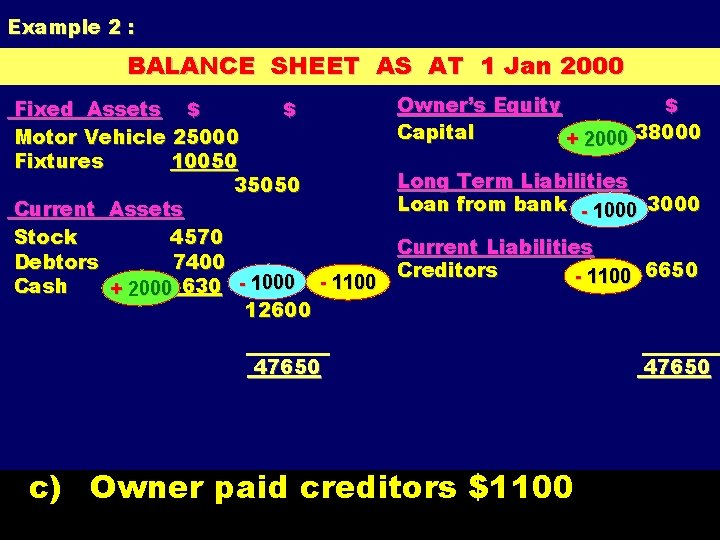
Example 2 : BALANCE SHEET AS AT 1 Jan 2000 Fixed Assets $ $ Motor Vehicle 25000 Fixtures 10050 35050 Current Assets Stock 4570 Debtors 7400 Cash + 2000 630 - 1000 - 1100 12600 Owner’s Equity $ Capital + 2000 38000 Long Term Liabilities Loan from bank - 1000 3000 Current Liabilities Creditors - 1100 6650 47650 c) Owner paid creditors $1100 47650
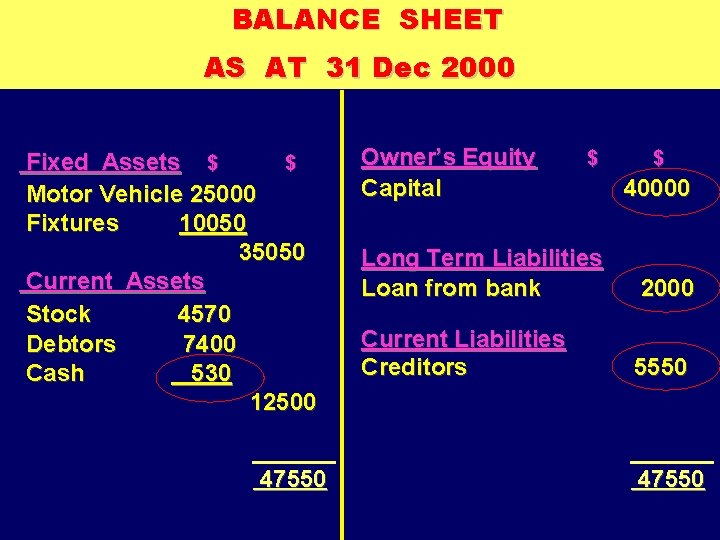
BALANCE SHEET AS AT 31 Dec 2000 Fixed Assets $ $ Motor Vehicle 25000 Fixtures 10050 35050 Current Assets Stock 4570 Debtors 7400 Cash 530 12500 47550 Owner’s Equity Capital $ $ 40000 Long Term Liabilities Loan from bank 2000 Current Liabilities Creditors 5550 47550
IN CLOSING…
- Slides: 18