
Double Cropped Field Peas for Swine Rations in
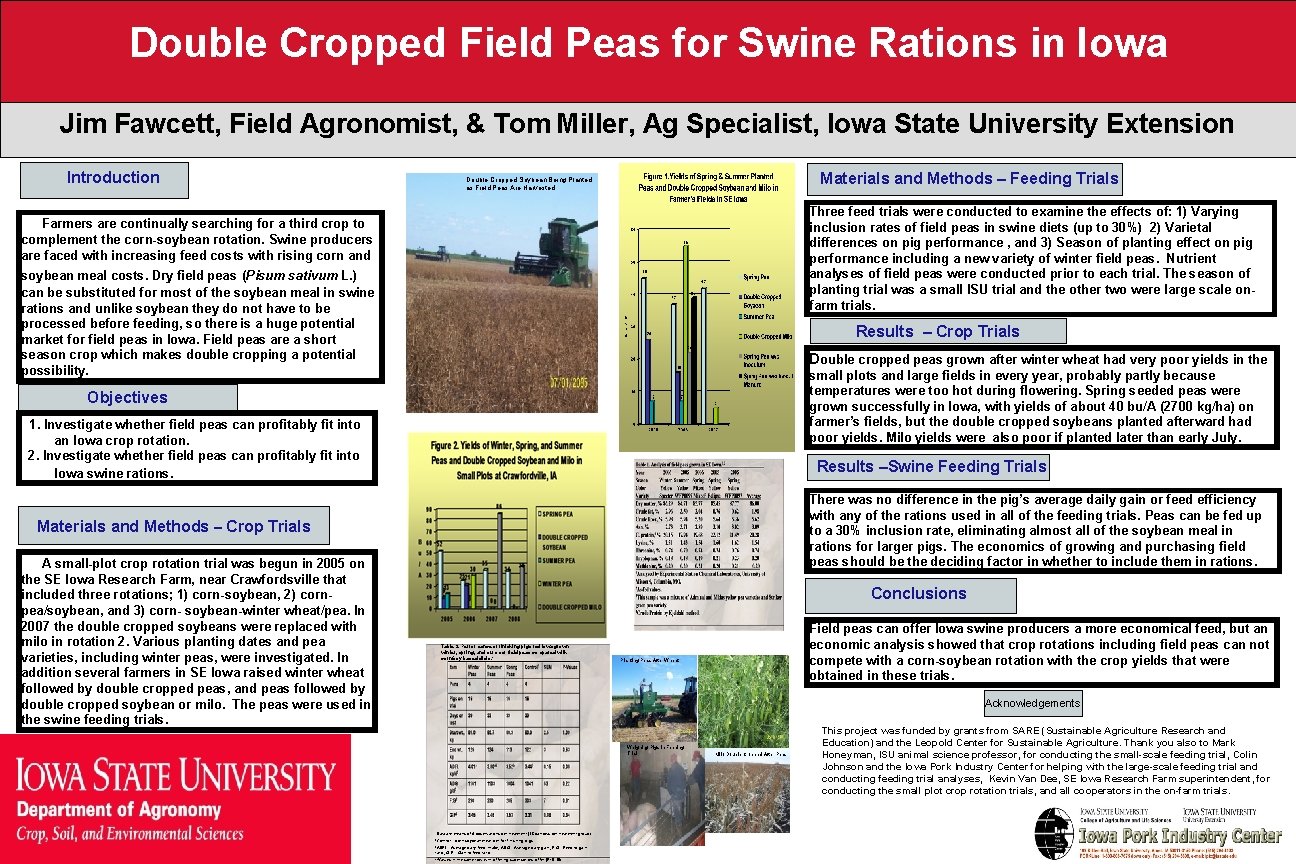
Double Cropped Field Peas for Swine Rations in Iowa Jim Fawcett, Field Agronomist, & Tom Miller, Ag Specialist, Iowa State University Extension Introduction Materials and Methods – Feeding Trials Double Cropped Soybean Being Planted as Field Peas Are Harvested Three feed trials were conducted to examine the effects of: 1) Varying inclusion rates of field peas in swine diets (up to 30%) 2) Varietal differences on pig performance , and 3) Season of planting effect on pig performance including a new variety of winter field peas. Nutrient analyses of field peas were conducted prior to each trial. The season of planting trial was a small ISU trial and the other two were large scale onfarm trials. Farmers are continually searching for a third crop to complement the corn-soybean rotation. Swine producers are faced with increasing feed costs with rising corn and soybean meal costs. Dry field peas (Pisum sativum L. ) can be substituted for most of the soybean meal in swine rations and unlike soybean they do not have to be processed before feeding, so there is a huge potential market for field peas in Iowa. Field peas are a short season crop which makes double cropping a potential possibility. Results – Crop Trials Double cropped peas grown after winter wheat had very poor yields in the small plots and large fields in every year, probably partly because temperatures were too hot during flowering. Spring seeded peas were grown successfully in Iowa, with yields of about 40 bu/A (2700 kg/ha) on farmer’s fields, but the double cropped soybeans planted afterward had poor yields. Milo yields were also poor if planted later than early July. Objectives 1. Investigate whether field peas can profitably fit into an Iowa crop rotation. 2. Investigate whether field peas can profitably fit into Iowa swine rations. Results –Swine Feeding Trials CHART or PICTURE Materials and Methods – Crop Trials A small-plot crop rotation trial was begun in 2005 on the SE Iowa Research Farm, near Crawfordsville that included three rotations; 1) corn-soybean, 2) cornpea/soybean, and 3) corn- soybean-winter wheat/pea. In 2007 the double cropped soybeans were replaced with milo in rotation 2. Various planting dates and pea varieties, including winter peas, were investigated. In addition several farmers in SE Iowa raised winter wheat followed by double cropped peas, and peas followed by double cropped soybean or milo. The peas were used in the swine feeding trials. There was no difference in the pig’s average daily gain or feed efficiency with any of the rations used in all of the feeding trials. Peas can be fed up to a 30% inclusion rate, eliminating almost all of the soybean meal in rations for larger pigs. The economics of growing and purchasing field peas should be the deciding factor in whether to include them in rations. Conclusions Table 2. Performance of finishing pigs fed Iowa grown winter, spring, and summer field peas compared with corn/soy based diets. 1 Field peas can offer Iowa swine producers a more economical feed, but an economic analysis showed that crop rotations including field peas can not compete with a corn-soybean rotation with the crop yields that were obtained in these trials. Planting Peas After Wheat Acknowledgements Weighing Pigs in Feeding Trial 1 Data are means of 4 observations per treatment (16 barrows per treatment group). 2 Control = corn soybean meal diet for finishing pigs. 3 ADFI = Average daily feed intake; ADG = Average daily gain; F: G = Feed to gain ratio; G: F = Gain to feed ratio ab. Values in the same row with differing superscripts differ (P<0. 10) Milo Double Cropped After Peas This project was funded by grants from SARE (Sustainable Agriculture Research and Education) and the Leopold Center for Sustainable Agriculture. Thank you also to Mark Honeyman, ISU animal science professor, for conducting the small-scale feeding trial, Colin Johnson and the Iowa Pork Industry Center for helping with the large-scale feeding trial and conducting feeding trial analyses, Kevin Van Dee, SE Iowa Research Farm superintendent, for conducting the small plot crop rotation trials, and all cooperators in the on-farm trials.
- Slides: 1