
Double circulation Blood passes through the heart twice
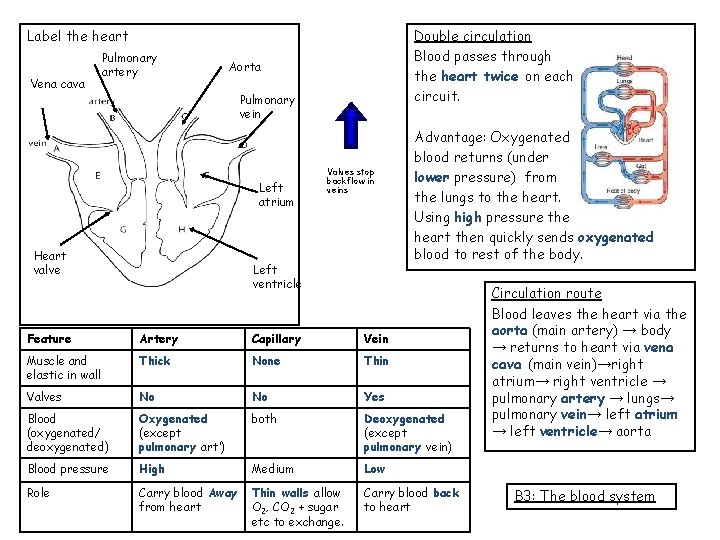
Double circulation Blood passes through the heart twice on each circuit. Label the heart Vena cava Pulmonary artery Aorta Pulmonary vein Left atrium Heart valve Valves stop backflow in veins Left ventricle Advantage: Oxygenated blood returns (under lower pressure) from the lungs to the heart. Using high pressure the heart then quickly sends oxygenated blood to rest of the body. Feature Artery Capillary Vein Muscle and elastic in wall Thick None Thin Valves No No Yes Blood (oxygenated/ deoxygenated) Oxygenated (except pulmonary art’) both Deoxygenated (except pulmonary vein) Blood pressure High Medium Low Role Carry blood Away from heart Thin walls allow O 2, CO 2 + sugar etc to exchange. Carry blood back to heart Circulation route Blood leaves the heart via the aorta (main artery) → body → returns to heart via vena cava (main vein)→right atrium→ right ventricle → pulmonary artery → lungs→ pulmonary vein→ left atrium → left ventricle→ aorta B 3: The blood system

Artificial Blood Products Plasma / saline (salt water): Used in emergencies to replace lost blood volume, helping to keep blood pressure normal. Adv: Can give time for body to make own blood or while awaiting blood transfusion. Disadv: Plasma has a little dissolved oxygen. PFCs Perfluorocarbons (PFC’s) can carry a lot of oxygen. Advantages: As they have no blood cells can get oxygen to swollen/ damaged tissues. Long storage life. No danger of disease. Disadv’: breakdown quickly, side effects, difficult to dissolve in blood. Haemoglobin only (no red blood cells) Haemoglobin taken from human/animal red blood cells or made synthetically or made using GM bacteria. Adv’: Carries more oxygen than normal blood Disadv: it’s broken down quickly inside the body. Stents: A stent is a metal mesh placed in an artery. Inflating the tiny balloon opens the stent and widens the artery. Used to widen coronary arteries of the heart that have narrowed or been blocked by fatty deposits like cholesterol. This increases blood flow to heart muscle helping to prevent heart attacks. Adv’: Can be done with just a local anaesthetic for a low cost. Disadv’: Will not open the most severely blocked arteries. In addition none of the artificial bloods can clot or fight disease. Leaky heart valves Heart valves prevent backflow of blood. Faulty/leaky valves can be replaced, a major operation. Mechanical valves made from polymers or titanium are long lasting, but patients need drugs for rest of lifetime to stop blood clotting. Biological valves use valves from humans, pigs or cattle. Patients do not need drugs after, but they only last about 15 years. B 3: Transport systems – Evaluation topics Artificial heart Adv’: Temporary solution to keep patients alive whilst they wait for a suitable heart donor. Disadv’: Need lots of machinery to keep working, patients with them often have to stay in hospital. Higher risk of blood clotting.
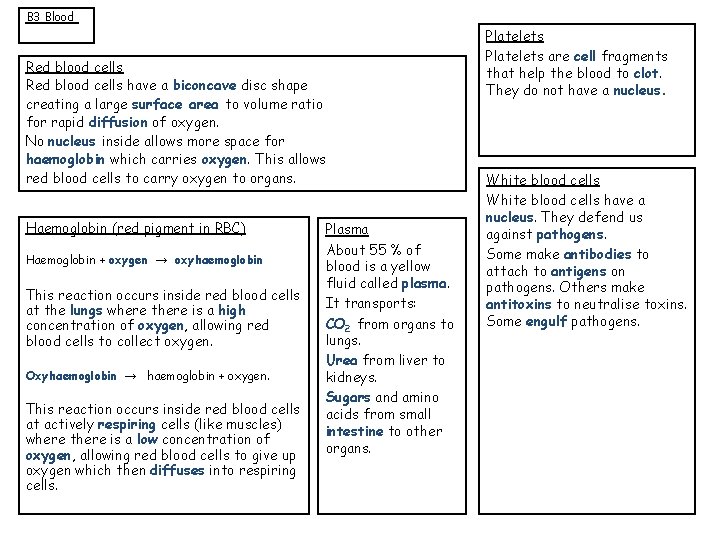
B 3 Blood Red blood cells have a biconcave disc shape creating a large surface area to volume ratio for rapid diffusion of oxygen. No nucleus inside allows more space for haemoglobin which carries oxygen. This allows red blood cells to carry oxygen to organs. Haemoglobin (red pigment in RBC) Haemoglobin + oxygen → oxyhaemoglobin This reaction occurs inside red blood cells at the lungs where there is a high concentration of oxygen, allowing red blood cells to collect oxygen. Oxyhaemoglobin → haemoglobin + oxygen. This reaction occurs inside red blood cells at actively respiring cells (like muscles) where there is a low concentration of oxygen, allowing red blood cells to give up oxygen which then diffuses into respiring cells. Plasma About 55 % of blood is a yellow fluid called plasma. It transports: CO 2 from organs to lungs. Urea from liver to kidneys. Sugars and amino acids from small intestine to other organs. Platelets are cell fragments that help the blood to clot. They do not have a nucleus. White blood cells have a nucleus. They defend us against pathogens. Some make antibodies to attach to antigens on pathogens. Others make antitoxins to neutralise toxins. Some engulf pathogens.
- Slides: 3