
DOSIMETRY SYSTEMS METHODS APPLICATION SELECTION CRITERIA Andrs Kovcs


- Slides: 31
DOSIMETRY SYSTEMS, METHODS, APPLICATION, SELECTION CRITERIA András Kovács Center for Energy Research Hungarian Academy of Sciences Budapest, Hungary
BACKGROUND • In radiation processing, validation and process control (sterilization, food irradiation, etc. ) depend on the measurement of absorbed dose. • Measurements of absorbed dose shall be performed using a dosimetric system or systems having a known level of accuracy and precision. • The calibration of each dosimetric system shall be traceable to an appropriate national standard. • (E 2628 – 09 to be putted on the References section)
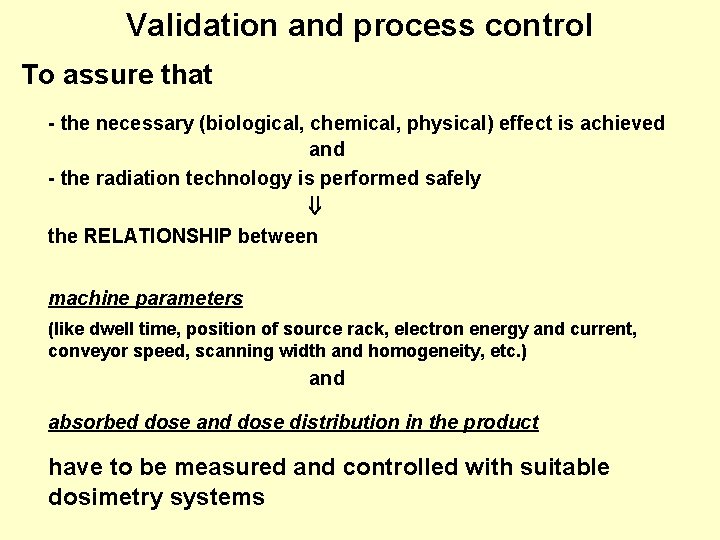
Validation and process control To assure that - the necessary (biological, chemical, physical) effect is achieved and - the radiation technology is performed safely the RELATIONSHIP between machine parameters (like dwell time, position of source rack, electron energy and current, conveyor speed, scanning width and homogeneity, etc. ) and absorbed dose and dose distribution in the product have to be measured and controlled with suitable dosimetry systems
Dosimetry – principles and requirements • In most radiation processing applications, absorbed dose should be measured in product by means of specific dosimetry systems (having similar radiation absorption characteristics). • Dosimetry – as part of the total quality system - provides quality assurance and documentation that the irradiation procedure has been carried out according to specifications. • Accurate, traceable dose measurements provide independent, inexpensive means for quality control in radiation processing.
Dosimetry –systems used in radiation processing applications • Main fields of application (ISO 11137): - process definition; - installation qualification; - operational qualification; - performance qualification; - process control; • Dosimetry provides documentation in the processes, if - the measurement is traceable to a national standard, - the uncertainty of the system is known. • Applied systems: - reference and routine systems;
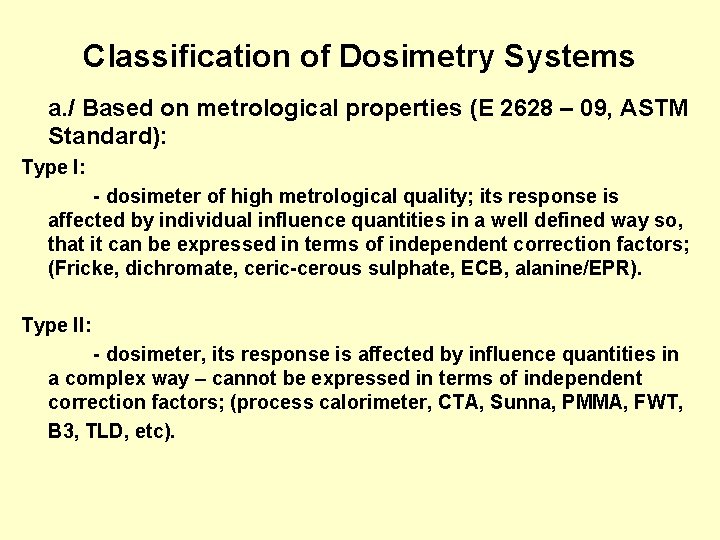
Classification of Dosimetry Systems a. / Based on metrological properties (E 2628 – 09, ASTM Standard): Type I: - dosimeter of high metrological quality; its response is affected by individual influence quantities in a well defined way so, that it can be expressed in terms of independent correction factors; (Fricke, dichromate, ceric-cerous sulphate, ECB, alanine/EPR). Type II: - dosimeter, its response is affected by influence quantities in a complex way – cannot be expressed in terms of independent correction factors; (process calorimeter, CTA, Sunna, PMMA, FWT, B 3, TLD, etc).
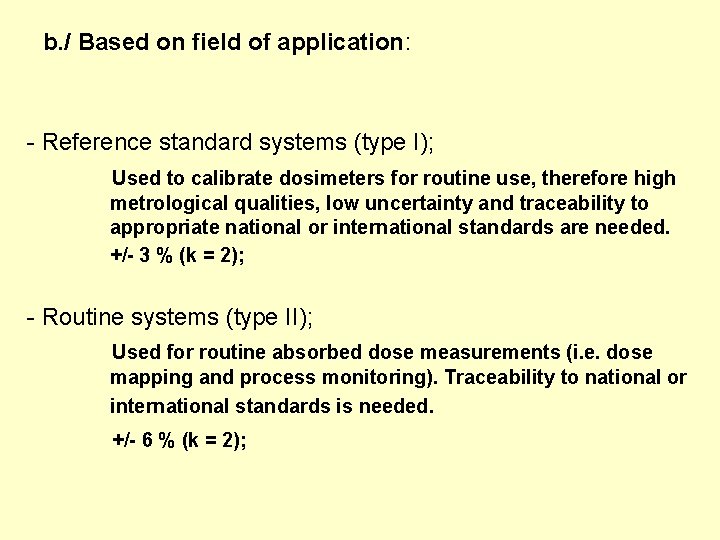
b. / Based on field of application: - Reference standard systems (type I); Used to calibrate dosimeters for routine use, therefore high metrological qualities, low uncertainty and traceability to appropriate national or international standards are needed. +/- 3 % (k = 2); - Routine systems (type II); Used for routine absorbed dose measurements (i. e. dose mapping and process monitoring). Traceability to national or international standards is needed. +/- 6 % (k = 2);
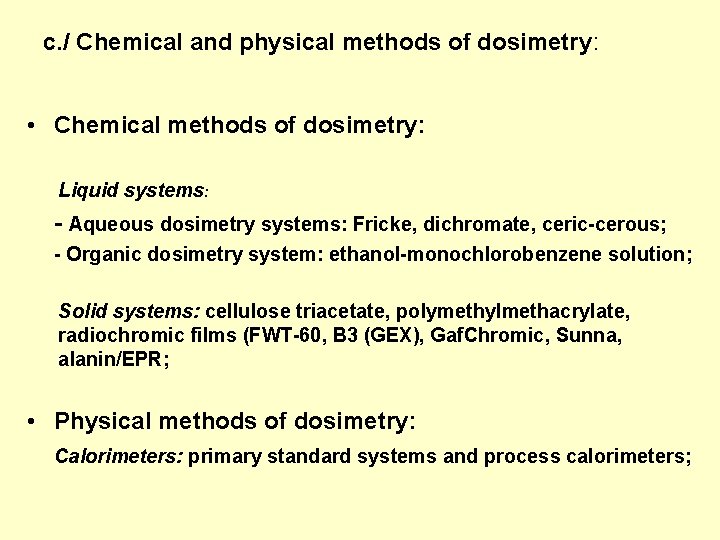
c. / Chemical and physical methods of dosimetry: • Chemical methods of dosimetry: Liquid systems: - Aqueous dosimetry systems: Fricke, dichromate, ceric-cerous; - Organic dosimetry system: ethanol-monochlorobenzene solution; Solid systems: cellulose triacetate, polymethylmethacrylate, radiochromic films (FWT-60, B 3 (GEX), Gaf. Chromic, Sunna, alanin/EPR; • Physical methods of dosimetry: Calorimeters: primary standard systems and process calorimeters;
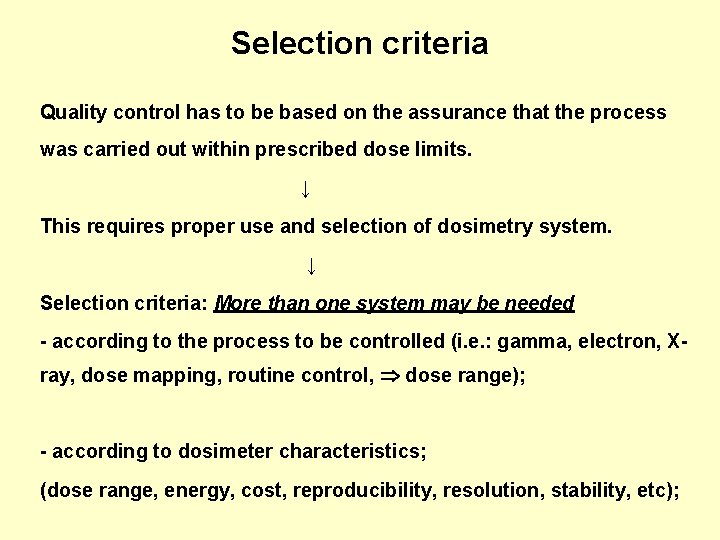
Selection criteria Quality control has to be based on the assurance that the process was carried out within prescribed dose limits. ↓ This requires proper use and selection of dosimetry system. ↓ Selection criteria: More than one system may be needed - according to the process to be controlled (i. e. : gamma, electron, Xray, dose mapping, routine control, dose range); - according to dosimeter characteristics; (dose range, energy, cost, reproducibility, resolution, stability, etc);
Selection criteria • Determination of absorbed dose in product specific dosimeter systems; • The radiation absorption characteristics of the product and the dosimeter material should be similar in terms of atomic number; absorbed dose is material dependent
Dosimetry principles Dose measurements depend on various methods (e. g. ): - Temperature increase (calorimeters); - Colour change (perspex, radiochromic systems); - Free radical concentration (alanine); - Conductivity change (ECB, aqueous-alanine solution); - Radiation chemical oxidation (Fricke); - Radiation chemical reduction (dichromate, ceric-cerous); - Optically stimulated luminescence (Sunna);
Dosimetry systems in radiation processing Primary standard systems: - Dosimeter of the highest metrological quality, established and maintained as an absorbed dose standard by a national or international standards organization for calibration of radiation environments (fields); - Application is based on measurement of basic physical quantities (ionization current and temperature); - Most common systems: ionization chambers, calorimeters; (primary standard laboratories: e. g. NPL); - No calibration is needed;
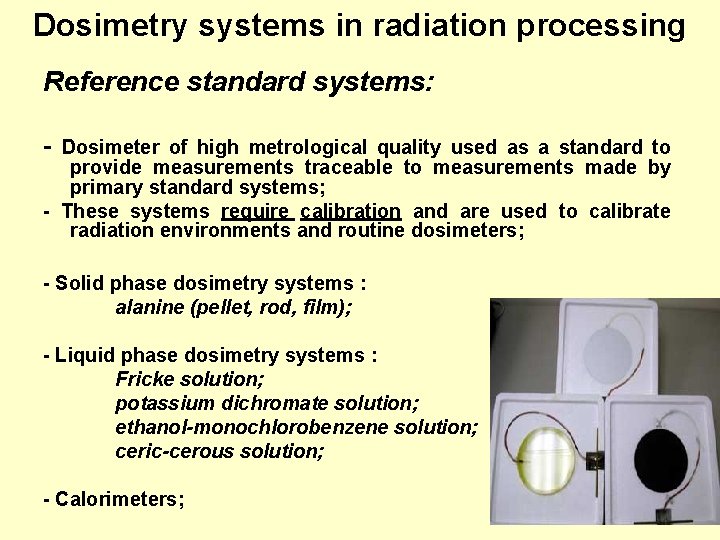
Dosimetry systems in radiation processing Reference standard systems: - Dosimeter of high metrological quality used as a standard to provide measurements traceable to measurements made by primary standard systems; - These systems require calibration and are used to calibrate radiation environments and routine dosimeters; - Solid phase dosimetry systems : alanine (pellet, rod, film); - Liquid phase dosimetry systems : Fricke solution; potassium dichromate solution; ethanol-monochlorobenzene solution; ceric-cerous solution; - Calorimeters;
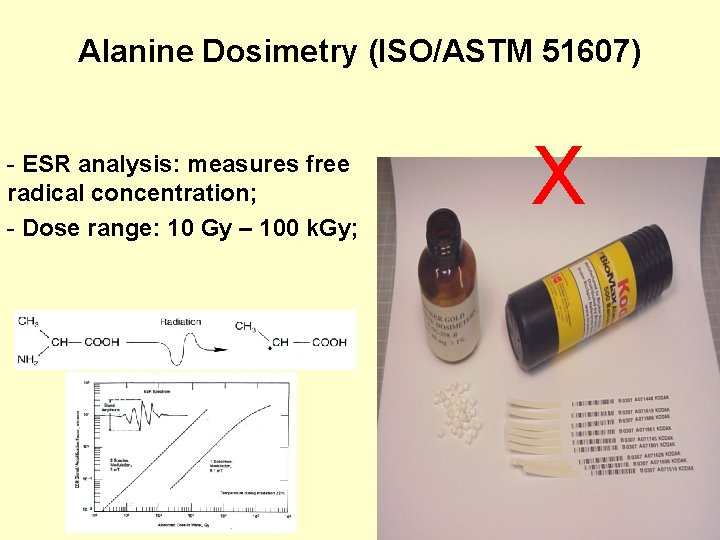
Alanine Dosimetry (ISO/ASTM 51607) - ESR analysis: measures free radical concentration; - Dose range: 10 Gy – 100 k. Gy; X
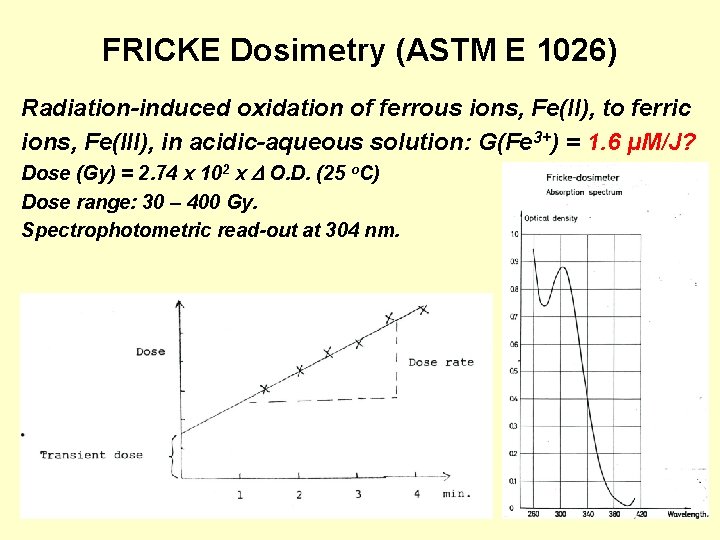
FRICKE Dosimetry (ASTM E 1026) Radiation-induced oxidation of ferrous ions, Fe(II), to ferric ions, Fe(III), in acidic-aqueous solution: G(Fe 3+) = 1. 6 μM/J? Dose (Gy) = 2. 74 x 102 x O. D. (25 o. C) Dose range: 30 – 400 Gy. Spectrophotometric read-out at 304 nm.
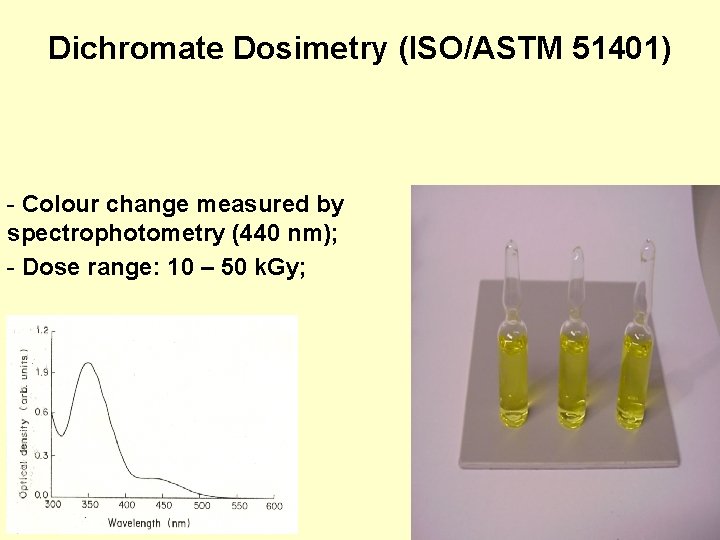
Dichromate Dosimetry (ISO/ASTM 51401) - Colour change measured by spectrophotometry (440 nm); - Dose range: 10 – 50 k. Gy;
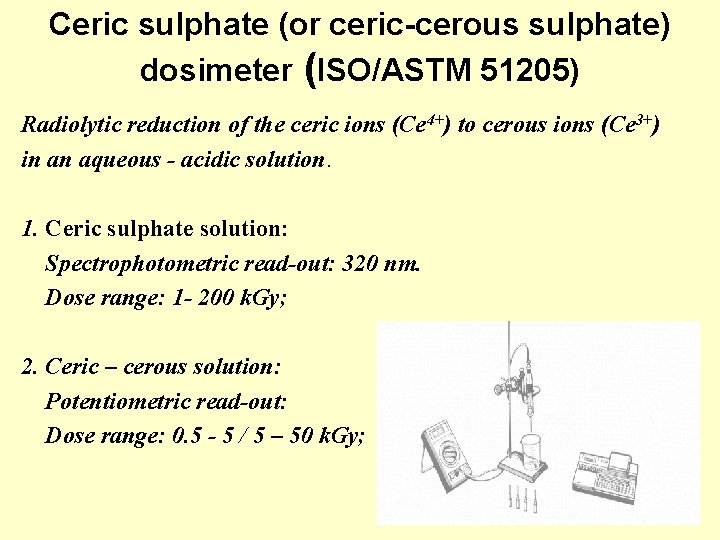
Ceric sulphate (or ceric-cerous sulphate) dosimeter (ISO/ASTM 51205) Radiolytic reduction of the ceric ions (Ce 4+) to cerous ions (Ce 3+) in an aqueous - acidic solution. 1. Ceric sulphate solution: Spectrophotometric read-out: 320 nm. Dose range: 1 - 200 k. Gy; 2. Ceric – cerous solution: Potentiometric read-out: Dose range: 0. 5 - 5 / 5 – 50 k. Gy;
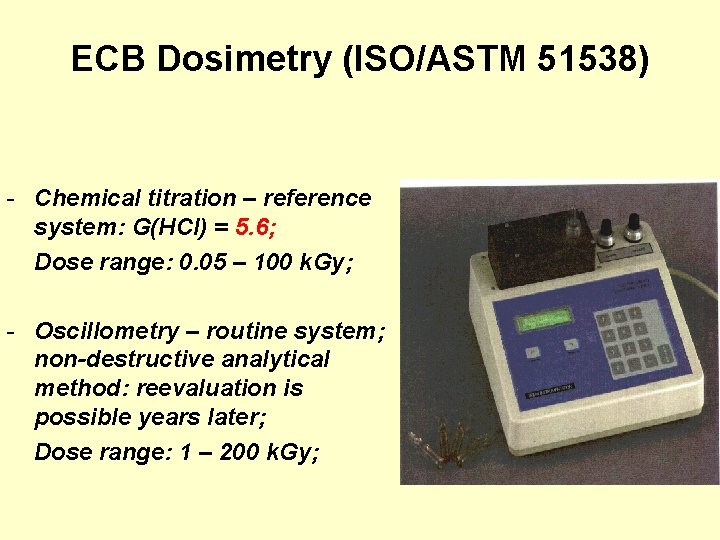
ECB Dosimetry (ISO/ASTM 51538) - Chemical titration – reference system: G(HCl) = 5. 6; Dose range: 0. 05 – 100 k. Gy; - Oscillometry – routine system; non-destructive analytical method: reevaluation is possible years later; Dose range: 1 – 200 k. Gy;
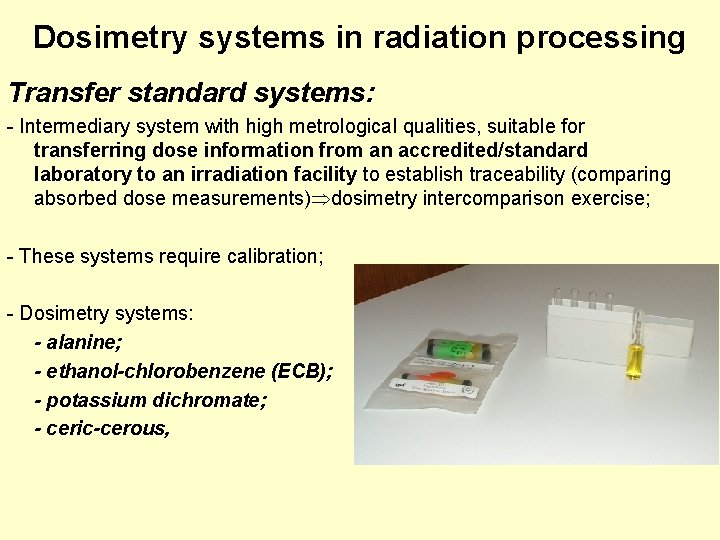
Dosimetry systems in radiation processing Transfer standard systems: - Intermediary system with high metrological qualities, suitable for transferring dose information from an accredited/standard laboratory to an irradiation facility to establish traceability (comparing absorbed dose measurements) dosimetry intercomparison exercise; - These systems require calibration; - Dosimetry systems: - alanine; - ethanol-chlorobenzene (ECB); - potassium dichromate; - ceric-cerous,
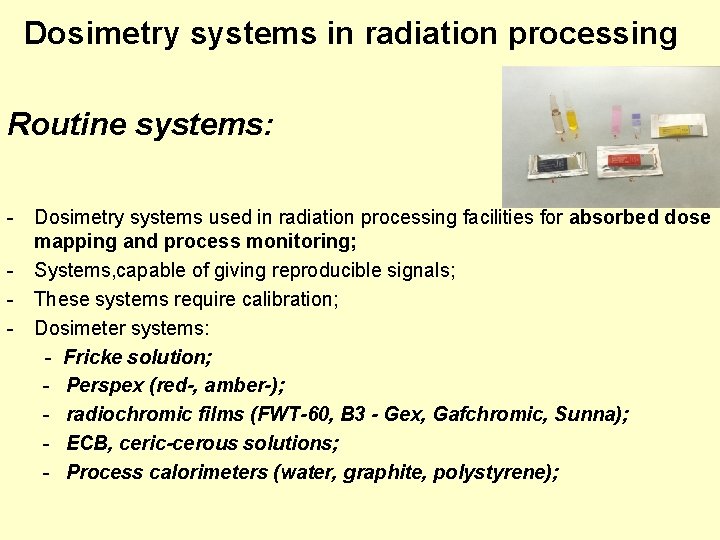
Dosimetry systems in radiation processing Routine systems: - Dosimetry systems used in radiation processing facilities for absorbed dose mapping and process monitoring; - Systems, capable of giving reproducible signals; - These systems require calibration; - Dosimeter systems: - Fricke solution; - Perspex (red-, amber-); - radiochromic films (FWT-60, B 3 - Gex, Gafchromic, Sunna); - ECB, ceric-cerous solutions; - Process calorimeters (water, graphite, polystyrene);
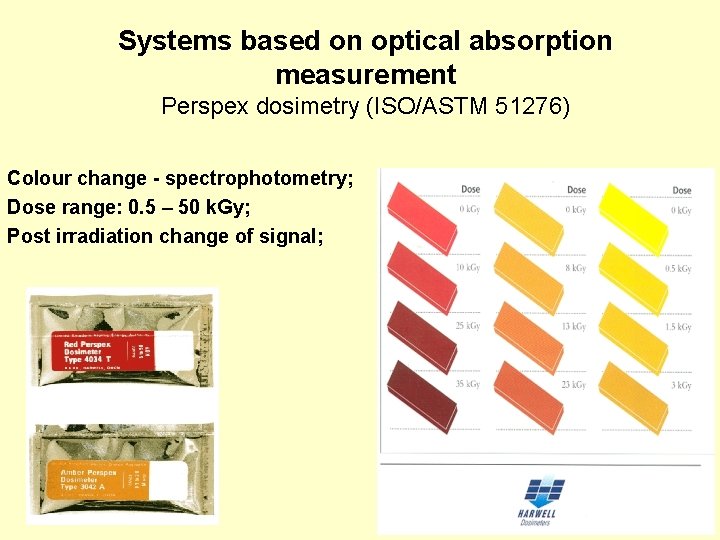
Systems based on optical absorption measurement Perspex dosimetry (ISO/ASTM 51276) Colour change - spectrophotometry; Dose range: 0. 5 – 50 k. Gy; Post irradiation change of signal;
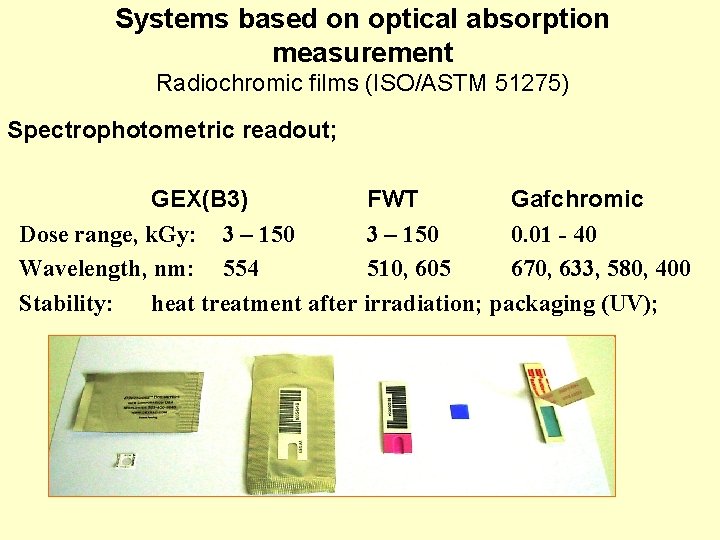
Systems based on optical absorption measurement Radiochromic films (ISO/ASTM 51275) Spectrophotometric readout; GEX(B 3) FWT Gafchromic Dose range, k. Gy: 3 – 150 0. 01 - 40 Wavelength, nm: 554 510, 605 670, 633, 580, 400 Stability: heat treatment after irradiation; packaging (UV);
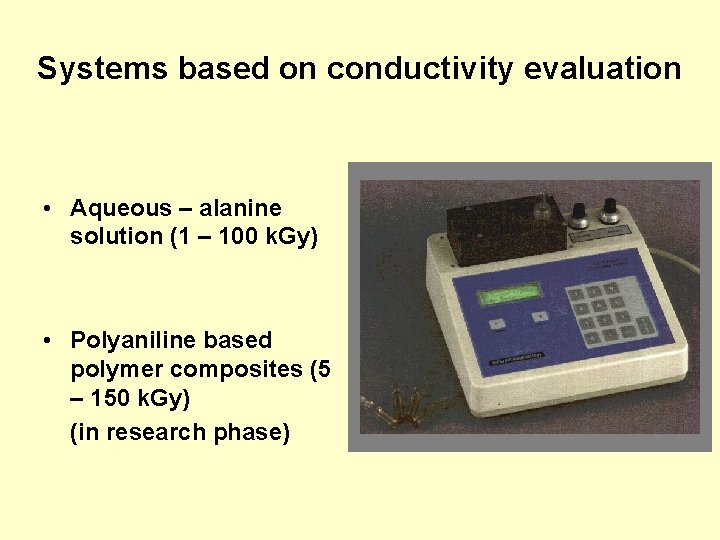
Systems based on conductivity evaluation • Aqueous – alanine solution (1 – 100 k. Gy) • Polyaniline based polymer composites (5 – 150 k. Gy) (in research phase)
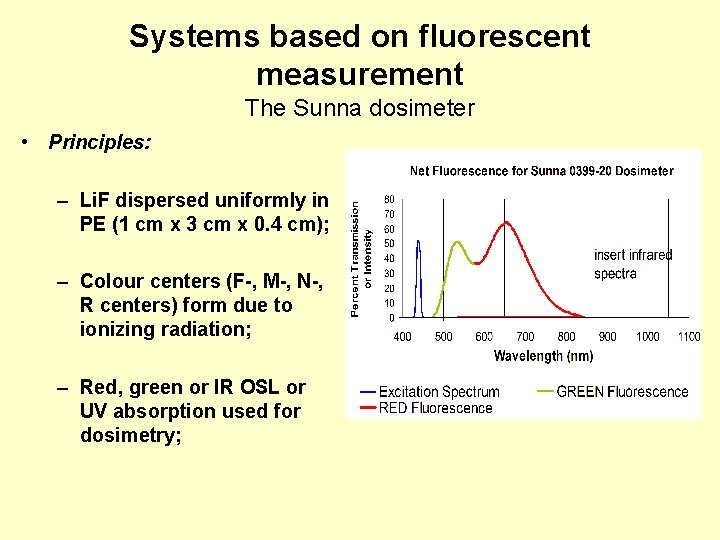
Systems based on fluorescent measurement The Sunna dosimeter • Principles: – Li. F dispersed uniformly in PE (1 cm x 3 cm x 0. 4 cm); – Colour centers (F-, M-, N-, R centers) form due to ionizing radiation; – Red, green or IR OSL or UV absorption used for dosimetry;
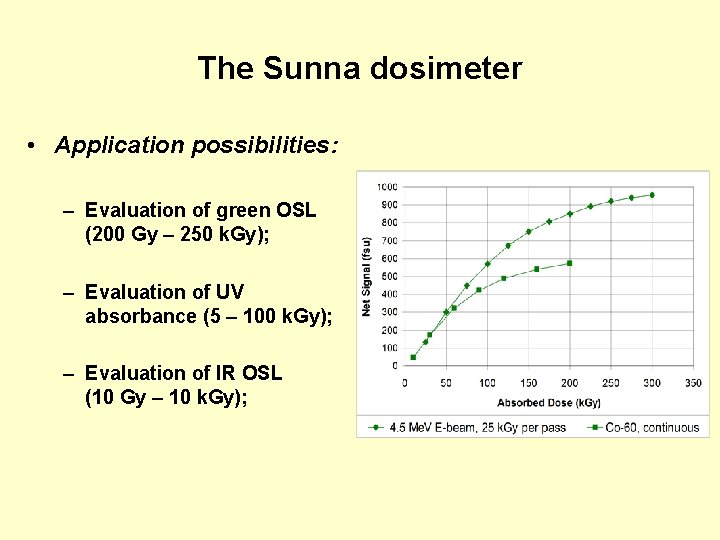
The Sunna dosimeter • Application possibilities: – Evaluation of green OSL (200 Gy – 250 k. Gy); – Evaluation of UV absorbance (5 – 100 k. Gy); – Evaluation of IR OSL (10 Gy – 10 k. Gy);
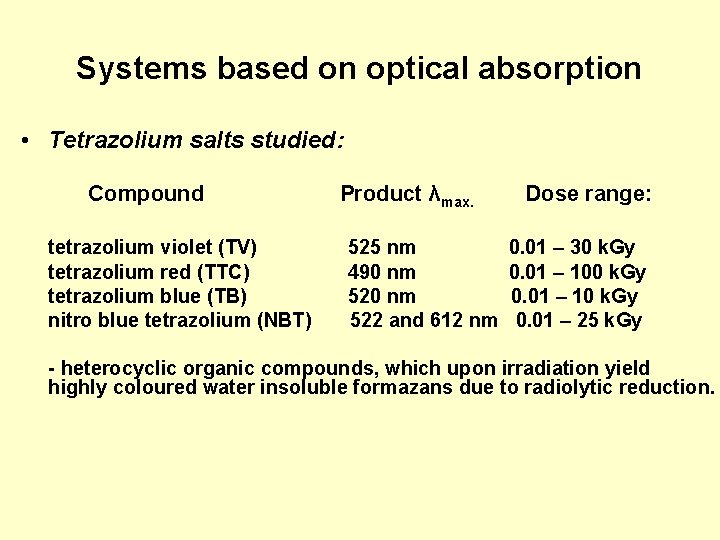
Systems based on optical absorption • Tetrazolium salts studied: Compound tetrazolium violet (TV) tetrazolium red (TTC) tetrazolium blue (TB) nitro blue tetrazolium (NBT) Product λmax. 525 nm 490 nm 522 and 612 nm Dose range: 0. 01 – 30 k. Gy 0. 01 – 10 k. Gy 0. 01 – 25 k. Gy - heterocyclic organic compounds, which upon irradiation yield highly coloured water insoluble formazans due to radiolytic reduction.
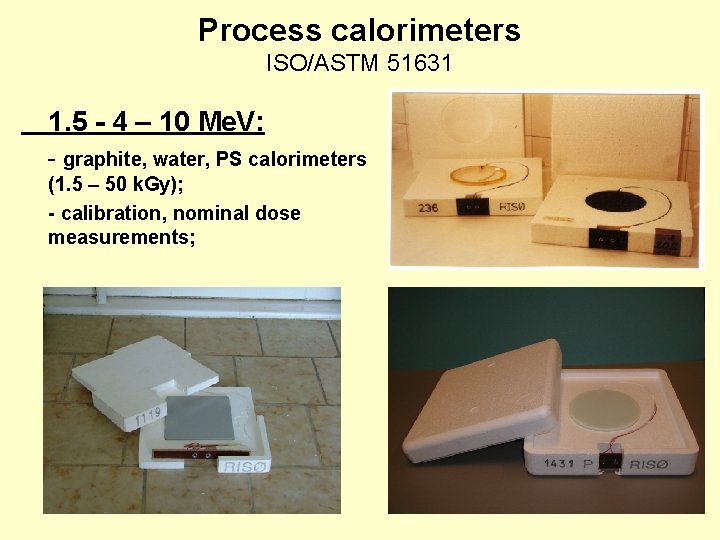
Process calorimeters ISO/ASTM 51631 1. 5 - 4 – 10 Me. V: - graphite, water, PS calorimeters (1. 5 – 50 k. Gy); - calibration, nominal dose measurements;
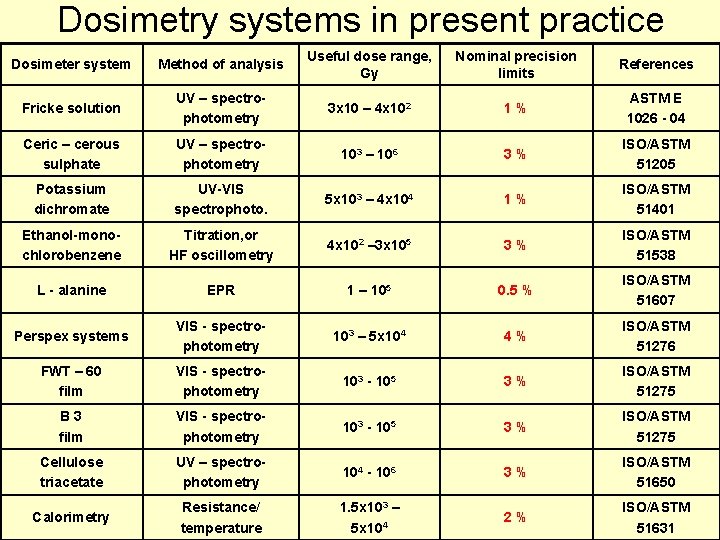
Dosimetry systems in present practice Dosimeter system Method of analysis Useful dose range, Gy Nominal precision limits References Fricke solution UV – spectrophotometry 3 x 10 – 4 x 10² 1% ASTM E 1026 - 04 Ceric – cerous sulphate UV – spectrophotometry 103 – 106 3% ISO/ASTM 51205 Potassium dichromate UV-VIS spectrophoto. 5 x 10³ – 4 x 10⁴ 1% ISO/ASTM 51401 Ethanol-monochlorobenzene Titration, or HF oscillometry 4 x 10² – 3 x 10⁵ 3% ISO/ASTM 51538 L - alanine EPR 1 – 105 0. 5 % ISO/ASTM 51607 Perspex systems VIS - spectrophotometry 103 – 5 x 10⁴ 4% ISO/ASTM 51276 FWT – 60 film VIS - spectrophotometry 103 - 105 3% ISO/ASTM 51275 B 3 film VIS - spectrophotometry 103 - 105 3% ISO/ASTM 51275 Cellulose triacetate UV – spectrophotometry 104 - 106 3% ISO/ASTM 51650 Calorimetry Resistance/ temperature 1. 5 x 10³ – 5 x 10⁴ 2% ISO/ASTM 51631
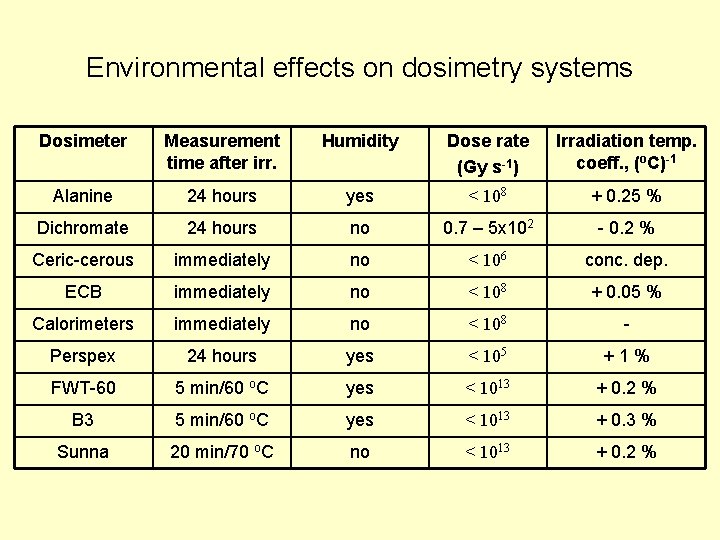
Environmental effects on dosimetry systems Dosimeter Measurement time after irr. Humidity Dose rate (Gy s-1) Irradiation temp. coeff. , (o. C)-1 Alanine 24 hours yes < 108 + 0. 25 % Dichromate 24 hours no 0. 7 – 5 x 10² - 0. 2 % Ceric-cerous immediately no < 106 conc. dep. ECB immediately no < 108 + 0. 05 % Calorimeters immediately no < 108 - Perspex 24 hours yes < 105 +1% FWT-60 5 min/60 o. C yes < 1013 + 0. 2 % B 3 5 min/60 o. C yes < 1013 + 0. 3 % Sunna 20 min/70 o. C no < 1013 + 0. 2 %
Environmental Protection Technologies • Industrial and municipal waste water treatment; • Drinking water treatment; • Flue gas treatment; • Sludge decontamination; • Medical waste;
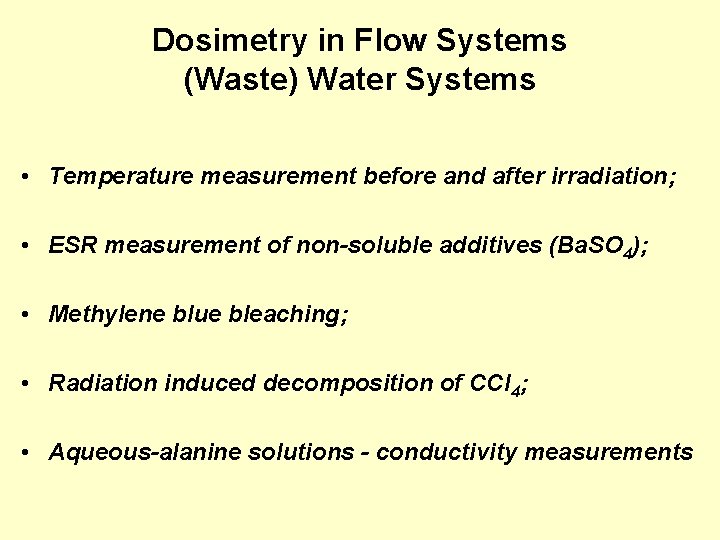
Dosimetry in Flow Systems (Waste) Water Systems • Temperature measurement before and after irradiation; • ESR measurement of non-soluble additives (Ba. SO 4); • Methylene blue bleaching; • Radiation induced decomposition of CCl 4; • Aqueous-alanine solutions - conductivity measurements