
Dosimetric Comparisons of Uniform Scanning Proton Beam Therapy
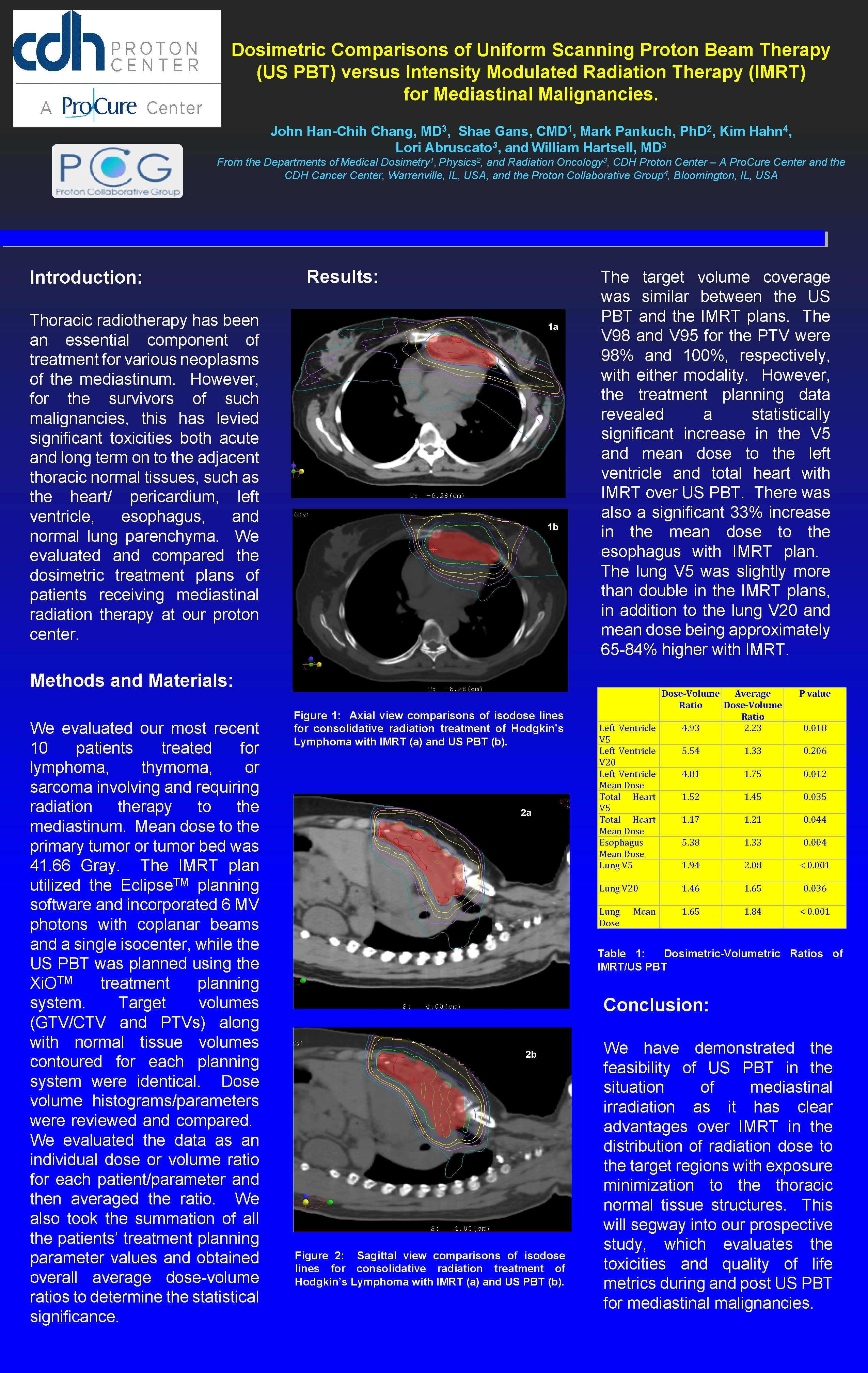
Dosimetric Comparisons of Uniform Scanning Proton Beam Therapy (US PBT) versus Intensity Modulated Radiation Therapy (IMRT) for Mediastinal Malignancies. John Han-Chih Chang, MD 3, Shae Gans, CMD 1, Mark Pankuch, Ph. D 2, Kim Hahn 4, Lori Abruscato 3, and William Hartsell, MD 3 From the Departments of Medical Dosimetry 1, Physics 2, and Radiation Oncology 3, CDH Proton Center – A Pro. Cure Center and the CDH Cancer Center, Warrenville, IL, USA, and the Proton Collaborative Group 4, Bloomington, IL, USA Introduction: Results: Thoracic radiotherapy has been an essential component of treatment for various neoplasms of the mediastinum. However, for the survivors of such malignancies, this has levied significant toxicities both acute and long term on to the adjacent thoracic normal tissues, such as the heart/ pericardium, left ventricle, esophagus, and normal lung parenchyma. We evaluated and compared the dosimetric treatment plans of patients receiving mediastinal radiation therapy at our proton center. 1 a 1 b Methods and Materials: We evaluated our most recent 10 patients treated for lymphoma, thymoma, or sarcoma involving and requiring radiation therapy to the mediastinum. Mean dose to the primary tumor or tumor bed was 41. 66 Gray. The IMRT plan utilized the Eclipse. TM planning software and incorporated 6 MV photons with coplanar beams and a single isocenter, while the US PBT was planned using the Xi. OTM treatment planning system. Target volumes (GTV/CTV and PTVs) along with normal tissue volumes contoured for each planning system were identical. Dose volume histograms/parameters were reviewed and compared. We evaluated the data as an individual dose or volume ratio for each patient/parameter and then averaged the ratio. We also took the summation of all the patients’ treatment planning parameter values and obtained overall average dose-volume ratios to determine the statistical significance. The target volume coverage was similar between the US PBT and the IMRT plans. The V 98 and V 95 for the PTV were 98% and 100%, respectively, with either modality. However, the treatment planning data revealed a statistically significant increase in the V 5 and mean dose to the left ventricle and total heart with IMRT over US PBT. There was also a significant 33% increase in the mean dose to the esophagus with IMRT plan. The lung V 5 was slightly more than double in the IMRT plans, in addition to the lung V 20 and mean dose being approximately 65 -84% higher with IMRT. Figure 1: Axial view comparisons of isodose lines for consolidative radiation treatment of Hodgkin’s Lymphoma with IMRT (a) and US PBT (b). 2 a Dose-Volume Average Ratio Dose-Volume Ratio Left Ventricle 4. 93 2. 23 V 5 Left Ventricle 5. 54 1. 33 V 20 Left Ventricle 4. 81 1. 75 Mean Dose Total Heart 1. 52 1. 45 V 5 Total Heart 1. 17 1. 21 Mean Dose Esophagus 5. 38 1. 33 Mean Dose Lung V 5 1. 94 2. 08 P value 0. 018 0. 206 0. 012 0. 035 0. 044 0. 004 < 0. 001 Lung V 20 1. 46 1. 65 0. 036 Lung Dose 1. 65 1. 84 < 0. 001 Mean Table 1: Dosimetric-Volumetric Ratios of IMRT/US PBT Conclusion: 2 b Figure 2: Sagittal view comparisons of isodose lines for consolidative radiation treatment of Hodgkin’s Lymphoma with IMRT (a) and US PBT (b). We have demonstrated the feasibility of US PBT in the situation of mediastinal irradiation as it has clear advantages over IMRT in the distribution of radiation dose to the target regions with exposure minimization to the thoracic normal tissue structures. This will segway into our prospective study, which evaluates the toxicities and quality of life metrics during and post US PBT for mediastinal malignancies.
- Slides: 1