
Doseresponse metaregression of mindfulnessbased interventions MBIs Method challenges
Dose-response meta-regression of mindfulness-based interventions (MBIs): Method, challenges & preliminary findings Sarah Strohmaier, Fergal Jones, Clara Strauss, Kate Cavanagh Canterbury Christ Church University, University of Sussex, United Kingdom Email: sarah. strohmaier@canterbury. ac. uk
Overview Ø Background of dose in MBIs Ø Method & process Ø Challenges Ø Preliminary results Ø Discussion of results Ø Questions and comments
Background of dose in MBIs Ø Increase in research with different types, formats and doses of MBIs ØResearch with different participants ØPotential benefits of examining dose in MBIs ØExpectations based on mindfulness theory ØPrevious research: Mixed results for role of dose in MBIs
Method and process ØSystematic literature searches ØScreening (PRISMA guidelines; Moher et al. , 2009) ØInclusion criteria ØRandomised Controlled Trial (RCT) ØMBI based on mindfulness principles & practices (Crane et al. , 2017) ØQuantitative measure of depression ØCompared to inactive or active controls ØAdult participants ØOutcomes: Mindfulness, depression, anxiety and stress
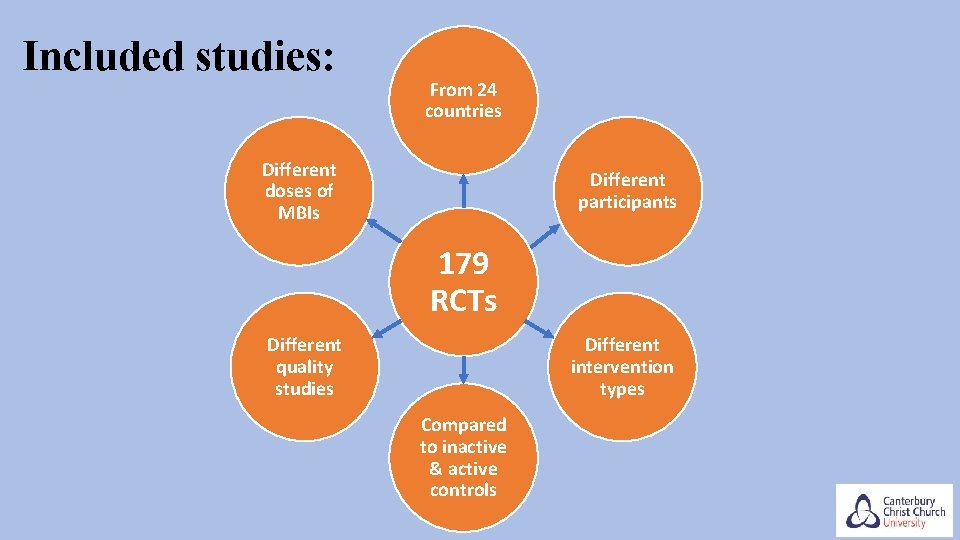
Included studies: From 24 countries Different doses of MBIs Different participants 179 RCTs Different quality studies Different intervention types Compared to inactive & active controls

Dose variables Primary dose variables Composite dose variables Number of sessions (total) Amount of face-to-face facilitator contact (in hours) Duration of sessions (in hours) Recommended use of intervention (in hours) Length of intervention (in weeks) Intensity of intervention (number of sessions a week) Number of recommended home practices a week Amount of face-to-face facilitator contact (in hours) a week Duration of recommended home practices (in minutes) Recommended use of intervention (in hours) a week Actual/self-reported use of intervention (in hours) a week
Challenges in calculating dose for MBIs Ø Amount and type of (formal and informal) mindfulness practice difficult to extract and calculate ØMemory and social desirability bias for actual practice reporting ØNot enough studies available for each dose and outcome to run separate analyses for different population groups ØFollow-up: Rarely collected how much participants practiced from end of intervention until follow-up data collection timepoint
Meta-analysis results Prior to including dose: Significant between-group differences favouring MBI group compared to controls at post-intervention and follow-up time-points for mindfulness, depression, anxiety and stress outcomes Ø(ES: d = 0. 3 to 0. 8)
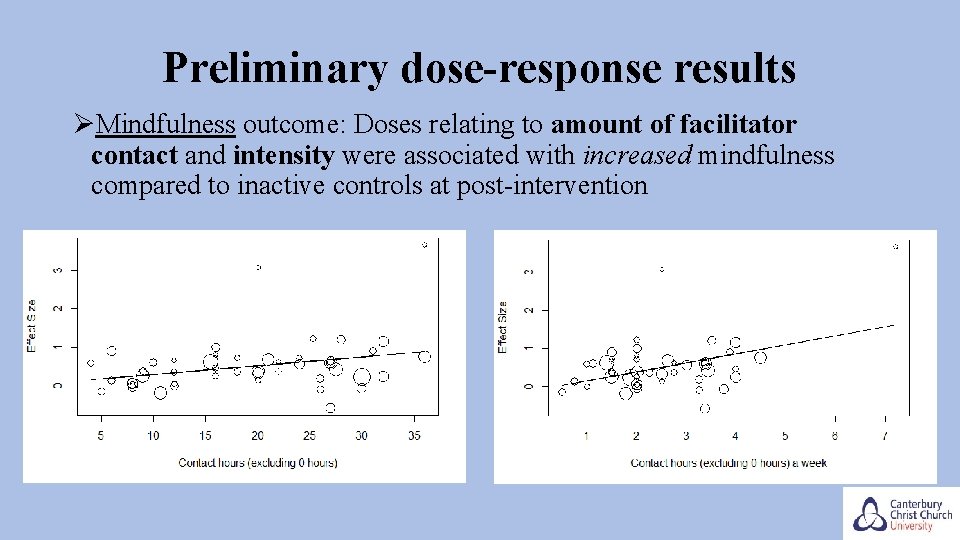
Preliminary dose-response results ØMindfulness outcome: Doses relating to amount of facilitator contact and intensity were associated with increased mindfulness compared to inactive controls at post-intervention
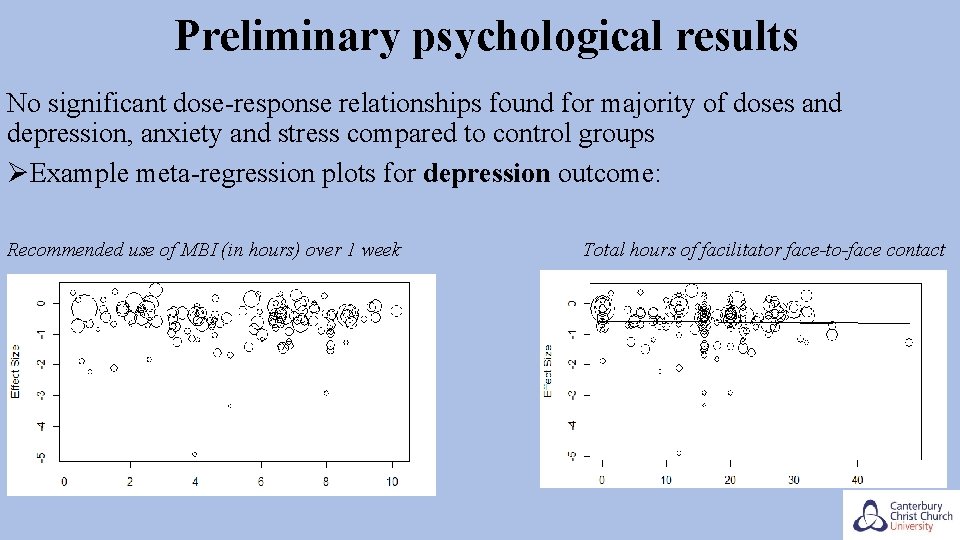
Preliminary psychological results No significant dose-response relationships found for majority of doses and depression, anxiety and stress compared to control groups ØExample meta-regression plots for depression outcome: Recommended use of MBI (in hours) over 1 week Total hours of facilitator face-to-face contact
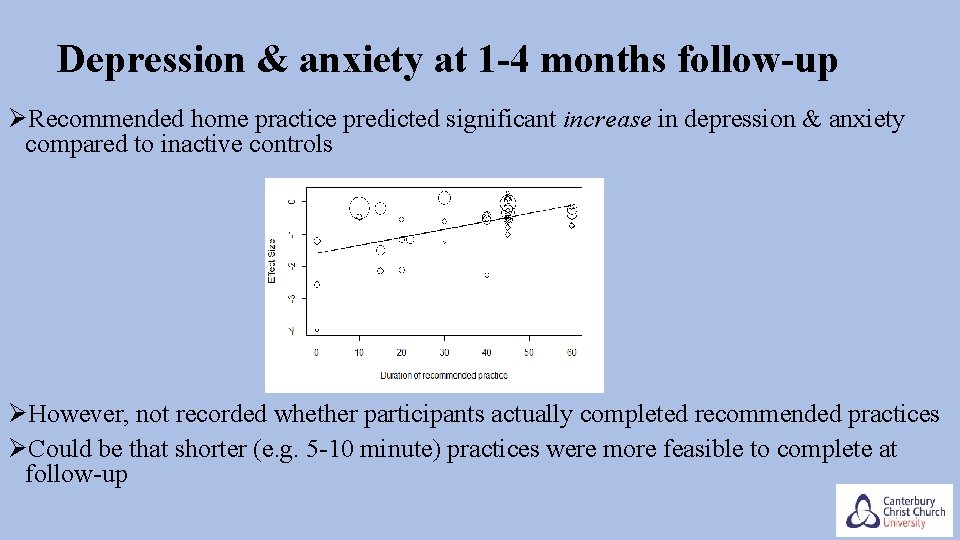
Depression & anxiety at 1 -4 months follow-up ØRecommended home practice predicted significant increase in depression & anxiety compared to inactive controls ØHowever, not recorded whether participants actually completed recommended practices ØCould be that shorter (e. g. 5 -10 minute) practices were more feasible to complete at follow-up
Discussion of results ØMindfulness appears helpful to learn face-to-face from facilitator and if sessions closer together ØKabat-Zinn (2003): Helpful to learn mindfulness from experienced practitioners ØGroup processes may be important (e. g. Segal et al. , 2002; Yalom, 1983) ØIntensity as significant predictor: Similar to dose-response research with psychotherapy (Cuijpers et al. , 2013) ØDepression, anxiety, stress ØPotential floor effect due to participants mostly from non-clinical population ØRecent research supporting benefits of lower dose and online MBIs (e. g. Klatt et al. , 2009; Spijkerman et al. , 2016)
Limitations ØPossibility of Type I and II errors ØStatistical multiple comparisons ØLow power for some analyses ØActual use of intervention dose: Information not collected by majority of papers ØGenerally novice practitioners: Not necessarily generalisable for more experienced, long-term practitioners Future: Experimental examinations to determine causation

Thank you very much! ? Questions? Comments? For any further questions, please feel free to contact me: Email: sarah. strohmaier@canterbury. ac. uk Twitter: @sarahstrohmaier Website: www. canterbury. ac. uk/appliedpsychology
References Crane, R. S. , Brewer, J. , Feldman, C. , Kabat-Zinn, J. , Santorelli, S. , Williams, J. M. G. & Kuyken, W. (2017). What defined mindfulness-based programs? The warp and the weft. Psychological Medicine, 47 (6) 990 -999. doi: 10. 1017/S 0033291716003317. Cuijpers, P. , Huibers, M. , Ebert, D. D. , Koole, S. L. , & Andersson, G. (2013). How much psychotherapy is needed to treat depression? A meta-regression analysis. Journal of Affective Disorders, 149, 1 -13. doi: 10. 1016/j. jad. 2013. 02. 030. Kabat-Zinn, J. (2003). Mindfulness-Based Interventions in Context: Past, Present, and Future. Clinical Psychology: Science and Practice, 10, 144 -156. doi: 10. 1093/clipsy/bpg 016. Klatt, M. D. , Buckworth, J. , & Malarky, W. B. (2009). Effects of Low-Dose Mindfulness-Based Stress Reduction (MBSR-ld) on Working Adults. Health Education & Behavior, 36 (3), 601 -614. doi: 10. 1177/1090198108317627. Moher, D. , Liberati, A. , Tetzlaff, J. , Altman, D. G. , & The PRISMA Group (2009). Preferred Reporting Items for Systematic Reviews and Meta-Analyses: The PRISMA Statement. PLo. S Med, 6 (7), e 1000097. doi: 10. 1371/journal. pmed 1000097. Segal, Z. V. , Williams, M. G. , & Teasdale, J. D. (2002). Mindfulness-based Cognitive Therapy for Depression: A new approach to preventing relapse. New York: Guildford Press. Spijkerman, M. P. J. , Pots, W. T. M. , & Bohlmeijer, E. T. (2016). Effectiveness of online mindfulness-based interventions in improving mental health: A review and meta-analysis of randomised controlled trials. Clinical Psychology Review, 45, 102 -114. doi: 10. 1016/j. cpr. 2016. 03. 009. Yalom, I. D. (1983). Inpatient group psychotherapy. New York: Basic Books.
![Image references Cooke, H. (2018). [Balancing rocks on water] Retrieved November 3, 2018 from:](http://slidetodoc.com/presentation_image_h2/71b5d67289cfbf77851457dc536afa34/image-16.jpg "Image references Cooke, H. (2018). [Balancing rocks on water] Retrieved November 3, 2018 from:")
Image references Cooke, H. (2018). [Balancing rocks on water] Retrieved November 3, 2018 from: http: //helencookenutrition. co. uk/wp-content/uploads/2018/04/pebbles. jpg [Clipart of magnifying glass over papers] (2016). Retrieved November 10, 2018 from: https: //new- img. patrika. com/upload/mediafiles/2016/09/30/l_the-charge-sheet-naib 552 a 3161 a 3140_l-1475225937_835 x 547. jpg [Clipart of meditating person silhouette] Retrieved January 4, 2019 from: https: //us. 123 rf. com/450 wm/oljgaa 1509/oljgaa 150900020/45775185 stock-vector-meditation-silhouette-vector. jpg? ver=6 [Image of sign reading Challenges Ahead] Retrieved December 18, 2018 from: https: //image. slidesharecdn. com/serchazdonkeynote-171004192551/95/serchazdon-keynote-26 -638. jpg? cb=1507145358 [Image of Limits letters and their shadow] (2016). Retrieved December 18, 2018 from: https: //www. lattianderson. com/wp-content/uploads/2016/06/Limitation-of. Liability-3. jpg [Photograph of woman meditating by lake] (2000). Retrieved November 3, 2018 from: https: //odysseyonlineimg. rbl. ms/simage/https%3 A%2 F%2 Fassets. rbl. ms%2 F 108 69218%2 F 980 x. jpg/2000%2 C 2000/6 Xlsiwyv. BPF%2 BYu. TR/img. jpg
- Slides: 16