
Dorsal displacement of the soft palate In horses
- Slides: 16
Dorsal displacement of the soft palate In horses
Dorsal displacement of the soft palate (DDSP) • Dorsal displacement of the soft palate is a disorder of the upper airway in horses. It is one of the most common upper airway obstructions, and it causes poor performance and abnormal noise while exercising. It's usually a disease of racehorses, for which it is often a performance-limiting problem. • Over the years, a number of treatments have been developed for this condition; however, none are universally successful, mostly because we do not as yet fully understand the exact cause(s) of this disorder. But before we can further discuss this abnormality, you first need to understand what is normal for the equine upper airway.
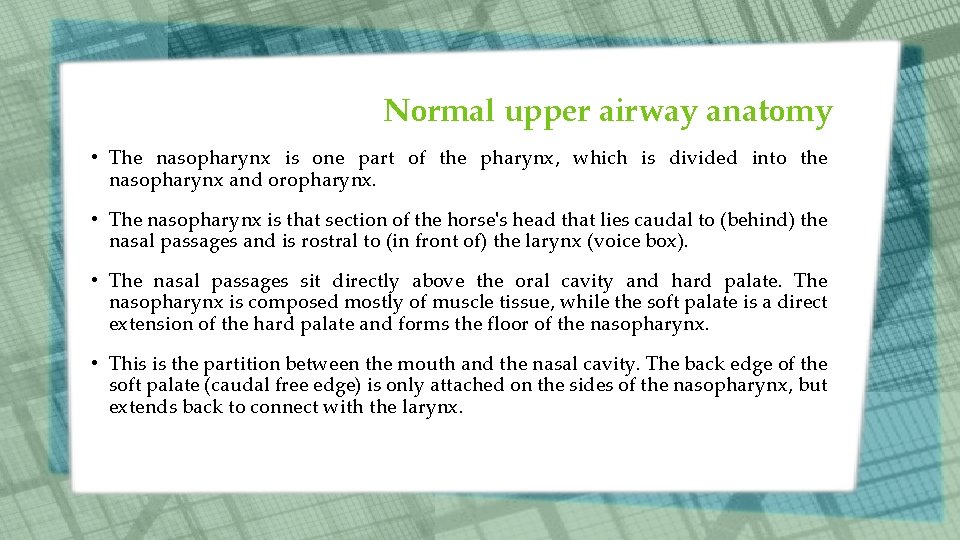
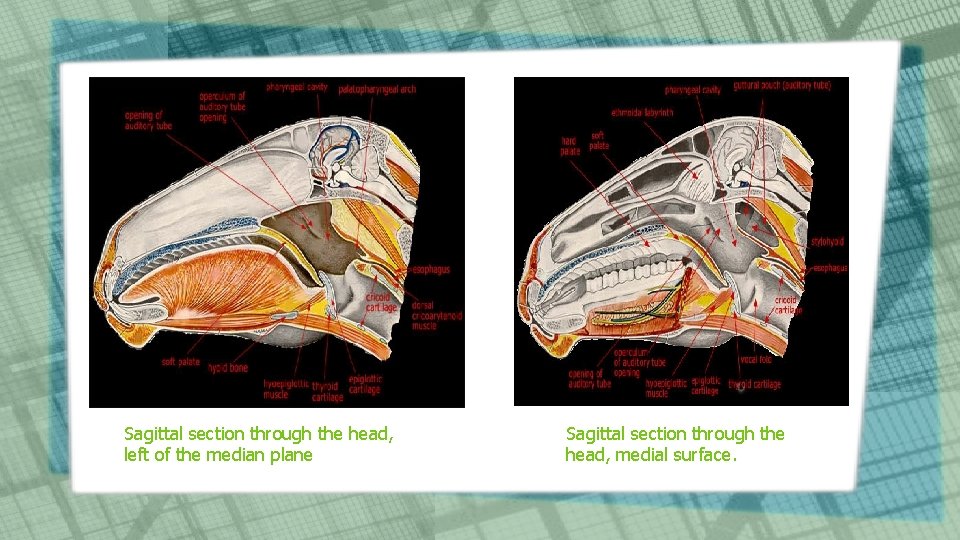
Normal upper airway anatomy • The nasopharynx is one part of the pharynx, which is divided into the nasopharynx and oropharynx. • The nasopharynx is that section of the horse's head that lies caudal to (behind) the nasal passages and is rostral to (in front of) the larynx (voice box). • The nasal passages sit directly above the oral cavity and hard palate. The nasopharynx is composed mostly of muscle tissue, while the soft palate is a direct extension of the hard palate and forms the floor of the nasopharynx. • This is the partition between the mouth and the nasal cavity. The back edge of the soft palate (caudal free edge) is only attached on the sides of the nasopharynx, but extends back to connect with the larynx.
Sagittal section through the head, left of the median plane Sagittal section through the head, medial surface.
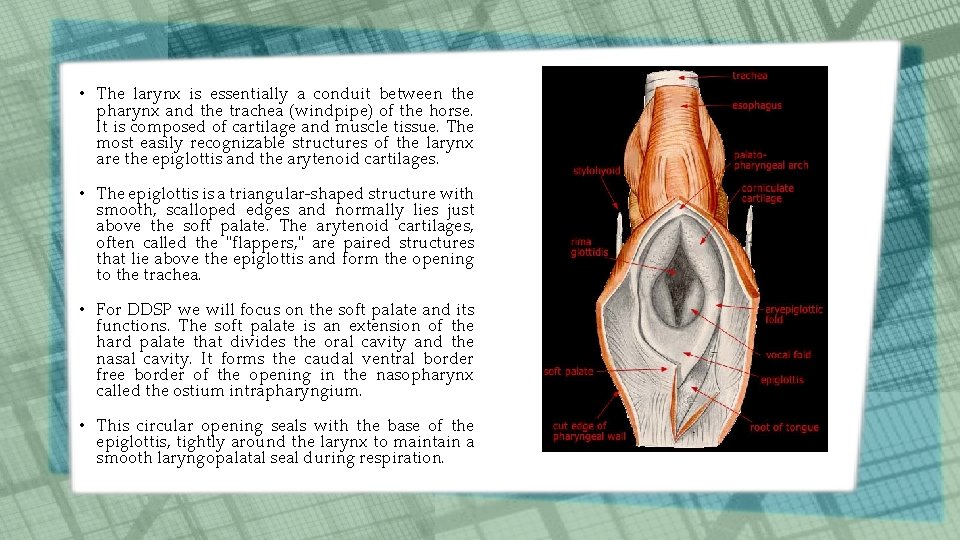
• The larynx is essentially a conduit between the pharynx and the trachea (windpipe) of the horse. It is composed of cartilage and muscle tissue. The most easily recognizable structures of the larynx are the epiglottis and the arytenoid cartilages. • The epiglottis is a triangular-shaped structure with smooth, scalloped edges and normally lies just above the soft palate. The arytenoid cartilages, often called the "flappers, " are paired structures that lie above the epiglottis and form the opening to the trachea. • For DDSP we will focus on the soft palate and its functions. The soft palate is an extension of the hard palate that divides the oral cavity and the nasal cavity. It forms the caudal ventral border free border of the opening in the nasopharynx called the ostium intrapharyngium. • This circular opening seals with the base of the epiglottis, tightly around the larynx to maintain a smooth laryngopalatal seal during respiration.
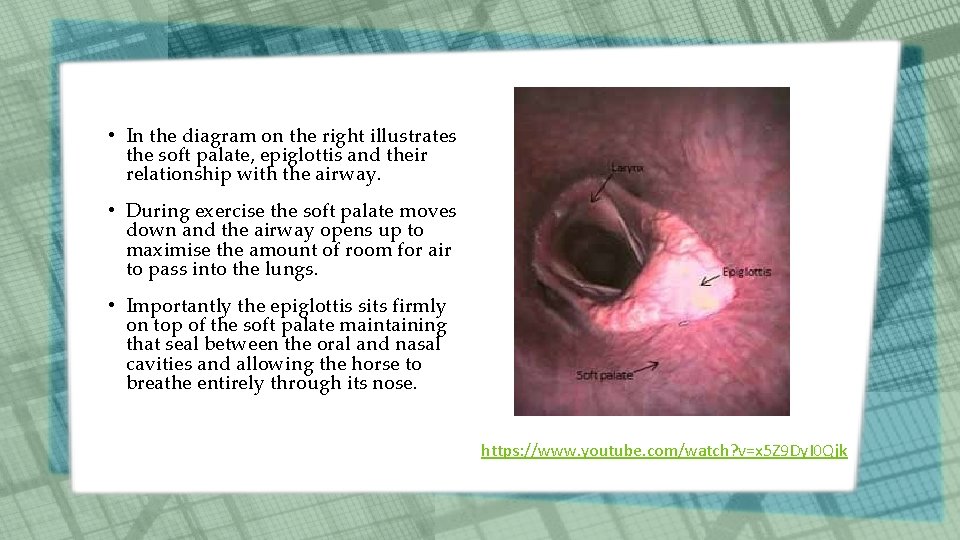
• In the diagram on the right illustrates the soft palate, epiglottis and their relationship with the airway. • During exercise the soft palate moves down and the airway opens up to maximise the amount of room for air to pass into the lungs. • Importantly the epiglottis sits firmly on top of the soft palate maintaining that seal between the oral and nasal cavities and allowing the horse to breathe entirely through its nose. https: //www. youtube. com/watch? v=x 5 Z 9 Dy. I 0 Qjk
How DDSP occurs https: //www. youtube. com/watch? v=R 84 t 5 wq 7 bvw • Factors that produce an elevation of the soft palate or retraction of the larynx disrupt the seal of the result in laryngopalatal dislocation and dorsal displacement of the soft palate. • Retraction of the tongue causes caudal displacement of the larynx and pushes the soft palate up. • Vigorous contraction of the sternothyrohyoideus and omohyoideus muscles during inspiration can result in caudal retraction of the larynx. • The soft palate is may be drawn dorsally by negative pharyngeal pressure during inspiration or by open mouth breathing, swallowing or coughing during exercise. • Flexion of the head causes relaxation and narrowing of the nasopharynx, which impedes air flow and increases negative pharyngeal pressures.
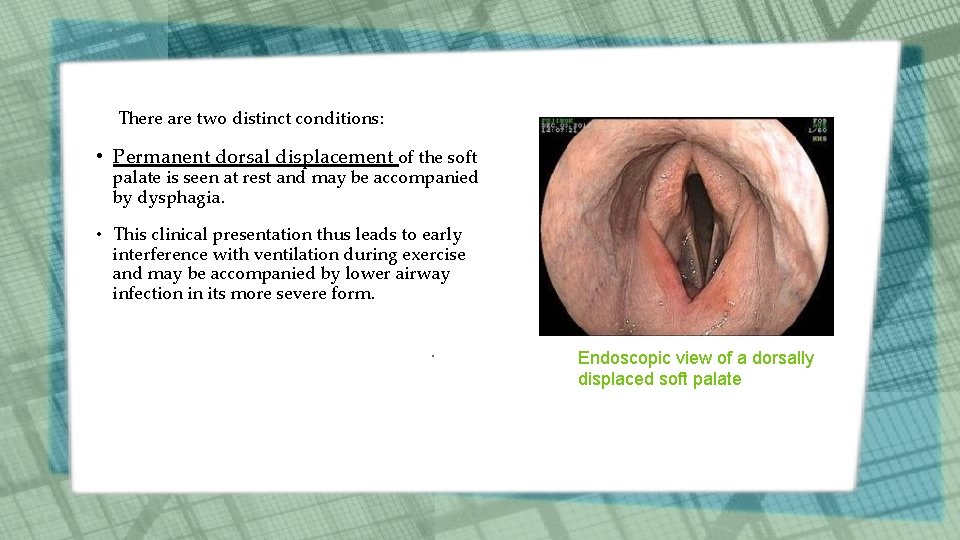
There are two distinct conditions: • Permanent dorsal displacement of the soft palate is seen at rest and may be accompanied by dysphagia. • This clinical presentation thus leads to early interference with ventilation during exercise and may be accompanied by lower airway infection in its more severe form. . Endoscopic view of a dorsally displaced soft palate
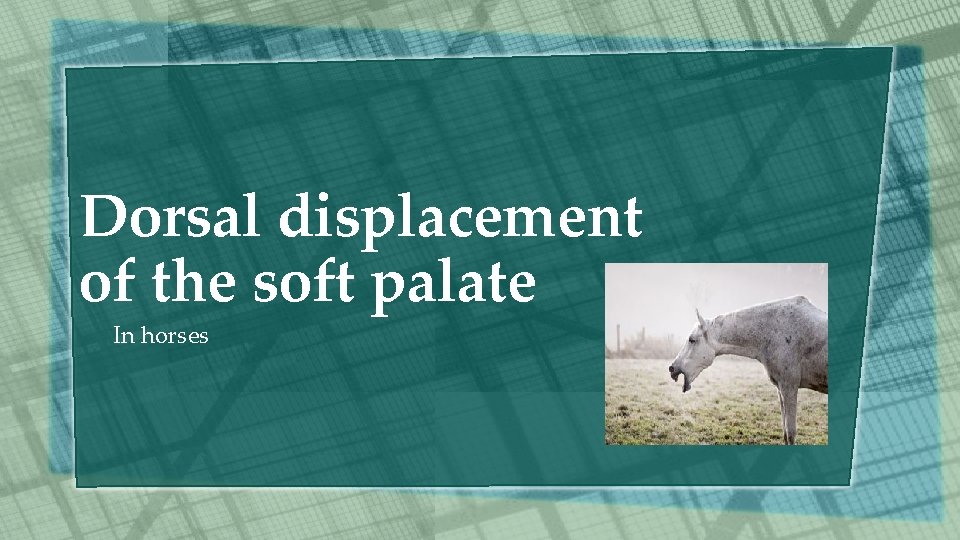
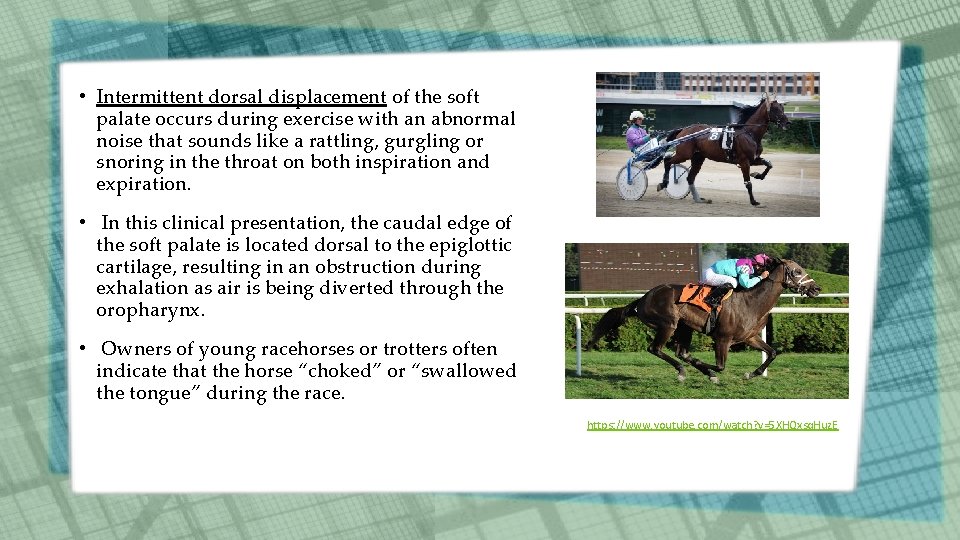
• Intermittent dorsal displacement of the soft palate occurs during exercise with an abnormal noise that sounds like a rattling, gurgling or snoring in the throat on both inspiration and expiration. • In this clinical presentation, the caudal edge of the soft palate is located dorsal to the epiglottic cartilage, resulting in an obstruction during exhalation as air is being diverted through the oropharynx. • Owners of young racehorses or trotters often indicate that the horse “choked” or “swallowed the tongue” during the race. https: //www. youtube. com/watch? v=5 XHQxsq. Huz. E
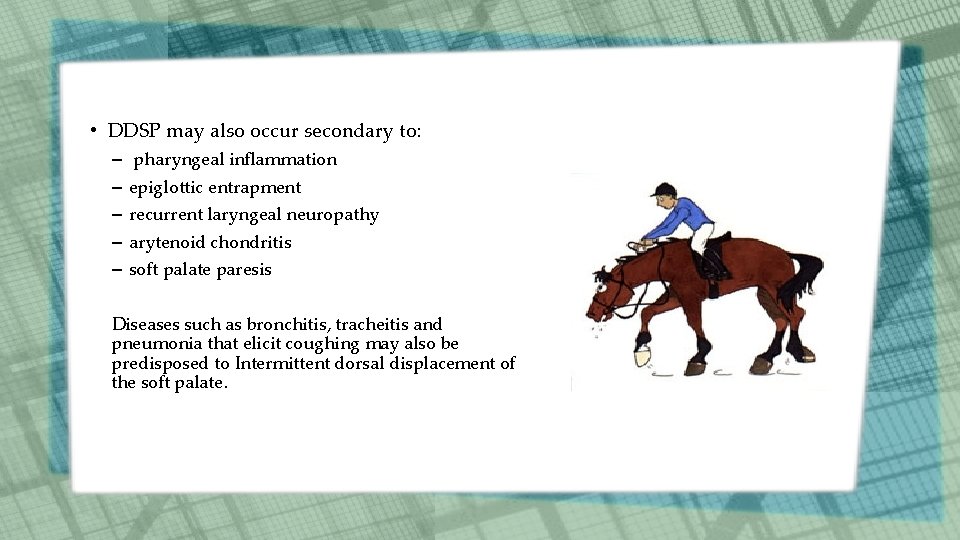
• DDSP may also occur secondary to: – – – pharyngeal inflammation epiglottic entrapment recurrent laryngeal neuropathy arytenoid chondritis soft palate paresis Diseases such as bronchitis, tracheitis and pneumonia that elicit coughing may also be predisposed to Intermittent dorsal displacement of the soft palate.
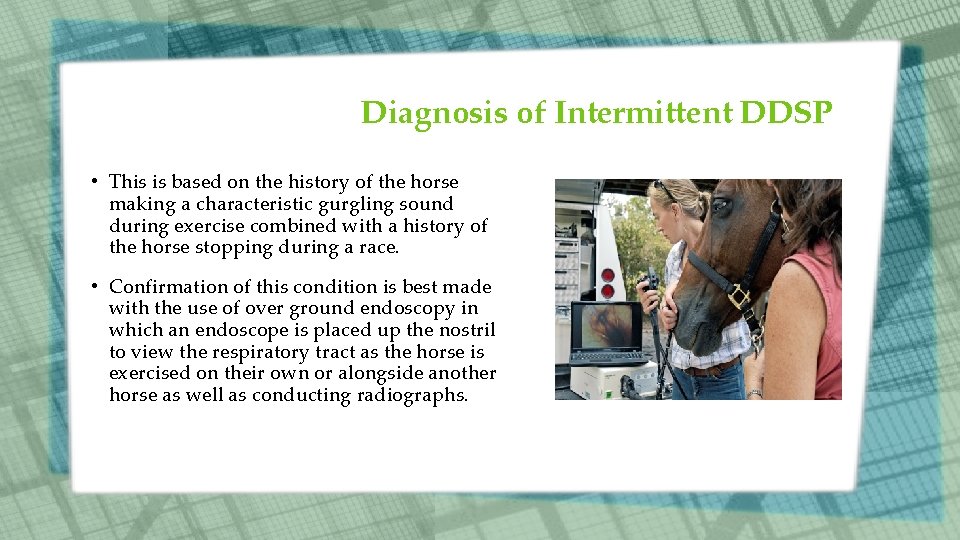
Diagnosis of Intermittent DDSP • This is based on the history of the horse making a characteristic gurgling sound during exercise combined with a history of the horse stopping during a race. • Confirmation of this condition is best made with the use of over ground endoscopy in which an endoscope is placed up the nostril to view the respiratory tract as the horse is exercised on their own or alongside another horse as well as conducting radiographs.
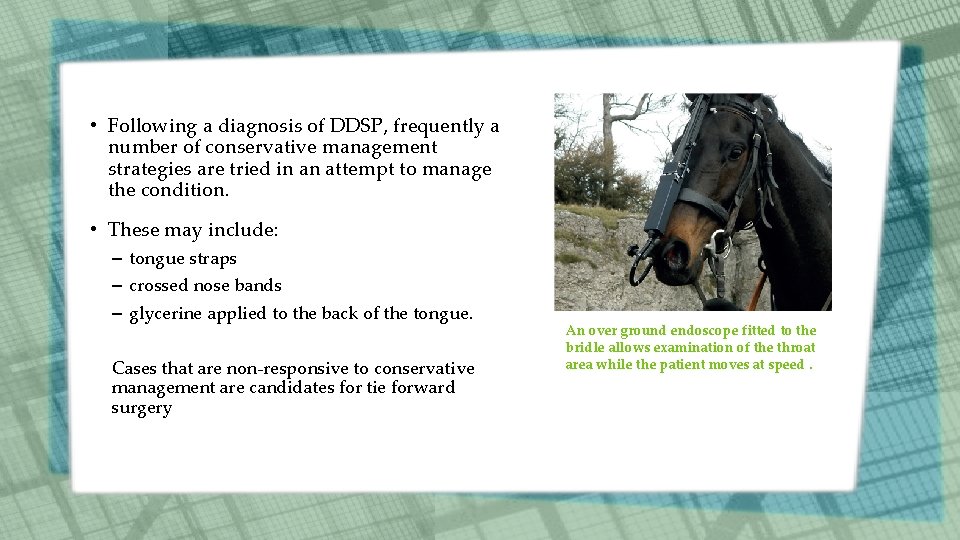
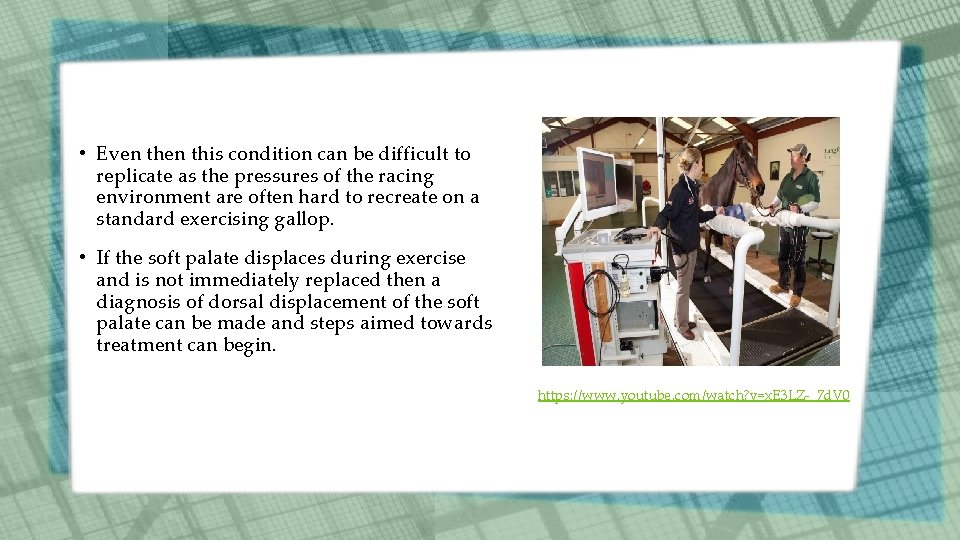
• Following a diagnosis of DDSP, frequently a number of conservative management strategies are tried in an attempt to manage the condition. • These may include: – tongue straps – crossed nose bands – glycerine applied to the back of the tongue. Cases that are non-responsive to conservative management are candidates for tie forward surgery An over ground endoscope fitted to the bridle allows examination of the throat area while the patient moves at speed.
• Even this condition can be difficult to replicate as the pressures of the racing environment are often hard to recreate on a standard exercising gallop. • If the soft palate displaces during exercise and is not immediately replaced then a diagnosis of dorsal displacement of the soft palate can be made and steps aimed towards treatment can begin. https: //www. youtube. com/watch? v=x. E 3 LZ-_7 d. V 0
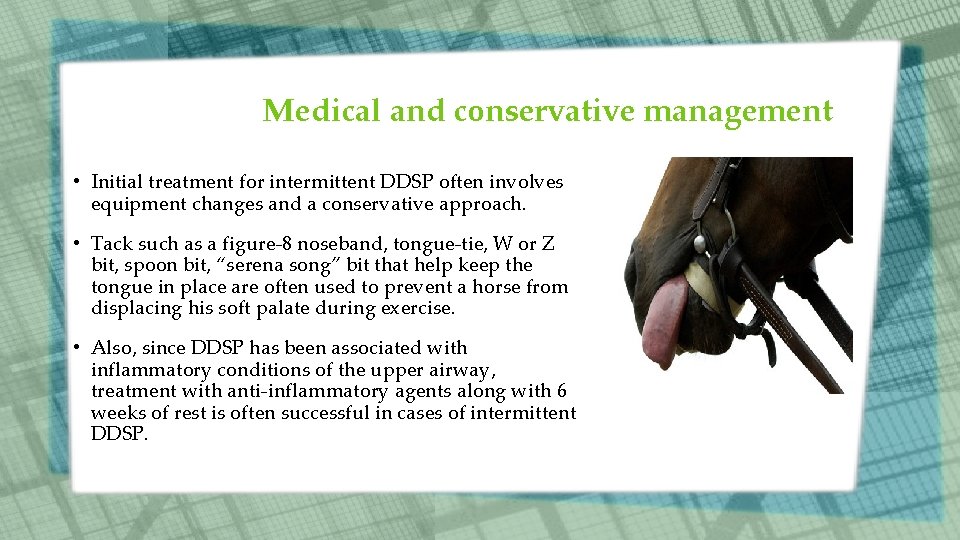
Medical and conservative management • Initial treatment for intermittent DDSP often involves equipment changes and a conservative approach. • Tack such as a figure-8 noseband, tongue-tie, W or Z bit, spoon bit, “serena song” bit that help keep the tongue in place are often used to prevent a horse from displacing his soft palate during exercise. • Also, since DDSP has been associated with inflammatory conditions of the upper airway, treatment with anti-inflammatory agents along with 6 weeks of rest is often successful in cases of intermittent DDSP.
Surgical treatments • These include: – – – – Myectomy of the sternohyoid and sternothyroid muscles pharyngoplasty Staphylectomy Combined Staphylectomy & myectomy Palate cautery Epiglottic augmentation with polytetrafluoroethylene paste Laryngeal tie forward aka Laryngohyoid reduction
Laryngeal tie forward • It is now the most widely accepted surgical treatment for confirmed DDSP. This involves permanently fixing the larynx forward by means of two sutures placed either side of the larynx tied to the more rostrally positioned basihyoid bone. • The distance between the epiglottis and the opening of the larynx is reduced thereby making it harder for the soft palate to displace on top of the epiglottis. • Procedures that help to increase the seal between the soft palate and epiglottis have orientated around either advancing the larynx forward, thereby pulling the epiglottis closer to the edge of the soft palate or preventing the caudal pull of the larynx by transection of two muscle groups (sternothyroid and sternohyoid that attach to the thyroid cartilage at the back of the larynx. • Some surgeons like to combine this procedure with a Staphylectomy in which a small portion of the free border of the soft palate is surgically removed. • This can also be done as a separate procedure by transendoscopic laser.