
Dorri te Boekhorst TWM fall 2009 River basin
Dorri te Boekhorst TWM - fall 2009 River basin management in China IRBM and the nine-headed dragon
- Problem definition - Government and water management - Where did we come from? - Where are we now?
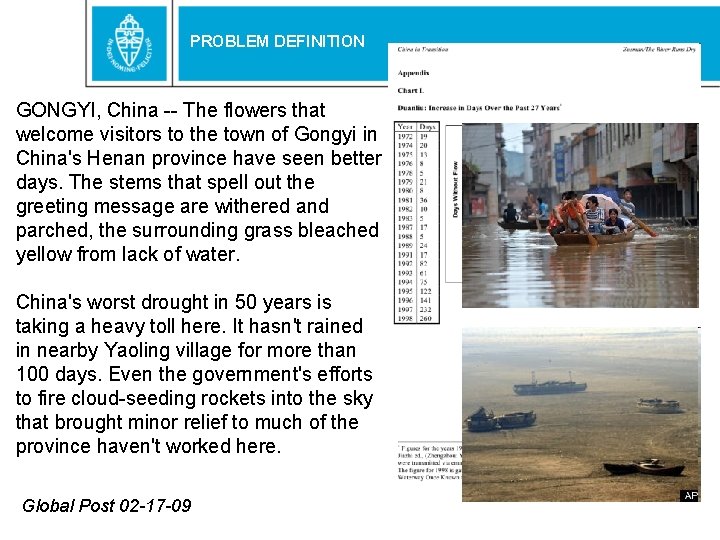
PROBLEM DEFINITION GONGYI, China -- The flowers that welcome visitors to the town of Gongyi in China's Henan province have seen better days. The stems that spell out the greeting message are withered and parched, the surrounding grass bleached yellow from lack of water. China's worst drought in 50 years is taking a heavy toll here. It hasn't rained in nearby Yaoling village for more than 100 days. Even the government's efforts to fire cloud-seeding rockets into the sky that brought minor relief to much of the province haven't worked here. Global Post 02 -17 -09
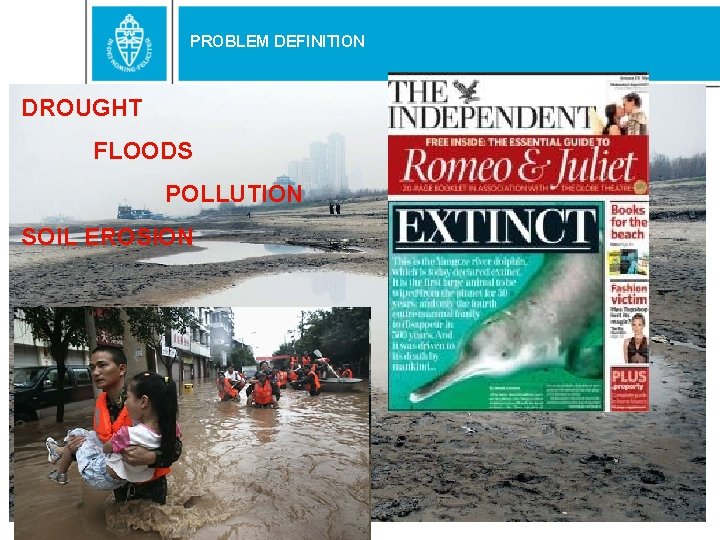
PROBLEM DEFINITION DROUGHT FLOODS POLLUTION SOIL EROSION
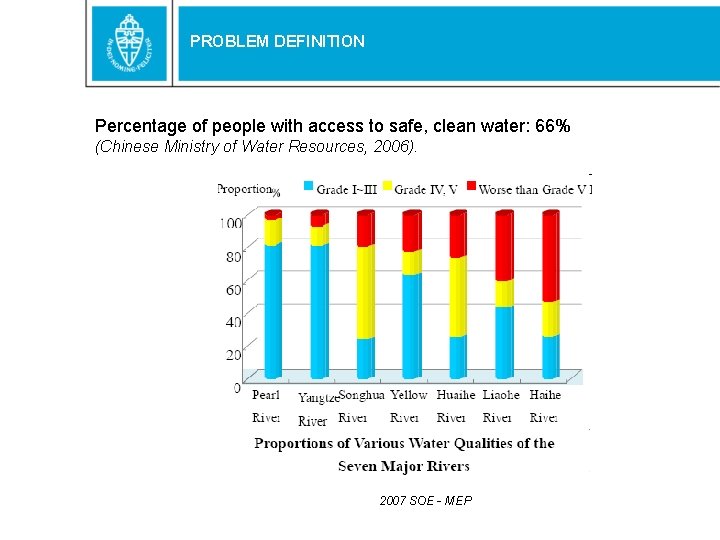
PROBLEM DEFINITION Percentage of people with access to safe, clean water: 66% (Chinese Ministry of Water Resources, 2006). 2007 SOE - MEP
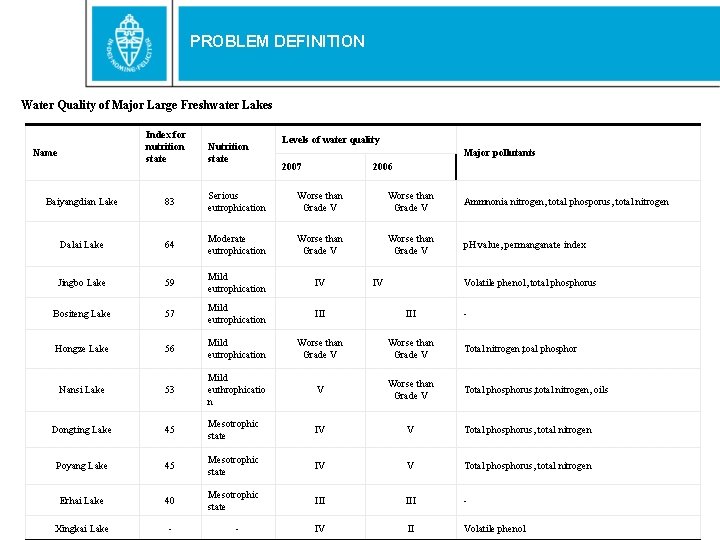
PROBLEM DEFINITION Water Quality of Major Large Freshwater Lakes Index for nutrition state Name Nutrition state Levels of water quality Major pollutants 2007 2006 Baiyangdian Lake 83 Serious eutrophication Worse than Grade V Ammnonia nitrogen, total phosporus, total nitrogen Dalai Lake 64 Moderate eutrophication Worse than Grade V p. H value, permanganate index Jingbo Lake 59 Mild eutrophication IV Bositeng Lake 57 Mild eutrophication III Hongze Lake 56 Mild eutrophication Worse than Grade V Total nitrogen, toal phosphor Nansi Lake 53 Mild euthrophicatio n V Worse than Grade V Total phosphorus, total nitrogen, oils Dongting Lake 45 Mesotrophic state IV V Total phosphorus, total nitrogen Poyang Lake 45 Mesotrophic state IV V Total phosphorus, total nitrogen Erhai Lake 40 Mesotrophic state III - Xingkai Lake - IV II Volatile phenol - IV Volatile phenol, total phosphorus -
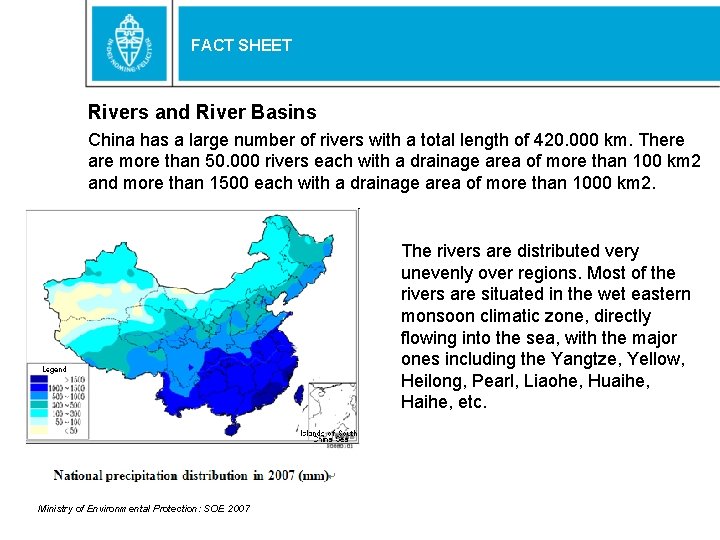
FACT SHEET Rivers and River Basins China has a large number of rivers with a total length of 420. 000 km. There are more than 50. 000 rivers each with a drainage area of more than 100 km 2 and more than 1500 each with a drainage area of more than 1000 km 2. The rivers are distributed very unevenly over regions. Most of the rivers are situated in the wet eastern monsoon climatic zone, directly flowing into the sea, with the major ones including the Yangtze, Yellow, Heilong, Pearl, Liaohe, Huaihe, Haihe, etc. Ministry of Environmental Protection: SOE 2007
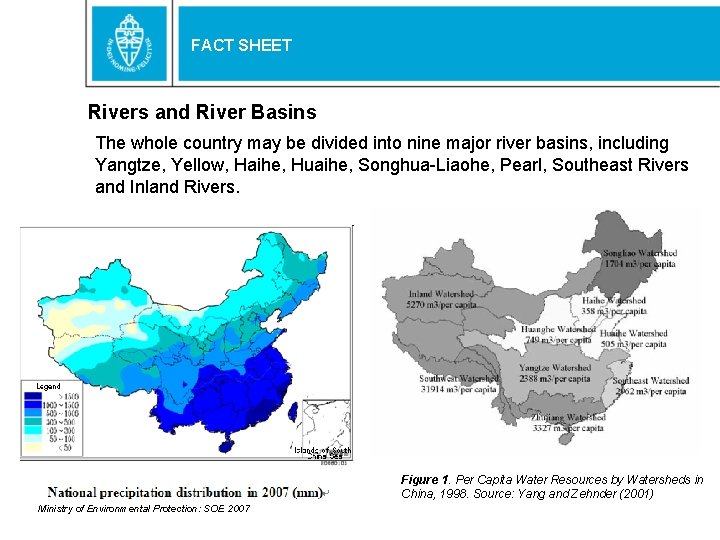
FACT SHEET Rivers and River Basins The whole country may be divided into nine major river basins, including Yangtze, Yellow, Haihe, Huaihe, Songhua-Liaohe, Pearl, Southeast Rivers and Inland Rivers. Figure 1. Per Capita Water Resources by Watersheds in China, 1998. Source: Yang and Zehnder (2001) Ministry of Environmental Protection: SOE 2007
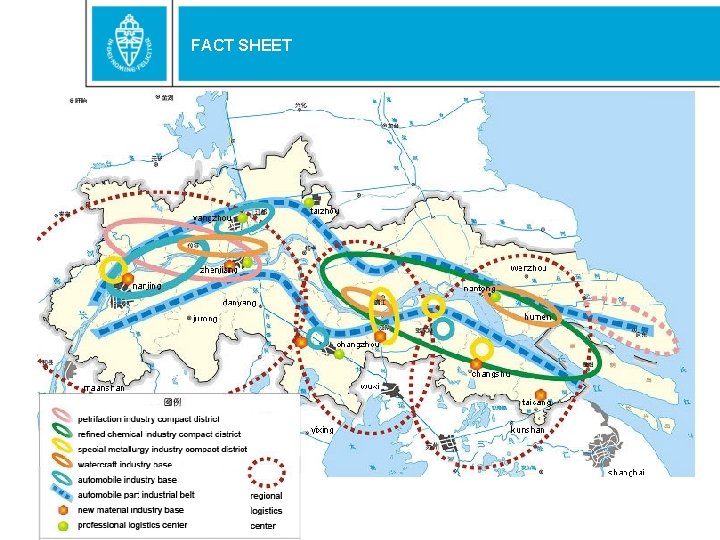
FACT SHEET Yangzte river • • China’s longest river: 6300 km ~ 700 tributaries Basin covers about 19% China’s total land area 19 provinces, automnomous regions and municipalities • • • Major inland waterway Major source for irrigation, agriculture and hydro-electric power 17 dams, inlcuding San Ba • • Important ecosystem wich in biodiversity 370 fish species, birds (wintering area threatened japanese crane), flora
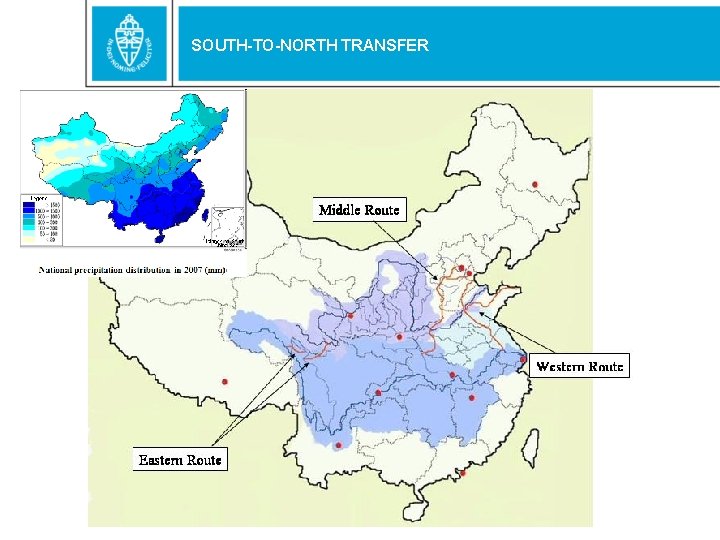
SOUTH-TO-NORTH TRANSFER
SOUTH-TO-NORTH TRANSFER “the present conflicts caused by competitive water users of agricultural, industrial, domestic and ecological shall be alleviated. Water demand of agriculture and ecologic system shall be met and over-exploitation of groundwater shall be controlled. ” MWR 2006 project proponent COSTS: US$62 billion BENEFITS: 45 billion (109) m 3 water annually STATUS: Construction on the eastern and central routes is underway. Western route in planning stage. Entire project duration ~ 50 years to complete. BENEFICIARIES: Cities and industries. Eastern route: domestic and industrial water use for Shandong and Jiangsu provinces. Central route more than 20 cities, including Beijing and Tianjin. Farmers will be the last to benefit from project water. PROBLEMS: Decreased water quality in both channels (run-off factories) and Yangtze river basin; water tariffs will be stiff, cities may pass this water; roughly 300, 000 people are to be resettled by the project.
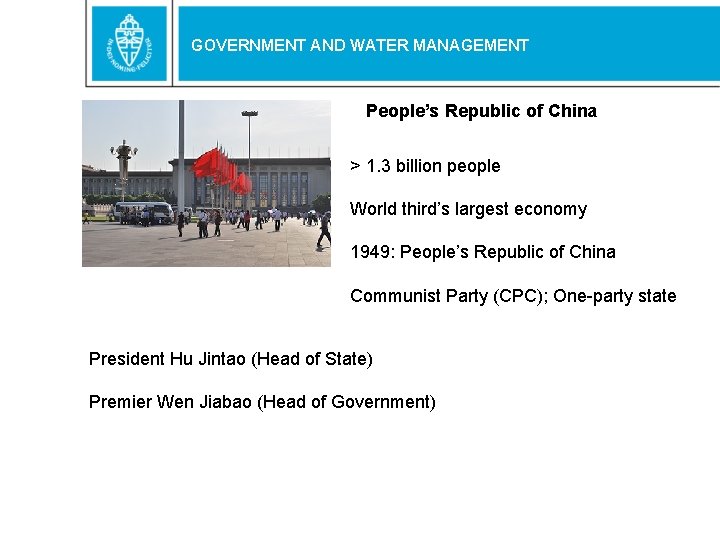
GOVERNMENT AND WATER MANAGEMENT People’s Republic of China > 1. 3 billion people World third’s largest economy 1949: People’s Republic of China Communist Party (CPC); One-party state President Hu Jintao (Head of State) Premier Wen Jiabao (Head of Government)
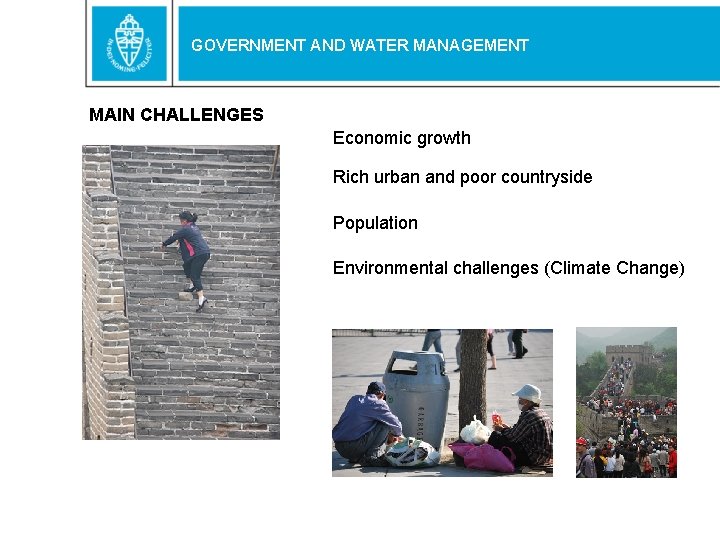
GOVERNMENT AND WATER MANAGEMENT MAIN CHALLENGES Economic growth Rich urban and poor countryside Population Environmental challenges (Climate Change)
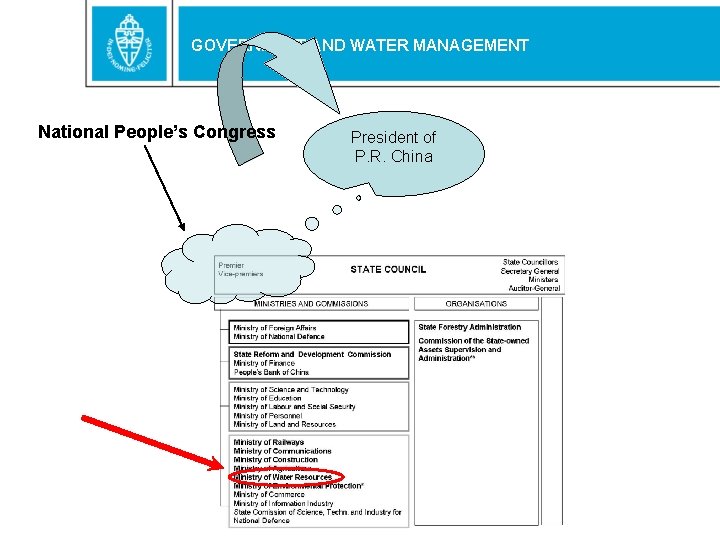
GOVERNMENT AND WATER MANAGEMENT National People’s Congress President of P. R. China
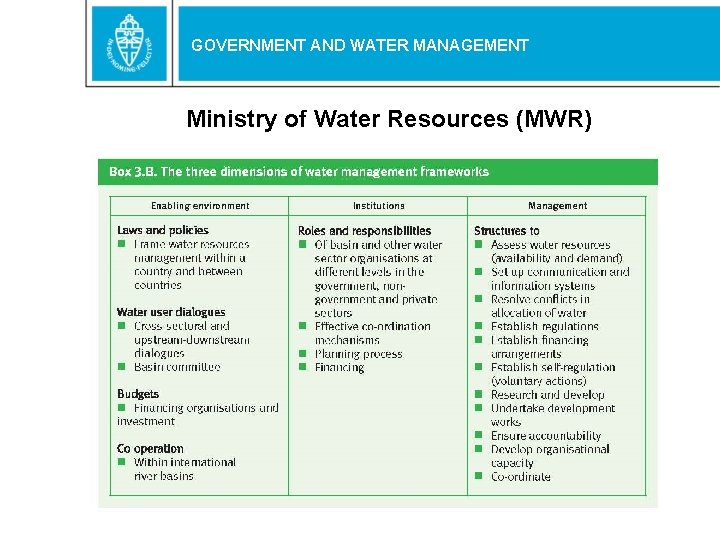
GOVERNMENT AND WATER MANAGEMENT Ministry of Water Resources (MWR)
GOVERNMENT AND WATER MANAGEMENT 1. Ensure water resources are rationally developed and utilized; […]; provide draft legislations and promulgate water administrative rules and regulations; make integrated river basin management plans and flood control plans for major rivers and lakes […] 2. Take overall consideration and secure domestic, industrial and ecological water uses; undertake integrated water resources management and supervision; formulate and supervise the implementation of national and inter-provincial development plans of water supply and demand schemes for water allocation […] 3. Take charge of water resource protection; organize and draft water resource protection plans, water function zoning in major rivers and lakes and implementation supervision; review and verify the capacity of pollutant load of water bodies; make proposals on the limit of total wastewater discharge; … 4. Take charge of flood control and drought relief, and undertake day-to-day work of the Office of State Flood Control and Drought Relief Headquarters… 5. Take charge of water conservation; formulate water conservation policies, draft water-saving plans, develop relevant standards and give directions and promote the water-saving society campaign. 6. Provide guidance to hydrological work, including hydrological monitoring of water resources, … 7. Provide guidance to the management and protection of water infrastructures, water bodies and shorelines, control and development of major rivers, lakes, estuaries and coast beaches; … 8. Be responsible for control of soil and water losses by formulating soil and water conservation plans and supervision, … 9. Provide guidance to irrigation & drainage and rural water supply by organizing and coordinating construction of farmland water facilities, construction and management of projects of safe drinking water supply and water-saving irrigation, … 10. Be responsible for investigating illegal cases that violating water laws, mediate and arbitrate inter-sector and interprovince water disputes, provide guidance to the enforcement and execution of water laws and regulations; … 11. Management of water science and technology and foreign affairs related to water issues, … 12. Other duties and responsibilities assigned by the State Council.
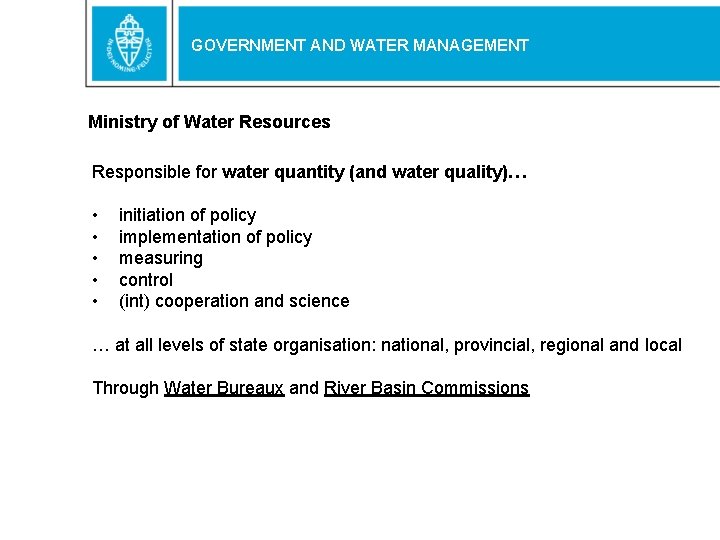
GOVERNMENT AND WATER MANAGEMENT Ministry of Water Resources Responsible for water quantity (and water quality)… • • • initiation of policy implementation of policy measuring control (int) cooperation and science … at all levels of state organisation: national, provincial, regional and local Through Water Bureaux and River Basin Commissions
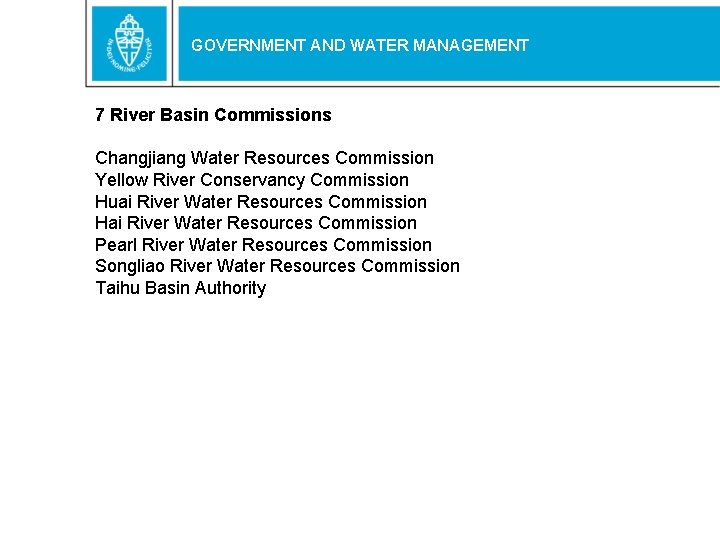
GOVERNMENT AND WATER MANAGEMENT 7 River Basin Commissions Changjiang Water Resources Commission Yellow River Conservancy Commission Huai River Water Resources Commission Hai River Water Resources Commission Pearl River Water Resources Commission Songliao River Water Resources Commission Taihu Basin Authority
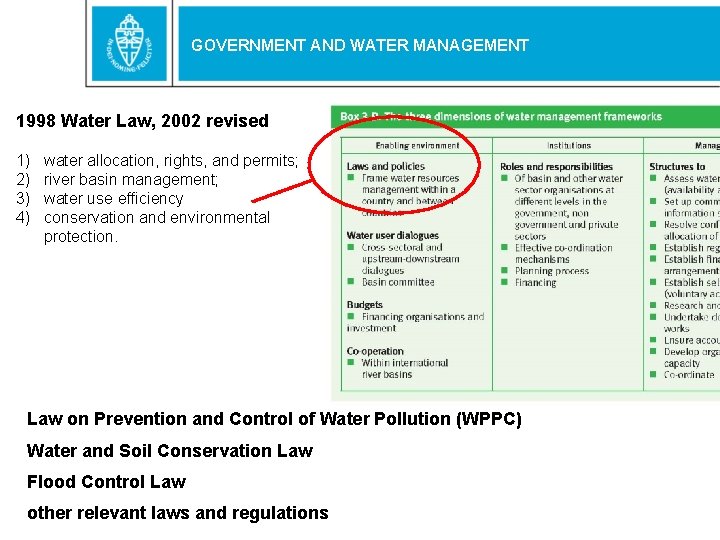
GOVERNMENT AND WATER MANAGEMENT 1998 Water Law, 2002 revised 1) 2) 3) 4) water allocation, rights, and permits; river basin management; water use efficiency conservation and environmental protection. Law on Prevention and Control of Water Pollution (WPPC) Water and Soil Conservation Law Flood Control Law other relevant laws and regulations
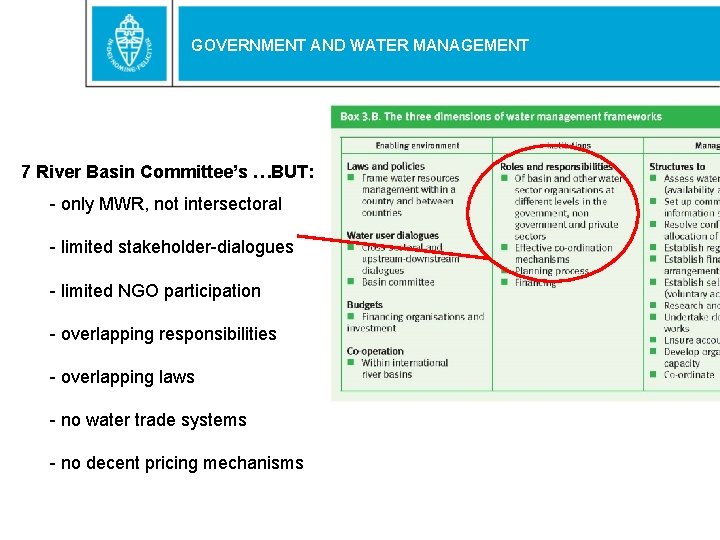
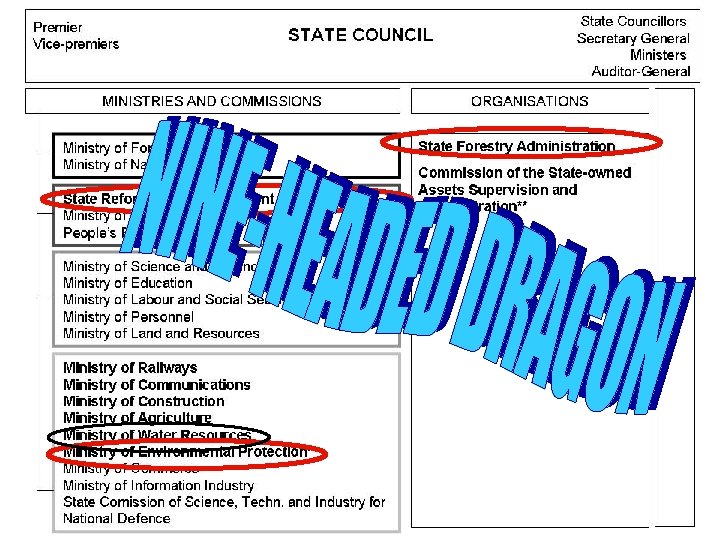
GOVERNMENT AND WATER MANAGEMENT 7 River Basin Committee’s …BUT: - only MWR, not intersectoral - limited stakeholder-dialogues - limited NGO participation - overlapping responsibilities - overlapping laws - no water trade systems - no decent pricing mechanisms
D. te Boekhorst 04 -07 -2008
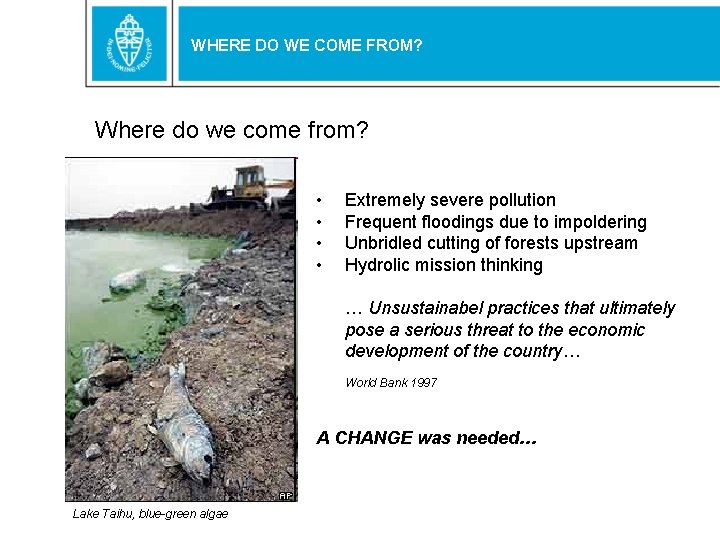
WHERE DO WE COME FROM? Where do we come from? • • Extremely severe pollution Frequent floodings due to impoldering Unbridled cutting of forests upstream Hydrolic mission thinking … Unsustainabel practices that ultimately pose a serious threat to the economic development of the country… World Bank 1997 A CHANGE was needed… Lake Taihu, blue-green algae
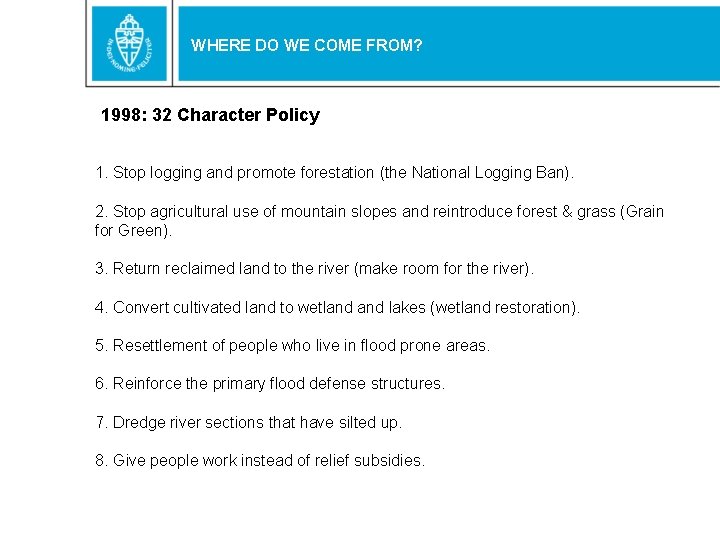
WHERE DO WE COME FROM? 1998: 32 Character Policy 1. Stop logging and promote forestation (the National Logging Ban). 2. Stop agricultural use of mountain slopes and reintroduce forest & grass (Grain for Green). 3. Return reclaimed land to the river (make room for the river). 4. Convert cultivated land to wetland lakes (wetland restoration). 5. Resettlement of people who live in flood prone areas. 6. Reinforce the primary flood defense structures. 7. Dredge river sections that have silted up. 8. Give people work instead of relief subsidies.
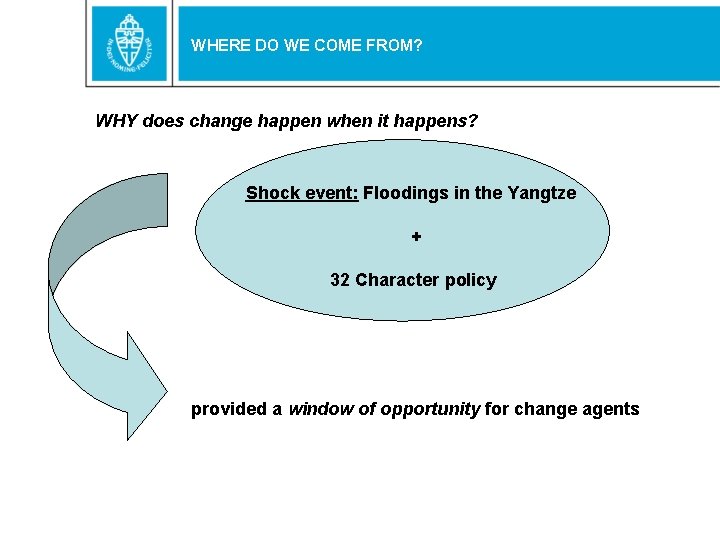
WHERE DO WE COME FROM? WHY does change happen when it happens? Shock event: Floodings in the Yangtze + 32 Character policy provided a window of opportunity for change agents
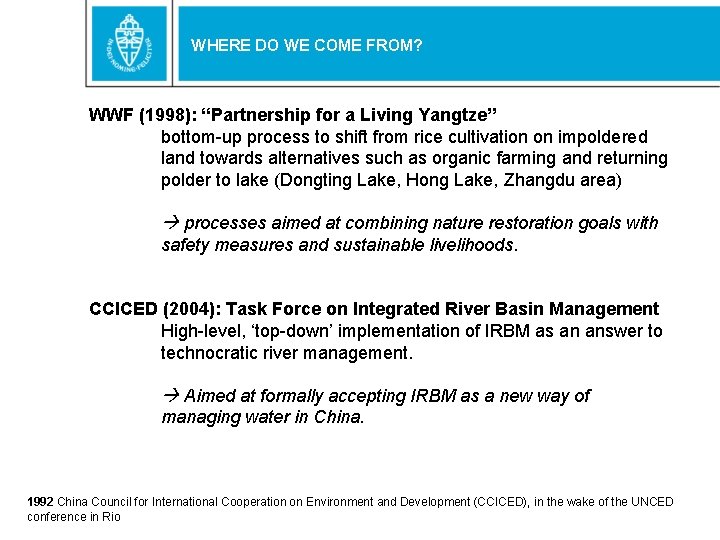
WHERE DO WE COME FROM? WWF (1998): “Partnership for a Living Yangtze” bottom-up process to shift from rice cultivation on impoldered land towards alternatives such as organic farming and returning polder to lake (Dongting Lake, Hong Lake, Zhangdu area) processes aimed at combining nature restoration goals with safety measures and sustainable livelihoods. CCICED (2004): Task Force on Integrated River Basin Management High-level, ‘top-down’ implementation of IRBM as an answer to technocratic river management. Aimed at formally accepting IRBM as a new way of managing water in China. 1992 China Council for International Cooperation on Environment and Development (CCICED), in the wake of the UNCED conference in Rio
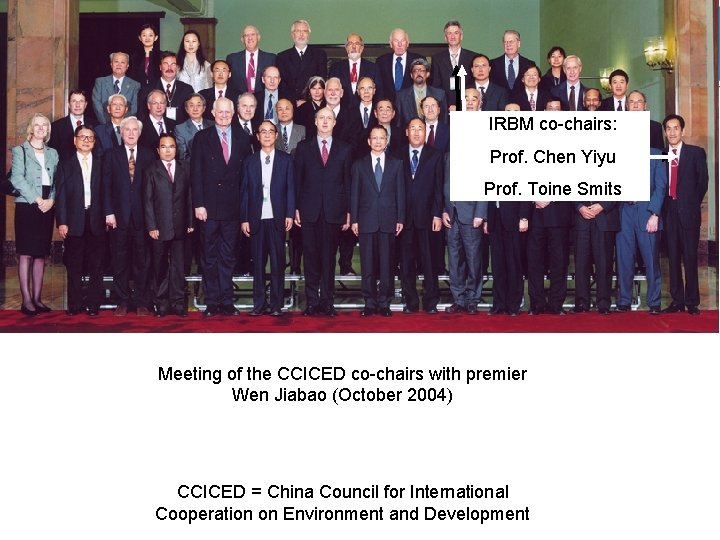
IRBMco-chairs: Prof. Chen. Yiyu Prof. Toine. Smits Meeting of the CCICED co-chairs with premier Wen Jiabao (October 2004) CCICED = China Council for International Cooperation on Environment and Development
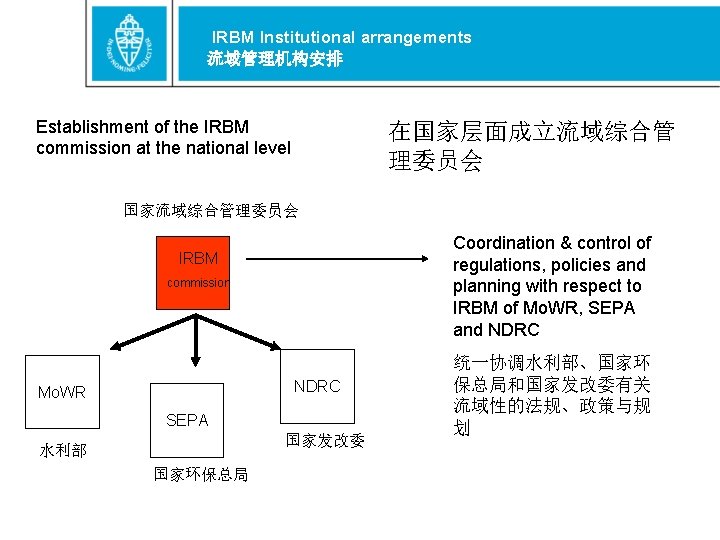
IRBM Institutional arrangements 流域管理机构安排 Establishment of the IRBM commission at the national level 在国家层面成立流域综合管 理委员会 国家流域综合管理委员会 Coordination & control of regulations, policies and planning with respect to IRBM of Mo. WR, SEPA and NDRC IRBM commission NDRC Mo. WR SEPA 国家发改委 水利部 国家环保总局 统一协调水利部、国家环 保总局和国家发改委有关 流域性的法规、政策与规 划
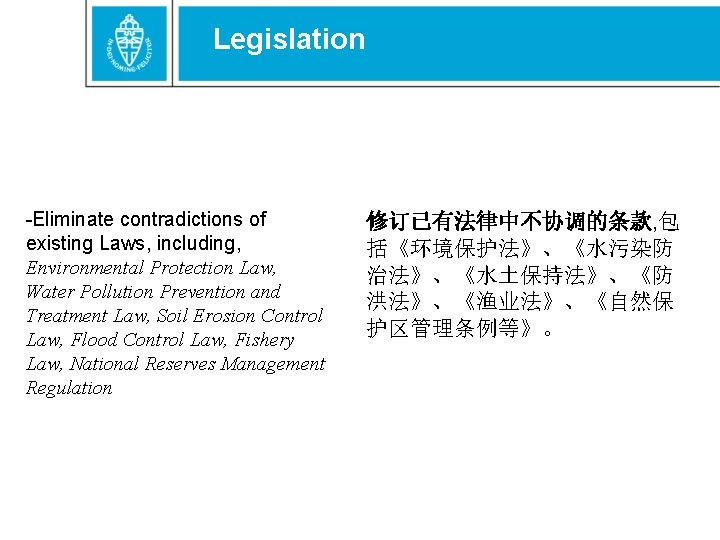
Legislation -Eliminate contradictions of existing Laws, including, Environmental Protection Law, Water Pollution Prevention and Treatment Law, Soil Erosion Control Law, Flood Control Law, Fishery Law, National Reserves Management Regulation 修订已有法律中不协调的条款, 包 括《环境保护法》、《水污染防 治法》、《水土保持法》、《防 洪法》、《渔业法》、《自然保 护区管理条例等》。
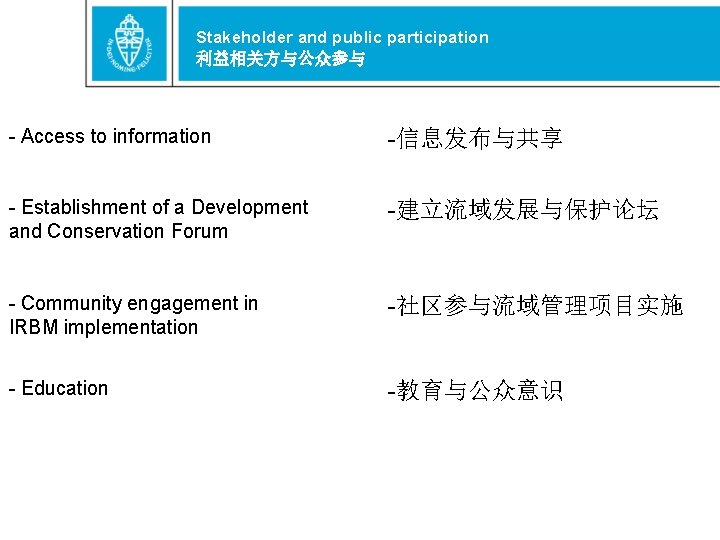
Stakeholder and public participation 利益相关方与公众参与 - Access to information -信息发布与共享 - Establishment of a Development and Conservation Forum -建立流域发展与保护论坛 - Community engagement in IRBM implementation -社区参与流域管理项目实施 - Education -教育与公众意识
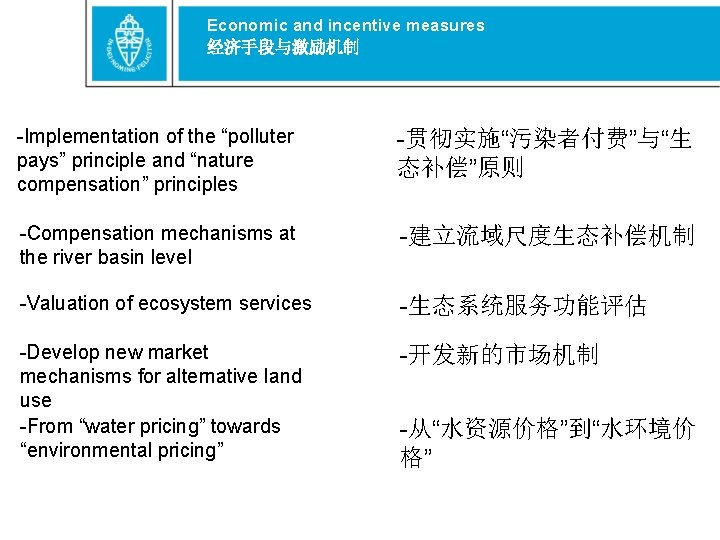
Economic and incentive measures 经济手段与激励机制 -Implementation of the “polluter pays” principle and “nature compensation” principles -贯彻实施“污染者付费”与“生 态补偿”原则 -Compensation mechanisms at the river basin level -建立流域尺度生态补偿机制 -Valuation of ecosystem services -生态系统服务功能评估 -Develop new market mechanisms for alternative land use -From “water pricing” towards “environmental pricing” -开发新的市场机制 -从“水资源价格”到“水环境价 格”
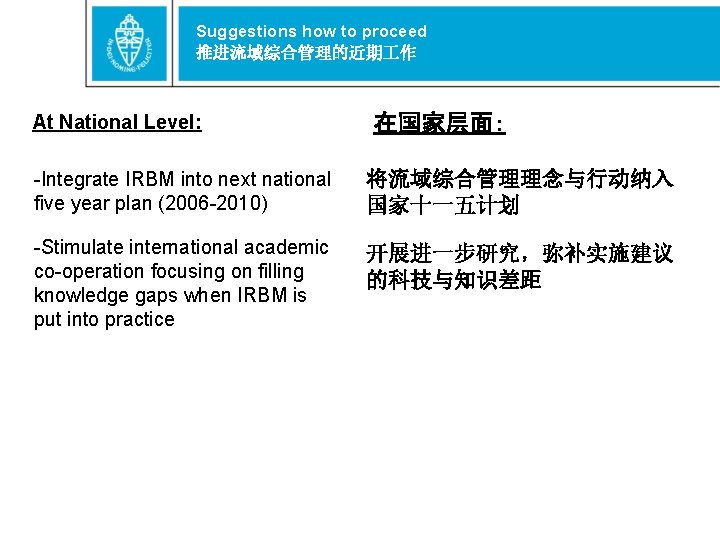
Suggestions how to proceed 推进流域综合管理的近期 作 At National Level: 在国家层面: -Integrate IRBM into next national five year plan (2006 -2010) 将流域综合管理理念与行动纳入 国家十一五计划 -Stimulate international academic co-operation focusing on filling knowledge gaps when IRBM is put into practice 开展进一步研究,弥补实施建议 的科技与知识差距
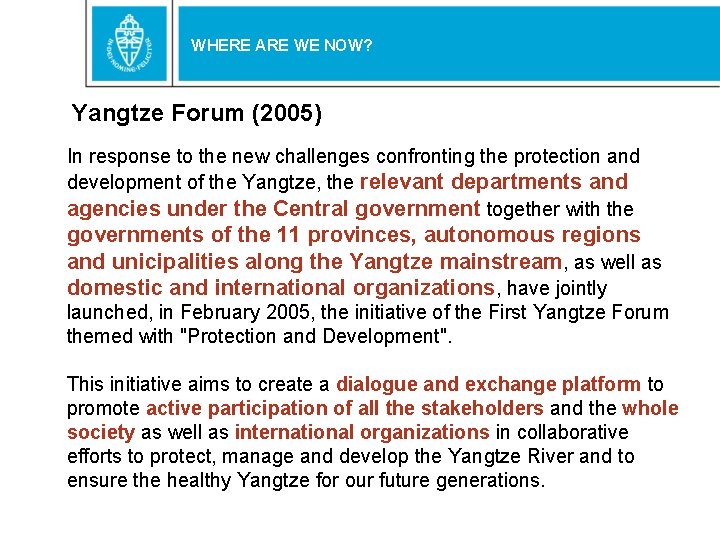
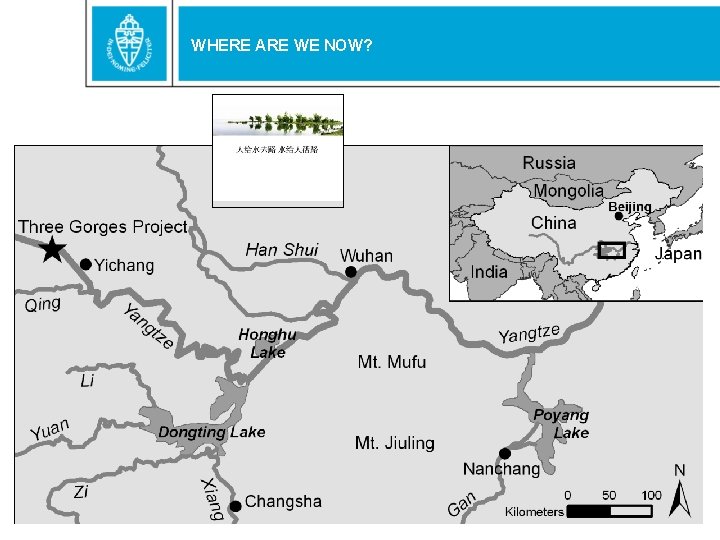
WHERE ARE WE NOW? Yangtze Forum (2005) In response to the new challenges confronting the protection and development of the Yangtze, the relevant departments and agencies under the Central government together with the governments of the 11 provinces, autonomous regions and unicipalities along the Yangtze mainstream, as well as domestic and international organizations, have jointly launched, in February 2005, the initiative of the First Yangtze Forum themed with "Protection and Development". This initiative aims to create a dialogue and exchange platform to promote active participation of all the stakeholders and the whole society as well as international organizations in collaborative efforts to protect, manage and develop the Yangtze River and to ensure the healthy Yangtze for our future generations.
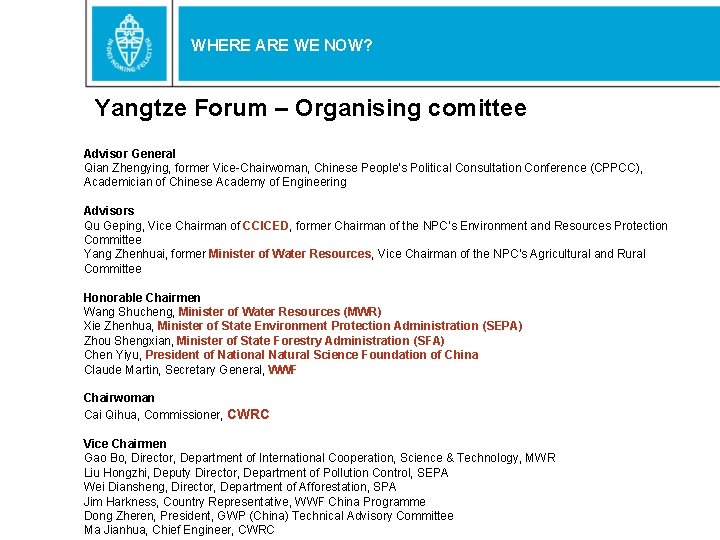
WHERE ARE WE NOW? Yangtze Forum – Organising comittee Advisor General Qian Zhengying, former Vice-Chairwoman, Chinese People’s Political Consultation Conference (CPPCC), Academician of Chinese Academy of Engineering Advisors Qu Geping, Vice Chairman of CCICED, former Chairman of the NPC’s Environment and Resources Protection Committee Yang Zhenhuai, former Minister of Water Resources, Vice Chairman of the NPC’s Agricultural and Rural Committee Honorable Chairmen Wang Shucheng, Minister of Water Resources (MWR) Xie Zhenhua, Minister of State Environment Protection Administration (SEPA) Zhou Shengxian, Minister of State Forestry Administration (SFA) Chen Yiyu, President of National Natural Science Foundation of China Claude Martin, Secretary General, WWF Chairwoman Cai Qihua, Commissioner, CWRC Vice Chairmen Gao Bo, Director, Department of International Cooperation, Science & Technology, MWR Liu Hongzhi, Deputy Director, Department of Pollution Control, SEPA Wei Diansheng, Director, Department of Afforestation, SPA Jim Harkness, Country Representative, WWF China Programme Dong Zheren, President, GWP (China) Technical Advisory Committee Ma Jianhua, Chief Engineer, CWRC
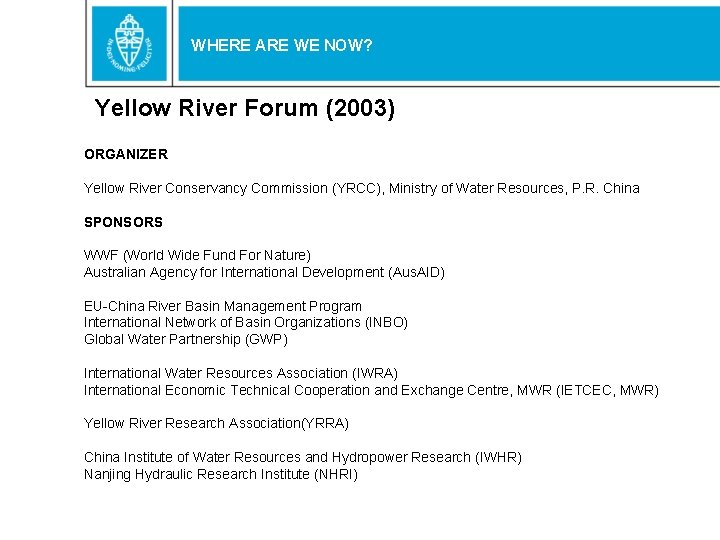
WHERE ARE WE NOW? Yellow River Forum (2003) ORGANIZER Yellow River Conservancy Commission (YRCC), Ministry of Water Resources, P. R. China SPONSORS WWF (World Wide Fund For Nature) Australian Agency for International Development (Aus. AID) EU-China River Basin Management Program International Network of Basin Organizations (INBO) Global Water Partnership (GWP) International Water Resources Association (IWRA) International Economic Technical Cooperation and Exchange Centre, MWR (IETCEC, MWR) Yellow River Research Association(YRRA) China Institute of Water Resources and Hydropower Research (IWHR) Nanjing Hydraulic Research Institute (NHRI)
WHERE ARE WE NOW?
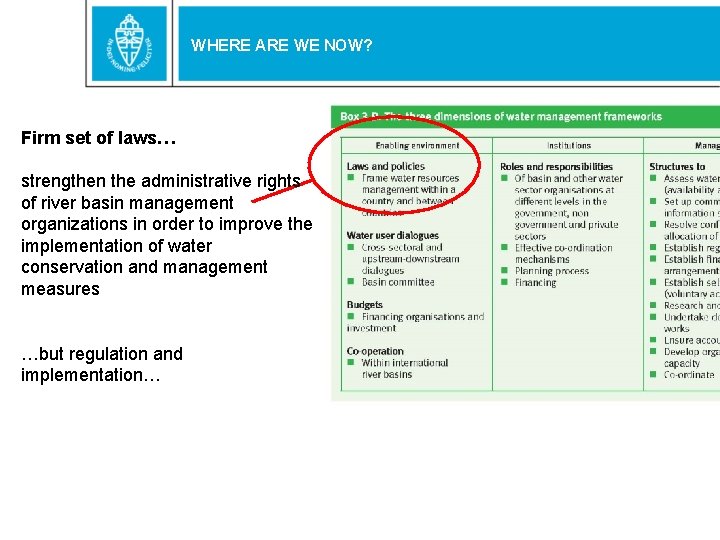
WHERE ARE WE NOW? Firm set of laws… strengthen the administrative rights of river basin management organizations in order to improve the implementation of water conservation and management measures …but regulation and implementation…
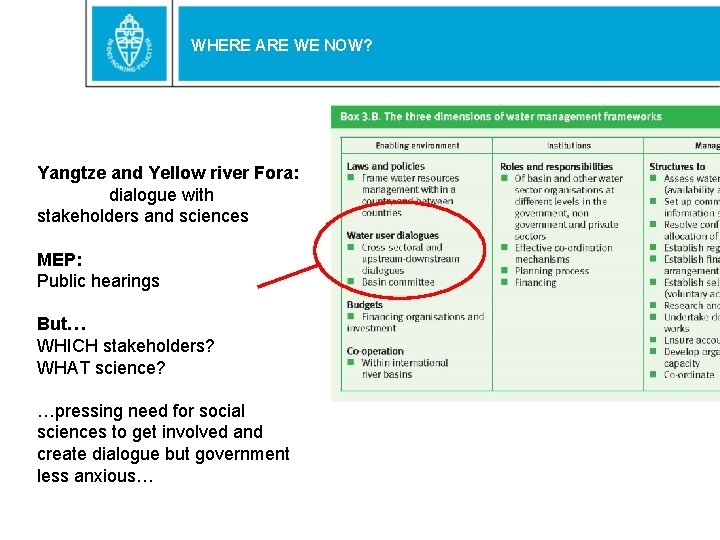
WHERE ARE WE NOW? Yangtze and Yellow river Fora: dialogue with stakeholders and sciences MEP: Public hearings But… WHICH stakeholders? WHAT science? …pressing need for social sciences to get involved and create dialogue but government less anxious…
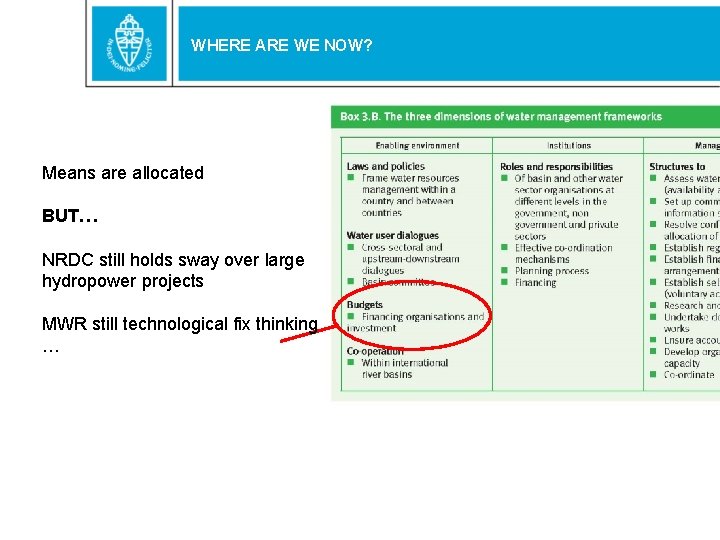
WHERE ARE WE NOW? Means are allocated BUT… NRDC still holds sway over large hydropower projects MWR still technological fix thinking …
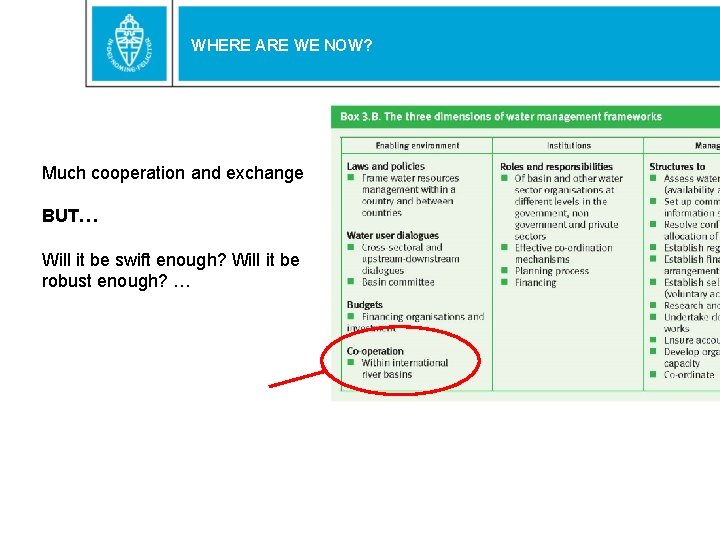
WHERE ARE WE NOW? Much cooperation and exchange BUT… Will it be swift enough? Will it be robust enough? …
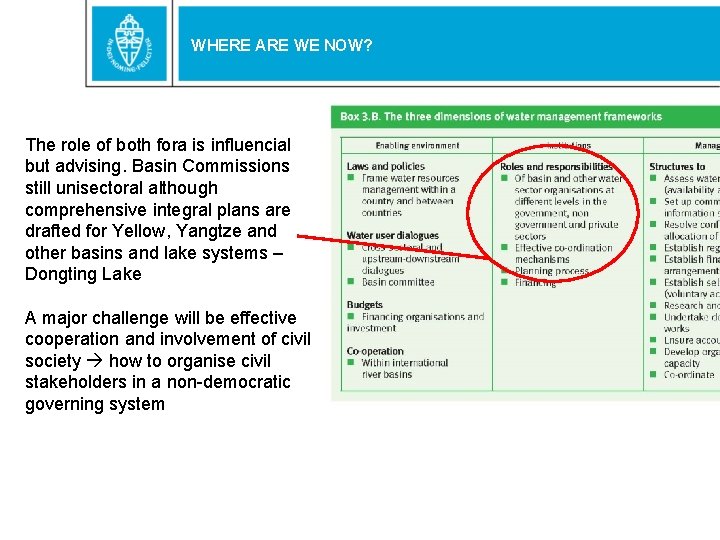
WHERE ARE WE NOW? The role of both fora is influencial but advising. Basin Commissions still unisectoral although comprehensive integral plans are drafted for Yellow, Yangtze and other basins and lake systems – Dongting Lake A major challenge will be effective cooperation and involvement of civil society how to organise civil stakeholders in a non-democratic governing system
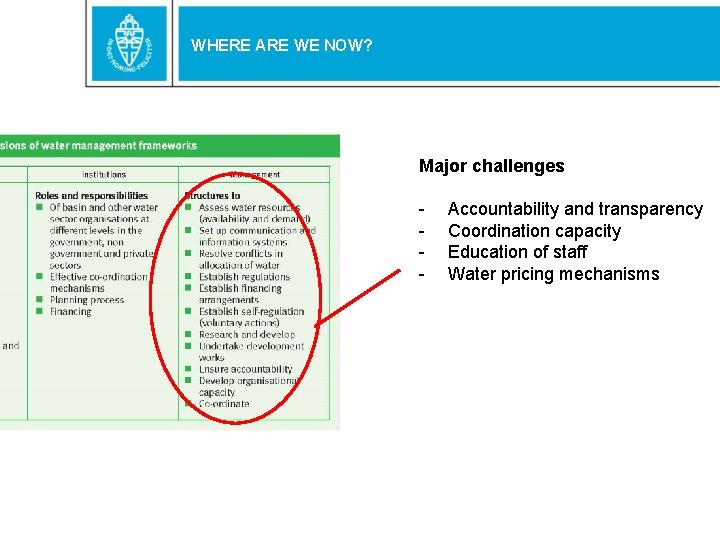
WHERE ARE WE NOW? Major challenges - Accountability and transparency Coordination capacity Education of staff Water pricing mechanisms
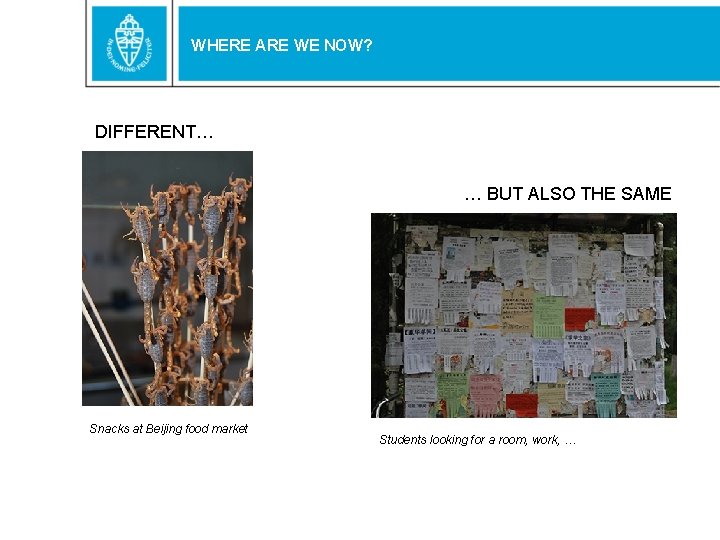
WHERE ARE WE NOW? DIFFERENT… … BUT ALSO THE SAME Snacks at Beijing food market Students looking for a room, work, …
- Slides: 42