
Dorothea Orems Self Care Deficit Nursing Theory Presented
- Slides: 7
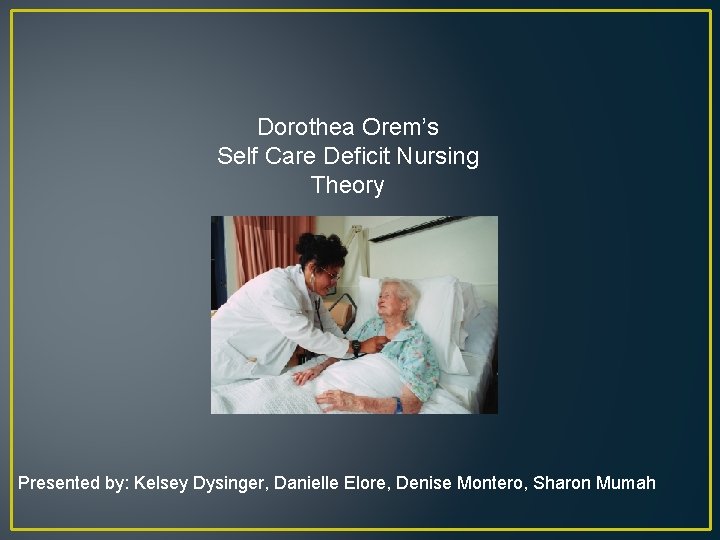
Dorothea Orem’s Self Care Deficit Nursing Theory Presented by: Kelsey Dysinger, Danielle Elore, Denise Montero, Sharon Mumah
Self Care Deficit Nursing Theory (SCDNT) • People in contemporary society want to be in control of their own lives • There are universal self-care requisites • Can the patient provide their own self-care? • People recover more quickly and holistically when providing own self-care
SCDNT and Evidence Based Practice • Used in many different medical settings • Contribute to & assist in increasing the general body of knowledge within the discipline through the research implemented to validate them. • Can be used by the practitioners to guide & improve their practice. • Theory research resulted in forms, tools, and scales used in nursing practice. • ESCA • ASA • SCI
Metaparadigm Concepts of SCDNT Person Environment A person (patient) who is under the care of a nurse; a total being with universal developmental needs and capable of self-care (Orem, 1985). The physical, chemical, biological, and social contents within which human beings exist; environmental components include environmental factors, environmental elements, environmental conditions, and developmental environment (Orem, 1985)
Metaparadigm concepts of SCDNT Health Nursing Health is a “state characterized by soundness or wholeness of developed human structures and of bodily and mental functioning” (Orem, 1995, p. 101). Nursing Therapeutic selfcare that is designed to supplement self-care requisites. Nursing actions fall into one of three categories: wholly compensatory, partly compensatory, or supportive -educative system (Orem, 1985).
SCDNT How can the Self Care Deficit Nursing Theory improve the contemporary health care environment? • Local & Regional- SCNDT in Baccalaureate Curriculum Nurses knowing role to assist patients in managing own healthcare Increase knowledge to guide the profession in education, practice, and research. • Global- Acceptance of SCDNT world wide in many countries resulting in consistent evidence based practices being followed.
References Berbiglia, V. A. . The Self Care Deficit Nursing Theory as a Curriculum Conceptual Framework in Baccalaureate Education. Nursing Science Quarterly, 24(2) 137 -145. Retrieved from http: //nsq. sagepub. com/content/24/2/137 Black, B. P. (2014). Professional Nursing: Concepts & Challenges. (7 th ed. ). St. Louis, MO: Elsevier Saunders Clarke, P. N. , Allison, S. E. , Berbiglia, V. A. , Taylor, S. G. , The Impact of Dorothea E. Orem’s Life and Work: An Interview with Orem Scholars. Nursing Science Quarterly, 22(1) 41 -46. Retrieved from http: //nsq. sagepub. com/content/22/1/41 Dorothea Orem’s Self Care Theory. (2012). Retrieved from http: //currentnursing. com/nursing_theory/self_care_deficit_theory. html Orem, D. (1985). Nursing: Concepts of Practice (3 rd ed. ). St Louis, MO: Mosby Orem, D. (1995). Nursing: Concepts of Practice (5 th ed. ). St Louis, MO: Mosby Nursing Theory. (2013). Dorothea Orem-Nursing Theorist. Retrieved from http: //www. nursing- theory. org/nursing-theorists/Dorothea-E-Orem-php Tomey, A. M. , Alligood, M. R. (2006) Dorothea E. Orem: Self Care Deficit Theory of Nursing. Yvonne Alexopoulus, Nursing theorists and Their Work (pp 267 -296). St Louis, MO: Mosby