
Dorothea Orems General Theory of Nursing Theory of
- Slides: 10
Dorothea Orem’s General Theory of Nursing • Theory of self care deficit • Theory of nursing system
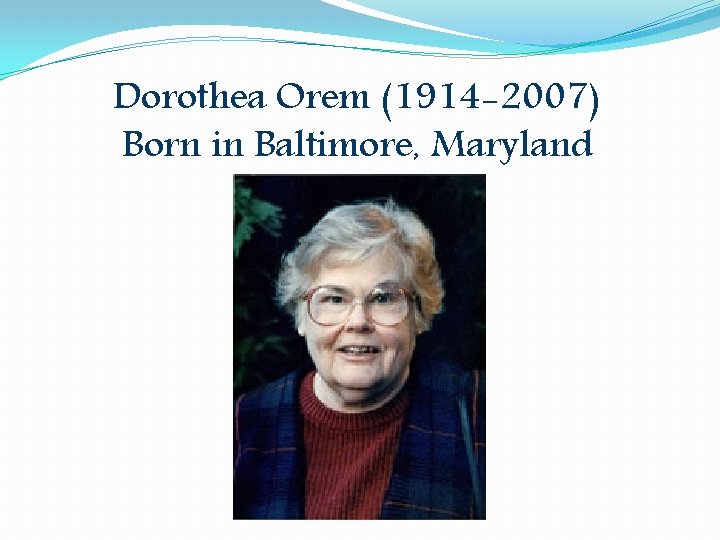
Dorothea Orem (1914 -2007) Born in Baltimore, Maryland
Education § Earned her diploma at Providence Hospital School of Nursing in 1930’s § Earned her BSN at Catholic University of America in 1939 § Earned her MSN at Catholic University of America in 1945 § Received an honorary Doctor of Science degree from Georgetown University in 1976 § Doctor of Nursing Honoris Causae from the § University of Missouri in 1998
A Brief Timeline of Accomplishments Early Experience included nursing in the operating room, private duty nursing, pediatric and adult med/surg nursing, evening supervisor in the emergency department, and biological science technician 1940 -1949 Dorothea Orem held directorship of both nursing school and department of nursing at Providence Hospital in Detroit 1949 -1957 Dorothea Orem worked at the Indiana State Board of Health where her goal was to upgrade the quality of nursing care throughout the state. It was during this time she began working on her definitions of nursing and related concepts 1959 Dorothea Orem worked for the US Department of Health where she helped publish Guidelines for Developing Curricula for the Education of Practical Nurses 1971 Her theory was first published in Nursing: Concepts of Practice. The theory was revised in 1980, 1985, 1991, 1995, and 2001
The Core Beliefs of Dorothea Orem § People should be self-reliant and responsible for their own care and others in their family needing care § People are distinct individuals § Nursing is a form of action § Successfully meeting universal and development self -care requisites is an important component of primary care prevention and ill health § A person’s knowledge of potential health problems is necessary for promoting self-care behaviors § Self-care and dependent-care behaviors learned within a socio-cultural context
The Core Beliefs of Dorothea Orem § People should be self-reliant and responsible for their own care and others in their family needing care § People are distinct individuals § Nursing is a form of action § Successfully meeting universal and development self-care requisites is an important component of primary care prevention and ill health § A person’s knowledge of potential health problems is necessary for promoting self-care behaviors § Self-care and dependent-care behaviors learned within a socio-cultural context
Dorothea Orem’s Nursing Metaparadigm (Person/Environment/Nursing/Health) Orem’s Nursing Metaparadigm: PERSON § The recipient of nursing care § Someone that functions biologically, symbolically, and socially § Has the potential for learning & development § Is subject to the forces of nature § Has a capacity for self-knowledge § Can engage in deliberate actions, interpret experiences, and perform beneficial actions § Can learn to meet self-care needs (requisites) § Human beings are distinguished from other living beings by their capacity to: Reflect upon themselves and their environment Symbolize what they experience Use symbolic creations in thinking, communicating, and guiding efforts to make things that are beneficial for themselves and for others
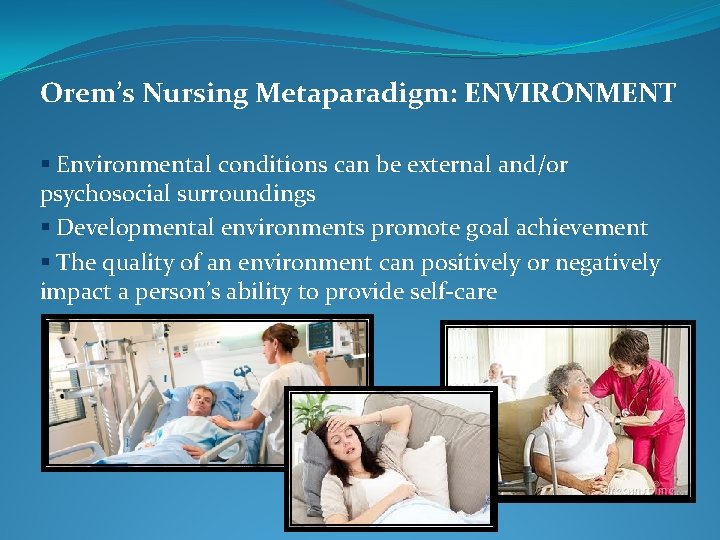
Orem’s Nursing Metaparadigm: ENVIRONMENT § Environmental conditions can be external and/or psychosocial surroundings § Developmental environments promote goal achievement § The quality of an environment can positively or negatively impact a person’s ability to provide self-care
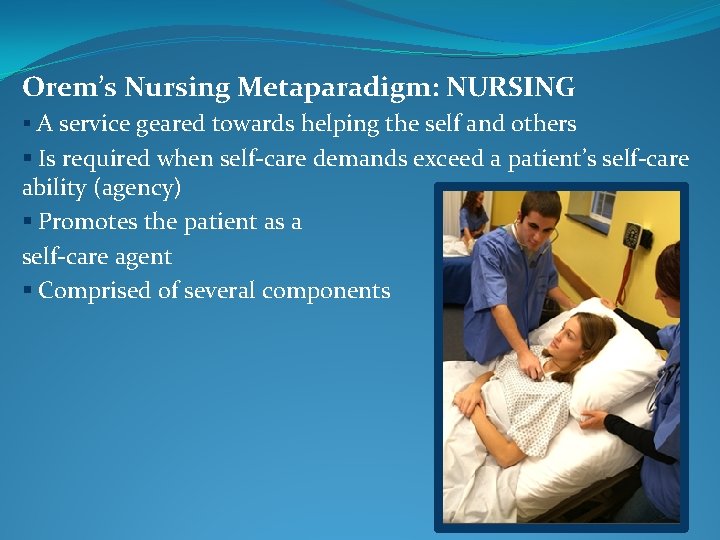
Orem’s Nursing Metaparadigm: NURSING § A service geared towards helping the self and others § Is required when self-care demands exceed a patient’s self-care ability (agency) § Promotes the patient as a self-care agent § Comprised of several components
Components of NURSING § NURSING ART: The theoretical base of nursing. Describes what it “ought” to do. § NURSING PRUDENCE: Enables the nurse to seek advice in new or difficult situations, to make correct judgments, and to decide to act in a particular manner. § NURSING SERVICE: An assistive service § NURSING AGENCY: The competency of the RN § ROLE THEORY: The role of the nurse & patient are complementary as they work together to achieve self-care § SPECIAL TECHNOLOGIES: § Social & Interpersonal technologies: Involve communicating, coordinating, establishing & maintaining therapeutic relations and providing help § Regulatory technologies: Involve maintaining and promoting life processes, growth/development, and psycho-physiological modes of functioning