
Dorothea Elizabeth Orem PRESENTED BY MEGAN DAVIS MEISHEL

Dorothea Elizabeth Orem PRESENTED BY: MEGAN DAVIS, MEISHEL FORTINO AND KIM MCPIKE
Self-Care Deficit Nursing Theory (SCDNT) �Focus on patient self-care capacity �Nurses should only do for the patient what they cannot do for themselves �Three interrelated theories Self-Care Deficit Nursing System �Three Operations
Theory of Self-Care �Self-care is the ability to perform activities and meet personal needs with the goal of maintaining health and wellness of mind, body and spirit. �Self-Care Requisites Universal Developmental Health Deviation
Theory of Self-Care Deficit �Every developed person has the ability to meet self- care needs. When a person experiences the inability to meet their needs due to limitations, a self-care deficit exists. �Nursing focuses on identifying the deficit and implementing appropriate interventions to meet the needs of the patient.
Theory of Nursing System �The ability of the nurse to assist the patient in meeting current and potential self-care demands. �It specifies how the patient’s self-care needs will be met by the nurse, patient or both.
Three Operations �Diagnostic: establish relationships and explore self- care needs. �Prescriptive: begin planning care based on mutually identified self-care needs. �Regulatory: nurse designs, plans and produces a system for care.
Diagnostic �Nurse-patient relationship �Explore self-care needs �Contracts �Influences
Prescriptive �Planning stage �Mutually identified self-care needs �Deficits determined �Nurse reviews various approaches
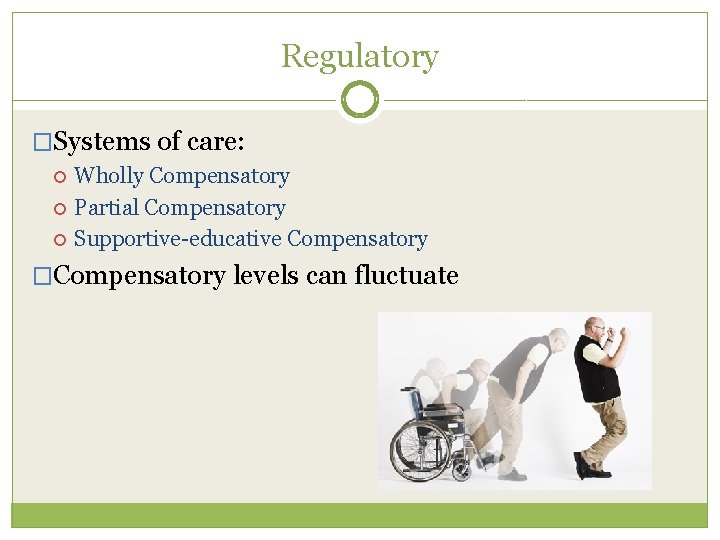
Regulatory �Systems of care: Wholly Compensatory Partial Compensatory Supportive-educative Compensatory �Compensatory levels can fluctuate
Orem’s Timeline �Born in 1914 � 1930’s- diploma in nursing � 1939 - BSN � 1945 - MSN � 1976 -1998 - honorary nursing and science doctorates �Died in 2007
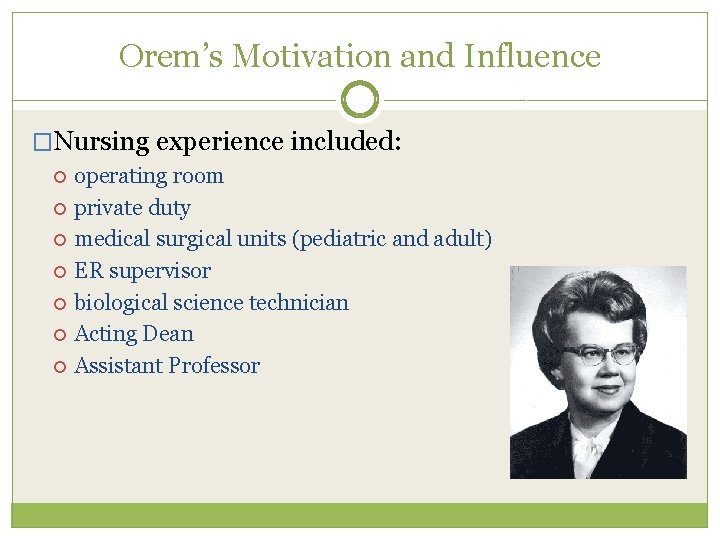
Orem’s Motivation and Influence �Nursing experience included: operating room private duty medical surgical units (pediatric and adult) ER supervisor biological science technician Acting Dean Assistant Professor
Achievements �Worked for the Division of Hospital and Institutional Services of the Indiana State Board of Health Her goal was to upgrade the quality of nursing in general hospitals throughout the state. During this time she developed her definition of Nursing Practice. �Publications Nursing: Concepts of Practice Guidelines for Developing Curricula for the Education of Practical Nurses
Orem’s Philosophy Orem’s theory is based upon the philosophy that all patients wish to care for themselves. It is believed that ordinary people in today’s society want to be in control of their lives. They can recover more quickly and holistically if they are allowed to perform their own self -care to the best of their ability.

Four Global Concepts �Human Being �Health �Environment �Nursing
Evaluation �Orem’s SCDNT relevant to the medical field �Global Concepts �Narrow View? �Theory in practice
Conclusion Orem has provided not only an intellectual and practical basis for nursing, but also a language for nursing. Orem, a visionary, deliberatively worked through, developed, and shared her understanding of nursing with others. She helped others to move nursing from a technological basis to a theoretical one, a science, and she showed the relationship between the two.
“Nursing is perhaps best described as the giving of direct assistance to a person, as required, because of the person’s specific inabilities in self-care resulting from a situation of personal health. ” -Dorothy Orem, 1959
Case Study �Jimmy Joe is 75 years old. He is POD#2 for a total hip replacement. He has a history of: CHF, BMI of 35. 2 and is HOH. PTA, he lived alone in an apartment with three stairs to his entryway and required no assistive devices. He is ambulating to the bathroom with a gait belt and front-wheeled walker. He requires moderate assistance getting in and out of bed. He is taking 2 tabs of Norco-5 every 6 hours. He plans to discharge home tomorrow with home health care.
What deficits does this patient have that prevents him from providing his own self-care? 2. What system of care does Mr. Joe fit into? 1. A. B. C. Wholly Compensatory Partially Compensatory Supportive-educative Compensatory
References
- Slides: 20