
DORIS Doppler Orbitography and Radiopositioning Integrated by Satellite
DORIS Doppler Orbitography and Radiopositioning Integrated by Satellite Basic system concept Main missions Schedules Conclusions
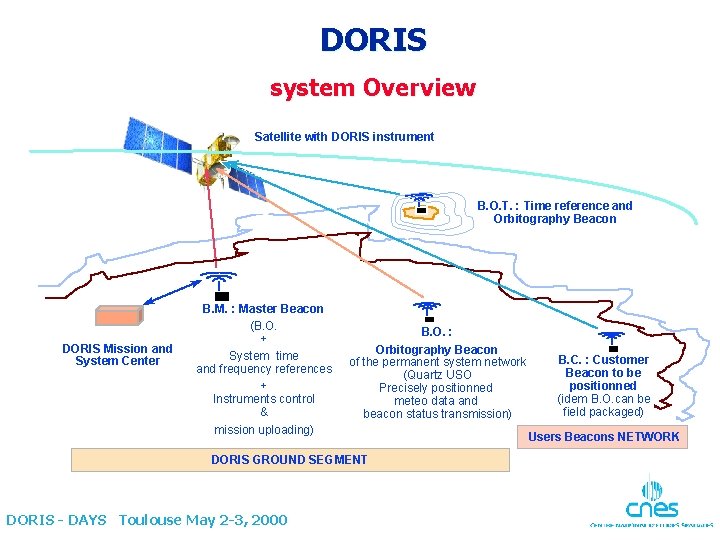
DORIS system Overview Satellite with DORIS instrument B. O. T. : Time reference and Orbitography Beacon DORIS Mission and System Center B. M. : Master Beacon (B. O. + System time and frequency references + Instruments control & mission uploading) B. O. : Orbitography Beacon of the permanent system network (Quartz USO Precisely positionned meteo data and beacon status transmission) DORIS GROUND SEGMENT DORIS - DAYS Toulouse May 2 -3, 2000 B. C. : Customer Beacon to be positionned (idem B. O. can be field packaged) Users Beacons NETWORK
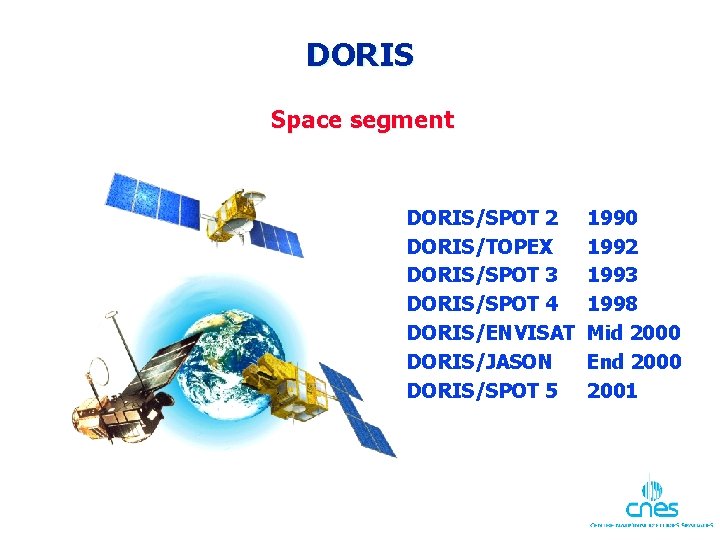
DORIS Space segment DORIS/SPOT 2 DORIS/TOPEX DORIS/SPOT 3 DORIS/SPOT 4 DORIS/ENVISAT DORIS/JASON DORIS/SPOT 5 1990 1992 1993 1998 Mid 2000 End 2000 2001
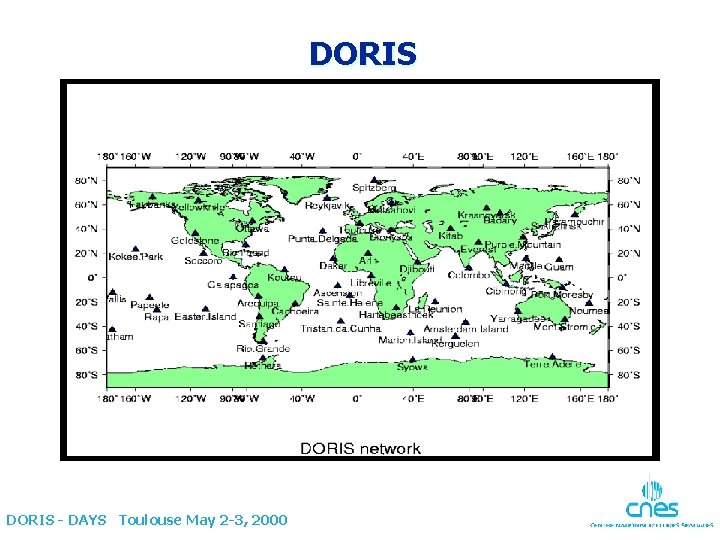
DORIS - DAYS Toulouse May 2 -3, 2000

DORIS Main missions u Precise orbit determination for Topex/Poseidon and Jason: Altitude of Topex/Poseidon accurate to within three centimetres, on radial component in support to scientific (altimetry) mission performance è Jason to provide centimetre accuracy è u Accurate location of ground beacons to establish and maintain the terrestrial reference system used for altimetry measurements è for geodetic and geodynamics applications è u Accurate autonomous navigation capability u Models improvements: è gravity field, air drag, ionosphere, troposphere.
DORIS Main missions Orbit determination (1/2) u Doris was originally designed for precise orbit determination in support of altimetry satellite missions: within 5 cm for Spot 2 è 3 cm for Topex radial component è Objective of 1 cm for Jason, thanks to improved gravitational models and cross utilization of other geodetic technics (GPS, Laser, …). è
DORIS Main missions Orbit determination (2/2) u Real time navigation: Thanks to on-board measurement processing by DIODE software (included in Doris software), and demonstrated in Spot 4, è Less than 30 cm rms 3 axes achievable on Jason, è Time synchronisation: 3 micro seconds wrt TAI or UTC time scale. è u Location station calibration (radar, 2 GHz networks) u Precise estimation of altitude control thruster efficiency (Spot)
DORIS PERFORMANCE Orbit determination mission DORIS orbit determination products Delayed time (ground) Real time (onboard) Accuracy Turnaround Satellite operation Initial orbit 10 centimetres 48 hours Precise orbit 3 centimetres 1 month Onboard real time Precise Doris (Jason) Single-frequency Doris (navigation) Application <1 metre 10 metres Immediate • Processing of satellite altimetry measurements • Calculation of manœuvre efficiency • Calibration of other measurement systems (radar, 2 GHz location, etc. ) • Satellite autonomy • Auxiliary data for satellite payload

DORIS Main missions Location u Geodesy accurate absolute and relative location u Geodynamics plate tectonics u Volcanology surface deformation monitoring u Glacier monitoring u Landslide monitoring u Construction and monitoring of large civil engineering structures DORIS - DAYS Toulouse May 2 -3, 2000

DORIS Geodetic applications (1/2) u Precise point positionning è è Doris provides fast data on ground beacons positions; The CLS company provides Doris services on an operational, commercial basis: w precise point coordinates at remote locations: islands, platforms, secondary reference points, etc. w tying local geodetic networks into reference networks, w long-term measurement of geodynamic drifts, w remote monitoring of natural hazard (e. g. , seismic zones, volcanoes, landslides). DORIS - DAYS Toulouse May 2 -3, 2000 areas
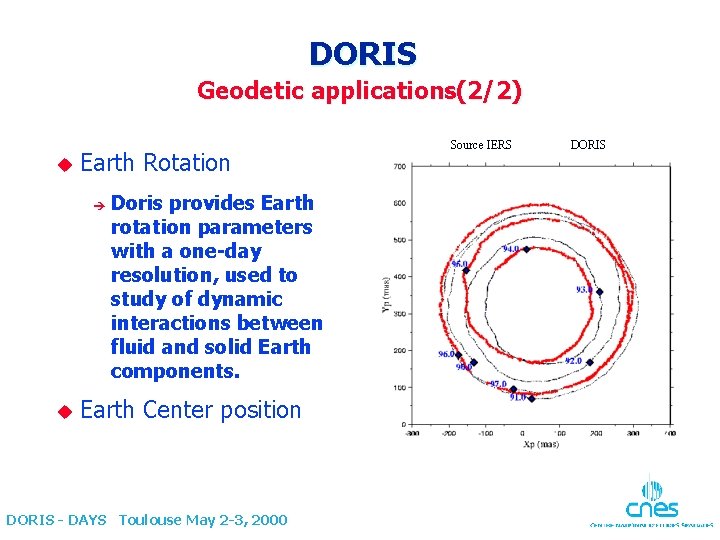
DORIS Geodetic applications(2/2) u Earth Rotation è u Doris provides Earth rotation parameters with a one-day resolution, used to study of dynamic interactions between fluid and solid Earth components. Earth Center position DORIS - DAYS Toulouse May 2 -3, 2000 Source IERS DORIS
DORIS Reference systems u Doris was accepted in 1994 as a new technique of the International Earth Rotation Service. u IERS objectives include the establishment and maintenance of a high accuracy Earth reference system. u Doris contributed to ITRF 94, 96, 97 and will contribute to ITRF 2000. u Because of its performances, the international community proposed to create an International Doris Service at the last general assembly of the IGGU (July 1999). DORIS - DAYS Toulouse May 2 -3, 2000
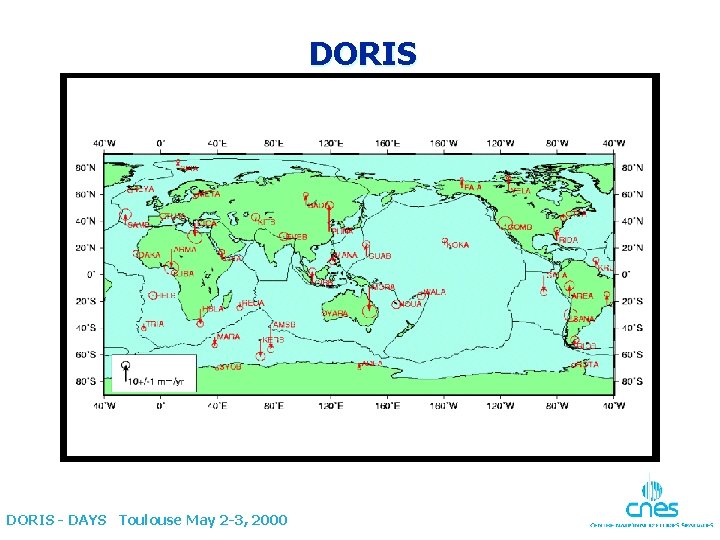
DORIS Geophysics u Doris can be used to measure tectonic plates relative motions of the terrestrial lithosphere; u Measurement accuracy allows validation of cinematic models and determination of local phenomena. DORIS - DAYS Toulouse May 2 -3, 2000
DORIS - DAYS Toulouse May 2 -3, 2000
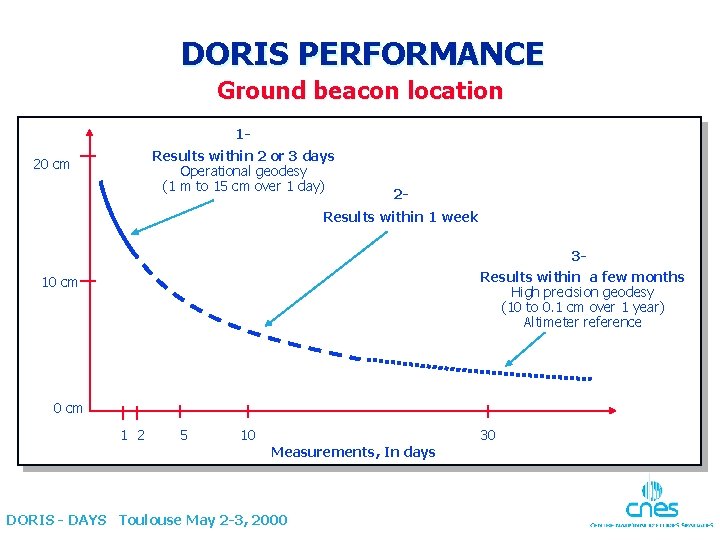
DORIS PERFORMANCE Ground beacon location 1 Results within 2 or 3 days Operational geodesy (1 m to 15 cm over 1 day) 20 cm 2 - Results within 1 week 3 Results within a few months High precision geodesy (10 to 0. 1 cm over 1 year) Altimeter reference 10 cm 1 2 5 10 30 Measurements, In days DORIS - DAYS Toulouse May 2 -3, 2000
DORIS Other DORIS applications u Improvement of the Earth gravity field; u Global ionosphere mapping propagation error correction; u Calibration and techniques. validation DORIS - DAYS Toulouse May 2 -3, 2000 for of radio-electric other space signal geodesy
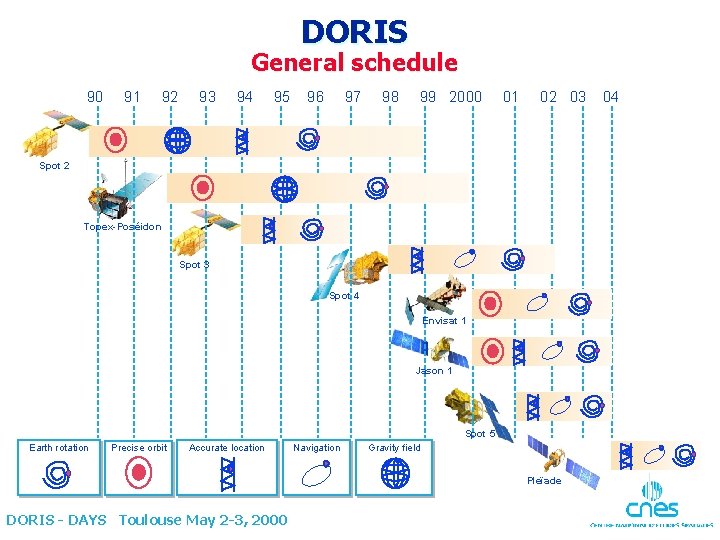
DORIS General schedule 90 91 92 93 94 95 96 97 98 99 2000 01 02 03 Spot 2 Topex-Poséidon Spot 3 Spot 4 Envisat 1 Jason 1 Spot 5 Earth rotation Precise orbit Accurate location Navigation Gravity field Pleïade DORIS - DAYS Toulouse May 2 -3, 2000 04
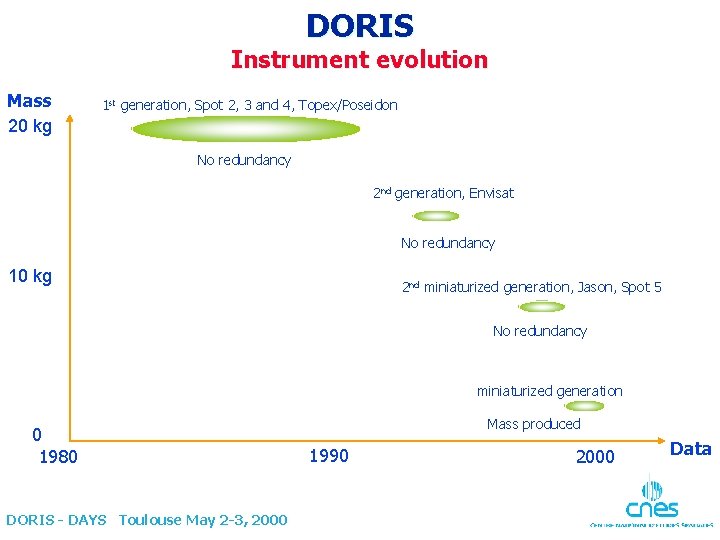
DORIS Instrument evolution Mass 20 kg 1 st generation, Spot 2, 3 and 4, Topex/Poseidon No redundancy 2 nd generation, Envisat No redundancy 10 kg 2 nd miniaturized generation, Jason, Spot 5 No redundancy miniaturized generation 0 1980 DORIS - DAYS Toulouse May 2 -3, 2000 Mass produced 1990 2000 Data
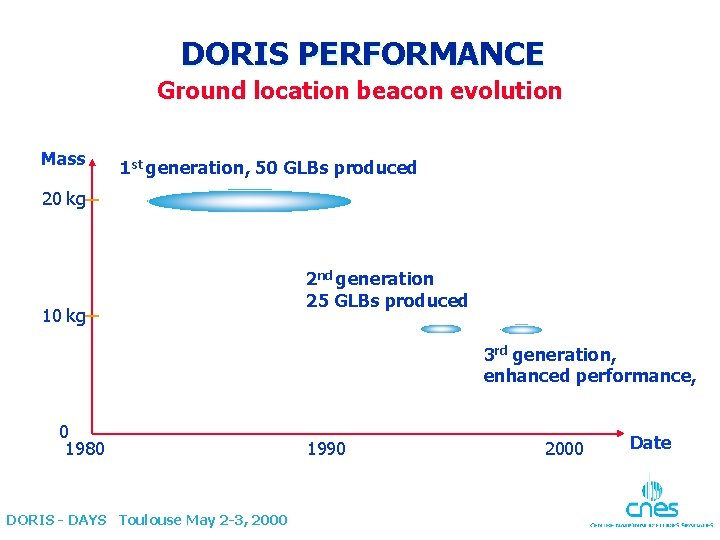
DORIS PERFORMANCE Ground location beacon evolution Mass 1 st generation, 50 GLBs produced 20 kg 10 kg 2 nd generation 25 GLBs produced 3 rd generation, enhanced performance, 0 1980 DORIS - DAYS Toulouse May 2 -3, 2000 1990 2000 Date
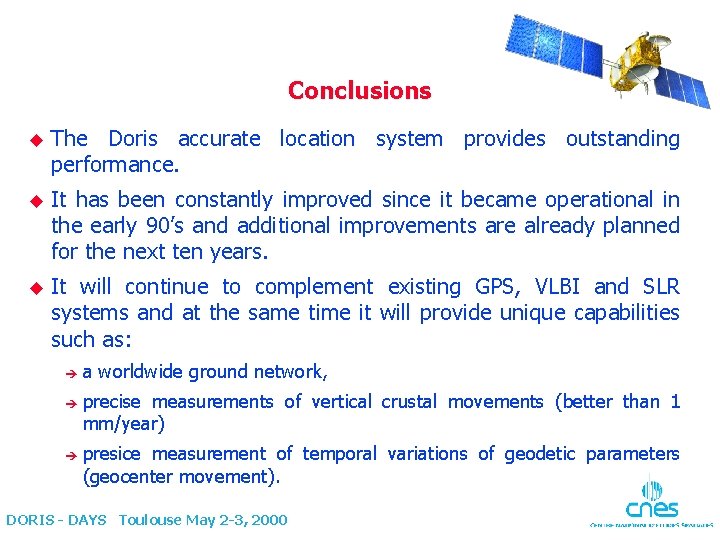
Conclusions u The Doris accurate location system provides outstanding performance. u It has been constantly improved since it became operational in the early 90’s and additional improvements are already planned for the next ten years. u It will continue to complement existing GPS, VLBI and SLR systems and at the same time it will provide unique capabilities such as: è è è a worldwide ground network, precise measurements of vertical crustal movements (better than 1 mm/year) presice measurement of temporal variations of geodetic parameters (geocenter movement). DORIS - DAYS Toulouse May 2 -3, 2000
- Slides: 20