
Dorian Gray the Devil The Devil 5 minutes
- Slides: 17
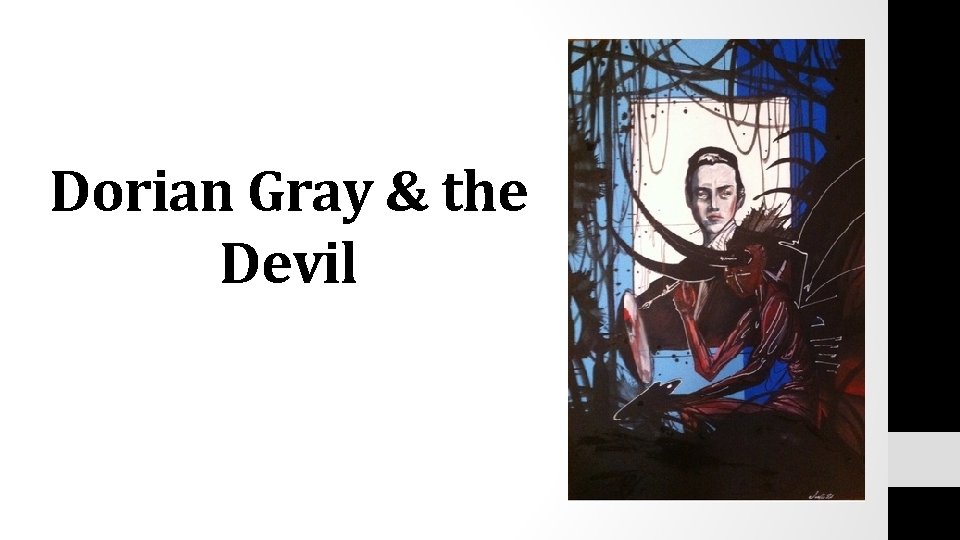
Dorian Gray & the Devil
The Devil 5 minutes: in pairs illustrate and annotate a colored image of whatever comes to mind when you hear the term “ Devil”
J. J. Cohen (Cohen’s thesis #4) and Michael Focualt (from the Wild Things writing prompts) each focused on how we label and identify “the monster among us. ” Cohen: “the exaggeration of cultural difference” leads to creation of monsters Foccault: monsters are “a cultural construction” • Are there monsters that do not walk among us? • How do various monsters fulfill a society’s needs? • What social needs does a society have that common monsters do not cover? • Can monsters teach us things? What can we learn? • Why did ancient humans start creating stories and writing?
Didactic Literature • Didactic Literature: texts meant to teach moral lessons or pass on rules for behavior. Didactic Literature texts are often created using allegory, metaphor, analogy, etc. Critics say didactic literature can be boring more often than not. Didactic literature tries to teach what is right and wrong. What examples of Didactic Literature can you think of?
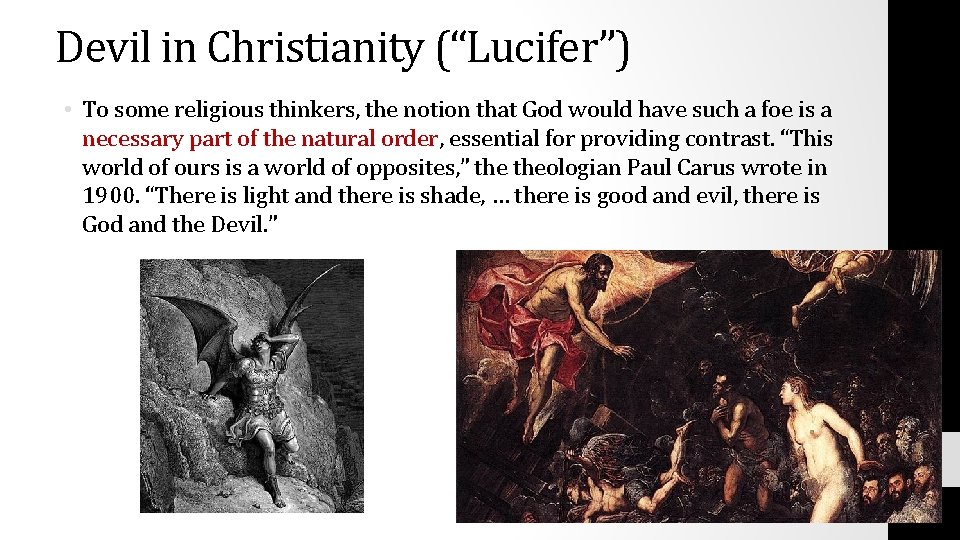
Devil in Christianity (“Lucifer”) • To some religious thinkers, the notion that God would have such a foe is a necessary part of the natural order, essential for providing contrast. “This world of ours is a world of opposites, ” theologian Paul Carus wrote in 1900. “There is light and there is shade, … there is good and evil, there is God and the Devil. ”
The Devil in the other Abrahamic Religions Judaism Islam • Satan, tempts people to do wrong things, though he makes only a few appearances in the Jewish Bible. • A fallen angel named Iblīs, the story differs from Christianity’s devil. • In the Muslim narrative, Iblīs refuses to bow down before Allah’s creation Adam, and is exiled from heaven as a result. • According to Islamic studies Professor Mona Siddiqui, on Earth Iblīs morphs into a tempter whose role is to lead people from Allah. • In Chronicles 21, for example, he provokes King David to offend God, which in turn led God to punish Israel. • He also appears in the book of Job, in which he inflicts the suffering believer with painful boils. • His first victims are Adam and Eve, whom he distracts with sexual pleasure. • The Jewish version of Satan seems • Muslims believe that the devil actually is less powerful than humans. “All to be mostly a symbolic figure, humankind has the potential to be victorious over Satan, i. e. , over their rather than an actual being—“an own passions that lead them astray, ” illusory obstacle in one’s way. ” she has written.
The ‘Devil’ in other religions The idea of a single figure who is the ultimate personification of evil may have originated in several different cultures. • Ancient Egyptians: mythology includes the god Seth, a bad-tempered trickster who brought storms, death, and disorder. • The Babylonians believed in demons, which were a manifestation of the nasty, vengeful side of their gods’ personalities. • Zoroastrianism: In the ancient Persian religion, the creator god Ahura Mazda is opposed by Ahriman, Spenta Mainyu’s twin brother, who has chosen to embody evil. Ahriman promotes greed, wrath and envy in humans to cause them to destroy themselves. • Buddhism also has a similar evil figure, Mara, whose name means “killer” or “death” in Sanskrit. In Buddhist belief, Mara’s role is to prevent humans beings from concentrating upon making spiritual progress, by tempting with sensual pleasures and other distractions.
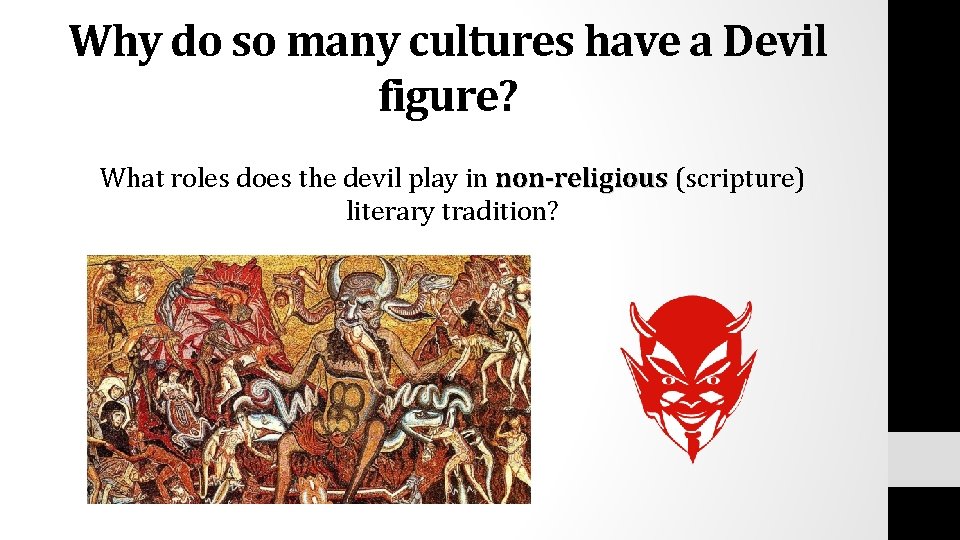
Why do so many cultures have a Devil figure? What roles does the devil play in non-religious (scripture) literary tradition?
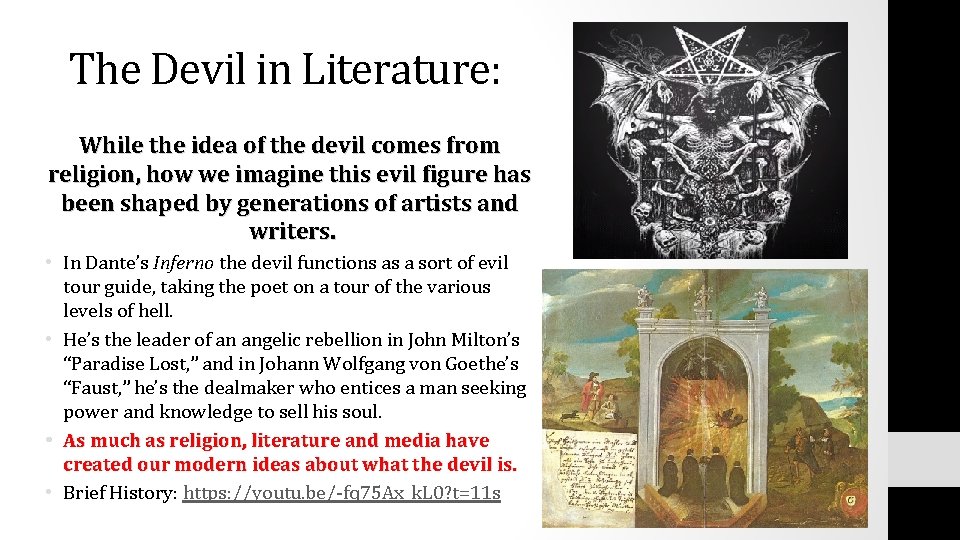
The Devil in Literature: While the idea of the devil comes from religion, how we imagine this evil figure has been shaped by generations of artists and writers. • In Dante’s Inferno the devil functions as a sort of evil tour guide, taking the poet on a tour of the various levels of hell. • He’s the leader of an angelic rebellion in John Milton’s “Paradise Lost, ” and in Johann Wolfgang von Goethe’s “Faust, ” he’s the dealmaker who entices a man seeking power and knowledge to sell his soul. • As much as religion, literature and media have created our modern ideas about what the devil is. • Brief History: https: //youtu. be/-fq 75 Ax_k. L 0? t=11 s
The Rolling Stones: “Sympathy for the Devil” • Listen to the song! • Focus on how the Devil is characterized and what he wants.
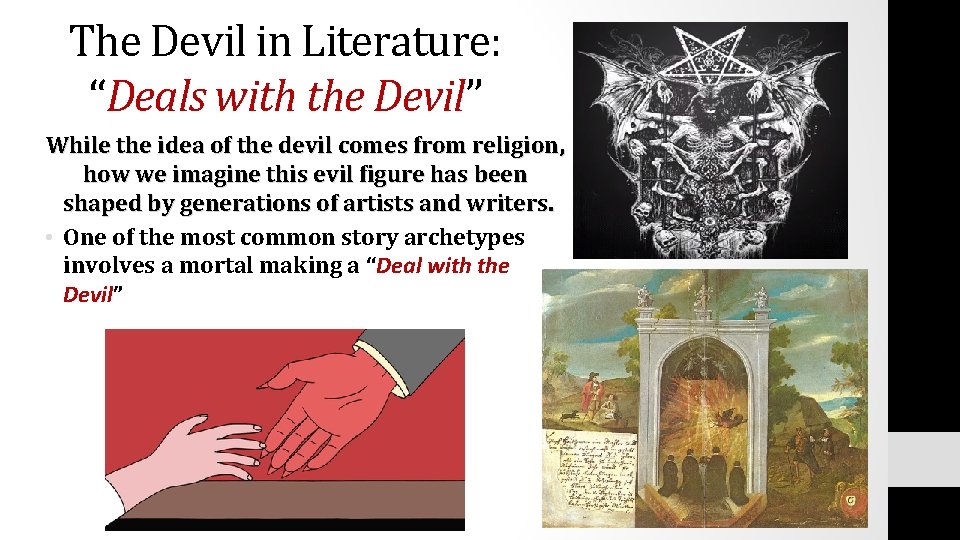
The Devil in Literature: “Deals with the Devil” While the idea of the devil comes from religion, how we imagine this evil figure has been shaped by generations of artists and writers. • One of the most common story archetypes involves a mortal making a “Deal with the Devil”
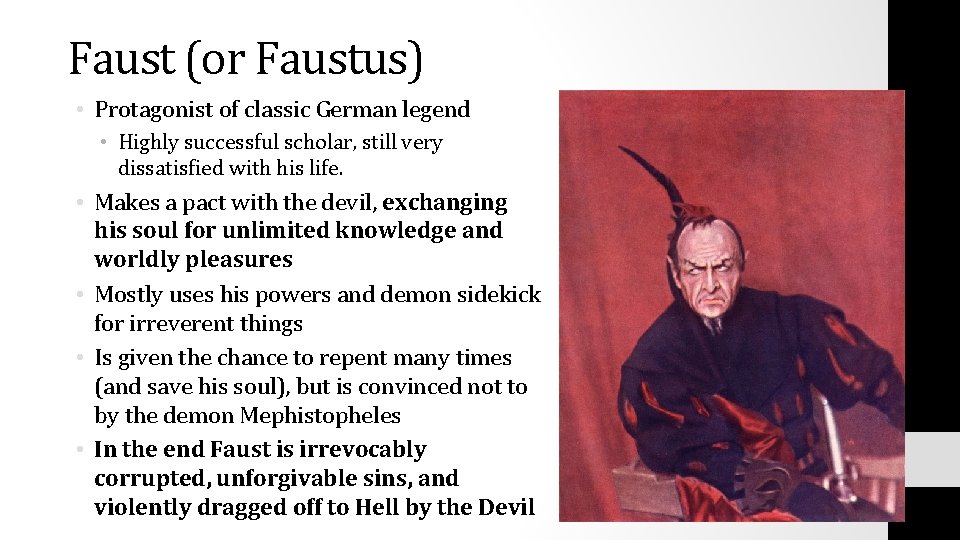
Faust (or Faustus) • Protagonist of classic German legend • Highly successful scholar, still very dissatisfied with his life. • Makes a pact with the devil, exchanging his soul for unlimited knowledge and worldly pleasures • Mostly uses his powers and demon sidekick for irreverent things • Is given the chance to repent many times (and save his soul), but is convinced not to by the demon Mephistopheles • In the end Faust is irrevocably corrupted, unforgivable sins, and violently dragged off to Hell by the Devil
Dorian’s Faustian Pact “If it were I who was to be always young, and the picture that was to grow old! For that – for that – I would give everything! Yes, there is nothing in the whole world I would not give! I would give my soul for that!” Dorian never signs a contract with the devil, as in other “Faustian” tales; Wilde does not choose to focus on the “how’s. ” How does this affect the novel? Would it have be different if Dorian had officially signed up for his fate?
Signing the Contract Faust: https: //www. youtube. com/watch? v=nt. DLd. Zqf. ZUk The Little Mermaid: https: //www. youtube. com/watch? v=a 0 f. WYtwvrww
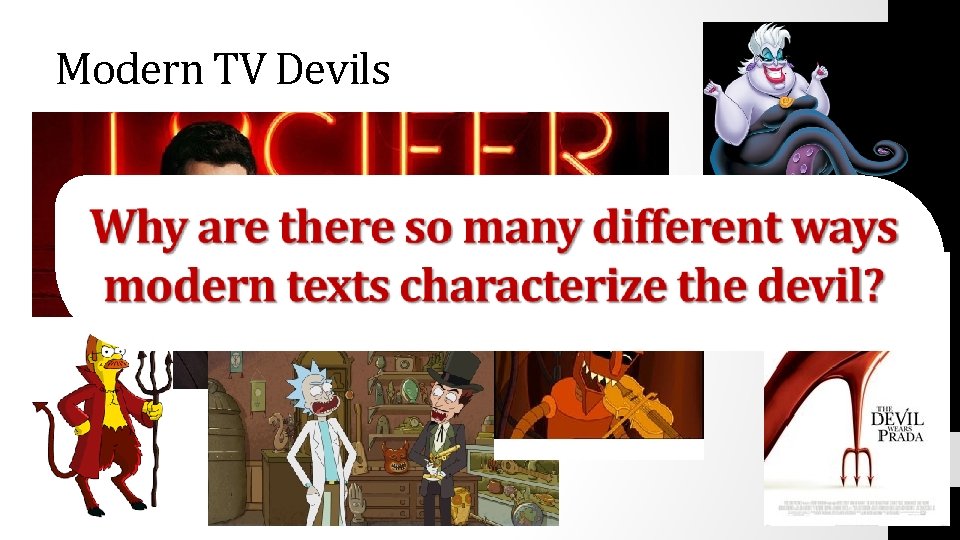
Modern TV Devils
CULMINATING CREATIVE TASKS: Your Choice! Research and create a product to represent one modern or traditional “deal with the devil” • Can be film analysis of a TV episode: • The Simpsons, Futurama, and Rick and Morty all have such an episode, for example. • Create your own Faustian Satire of High School • Classify 3 different ‘signings of contracts with the devil’ in literature, music, or movies; and then create one for Dorian based on the similarities in these scenes.
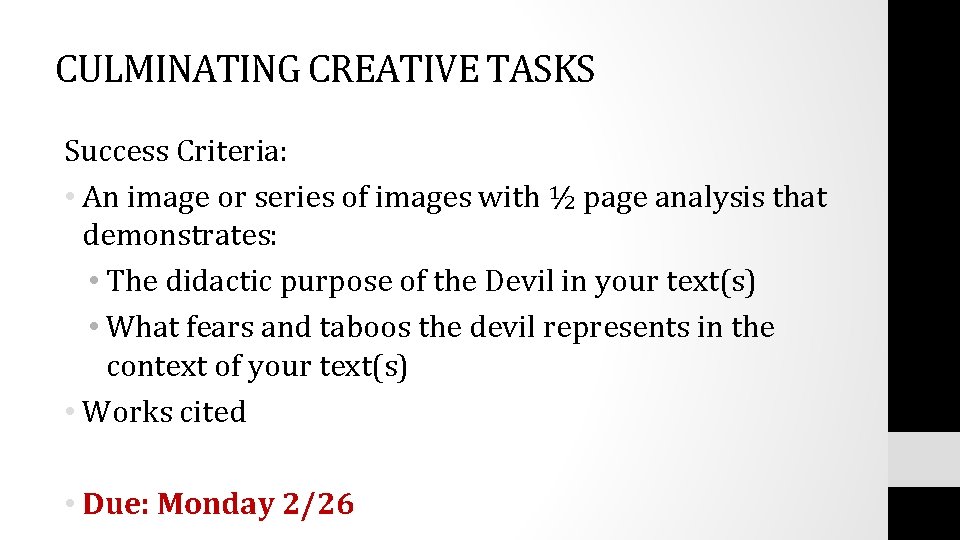
CULMINATING CREATIVE TASKS Success Criteria: • An image or series of images with ½ page analysis that demonstrates: • The didactic purpose of the Devil in your text(s) • What fears and taboos the devil represents in the context of your text(s) • Works cited • Due: Monday 2/26