
Doppler Wind Lidar Current Activities and Future Plans
- Slides: 17
Doppler Wind Lidar: Current Activities and Future Plans Presented to Winter T-PARC Workshop October 8 - 10, 2008 Presented by Dr. Wayman Baker NOAA/NASA/Do. D Joint Center for Satellite Data Assimilation
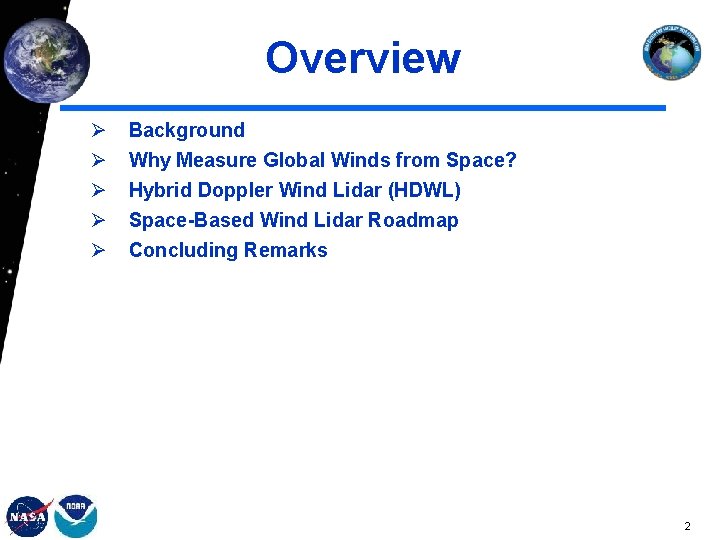
Overview Ø Ø Ø Background Why Measure Global Winds from Space? Hybrid Doppler Wind Lidar (HDWL) Space-Based Wind Lidar Roadmap Concluding Remarks 2
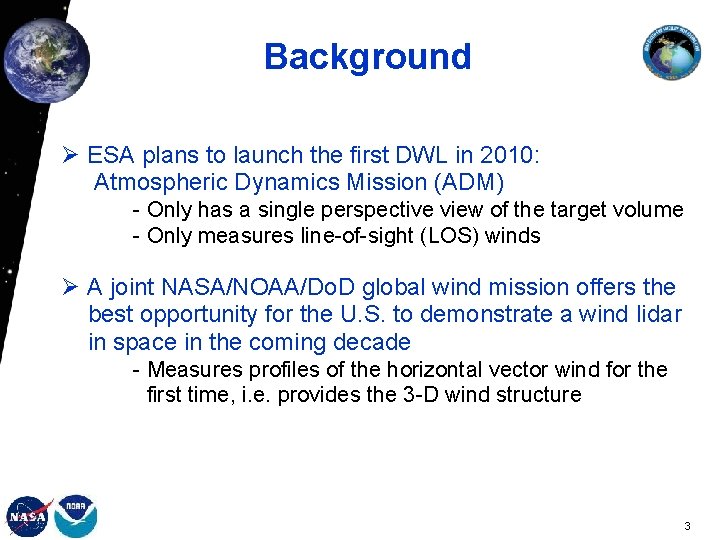
Background Ø ESA plans to launch the first DWL in 2010: Atmospheric Dynamics Mission (ADM) - Only has a single perspective view of the target volume - Only measures line-of-sight (LOS) winds Ø A joint NASA/NOAA/Do. D global wind mission offers the best opportunity for the U. S. to demonstrate a wind lidar in space in the coming decade - Measures profiles of the horizontal vector wind for the first time, i. e. provides the 3 -D wind structure 3
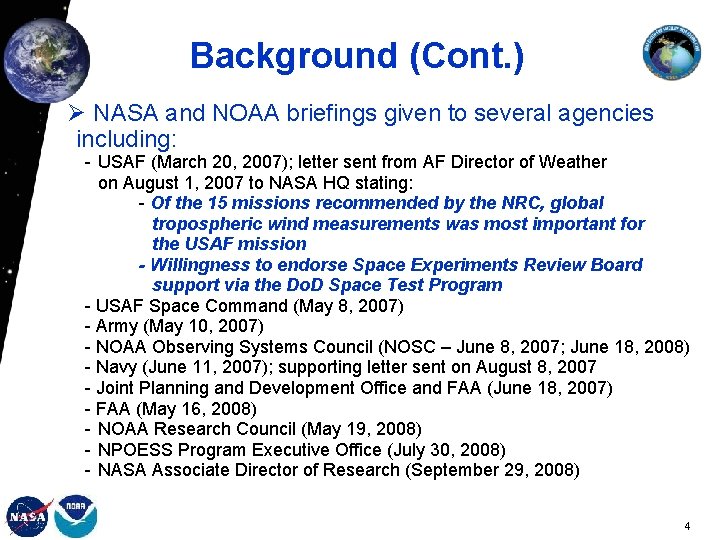
Background (Cont. ) Ø NASA and NOAA briefings given to several agencies including: - USAF (March 20, 2007); letter sent from AF Director of Weather on August 1, 2007 to NASA HQ stating: - Of the 15 missions recommended by the NRC, global tropospheric wind measurements was most important for the USAF mission - Willingness to endorse Space Experiments Review Board support via the Do. D Space Test Program - USAF Space Command (May 8, 2007) - Army (May 10, 2007) - NOAA Observing Systems Council (NOSC – June 8, 2007; June 18, 2008) - Navy (June 11, 2007); supporting letter sent on August 8, 2007 - Joint Planning and Development Office and FAA (June 18, 2007) - FAA (May 16, 2008) - NOAA Research Council (May 19, 2008) - NPOESS Program Executive Office (July 30, 2008) - NASA Associate Director of Research (September 29, 2008) 4
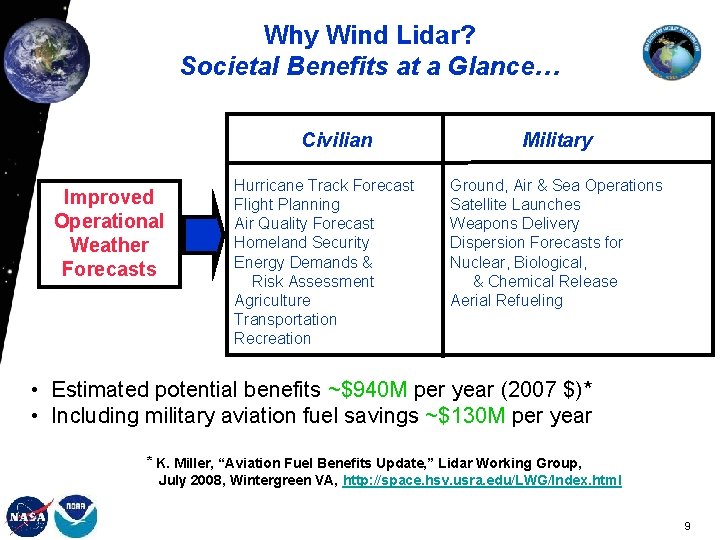
Background (Cont. ) Ø The National Research Council (NRC) Decadal Survey report recommended a global wind mission - The NRC Weather Panel determined that a Hybrid Doppler Wind Lidar (HDWL) in low Earth orbit could make a transformational impact on global tropospheric wind analyses. Ø “Wind profiles at all levels” is listed as the #1 priority in the strategic plan for United States Integrated Earth Observing System (USIEOS). Ø Cost benefit studies have identified economic benefits ~$940 M/year (2007 $) with the measurement of global wind profiles from space 1, 2 1 Cordes, J. (1995), “ Economic Benefits and Costs of Developing and Deploying a Space. Based Wind Lidar, Dept of Economics, George Washington University, D-9502. 2 Miller, K. (2008), “Aviation Fuel Benefits Update, ” Lidar Working Group, http: //space. hsv. usra. edu/LWG/Index. html 5
Why Measure Global Winds from Space ? ØThe Numerical Weather Prediction (NWP) community has unanimously identified global wind profiles as the most important missing observations. Ø Independent modeling studies at NCEP, ESRL, AOML, NASA and ECMWF have consistently shown tropospheric wind profiles to be the single most beneficial measurement now absent from the Global Observing System. 6
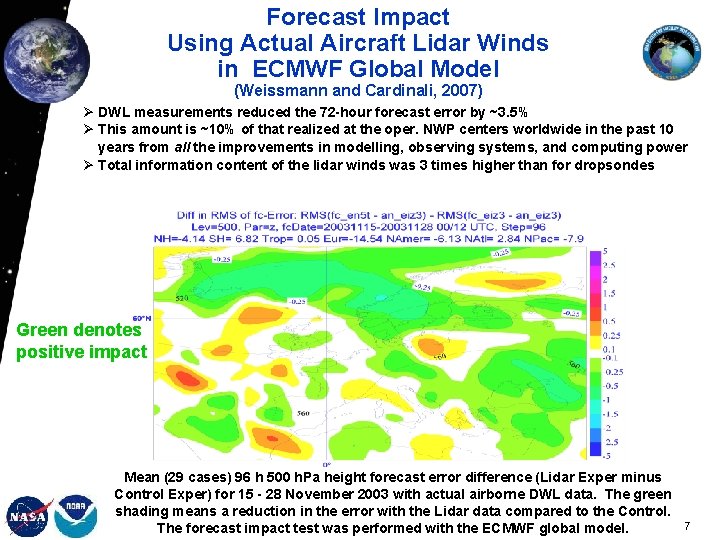
Forecast Impact Using Actual Aircraft Lidar Winds in ECMWF Global Model (Weissmann and Cardinali, 2007) Ø DWL measurements reduced the 72 -hour forecast error by ~3. 5% Ø This amount is ~10% of that realized at the oper. NWP centers worldwide in the past 10 years from all the improvements in modelling, observing systems, and computing power Ø Total information content of the lidar winds was 3 times higher than for dropsondes Green denotes positive impact Mean (29 cases) 96 h 500 h. Pa height forecast error difference (Lidar Exper minus Control Exper) for 15 - 28 November 2003 with actual airborne DWL data. The green shading means a reduction in the error with the Lidar data compared to the Control. The forecast impact test was performed with the ECMWF global model. 7
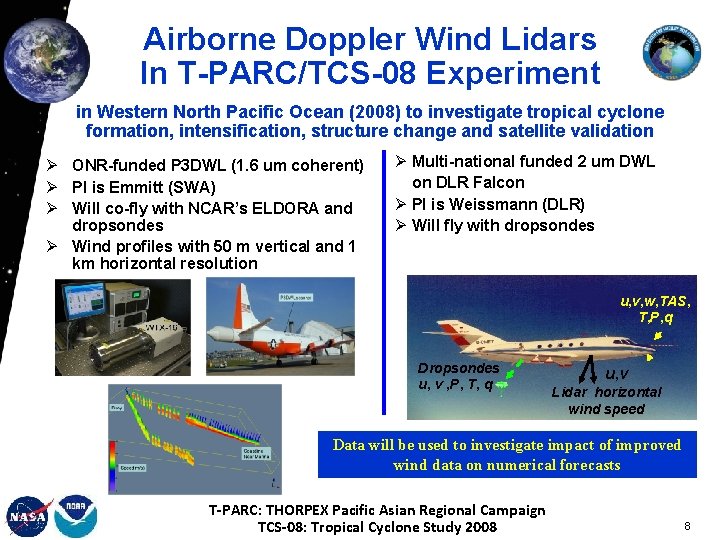
Airborne Doppler Wind Lidars In T-PARC/TCS-08 Experiment in Western North Pacific Ocean (2008) to investigate tropical cyclone formation, intensification, structure change and satellite validation Ø ONR-funded P 3 DWL (1. 6 um coherent) Ø PI is Emmitt (SWA) Ø Will co-fly with NCAR’s ELDORA and dropsondes Ø Wind profiles with 50 m vertical and 1 km horizontal resolution Ø Multi-national funded 2 um DWL on DLR Falcon Ø PI is Weissmann (DLR) Ø Will fly with dropsondes u, v, w, TAS, T, P, q Dropsondes u, v , P, T, q u, v Lidar horizontal wind speed Data will be used to investigate impact of improved wind data on numerical forecasts T-PARC: THORPEX Pacific Asian Regional Campaign TCS-08: Tropical Cyclone Study 2008 8
Why Wind Lidar? Societal Benefits at a Glance… Civilian Improved Operational Weather Forecasts Hurricane Track Forecast Flight Planning Air Quality Forecast Homeland Security Energy Demands & Risk Assessment Agriculture Transportation Recreation Military Ground, Air & Sea Operations Satellite Launches Weapons Delivery Dispersion Forecasts for Nuclear, Biological, & Chemical Release Aerial Refueling • Estimated potential benefits ~$940 M per year (2007 $)* • Including military aviation fuel savings ~$130 M per year * K. Miller, “Aviation Fuel Benefits Update, ” Lidar Working Group, July 2008, Wintergreen VA, http: //space. hsv. usra. edu/LWG/Index. html 9
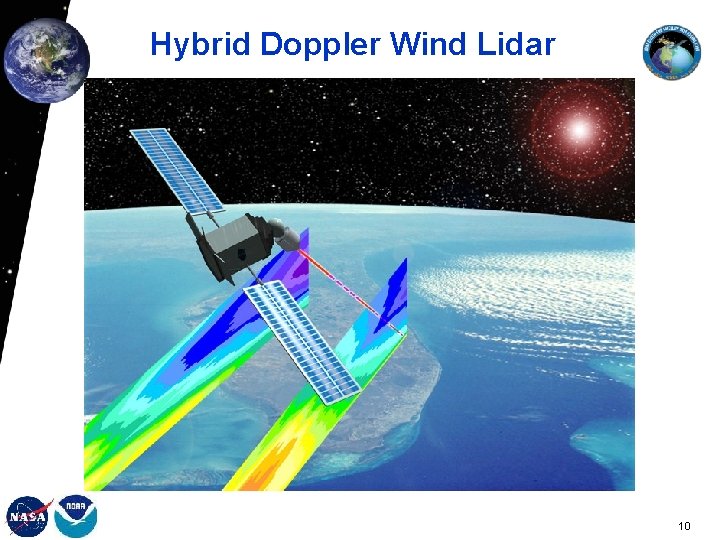
Hybrid Doppler Wind Lidar 10
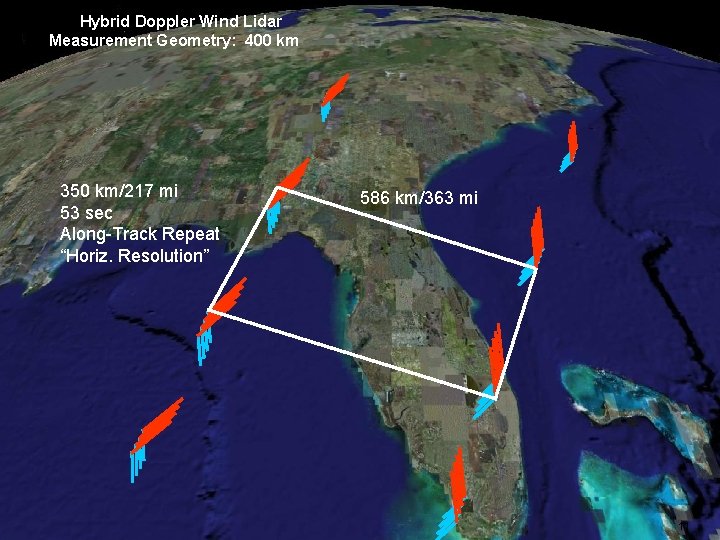
Hybrid Doppler Wind Lidar Measurement Geometry: 400 km 350 km/217 mi 53 sec Along-Track Repeat “Horiz. Resolution” 586 km/363 mi 11
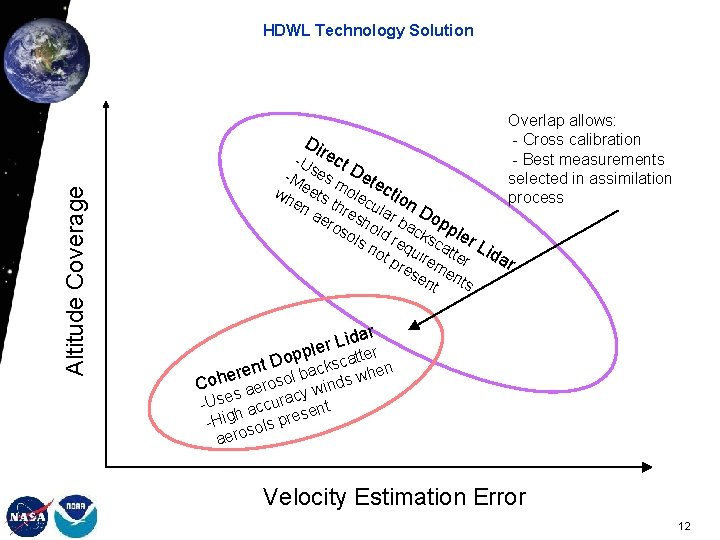
HDWL Technology Solution Altitude Coverage Dir Overlap allows: - Cross calibration - Best measurements selected in assimilation process -U ect -M ses m Dete wh eets ole ctio en thr cul n ae esh ar b Do p ros ol a ols d re cksc pler no qu att Lid t p ire er ar res me en nts t idar L r e tter oppl t D backsca hen n e r e l Coh s aeroso y winds w c -Use accura ent s h -Hig sols pre aero Velocity Estimation Error 12
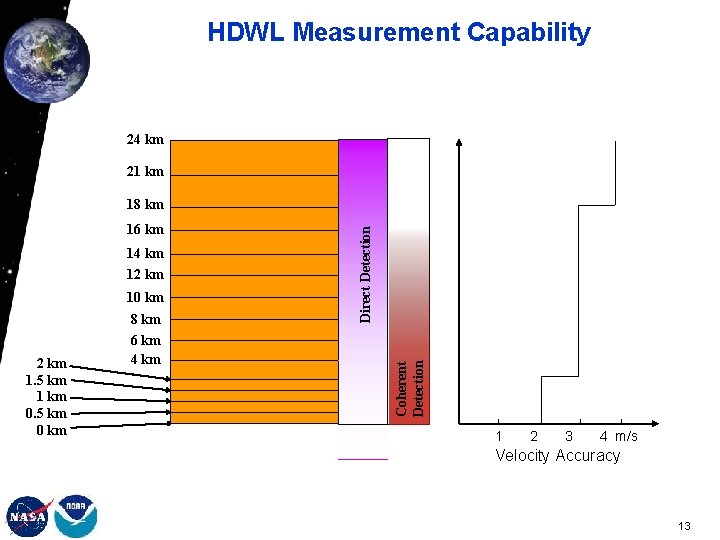
HDWL Measurement Capability 24 km 21 km 14 km 12 km 10 km 2 km 1. 5 km 1 km 0. 5 km 0 km 8 km 6 km 4 km Coherent Detection 16 km Direct Detection 18 km 1 2 3 4 m/s Velocity Accuracy 13
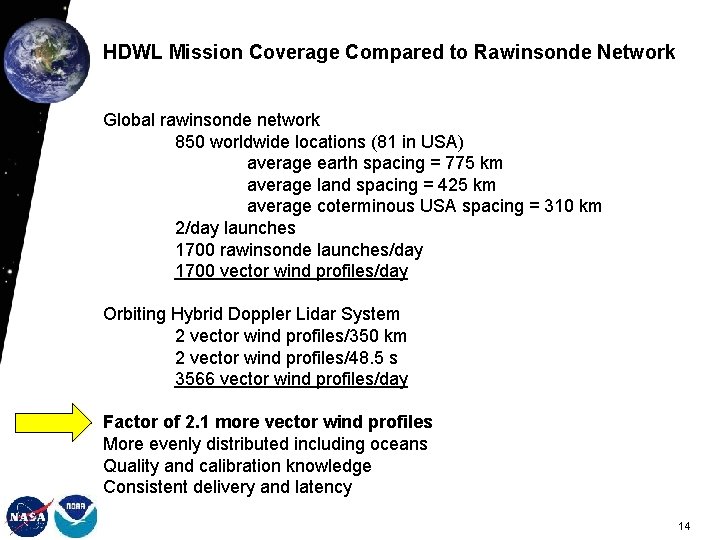
HDWL Mission Coverage Compared to Rawinsonde Network Global rawinsonde network 850 worldwide locations (81 in USA) average earth spacing = 775 km average land spacing = 425 km average coterminous USA spacing = 310 km 2/day launches 1700 rawinsonde launches/day 1700 vector wind profiles/day Orbiting Hybrid Doppler Lidar System 2 vector wind profiles/350 km 2 vector wind profiles/48. 5 s 3566 vector wind profiles/day Factor of 2. 1 more vector wind profiles More evenly distributed including oceans Quality and calibration knowledge Consistent delivery and latency 14
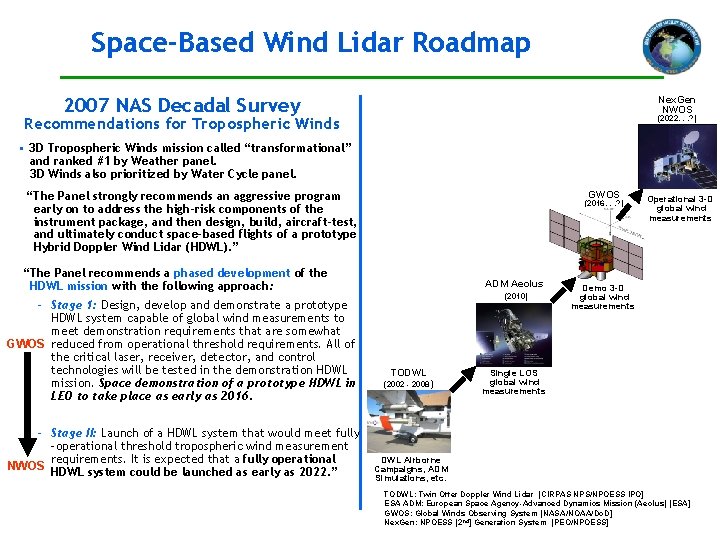
Space-Based Wind Lidar Roadmap 2007 NAS Decadal Survey Nex. Gen NWOS Recommendations for Tropospheric Winds (2022. . . ? ) • 3 D Tropospheric Winds mission called “transformational” and ranked #1 by Weather panel. 3 D Winds also prioritized by Water Cycle panel. “The Panel strongly recommends an aggressive program early on to address the high-risk components of the instrument package, and then design, build, aircraft-test, and ultimately conduct space-based flights of a prototype Hybrid Doppler Wind Lidar (HDWL). ” GWOS (2016. . . ? ) “The Panel recommends a phased development of the HDWL mission with the following approach: – Stage 1: Design, develop and demonstrate a prototype HDWL system capable of global wind measurements to meet demonstration requirements that are somewhat GWOS reduced from operational threshold requirements. All of the critical laser, receiver, detector, and control technologies will be tested in the demonstration HDWL mission. Space demonstration of a prototype HDWL in LEO to take place as early as 2016. – Stage II: Launch of a HDWL system that would meet fully -operational threshold tropospheric wind measurement requirements. It is expected that a fully operational NWOS HDWL system could be launched as early as 2022. ” ADM Aeolus (2010) TODWL (2002 - 2008 ) Operational 3 -D global wind measurements Demo 3 -D global wind measurements Single LOS global wind measurements DWL Airborne Campaigns, ADM Simulations, etc. TODWL: Twin Otter Doppler Wind Lidar [CIRPAS NPS/NPOESS IPO] ESA ADM: European Space Agency-Advanced Dynamics Mission (Aeolus) [ESA] GWOS: Global Winds Observing System [NASA/NOAA/Do. D] Nex. Gen: NPOESS [2 nd] Generation System [PEO/NPOESS]
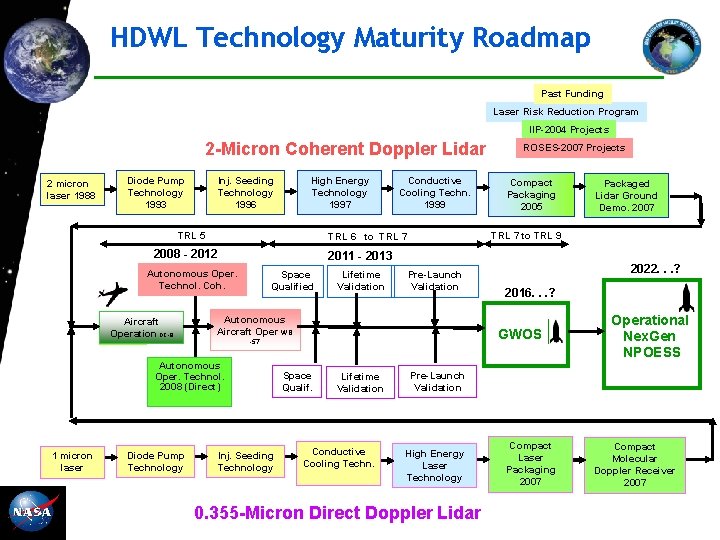
HDWL Technology Maturity Roadmap Past Funding Laser Risk Reduction Program IIP-2004 Projects 2 -Micron Coherent Doppler Lidar 2 micron laser 1988 Diode Pump Technology 1993 High Energy Technology 1997 Inj. Seeding Technology 1996 TRL 5 2011 - 2013 Autonomous Oper. Technol. Coh. Space Qualified Diode Pump Technology Lifetime Validation Pre-Launch Validation Autonomous Aircraft Oper WB Inj. Seeding Technology Space Qualif. Lifetime Validation Conductive Cooling Techn. Packaged Lidar Ground Demo. 2007 2022. . . ? 2016. . . ? GWOS -57 Autonomous Oper. Technol. 2008 (Direct) 1 micron laser Compact Packaging 2005 TRL 7 to TRL 9 TRL 6 to TRL 7 2008 - 2012 Aircraft Operation DC-8 Conductive Cooling Techn. 1999 ROSES-2007 Projects Operational Nex. Gen NPOESS Pre-Launch Validation High Energy Laser Technology 0. 355 -Micron Direct Doppler Lidar Compact Laser Packaging 2007 Compact Molecular Doppler Receiver 2007
Concluding Remarks Ø Global wind profiles are the most important missing observations in the current observing system Ø A HDWL mission will: - Fill a critical gap in our capability to measure global wind profiles - Significantly improve the skill in forecasting high impact weather systems globally (i. e. , hurricanes, mid-latitude storms, etc. ), - Provide major societal benefits, both civilian and military - Potentially make a transformational impact on global tropospheric wind analyses, according to the NRC Weather Panel, and provide major benefits to NASA, NOAA and Do. D, and to the Nation Ø Field campaigns, such as T-PARC, contribute significantly to lidar risk reduction and help build excitement for the wind lidar data and a space mission