
Dopamine pathways antipsychotics Flavio Guzmn MD Pharmacology Instructor
- Slides: 8
Dopamine pathways & antipsychotics Flavio Guzmán, MD Pharmacology Instructor Health Sciences Faculty University of Mendoza Argentina Psychiatry Resident Mental Health Teaching Hospital “Dr. Carlos Pereyra “ Mendoza Argentina
Learning objective • Understand basic concepts of dopaminergic pathways and their relevance to antipsychotic effects.
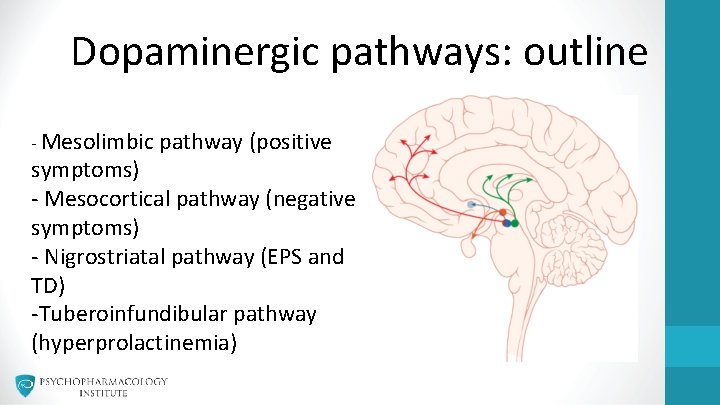
Dopaminergic pathways: outline - Mesolimbic pathway (positive symptoms) - Mesocortical pathway (negative symptoms) - Nigrostriatal pathway (EPS and TD) -Tuberoinfundibular pathway (hyperprolactinemia)
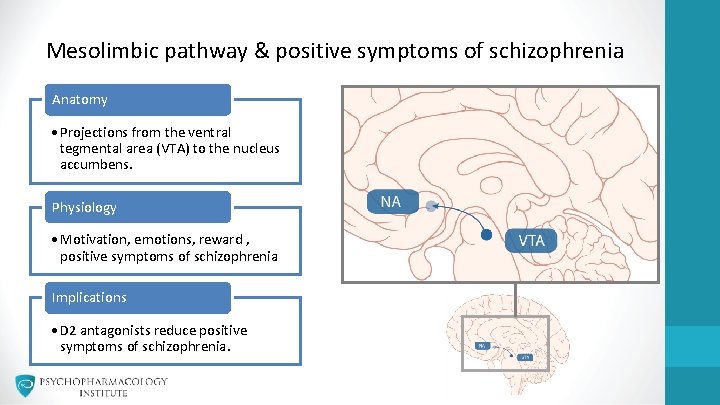
Mesolimbic pathway & positive symptoms of schizophrenia Anatomy • Projections from the ventral tegmental area (VTA) to the nucleus accumbens. Physiology • Motivation, emotions, reward , positive symptoms of schizophrenia Implications • D 2 antagonists reduce positive symptoms of schizophrenia.
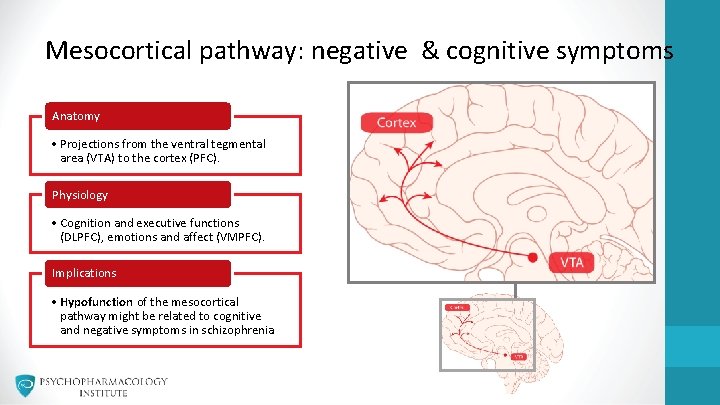
Mesocortical pathway: negative & cognitive symptoms Anatomy • Projections from the ventral tegmental area (VTA) to the cortex (PFC). Physiology • Cognition and executive functions (DLPFC), emotions and affect (VMPFC). Implications • Hypofunction of the mesocortical pathway might be related to cognitive and negative symptoms in schizophrenia
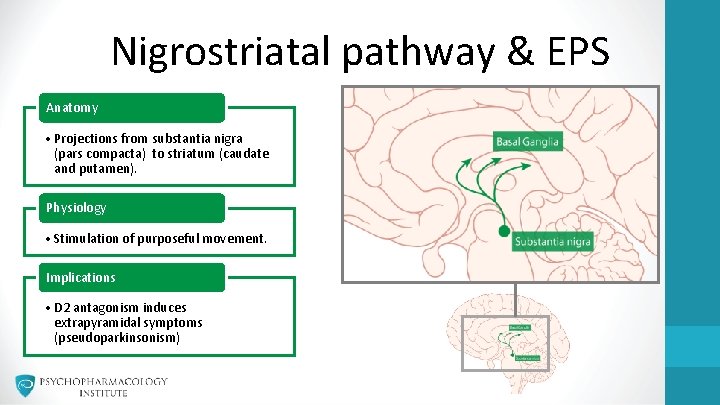
Nigrostriatal pathway & EPS Anatomy • Projections from substantia nigra (pars compacta) to striatum (caudate and putamen). Physiology • Stimulation of purposeful movement. Implications • D 2 antagonism induces extrapyramidal symptoms (pseudoparkinsonism)
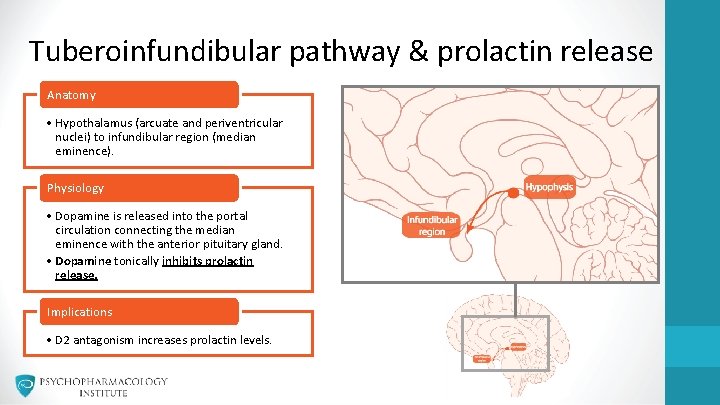
Tuberoinfundibular pathway & prolactin release Anatomy • Hypothalamus (arcuate and periventricular nuclei) to infundibular region (median eminence). Physiology • Dopamine is released into the portal circulation connecting the median eminence with the anterior pituitary gland. • Dopamine tonically inhibits prolactin release. Implications • D 2 antagonism increases prolactin levels.
Summary • Hyperactivation from the VTA to limbic areas might be related to positive symptoms of schizophrenia. • Hypofunction of the mesocortical pathway might in part explain cognitive and negative symptoms of schizophrenia. • D 2 blockade of the nigrostriatal pathway can cause EPS. • D 2 blockade of the tuberoinfundibular pathway increases prolactin blood levels.