
DOP and IOP n Bill hit the ball
DOP and IOP
n Bill hit the ball. n Sherry reads the book.
n The direct object can also be a person. n Sherry hit Bill. (DO=Bill) Sherry hit Bill.
Juan tira el pan. Maria envia la carta. Mike pasa los lapices. Susan busca las plumas.
n n n Often, it is desirable to replace the name of the direct object with a pronoun. Example 1: Paul bought the flowers. He took the flowers home and gave the flowers to his wife. Example 2: Paul bought the flowers. He took them home and gave them to his wife.
n When the pronoun replaces the name of the direct object, use the following pronouns: n me (me) n te (you-familiar) n lo, la (him, her, it, you-formal) n nos (us) n los, las (them, you-all-formal)
n The direct object pronoun comes immediately • before the conjugated verb. Tengo = I have n Tengo la pluma. = I have the pen. n La tengo. = I have it. n
Likewise, if the direct object of the sentence changes from singular to plural, the plural n pronoun must be used. n María tiene = Mary has n María tiene los libros. = Mary has the books. n María los tiene. = Mary has them. n
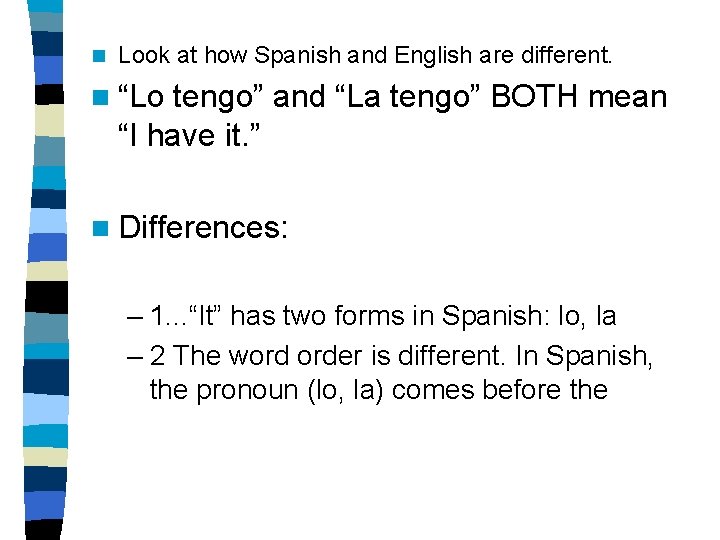
n Look at how Spanish and English are different. n “Lo tengo” and “La tengo” BOTH mean “I have it. ” n Differences: – 1. . . “It” has two forms in Spanish: lo, la – 2 The word order is different. In Spanish, the pronoun (lo, la) comes before the
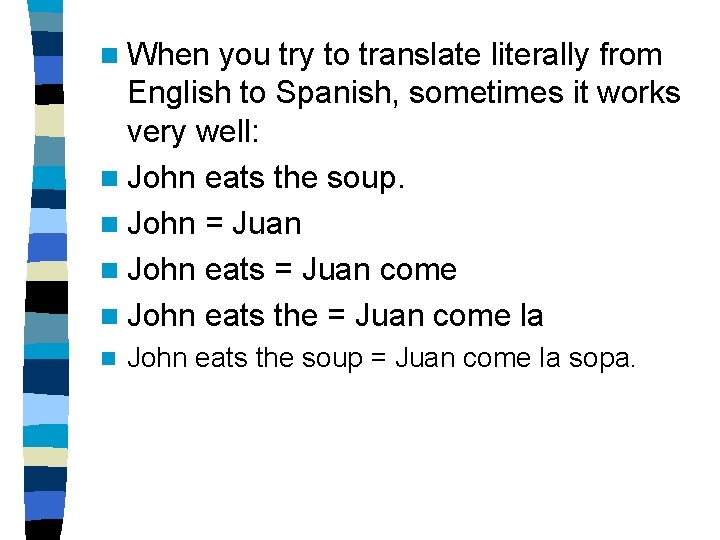
n When you try to translate literally from English to Spanish, sometimes it works very well: n John eats the soup. n John = Juan n John eats = Juan come n John eats the = Juan come la n John eats the soup = Juan come la sopa.
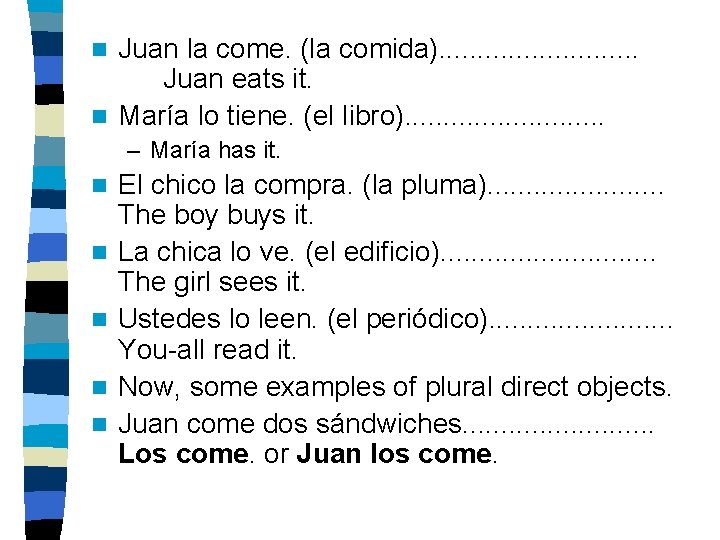
Juan la come. (la comida). . . Juan eats it. n María lo tiene. (el libro). . . n – María has it. n n n El chico la compra. (la pluma). . . The boy buys it. La chica lo ve. (el edificio). . . . The girl sees it. Ustedes lo leen. (el periódico). . . You-all read it. Now, some examples of plural direct objects. Juan come dos sándwiches. . . Los come. or Juan los come.
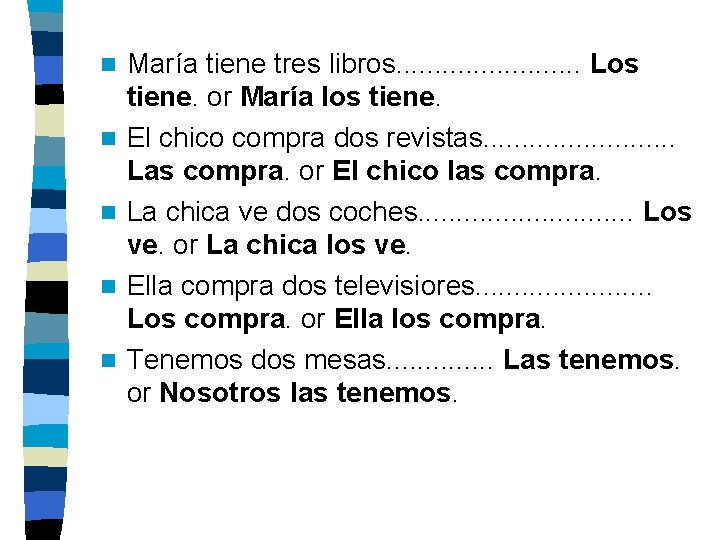
n n n María tiene tres libros. . . Los tiene. or María los tiene. El chico compra dos revistas. . . Las compra. or El chico las compra. La chica ve dos coches. . . . Los ve. or La chica los ve. Ella compra dos televisiores. . . Los compra. or Ella los compra. Tenemos dos mesas. . . Las tenemos. or Nosotros las tenemos.
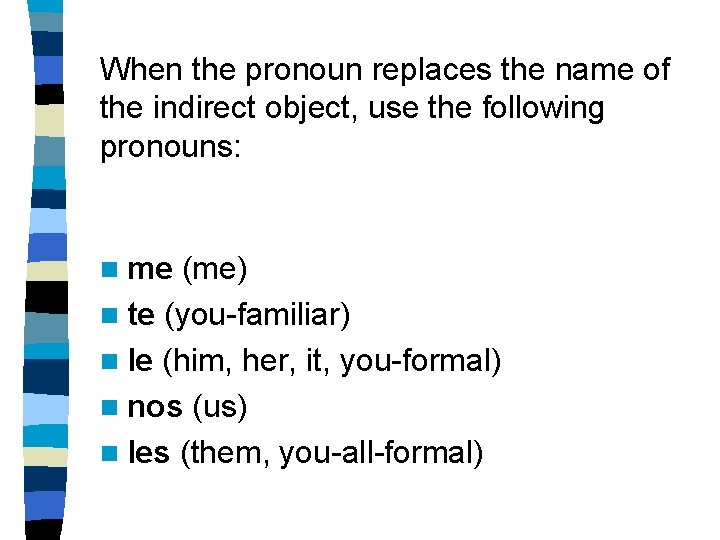
When the pronoun replaces the name of the indirect object, use the following pronouns: n me (me) n te (you-familiar) n le (him, her, it, you-formal) n nos (us) n les (them, you-all-formal)
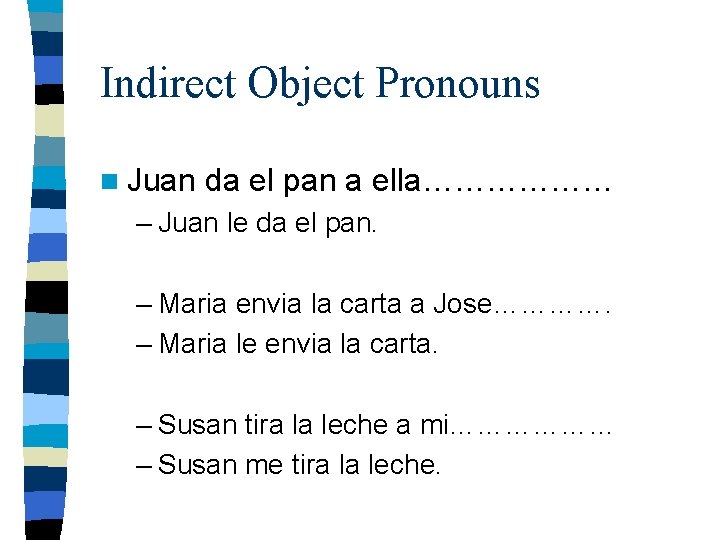
Indirect Object Pronouns n Juan da el pan a ella……………… – Juan le da el pan. – Maria envia la carta a Jose…………. – Maria le envia la carta. – Susan tira la leche a mi……………… – Susan me tira la leche.

El Fin
- Slides: 15