
Dont Let the Ticks Bite Maine Center for
Don’t Let the Ticks Bite! Maine Center for Disease Control and Prevention 2015 -2016 Maine Center for Disease Control and Prevention
…Ticks * * * What do ticks look like? Are all ticks the same? Where do ticks live? Why remove a tick? What is Lyme disease? How will I know if I have Lyme disease? * How do I protect myself? * What if I find a tick on me? Maine Center for Disease Control and Prevention
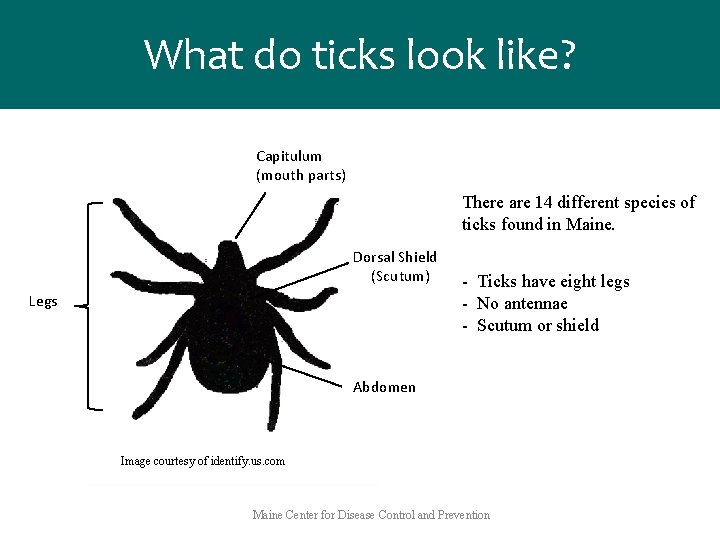
What do ticks look like? Capitulum (mouth parts) There are 14 different species of ticks found in Maine. Dorsal Shield (Scutum) Legs - Ticks have eight legs - No antennae - Scutum or shield Abdomen Image courtesy of identify. us. com Maine Center for Disease Control and Prevention
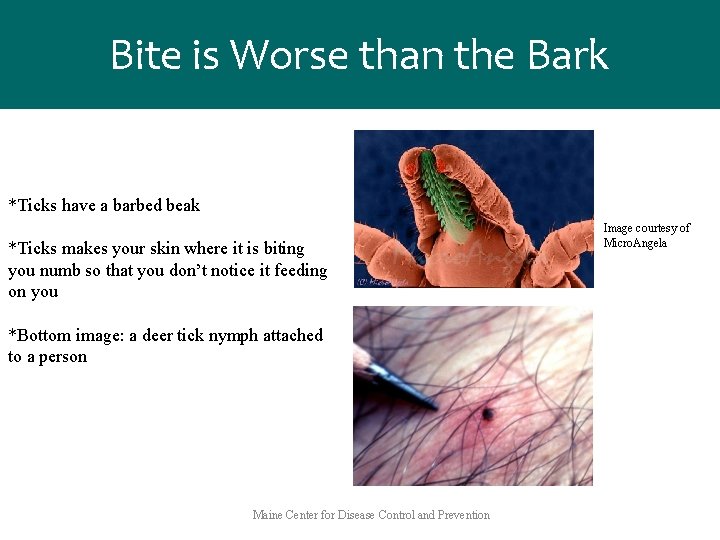
Bite is Worse than the Bark *Ticks have a barbed beak *Ticks makes your skin where it is biting you numb so that you don’t notice it feeding on you *Bottom image: a deer tick nymph attached to a person Maine Center for Disease Control and Prevention Image courtesy of Micro. Angela

What size are ticks? Ticks start off hatching from eggs and grow larger as they get older. Image courtesy of emedicinehealth. com Maine Center for Disease Control and Prevention
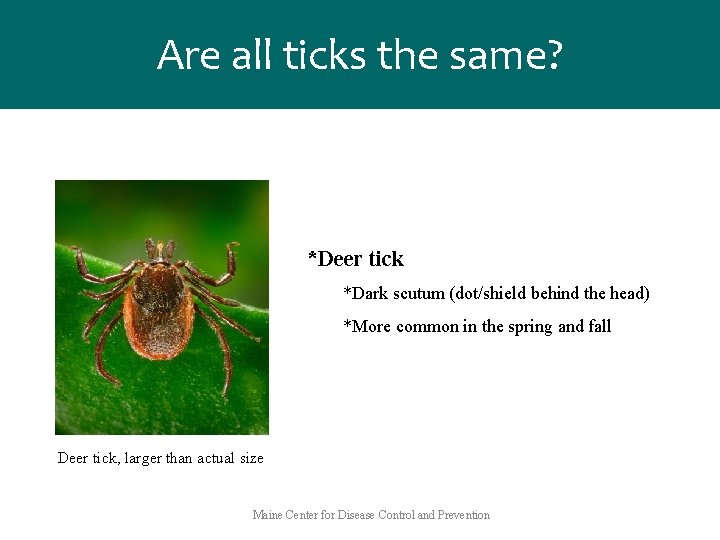
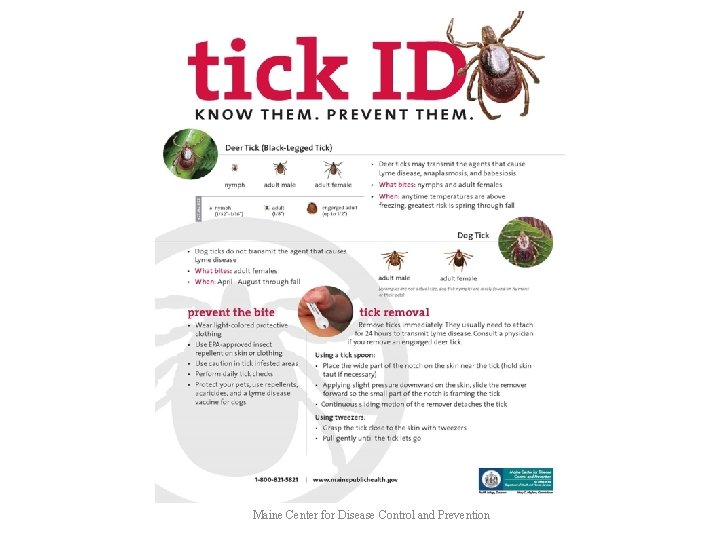
Are all ticks the same? *Deer tick *Dark scutum (dot/shield behind the head) *More common in the spring and fall Deer tick, larger than actual size Maine Center for Disease Control and Prevention

Are all ticks the same? *Dog tick *White scutum or white “racing stripes” down their back *More common in the summer Dog tick, larger than actual size Maine Center for Disease Control and Prevention
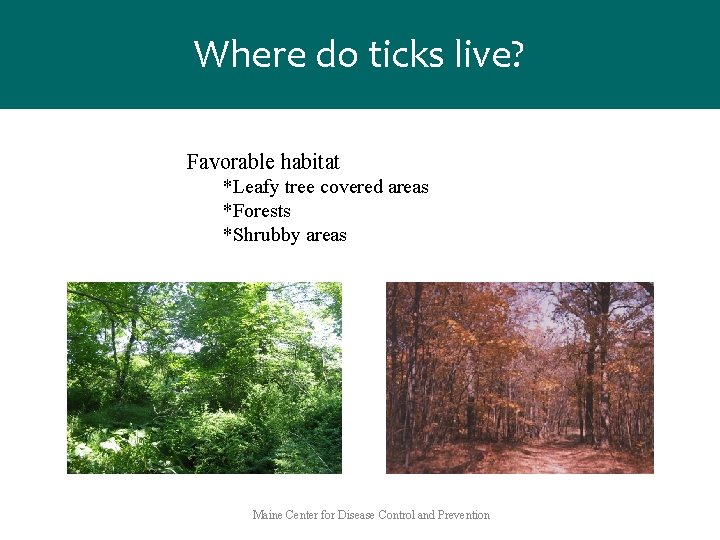
Where do ticks live? Favorable habitat *Leafy tree covered areas *Forests *Shrubby areas Maine Center for Disease Control and Prevention
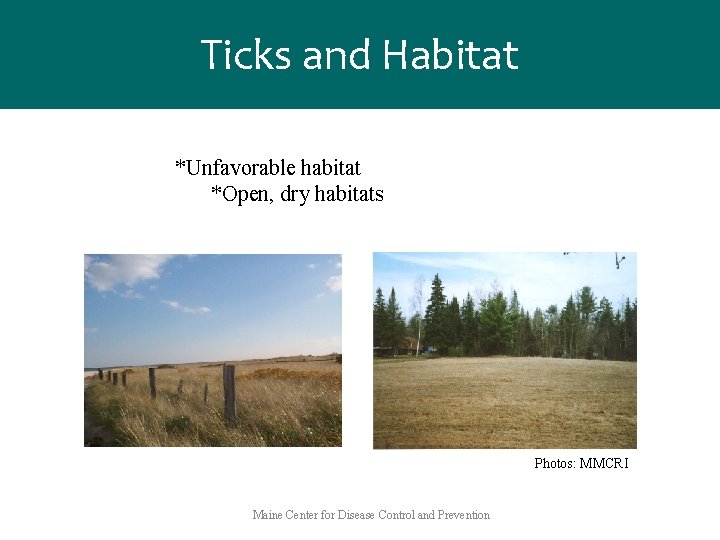
Ticks and Habitat *Unfavorable habitat *Open, dry habitats Photos: MMCRI Maine Center for Disease Control and Prevention
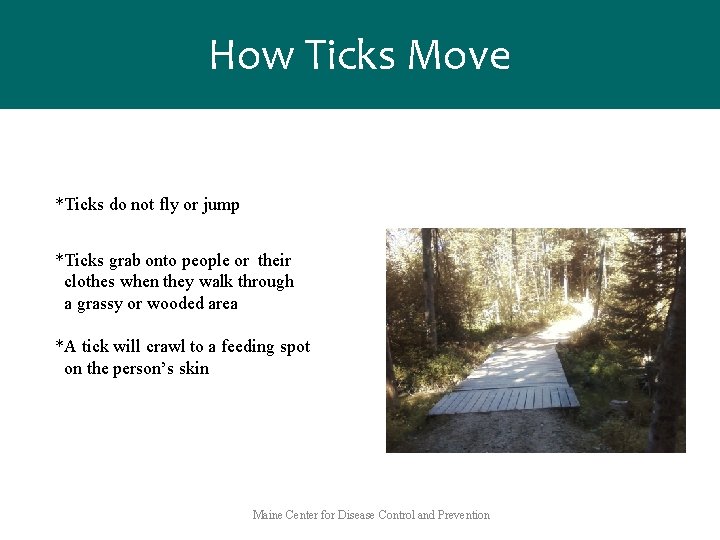
How Ticks Move *Ticks do not fly or jump *Ticks grab onto people or their clothes when they walk through a grassy or wooded area *A tick will crawl to a feeding spot on the person’s skin Maine Center for Disease Control and Prevention
Diseases that Maine ticks can carry *Lyme disease *Anaplasmosis *Babesiosis *Powassan Maine Center for Disease Control and Prevention
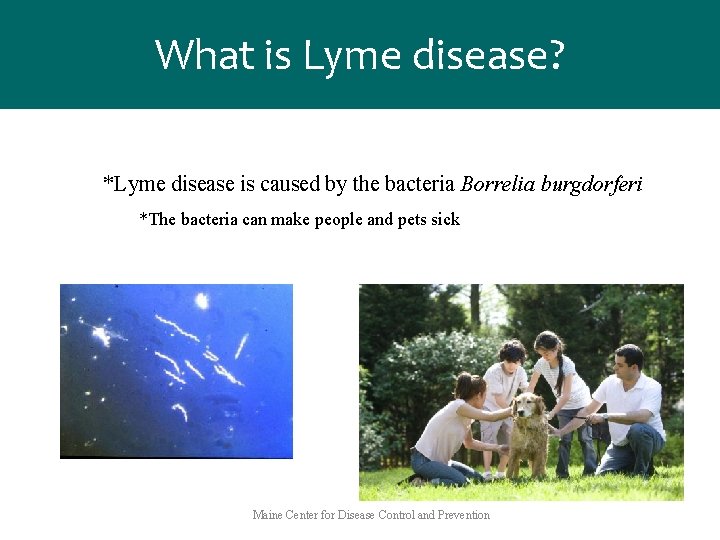
What is Lyme disease? *Lyme disease is caused by the bacteria Borrelia burgdorferi *The bacteria can make people and pets sick Maine Center for Disease Control and Prevention
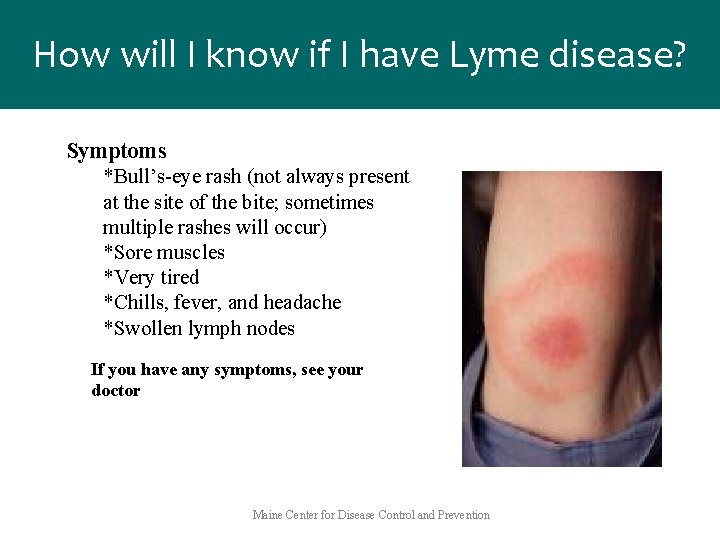
How will I know if I have Lyme disease? Symptoms *Bull’s-eye rash (not always present at the site of the bite; sometimes multiple rashes will occur) *Sore muscles *Very tired *Chills, fever, and headache *Swollen lymph nodes If you have any symptoms, see your doctor Maine Center for Disease Control and Prevention
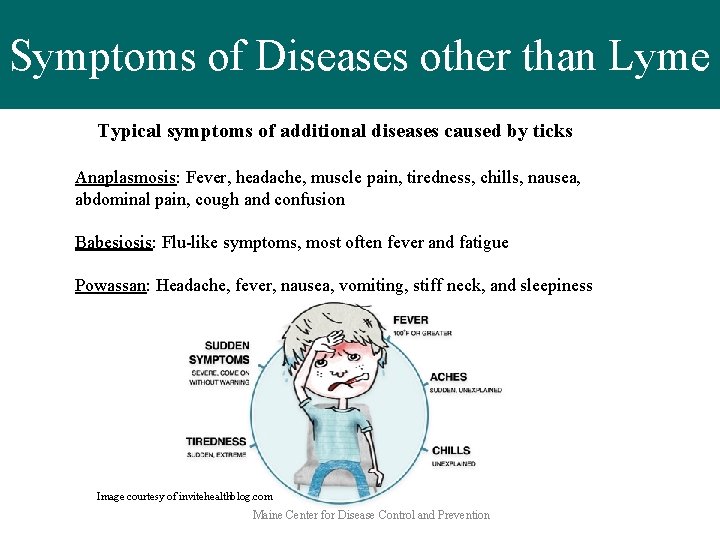
Symptoms of Diseases other than Lyme Typical symptoms of additional diseases caused by ticks Anaplasmosis: Fever, headache, muscle pain, tiredness, chills, nausea, abdominal pain, cough and confusion Babesiosis: Flu-like symptoms, most often fever and fatigue Powassan: Headache, fever, nausea, vomiting, stiff neck, and sleepiness Image courtesy of invitehealthblog. com Maine Center for Disease Control and Prevention
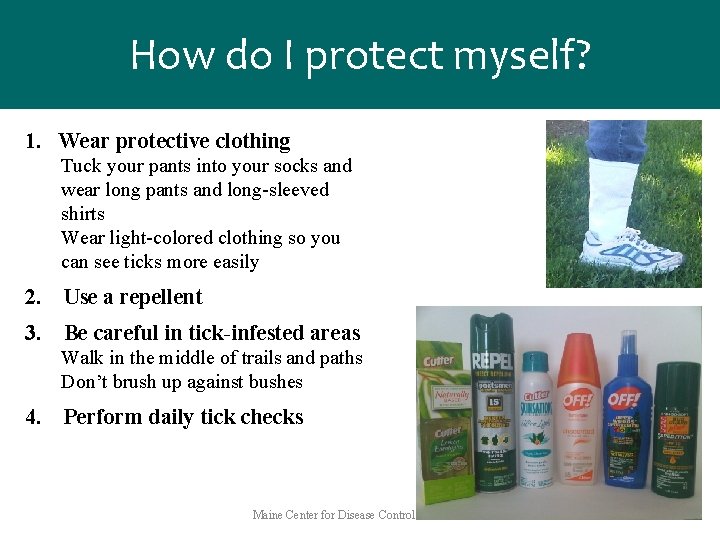
How do I protect myself? 1. Wear protective clothing Tuck your pants into your socks and wear long pants and long-sleeved shirts Wear light-colored clothing so you can see ticks more easily 2. Use a repellent 3. Be careful in tick-infested areas Walk in the middle of trails and paths Don’t brush up against bushes 4. Perform daily tick checks Maine Center for Disease Control and Prevention
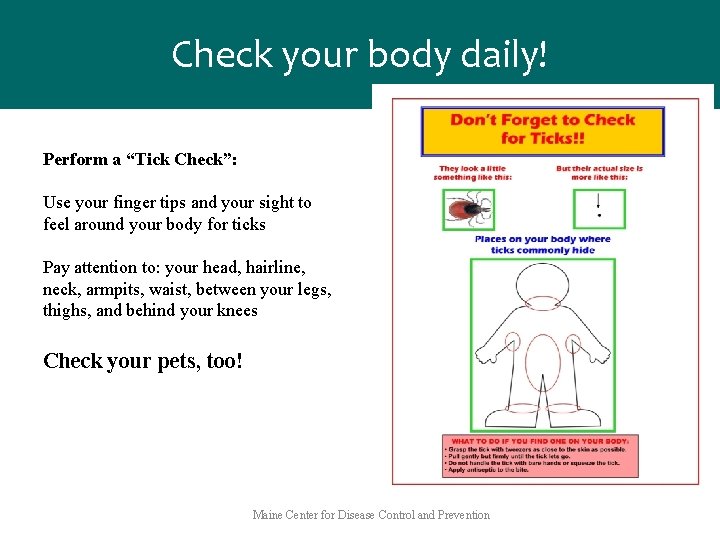
Check your body daily! Perform a “Tick Check”: Use your finger tips and your sight to feel around your body for ticks Pay attention to: your head, hairline, neck, armpits, waist, between your legs, thighs, and behind your knees Check your pets, too! Maine Center for Disease Control and Prevention
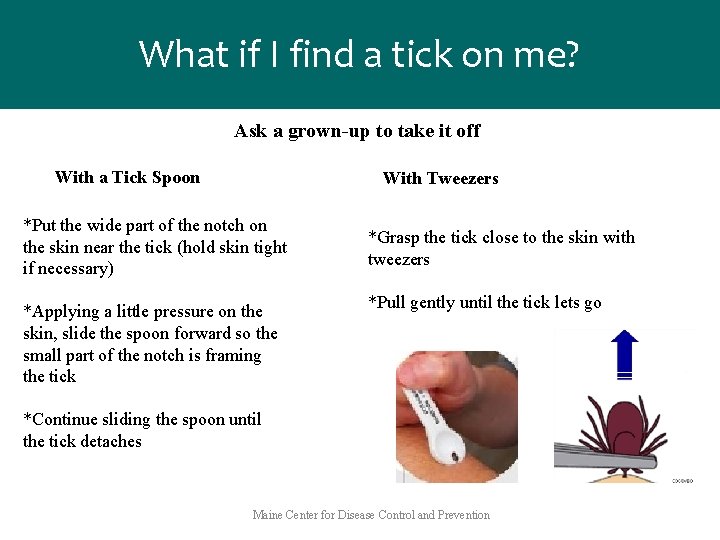
What if I find a tick on me? Ask a grown-up to take it off With a Tick Spoon With Tweezers *Put the wide part of the notch on the skin near the tick (hold skin tight if necessary) *Applying a little pressure on the skin, slide the spoon forward so the small part of the notch is framing the tick *Grasp the tick close to the skin with tweezers *Pull gently until the tick lets go *Continue sliding the spoon until the tick detaches Maine Center for Disease Control and Prevention
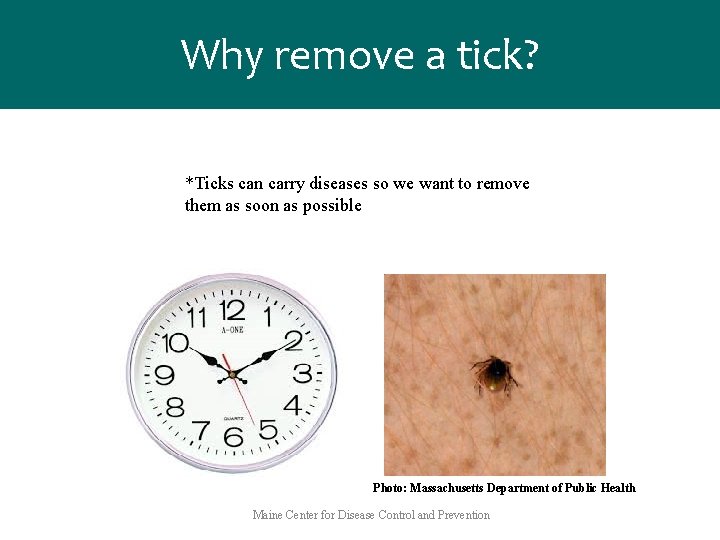
Why remove a tick? *Ticks can carry diseases so we want to remove them as soon as possible Photo: Massachusetts Department of Public Health Maine Center for Disease Control and Prevention

Make your yard safer *Remove brush, leaf litter and tall grass *Create a dry border between woods and lawn Before *Remove plants that attract deer and construct physical barriers that may discourage deer from entering your yard After Maine Center for Disease Control and Prevention
Maine Center for Disease Control and Prevention
Questions? * Maine CDC disease reporting and consultation: 1 -800 -821 -5821, Disease. reporting@maine. gov * Maine CDC Vector-Borne Disease Website: www. maine. gov/dhhs/mecdc/infectious-disease/epi/vector-borne/index. shtml * Maine Medical Center Research Institute – Vector-borne Disease Lab: 207 -396 -8246 Website: www. mmcri. org/lyme * UMaine Cooperative Extension Tick ID Lab: 207 -581 -3880 Website: www. extension. umaine. edu/ipm/tickid/ Maine Center for Disease Control and Prevention
- Slides: 21