
Dont Forget About Assistive Technology in the Transition
Don't Forget About Assistive Technology in the Transition Process Description Presented by Janet Peters and Bryan Ayres Center for Technology And Disability Webinar May 4, 2015 www. CTDInstitute. org
Session Overview • Key Factors to Consider when Transitioning with AT • Our Research • Introducing the QIAT-PS Project • Demonstration of Student Self-Evaluation Matrix • Case Examples Using Student Self-Evaluation Matrix • The Discussion on AT and Transition to Post-Secondary May 4 – 11, 2015 www. CTDInstitute. org
Assistive Technology In Post-Secondary www. CTDInstitute. org
Tell Us About Yourself? www. CTDInstitute. org
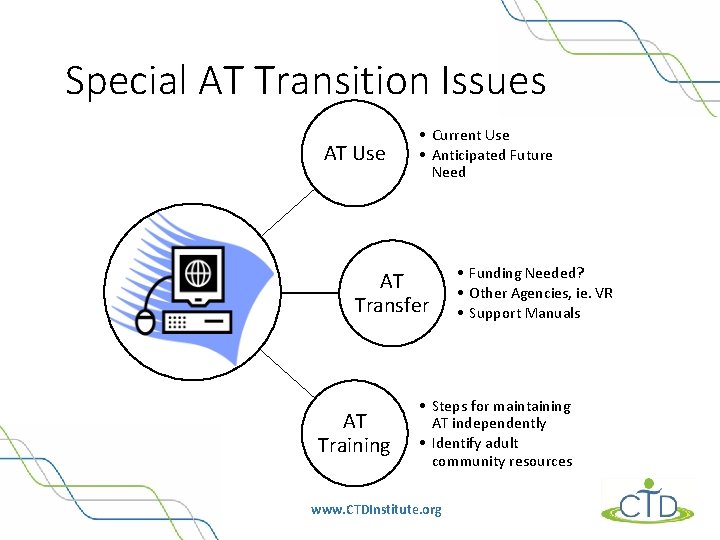
Special AT Transition Issues AT Use • Current Use • Anticipated Future Need AT Transfer AT Training • Funding Needed? • Other Agencies, ie. VR • Support Manuals • Steps for maintaining AT independently • Identify adult community resources www. CTDInstitute. org
Key Transition Factors for AT Doesn’t (usually) come with you to college or employment settings Accommodations provided only on request Some Assistive Technology options may be limited to what the college currently owns Postsecondary Institutions vary greatly on their disability and Assistive Technology expertise and disability support in general www. CTDInstitute. org
Assistive Technology Skills • Self determination is the ability to make free choices about your actions or state of being. • • • Choice-making skills Decision-making skills Problem-solving skills Goal setting and attainment skills Self-regulation/self-management skills Self-advocacy and leadership skills www. CTDInstitute. org
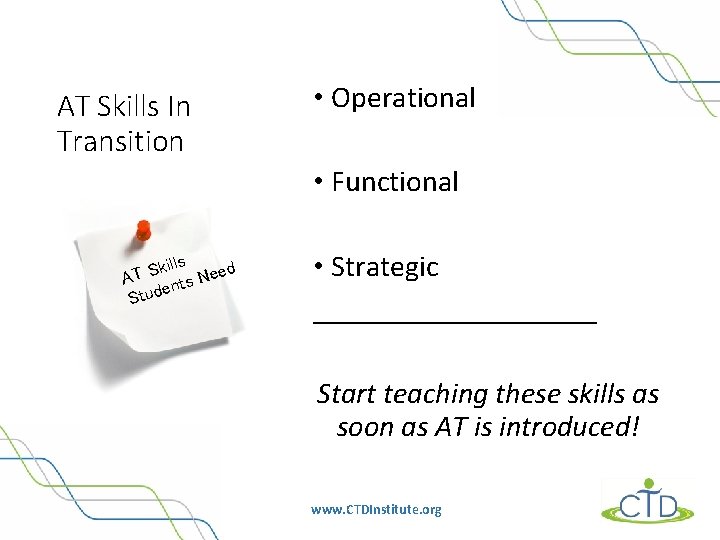
AT Skills In Transition • Operational • Functional ills k S eed N AT s ent d u t S • Strategic __________ Start teaching these skills as soon as AT is introduced! www. CTDInstitute. org
The QIAT-PS Project www. CTDInstitute. org
www. qiat-ps. org www. CTDInstitute. org
Collaborative Project • Great Lakes ADA Center www. adagreatlakes. org • Southwest ADA Center www. southwestada. org • Quality Indicators in Assistive Technology Services (K-12) www. qiat. org • Association on Higher Education and Disability www. ahead. org • Adirondack Accessibility www. adkaccess. org • Gayl Bowser, Independent Consultant www. linkedin. com/gbowser And hundreds of professionals contributed to creating, testing, and improving the Quality Indicators for Assistive Technology in Post Secondary Education. www. CTDInstitute. org
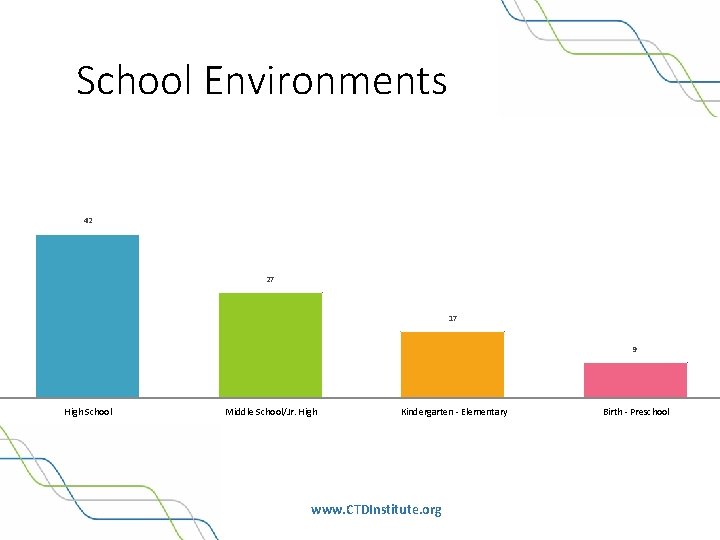
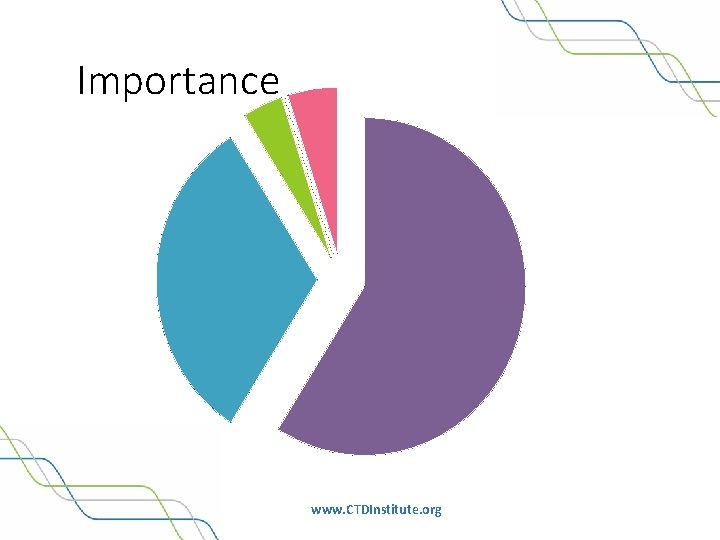
School Environments 42 27 17 9 High School Middle School/Jr. High Kindergarten - Elementary www. CTDInstitute. org Birth - Preschool
Importance www. CTDInstitute. org
Technology Transition 2015 www. CTDInstitute. org
Your Help Is Needed! http: //bit. ly/Survey. AT www. CTDInstitute. org
QIAT-PS Self-Evaluation Tools www. CTDInstitute. org
Participating Schools University of Wisconsin Whitewater Augsburg College University of Arkansas Fayetteville UW – Eau Claire Minneapolis City Colleges Chicago University of Arkansas Northland Community Little Rock College MN www. CTDInstitute. org Miami University Ohio Lone. Star College System TX
What Transition Activities are Required! • 21. 03 TRANSITION FROM SCHOOL TO ADULT LIFE • 21. 03. 1 Definition. • 21. 03. 1. 1 Transition services means a coordinated set of activities for a child with a disability that – • 21. 03. 1. 2 Is designed to be within a results oriented process that is focused on improving the academic and functional achievement of the child with a disability to facilitate the child’s movement from school to post school activities including, post-secondary education, vocational education, integrated employment (including supported employment), continuing and adult education, adult services, independent living, or community participation; • A. Is based upon the individual child's needs, taking into account the child's preferences and interests; and www. CTDInstitute. org
Transition and IDEA-continued • B. Includes – • 1. Instruction; • 2. Related services; • 3. Community experiences; • 4. The development of employment and other post-school adult living objectives, and; • 5. If appropriate, acquisition of daily living skills and provision of a functional vocational evaluation. 21. 03. 1. 3 Transition services for children with disabilities may be special education, if provided as specially designed instruction, or a related service, if required to assist a child with a disability to benefit from special education. www. CTDInstitute. org
Transition and IDEA-continued • 21. 03. 2 Content of the IEP. • 21. 03. 2. 1 Transition Services. The IEP must include – • A. For each child with a disability, beginning not later than the first IEP to be in effect when the child turns 16 (or younger, if determined appropriate by the IEP Team), and updated annually, thereafter, the IEP must include • 1. Appropriate measurable postsecondary goals based upon age appropriate transition assessments related to training, education, employment, and, where appropriate independent living skills; and • 2. The transition services (including courses of study) needed to assist the child in reaching those goals. • B. The following requirements do not apply to children with disabilities who are convicted as adults under State law and incarcerated in adult prisons: • 1. The requirements in 34 CFR 300. 320(b) (related to transition planning and transition services) do not apply with respect to the children whose eligibility under Part B of the Act will end, because of their age, before they will be eligible to be released from prison based on consideration of their sentence and early release. www. CTDInstitute. org
Transition and IDEA-continued • Also included: • Transfer of rights • Participants in meetings • Agency responsibilities Arkansas Department of Education. (2008). Procedural Requirements and Program Standards, Section 21. 00 Transition, Little Rock, AR: Author www. CTDInstitute. org
U. S. Department of Education. Building the Legacy. http: //idea. ed. gov/ • Section 1400(c)(14) describes the need to provide "effective transition services to promote successful post-school employment and/or education. www. CTDInstitute. org
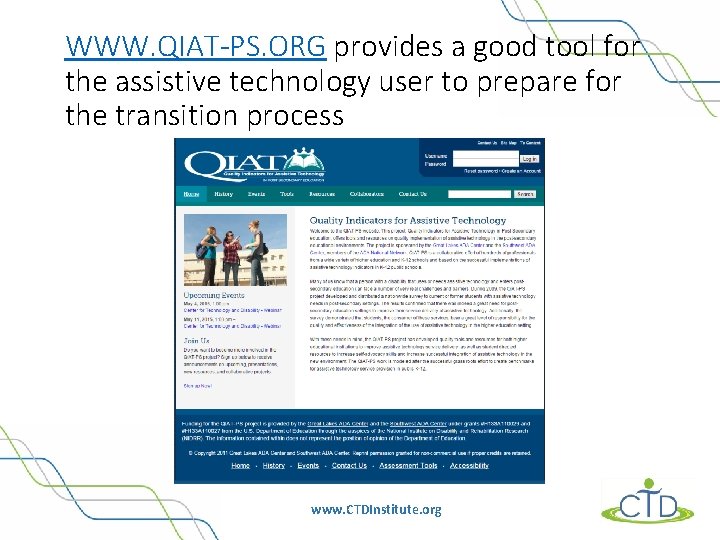
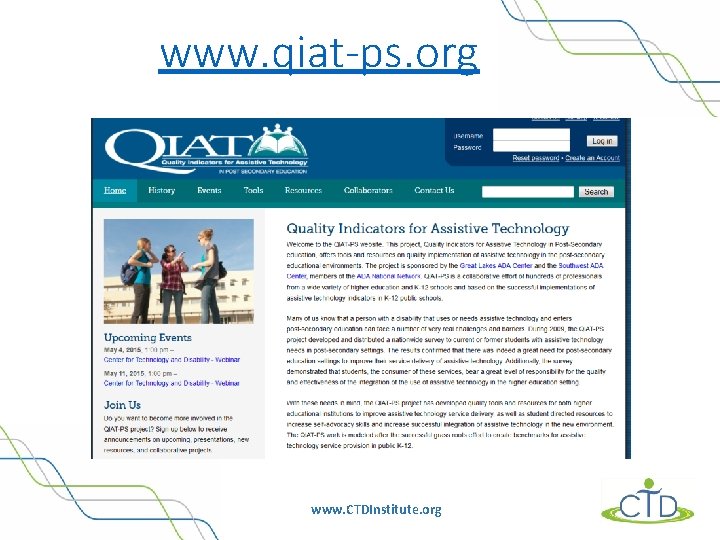
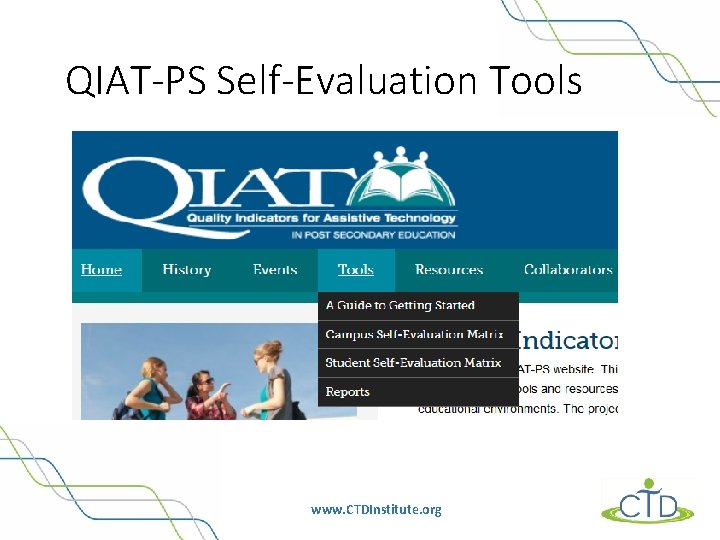
WWW. QIAT-PS. ORG provides a good tool for the assistive technology user to prepare for the transition process www. CTDInstitute. org
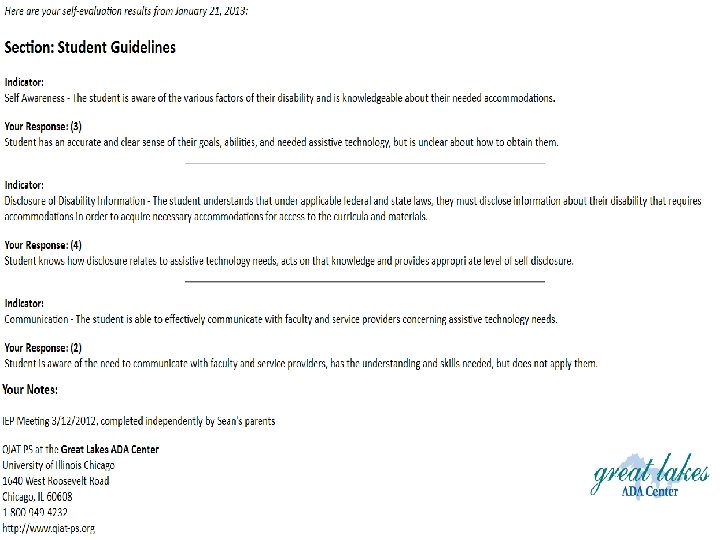
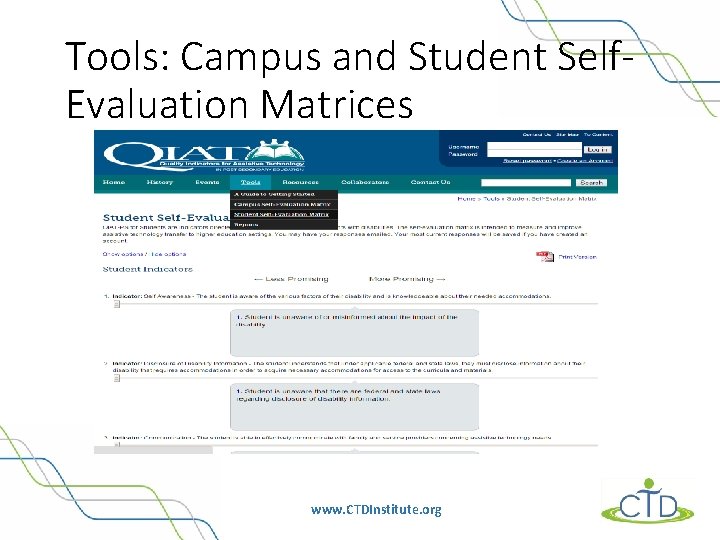
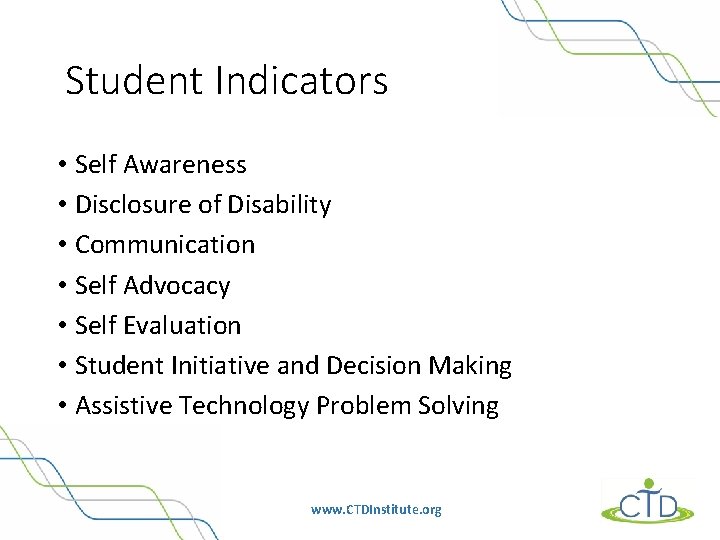
WWW. QIAT-PS. ORG has a number of links for Tools • Student Self-Evaluation Matrix • Contains a self-rating tool in seven indicator areas with one being less promising practice and five being more promising practice. • Reports can be generated by signing up for an account. • E-mail results in a tabular format • Download a comma-separated-format, (CSV) file. Spread sheet type format for accessible and edited use. • Your work will be saved and you can return later to finish. www. CTDInstitute. org
www. CTDInstitute. org
Tools: Campus and Student Self. Evaluation Matrices www. CTDInstitute. org
Student Indicators • Self Awareness • Disclosure of Disability • Communication • Self Advocacy • Self Evaluation • Student Initiative and Decision Making • Assistive Technology Problem Solving www. CTDInstitute. org
There a number of scenarios that can occur • The student is a proficient user of assistive technology and a good self advocate. • The student has been introduced to assistive technology but is not independent in its use or needs significant supports. • The student transitions with an un-met need academically or functionally that may be mediated if provided with supports or assistive technology devices or services. www. CTDInstitute. org
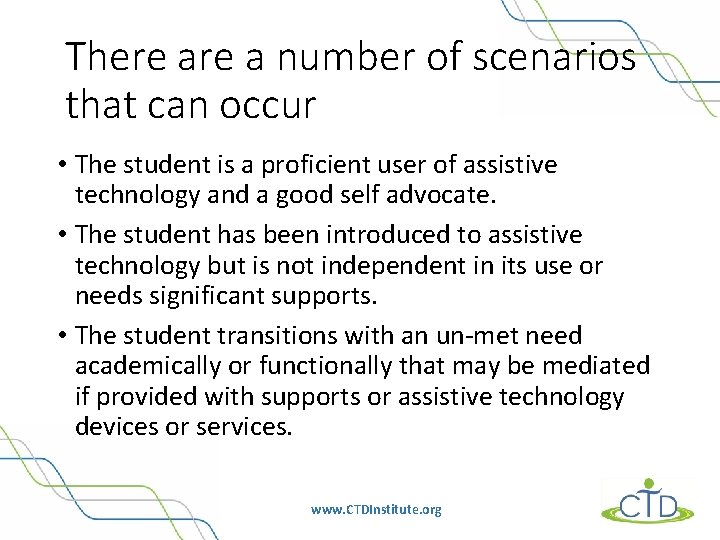
Scenarios--continued • The student has assistive technology but is not realistic about his/her needs. • The student uses their technology in only limited environments or settings. There can be many reasons that someone may be an exceptional AT user in college. Similarly, there could be a number of factors for not being prepared in an adult post-secondary educational setting in use of assistive technology. www. CTDInstitute. org
Let’s consider Susan • Susan is a 17 year old with Cerebral Palsy and she uses a communication device to communicate with others. She has had a device since she was 12 and is considered proficient at using it. • Susan relies on a Para-professional to assist her with management of educational materials and assistance with activities of daily living. • Susan has begun a transition plan at age 16 with her IEP team and indicates that she wants to go to college and major in Journalism--Writing/Literature. www. CTDInstitute. org
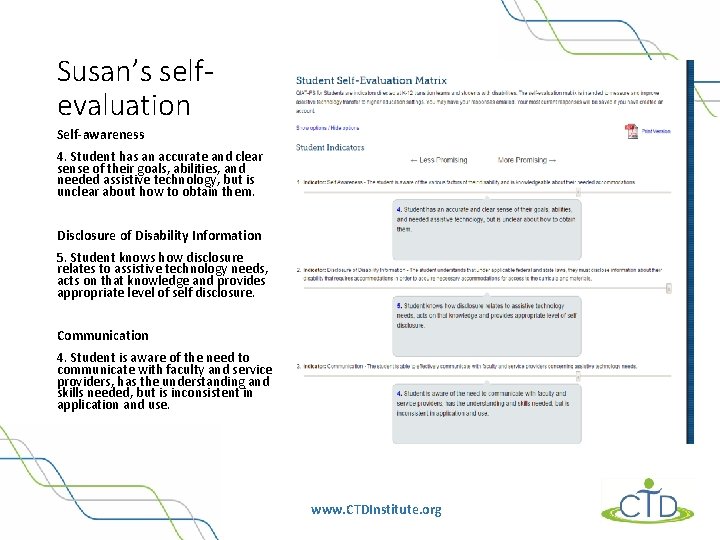
Susan’s selfevaluation Self-awareness 4. Student has an accurate and clear sense of their goals, abilities, and needed assistive technology, but is unclear about how to obtain them. Disclosure of Disability Information 5. Student knows how disclosure relates to assistive technology needs, acts on that knowledge and provides appropriate level of self disclosure. Communication 4. Student is aware of the need to communicate with faculty and service providers, has the understanding and skills needed, but is inconsistent in application and use. www. CTDInstitute. org
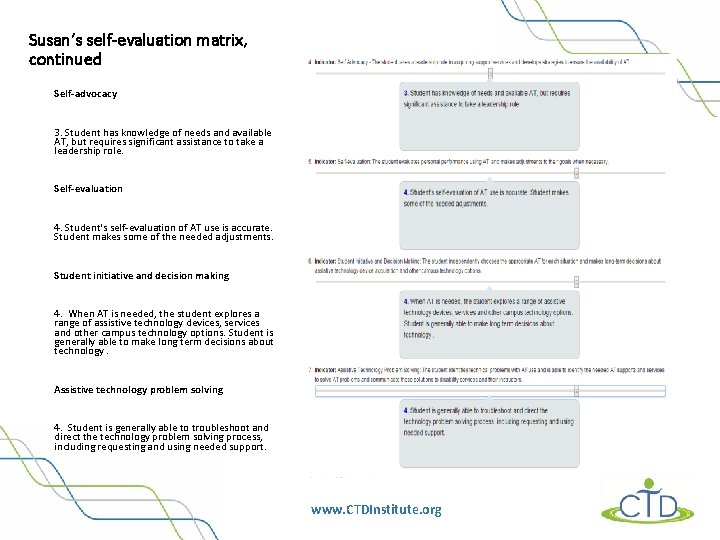
Susan’s self-evaluation matrix, continued Self-advocacy 3. Student has knowledge of needs and available AT, but requires significant assistance to take a leadership role. Self-evaluation 4. Student's self-evaluation of AT use is accurate. Student makes some of the needed adjustments. Student initiative and decision making 4. When AT is needed, the student explores a range of assistive technology devices, services and other campus technology options. Student is generally able to make long term decisions about technology. Assistive technology problem solving 4. Student is generally able to troubleshoot and direct the technology problem solving process, including requesting and using needed support. www. CTDInstitute. org
Brainstorm Professional development concerning her AT and possible support needs Investigate supports offered at Universities that interest her Assertiveness Training Quick Links to support numbers, e-mails and web sites for resources Other agency linkages Family and friend supports What MIGHT Susan and her IEP Team include in the transition plan based on the QIAT-PS Student Self-evaluation matrix? www. CTDInstitute. org
Let’s consider Eli • Eli is a 16 year old with a specific learning disability and he has difficulty with reading and writing. He has used a tablet at school the past two years to produce written products using an on-screen keyboard and word prediction. He thinks he wants to go to a local community college and then maybe finish a Bachelor’s Degree at a State college. His grades are not good but all of his staff and family says that he is capable and he just needs to buckle down and try harder. • Eli has 45 minutes daily on his IEP to work on reading and writing in a traditional resource room setting. • Eli has never attended his own IEP meetings. www. CTDInstitute. org
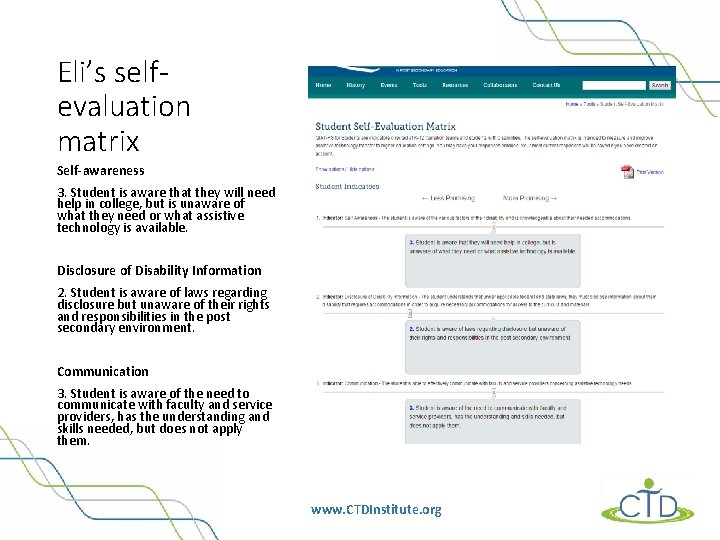
Eli’s selfevaluation matrix Self-awareness 3. Student is aware that they will need help in college, but is unaware of what they need or what assistive technology is available. Disclosure of Disability Information 2. Student is aware of laws regarding disclosure but unaware of their rights and responsibilities in the post secondary environment. Communication 3. Student is aware of the need to communicate with faculty and service providers, has the understanding and skills needed, but does not apply them. www. CTDInstitute. org
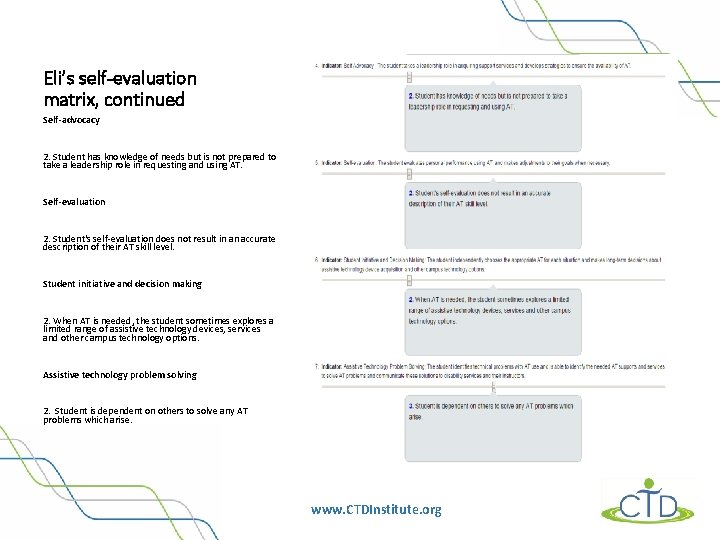
Eli’s self-evaluation matrix, continued Self-advocacy 2. Student has knowledge of needs but is not prepared to take a leadership role in requesting and using AT. Self-evaluation 2. Student's self-evaluation does not result in an accurate description of their AT skill level. Student initiative and decision making 2. When AT is needed, the student sometimes explores a limited range of assistive technology devices, services and other campus technology options. Assistive technology problem solving 2. Student is dependent on others to solve any AT problems which arise. www. CTDInstitute. org
Brainstorm Exploration of additional assistive technologies and what colleges offer in the area of supports. Training in laws such as Section 504, and the American’s with Disabilities Act and how this effects disclosure in adult settings. Practice in effective communication skills Training and practice in more advanced and effective self-advocacy skills Trials in other assistive technologies: (Examples; text to speech, speech to text). What MIGHT Eli and his IEP Team include in the transition plan based on the QIAT-PS Student Self-evaluation matrix? www. CTDInstitute. org
Questions to Ponder for Transition • What does it take for an IEP team and student who uses or needs assistive technology to mutually assess the student's capacity and exchange ideas? • What are some suggestions for how a student who uses assistive technology can learn to build a network of supports? • What are some strategies or techniques that can used to teach good habits in order to improve and sustain AT use? • Imposed collaboration does not work well in the adult world. How can this concept be taught to teens or young adult AT users? www. CTDInstitute. org
Questions? www. CTDInstitute. org
Thank You For Your Attention! Janet Peters, jpete@uic. edu Bryan Ayres, bayres@eastersealsar. com www. CTDInstitute. org
“Assistive and Instructional Technology Supporting Learners with Disabilities” www. CTDInstitute. org
- Slides: 41