
DONATELLO 1386 1466 History of Western Art BFAII

DONATELLO (1386 -1466) History of Western Art BFA-II (Visual Arts) Course Incharge: Ms. Farah Khan Institute of Design & Visual Arts (LCWU)
DONATELLO (1386 -1466) • Italian sculptor Donatello was the greatest Florentine sculptor before Michelangelo and was the most influential individual artist of the 15 th century in Italy. “He may be said to have been the first to illustrate the art of sculpture among the moderns” Giorgio Vasari
DONATELLO (1386 -1466) • His original name was Donato di Niccolo di Betto Bardi, (born on c. 1386, in Florence and died on December 13, 1466 in Florence (Italy). • He was a master of sculpture in both marble and bronze, and was considered to be one of the greatest of all Italian Renaissance artists. He also worked in wood, clay, wax and stucco. • He received his childhood education in the house of the Martelli family, considered to be one of Florence’s richest families. • His family (The Bardi family) was commercially successful and his father Niccolo Bardi was a wool carder that had earned a modest place in Florence’s bourgeois society. This social rank likely earned Donatello an apprenticeship around 1400 to learn stone-carving with one of the many sculptors who worked nearby during the construction of the Florence’s cathedral, the Duomo. • Like other Florentine sculptors such as Lorenzo Ghiberti and Benvenuto Cellini, Donatello received his early artistic training in the workshop of a goldsmith. His first major exposure as an artist arrived when he competed for the famous 1401 competition for the design of the Baptistery doors in Florence.

LORENZO GHIBERTI (1378 -1455)
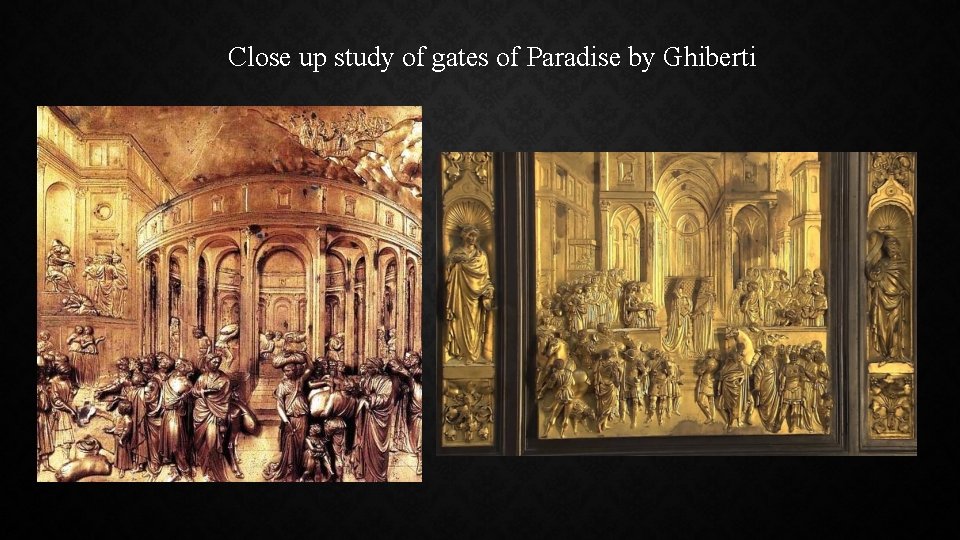
Close up study of gates of Paradise by Ghiberti
DONATELLO (1386 -1466) • Afterwards, he worked for a brief period of time in the studio of Ghiberti, winner of the Baptistery door competition, whose influential workshop provided training for a number of young artists. Ghiberti was well known for his International Gothic style of bronze sculpture and excelled at creating gracefully subtle lines in his work. • From 1402 -1404, Donatello studied with his friend and colleague Brunelleschi. According to Brunelleschi’s biographer Antonio Manetti (who wrote his account during the life of both artists), the pair travelled to Rome, where they excavated and studied the ancient ruins. This trip gave Donatello a reputation as a treasure seeker. The experience gave Donatello a deep understanding of ornamentation and classic forms, important knowledge that would eventually change the face of 15 th-century Italian art. • He later worked again in Rome sculpting tombs with the artist/architect Michelozzo, whom he had met in Ghiberti’s workshop. • This time marked the beginning of the Humanist movement in Florence, which favored the classical art of ancient Greece and Rome over the stiff and formal style of the Medieval and Gothic periods. • Donatello and Brunelleschi were the first to systematically study ancient ruins for inspiration. Donatello funded this time of artistic exploration by working as a goldsmith.
DONATELLO (1386 -1466) • He had detailed and wide-ranging knowledge of ancient sculpture than any other artist of his day. His work was inspired by ancient visual examples, which he often daringly transformed. Though he was traditionally viewed as essentially a realist, later research indicates he was much more. • Unlike many other celebrated artists of his day, Donatello did not spend his entire youth as a studio apprentice to a master. Instead, he studied briefly with a stone mason and a goldsmith. He then worked with Lorenzo Ghiberti on the bronze entry to Florence’s Baptistery. At the age of 17, Donatello was out on his own, making a name for himself in Renaissance Florence. • Donatello popularized a unique manner of communicating motion in otherwise inanimate stone. The Italian name for this technique, which shows figures in energetic, spiraling poses, is “figura serpentinata”. It is similar to but not the same as contrapposto, a type of pose also used by sculptors. Subsequent masters such as da Vinci, Raphael and Michelangelo variously adopted both technique to breathe life into their sculptures. • Over his career he developed a style of lifelike, highly emotional sculptures and a reputation second only to Michelangelo’s.
DONATELLO (1386 -1466) • Donatello’s first statue depicting David is one of his earliest known works and in many respects pays homage to Ghiberti’s style. Standing a little over five feet tall, David represents an allegory of civic virtue triumphing over brutality and irrationality. Other early works include his marble St. John the Evangelist for the Duomo’s facade and a crucifix made from wood for nearby Santa Croce’s church. • Around 1415 Donatello’s full range as an artist began to emerge in two marble statues completed in the same year. His statues of St. Mark and St. George show immense confidence and personality in everything from their attire to their facial expression. Both statues were carved from marble and also informed a series of statues of prophets that would later surround the bell tower of the Duomo. All of these depictions of the prophets are strikingly unique from medieval and ancient portraits of the prophets, with Zuccone being considered the finest and most masterful of the collection. • Donatello created his own form of relief in sculpted marble panels called “schiacciato”. Schiacciato is a technique which allows a sculptor to create a recessed or relief sculpture with carving only millimetres deep. To give the illusion of greater depth. the thickness gradually decreases from the foreground to the background. This translates in English as “flattened out”. He used this technique to great success in many works such as St. George Killing the Dragon and The Ascension, with Christ Giving the Keys to St. Peter.
DONATELLO (1386 -1466) • Rapidly maturing in his art, Donatello soon began to develop a style all his own, with figures much more dramatic and emotional. • His journey ranges from the Gothic style and toward a more classical technique. • Donatello gained a reputation for creating imposing, larger-than-life figures using innovative techniques and extraordinary skills. His style incorporated the new science of perspective, which allowed the sculptor to create figures that occupied measurable space. • Donatello also drew heavily from reality for inspiration in his sculptures, accurately showing suffering, joy and sorrow in his figure’s faces and body positions. • Feast of Herod showed a command of linear perspective in Donatello’s own relief technique with reference to schiacciato. • In the 1440 s Donatello was invited to Padua to work on a series of bronze works. He first completed the Crucifix for the Padua santo. Arguably the most enticing of the commissions in Padua was the equestrian statue known popularly of as Gattamelata. Its popularity spread immediately after its completion when other nobles desired the same type of depiction.
DONATELLO (1386 -1466) • While Donatello did take on a few more important commissions for the Church of San Antonio in Padua, he also seems to have gone through a personal crisis or illness in the small Venetian town. When Donatello returned to Florence his work had changed, reflecting perhaps his own realization of his mortality. Figures like his statue of Mary Magdalene revealed withered skin and an aging sensibility that seemed to reveal Donatello’s perception of himself. • In the early 15 th century, when Donatello sculpted this figure, there was a push by the Roman Catholic Church to promote penitence amongst the faithful. This influence can be clearly seen by the posture of the Penitent Magdalene, her hands nearly joining, as if in prayer, her open mouth like she is begging forgiveness. • Donatello did not confine himself to stone and metal as media for his sculptures. He produced a carved wood statue, Penitent Magdalene, around 1450, for the Bapistery of Florence. The statue was groundbreaking in Renaissance Christian art for its realism and the unique vision of Mary Magdalene as one who is wasted away from fasting rather than healthy and beautiful as she appears in earlier art.
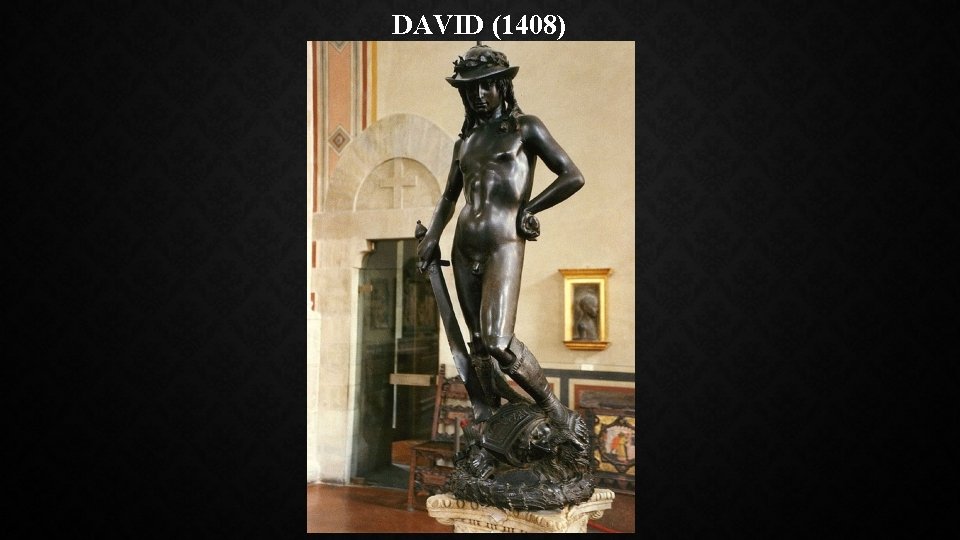
DAVID (1408)
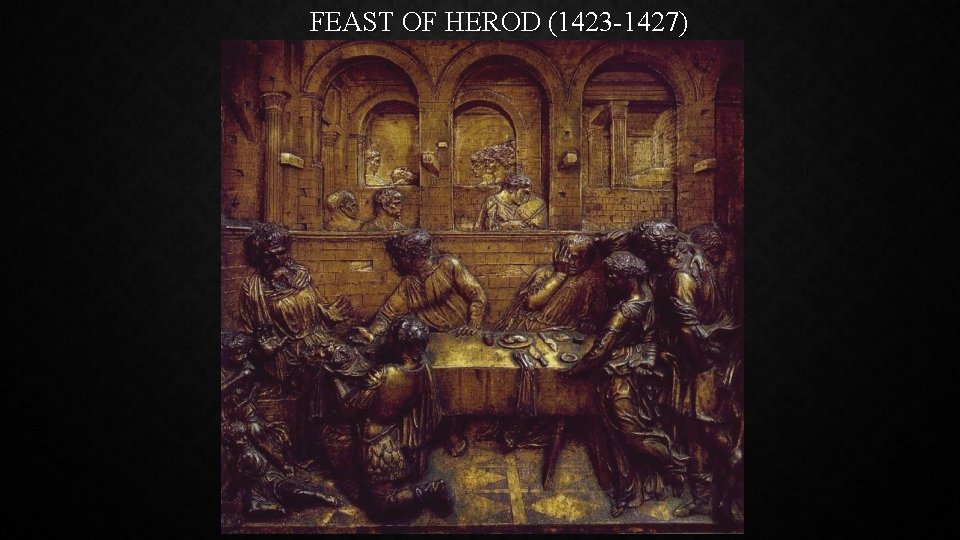
FEAST OF HEROD (1423 -1427)
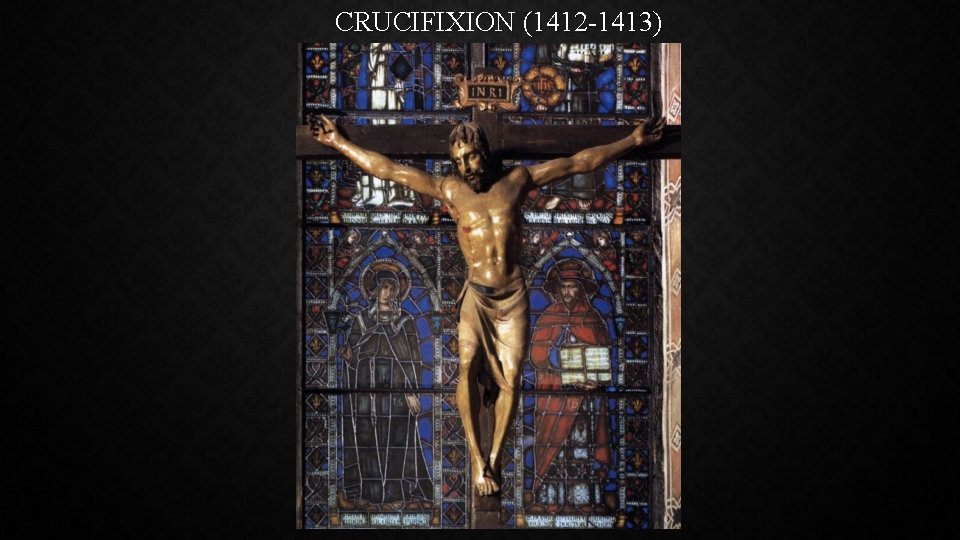
CRUCIFIXION (1412 -1413)
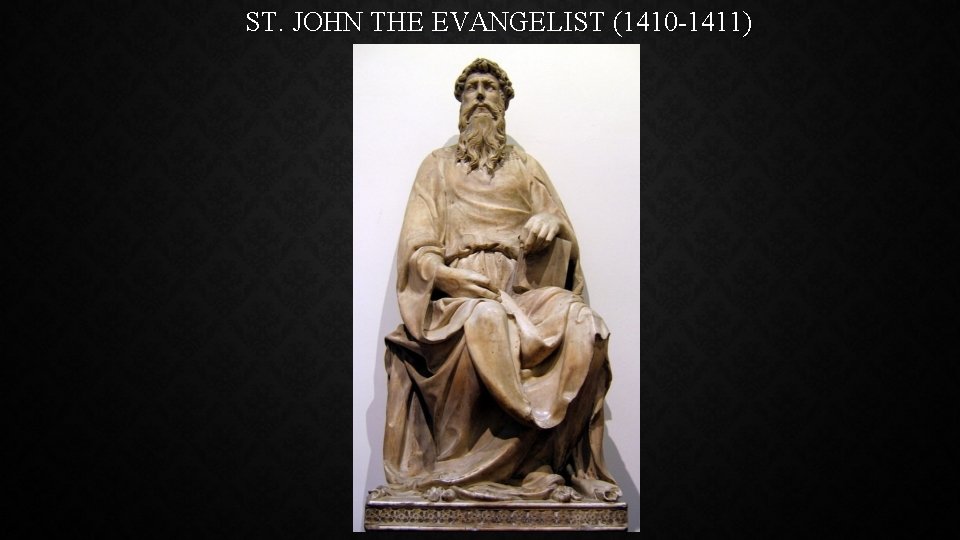
ST. JOHN THE EVANGELIST (1410 -1411)
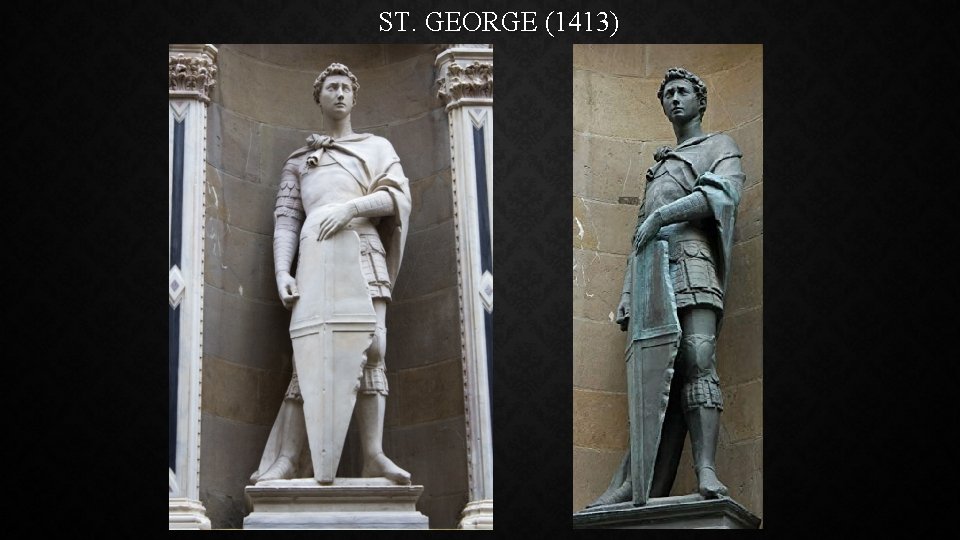
ST. GEORGE (1413)
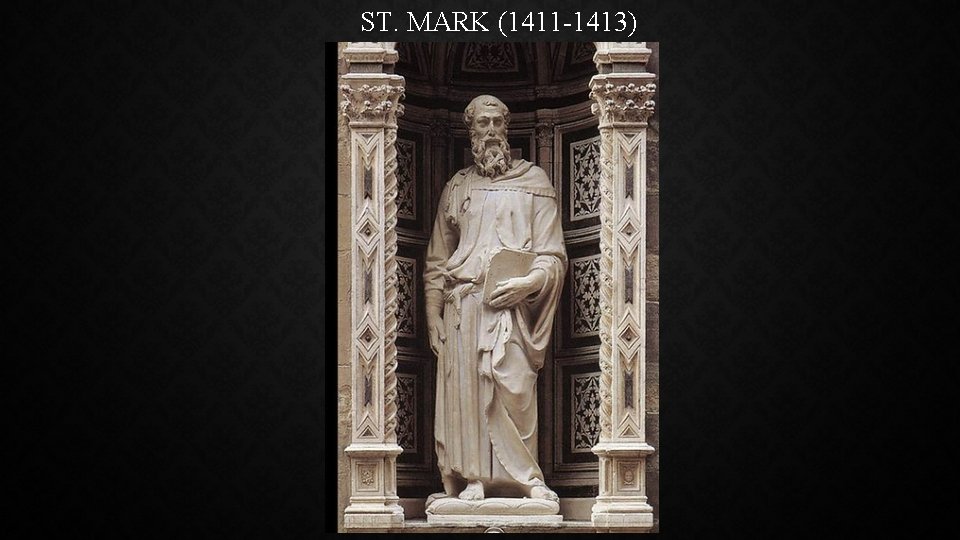
ST. MARK (1411 -1413)
• In the 16 th century, Giorgio Vasari, an Italian painter, wrote the following about Saint George by Donatello; “Life itself seems to be stirring vigorously within the stone. And to be sure no modern statues have the vivacity and spirit produced by nature and art, through the hand of Donatello in this marble”. • Another memorable quote was by Francesco Bocchi in the 16 th century. “The legs move, the arms are ready, the head alert, and the whole figure acts; by virtue of the character, the manner and form of the action present to our eyes a valiant, invincible, and magnanimous soul”.
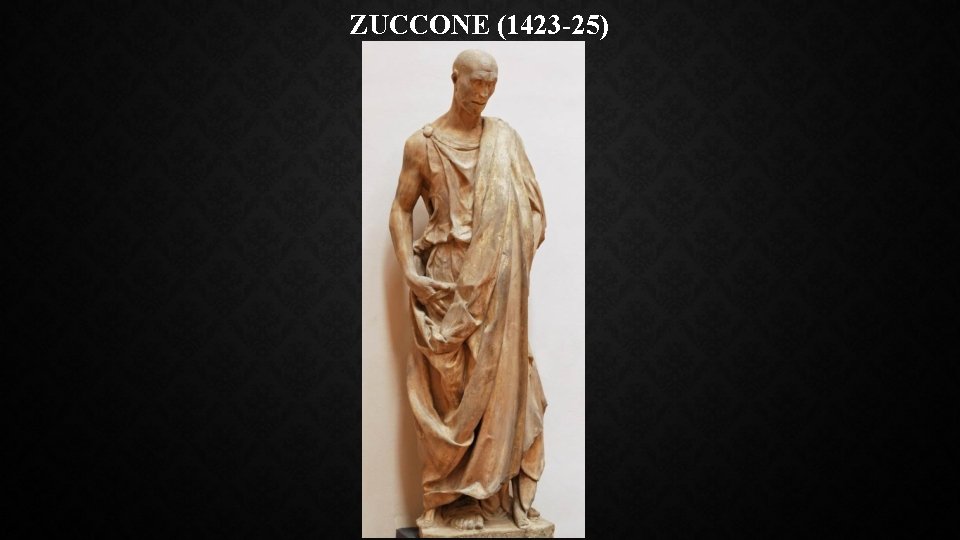
ZUCCONE (1423 -25)
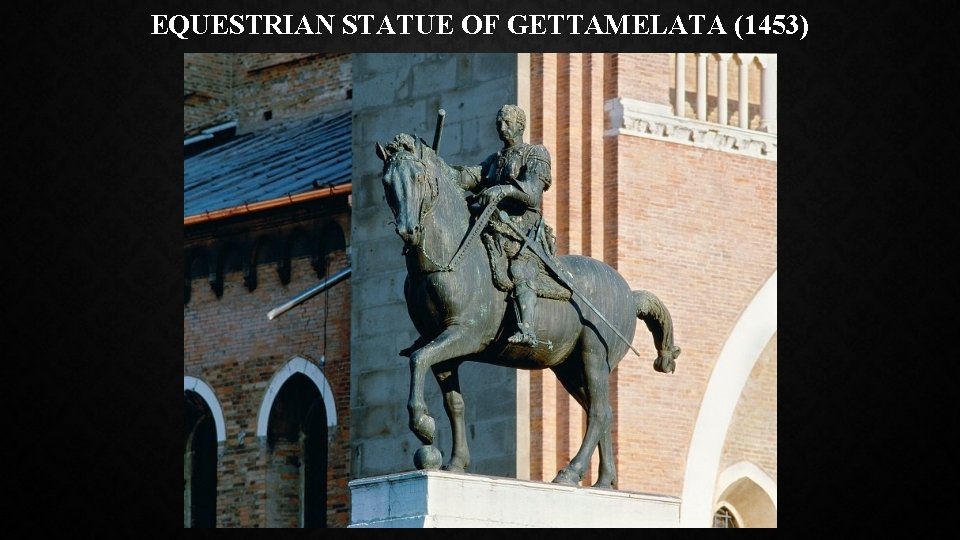
EQUESTRIAN STATUE OF GETTAMELATA (1453)
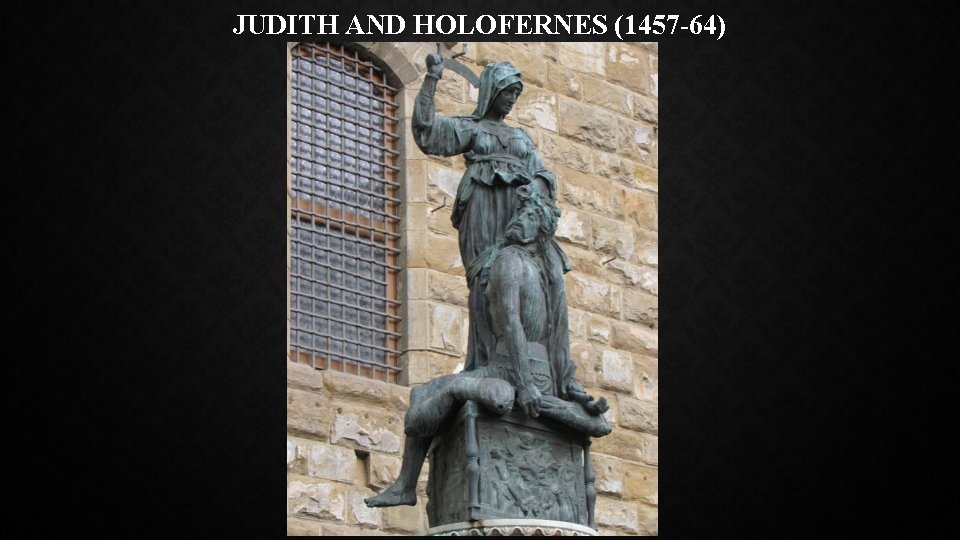
JUDITH AND HOLOFERNES (1457 -64)
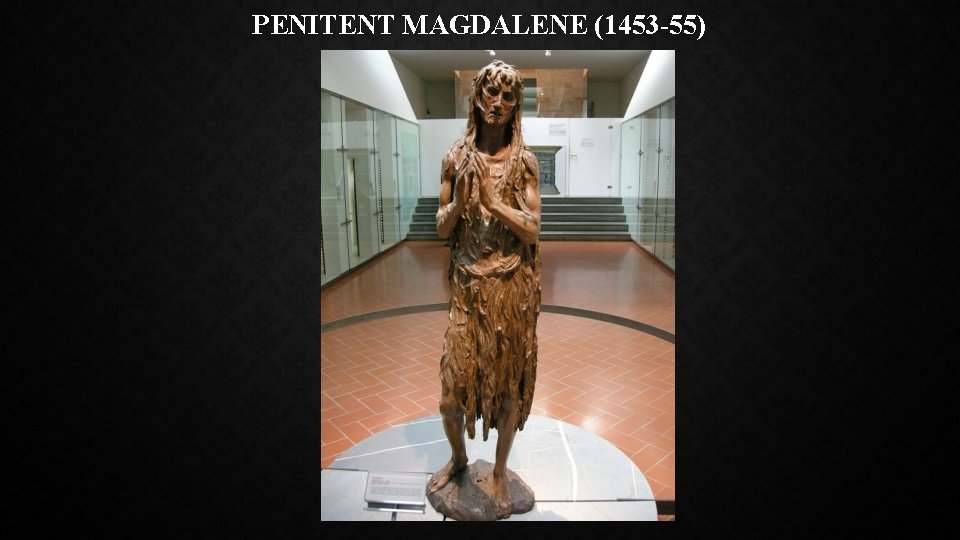
PENITENT MAGDALENE (1453 -55)
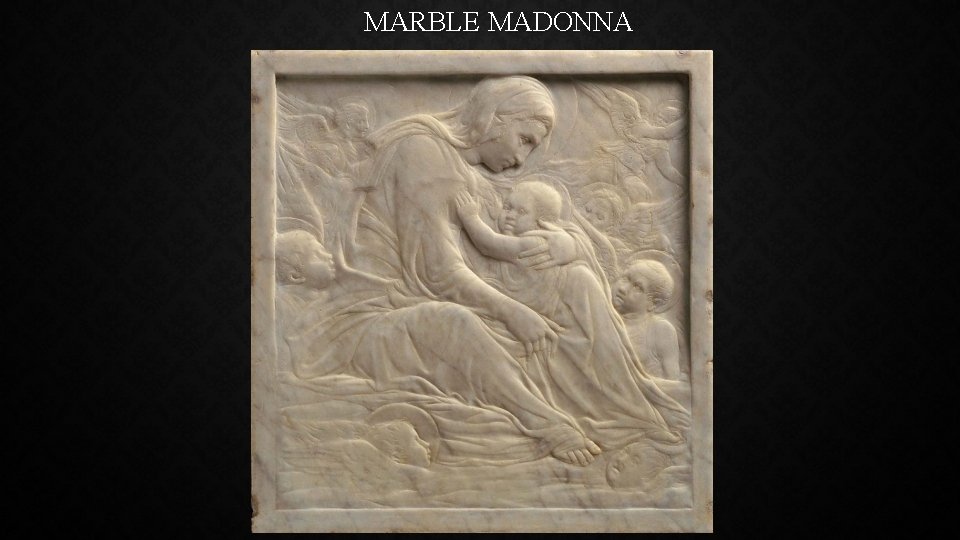
MARBLE MADONNA
- Slides: 22