
DON MARIANO MARCOS MEMORIAL STATE UNIVERSITY MidLa Union

- Slides: 55
DON MARIANO MARCOS MEMORIAL STATE UNIVERSITY Mid-La Union Campus COLLEGE OF GRADUATE STUDIES City of San Fernando, La Union Tem 336 Advanced entrepreneurship MANAGING THE ENTERPRISE Dr. Cedric Anthony E. Ochoco • Marketing management • Production Management • Financial Management • Employee Management Professor Miss Editha M. Bucsit Reporter
Managing the Enterprise MANAGEMENT – is a process of coordinating the resources of the organization in order to achieve its primary goals. MANAGEMENT - is both an art and a science.
Managing the Enterprise PRODUCTION RESOURCES 1. MATERIAL RESOURCES – tangible, physical resources 2. FINANCIAL RESOURCES - funds 3. HUMAN RESOURCES - people 4. INFORMATIONAL RESOURCES – correct and complete information
Managing the Enterprise BASIC FUNCTIONS OF MANAGEMENT 1. Establish goals of the enterprise and develop plans to attain goals. 2. Organize people and other resources to achieve goals. 3. Lead and motivate people towards the goals of the enterprise. 4. Maintain sufficient control system to ensure that the enterprise is moving well towards its goals.
Managing the Enterprise THE NEED FOR RISK MANAGEMENT Any business enterprise is faced with several risk possibilities. To sustain its business viability or success, an enterprise should eliminate or minimize business risks, such as fire, natural calamities, pilfering, robbery, strikes, accidents and so forth. Thru insurance: Insuring the products and properties against damage, theft, etc.
Managing the Enterprise A. MARKETING MANAGEMENT Refers to activities that are focused on strategic marketing issues which is to identify what product or service the buyers want.
Managing the Enterprise MARKETING – is the performance of business activities that directs the flow of goods and services from producer to consumer. Marketing is not just a single activity, but a process. It is a process of establishing natural satisfaction in exchange relationships between buyer and seller.
Managing the Enterprise IMPORTANCE OF CUSTOMER SERVICE Customers are the most valuable assets, and yet they are easily lost. 1. Train all employees to be courteous. 2. Coddle the customer. 3. Listen to others about your business.
Managing the Enterprise MARKETING PLAN - is an outline of actions designed to achieve a specific set of goals. - It should be realistic. - It must be compatible with marketing resources and the environment of the enterprise.
Managing the Enterprise CONSUMER BEHAVIOR An entrepreneur can easily satisfy the needs of consumers if he knows the behavior of consumers. Such knowledge and understanding of consumer behaviors create mutual benefits for both seller and buyer.
Managing the Enterprise Marketing Strategies A marketing strategy is a consistent, appropriate and feasible set of principles through which a particular enterprise hopes to attain its long-run customer and profit objectives in a particular competitive market.
Managing the Enterprise Introducing New Products There is a need to introduce new products or improved products. Because products have their life cycles, from introduction to growth and maturity, and finally to decline.
Managing the Enterprise Promotions 1. Advertising – utilizes the media: newspaper, magazine, radio, television, bill board, mail, and yellow pages. 2. Personal Selling – this is an area where small business has an advantage. In fact, people patronize a small business with its personalized customer service. Effective personal selling greatly depends on efficient sales force.
Managing the Enterprise Distribution Channels 1. Direct – producers deliver the goods to the consumers. 2. Indirect – a middleman sells the goods to the final users. A middleman can be a wholesaler or a retailer.
Managing the Enterprise Pricing Strategies 1. Some businessmen post P 4. 98 instead of P 5. 00 2. Others place “Buy one, take one. ” 3. Combined several low-price items and mark the package P 9. 95, instead of P 2. 50 per item.
Managing the Enterprise 4. Prestige Pricing – a very high price is set to project an aura of quality and status. 5. Penetration Pricing - a very low price for new product is offered. Break-Even Analysis – compares total revenues (TR) with total cost (TC). - To determine the effect of projected decline in sales on profit. - To determine the number of units an enterprise must sell in order to break-even
Managing the Enterprise B. PRODUCTION MANAGEMENT – refers to the activities that relate to the creation of goods and services through the transformation of inputs into outputs.
Managing the Enterprise Factors of Production 1. Land – includes natural resources. 2. Labor – refers to both physical and mental efforts. 3. Capital – pertains to machines, equipment, buildings, and other physical resources. 4. Entrepreneurial Ability – coordinates the other factors of production.
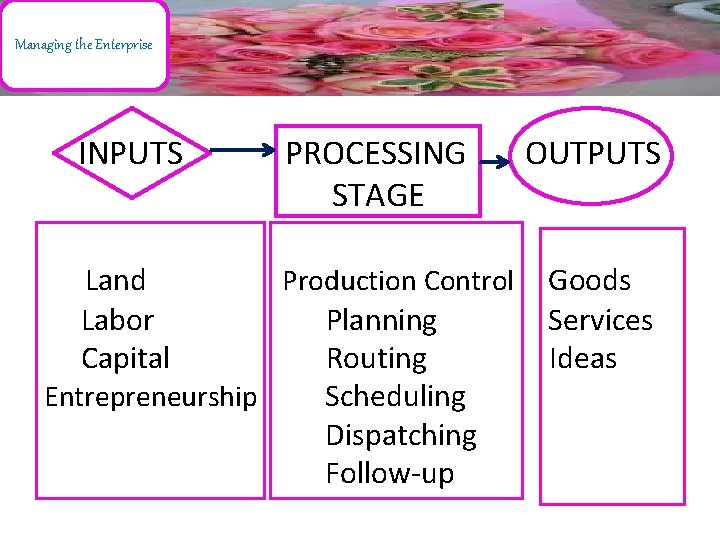
Managing the Enterprise INPUTS PROCESSING OUTPUTS STAGE Land Production Control Goods Labor Planning Services Capital Routing Ideas Entrepreneurship Scheduling Dispatching Follow-up
Managing the Enterprise Cost of Production - Represents the payments for the factors of production. These affect the ability and willingness of entrepreneurs to produce. When production costs are high, prices go up. This decreases the purchasing power of the consumers. This results to lower quantity demanded for goods and services.
Managing the Enterprise Total Costs of Production – is the sum total of expenses in producing a product or service. It is also the sum of fixed cost and variable cost. FC remains constant regardless of the volume of production while VC changes in proportion to the volume of production.
Managing the Enterprise Rules of Production Apply in a long-run period TR = Total Revenue (Income) TC = Total Cost (Expense) When TR is greater than TC, produce more When TR is less than TC, stop producing When TR is equal to TC, maintain production
Managing the Enterprise Apply in a short-run period TR = Total Revenue (Income) VC = Variable Cost (Operating Expenses) When TR is greater than VC, operate When TR is less than VC, shut down
Managing the Enterprise PURCHASING -is the buying of all the materials needed by the small firm. INVENTORY CONTROL -is the process of establishing and maintaining appropriate levels of reserve stocks of goods.
Managing the Enterprise QUALITY CONTROL is a process of insuring that goods and services are produced in accordance with their designs and specifications.
Managing the Enterprise Two Ways to Ensure the Quality of Products: 1. Quality Circle – A group of employees officially meet to study and solve problems of quality. 2. Inspection – this is done in various times during production.
Managing the Enterprise C. FINANCIAL MANAGEMENT - refers to activities that are concerned with securing money and using it properly .
Managing the Enterprise The Need for Financial Management Next to people, money is the most important resource of any business organization. Without money, there is no business at all.
Managing the Enterprise Financial Plan - is a course of action for obtaining and using the money that is needed to implement the goals of the business organization. Just like any other plan, financial planning should be flexible and realistic.
Managing the Enterprise Evaluating Financial Performance Plans are simply written statements. These are useless if they are not implemented. The entrepreneur as a financial manager should adopt ways of monitoring and evaluating financial performance. In evaluating financial performance, weaknesses and errors are discovered.
Managing the Enterprise The Two Most Important Financial Statements 1. Income Statement – compares the sales revenues and operating expenses in a given period, usually one year.
Managing the Enterprise 2. Balance Sheet – it is a statement of financial condition of an enterprise at a given point in time, usually on yearly basis. Balance Sheet Equation / Accounting Equation: Assets = Liabilities + Capital
Managing the Enterprise Basic Books to Keep 1. Purchase Journal – for credit purchase 2. Sales Journal – for credit sales 3. Cash Disbursement Journal – payments on cash basis 4. Cash Receipts Journal – all cash sales and payments from credit customers.
Managing the Enterprise D. EMPLOYEE MANAGEMENT - is the most important job that managers do in an organization. Since employees or people are regarded as the most important resources, it is but proper that entrepreneurs should have sound employee management in order to achieve its organizational goal.
Managing the Enterprise The Power of Praise in Business -- and How to Do it Right Here's what the psychologists think about praise: "Positive reinforcement works better than punishment. " Here's what the management experts think: "Employee recognition leads to profit. "
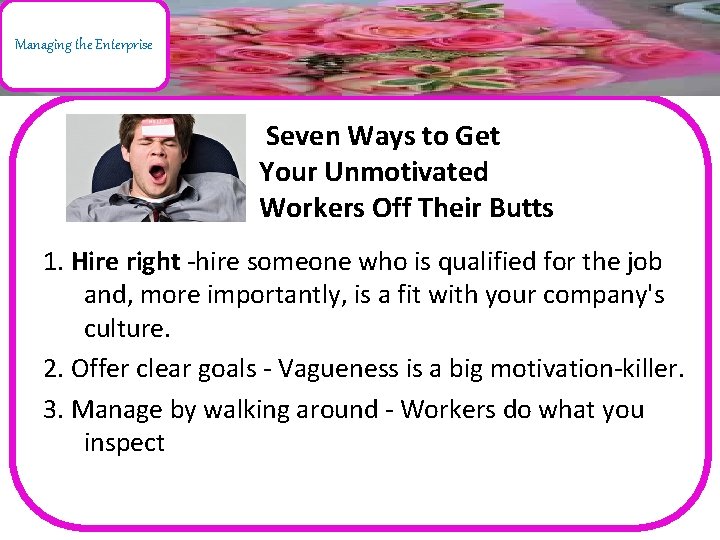
Managing the Enterprise Seven Ways to Get Your Unmotivated Workers Off Their Butts 1. Hire right -hire someone who is qualified for the job and, more importantly, is a fit with your company's culture. 2. Offer clear goals - Vagueness is a big motivation-killer. 3. Manage by walking around - Workers do what you inspect
Managing the Enterprise 4. Share your finances - sharing company financials can be a positive step. 5. Do incentives right 6. Build trust 7. Treat workers like people ***************
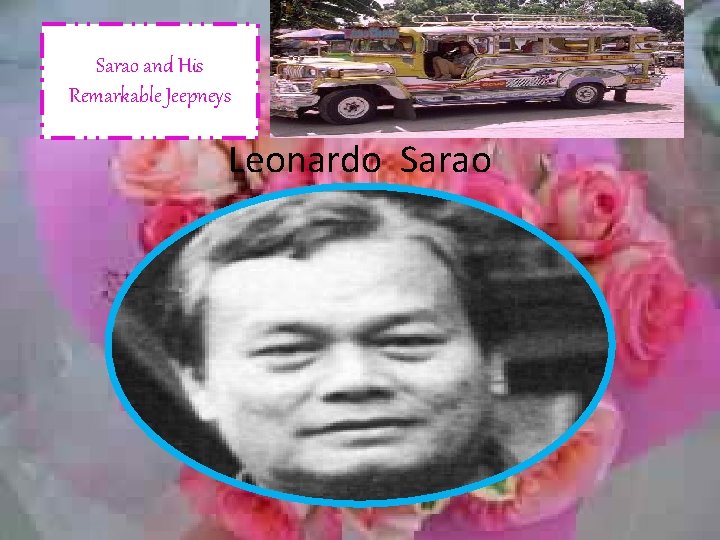
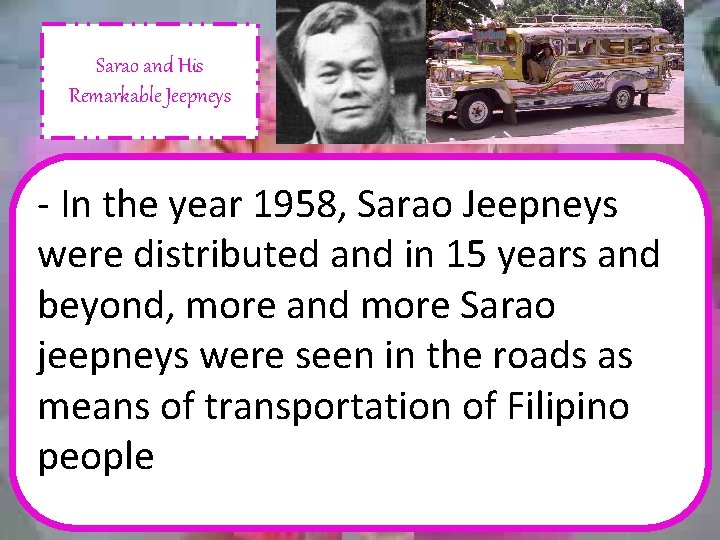
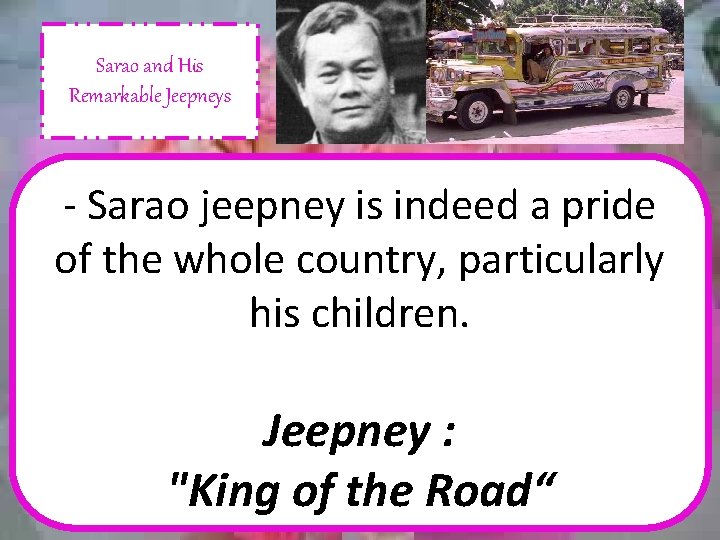
Sarao and His Remarkable Jeepneys Leonardo Sarao
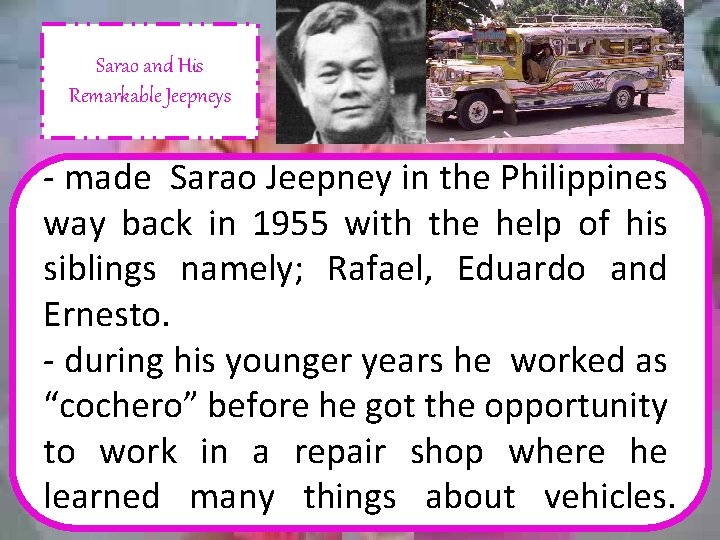
Sarao and His Remarkable Jeepneys - made Sarao Jeepney in the Philippines way back in 1955 with the help of his siblings namely; Rafael, Eduardo and Ernesto. - during his younger years he worked as “cochero” before he got the opportunity to work in a repair shop where he learned many things about vehicles.
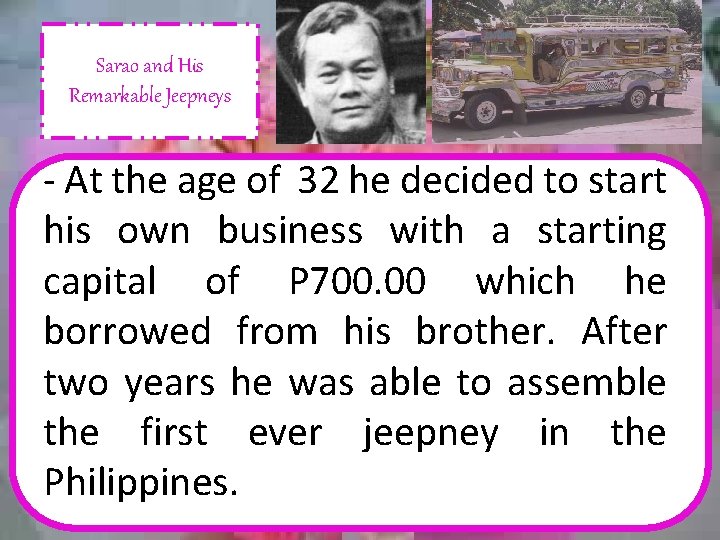
Sarao and His Remarkable Jeepneys - At the age of 32 he decided to start his own business with a starting capital of P 700. 00 which he borrowed from his brother. After two years he was able to assemble the first ever jeepney in the Philippines.
Sarao and His Remarkable Jeepneys - In the year 1958, Sarao Jeepneys were distributed and in 15 years and beyond, more and more Sarao jeepneys were seen in the roads as means of transportation of Filipino people
Sarao and His Remarkable Jeepneys - Sarao jeepney is indeed a pride of the whole country, particularly his children. Jeepney : "King of the Road“
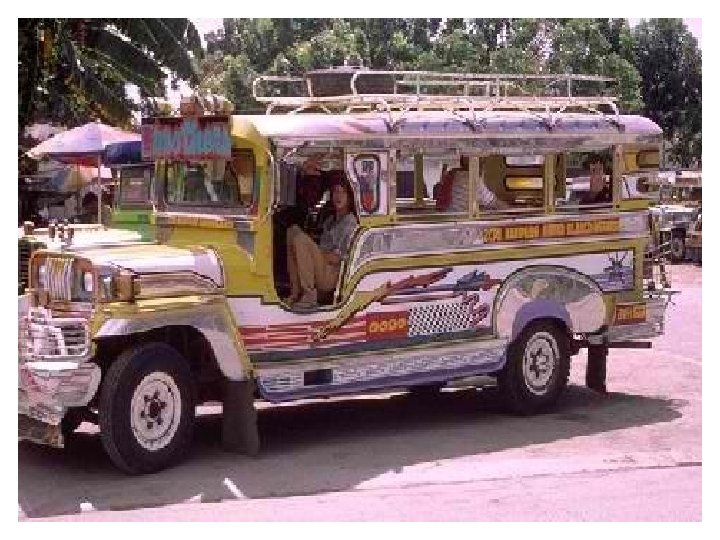
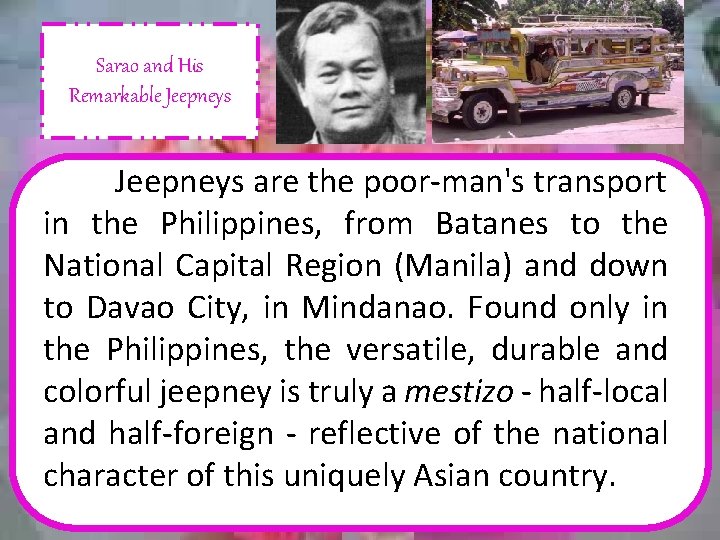
Sarao and His Remarkable Jeepneys are the poor-man's transport in the Philippines, from Batanes to the National Capital Region (Manila) and down to Davao City, in Mindanao. Found only in the Philippines, the versatile, durable and colorful jeepney is truly a mestizo - half-local and half-foreign - reflective of the national character of this uniquely Asian country.
Sarao and His Remarkable Jeepneys Its engine is imported, mostly from Japan, as "surplus" (second-hand) material. However, its body or chassis is designed by artistic, Filipino auto builders who adorn it with variegated images, bouncing psychedelic colors and eardrum-breaking sounds. An average jeepney can normally seat 20 adult passengers.
Sarao and His Remarkable Jeepneys But in the remote areas in the countryside where transport is scarce, the versatile jeepney is typically overloaded. Passengers often ride with non-human cargoes like farm produce, or even animals.
Sarao and His Remarkable Jeepneys began plying the streets of Manila after World War II, when U. S. soldiers left thousands of unserviceable jeeps. An entrepreneurial Caviteño named Leonardo Sarao saw in them a business opportunity for mass transport.
Sarao and His Remarkable Jeepneys He then remodelled the jeep to increase its functionality by extending the body to accommodate at least twice the number of passengers and by putting some railings at the back and top for extra passengers to cling to, and still leave some room for cargoes.
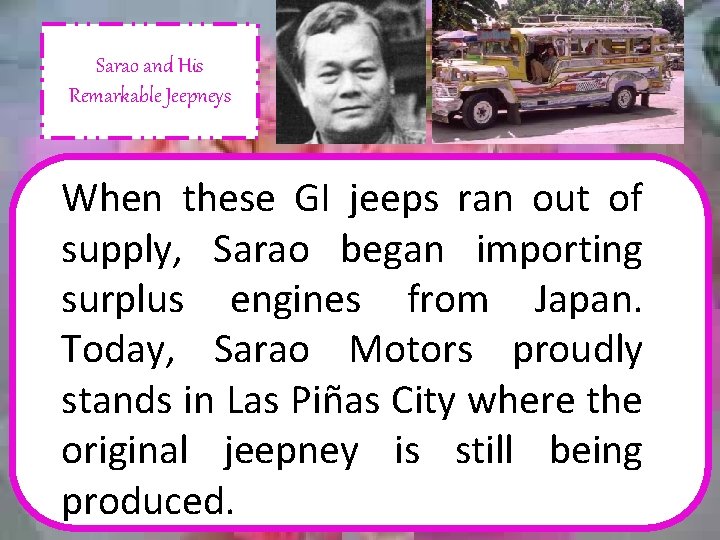
Sarao and His Remarkable Jeepneys When these GI jeeps ran out of supply, Sarao began importing surplus engines from Japan. Today, Sarao Motors proudly stands in Las Piñas City where the original jeepney is still being produced.
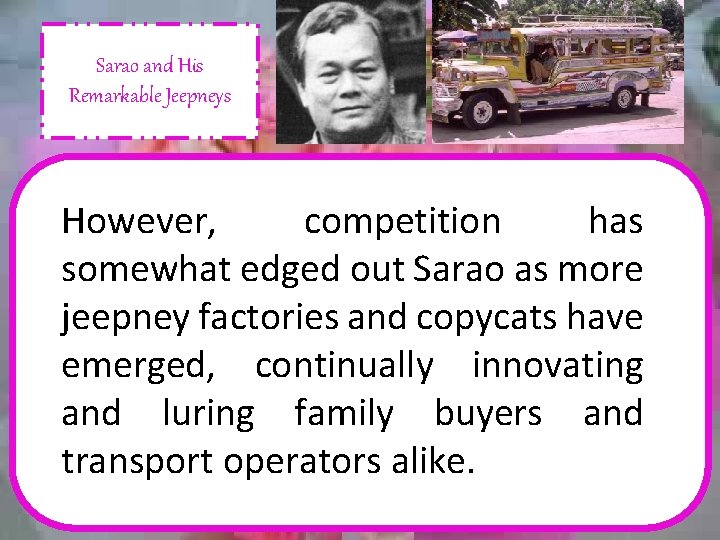
Sarao and His Remarkable Jeepneys However, competition has somewhat edged out Sarao as more jeepney factories and copycats have emerged, continually innovating and luring family buyers and transport operators alike.
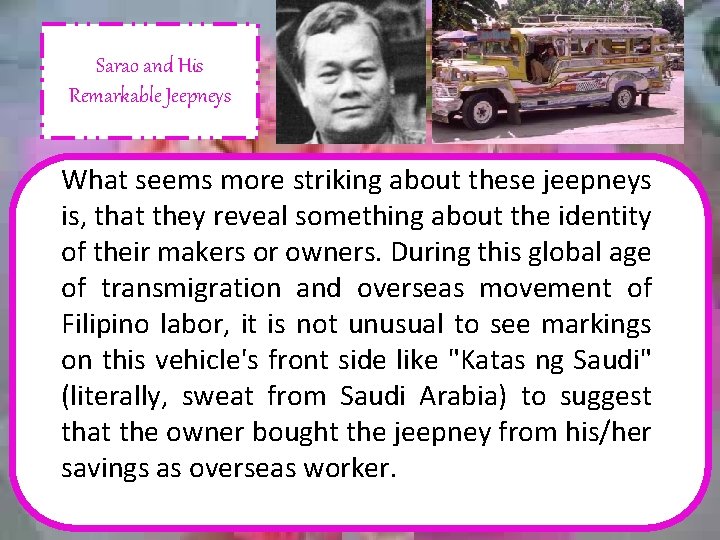
Sarao and His Remarkable Jeepneys What seems more striking about these jeepneys is, that they reveal something about the identity of their makers or owners. During this global age of transmigration and overseas movement of Filipino labor, it is not unusual to see markings on this vehicle's front side like "Katas ng Saudi" (literally, sweat from Saudi Arabia) to suggest that the owner bought the jeepney from his/her savings as overseas worker.
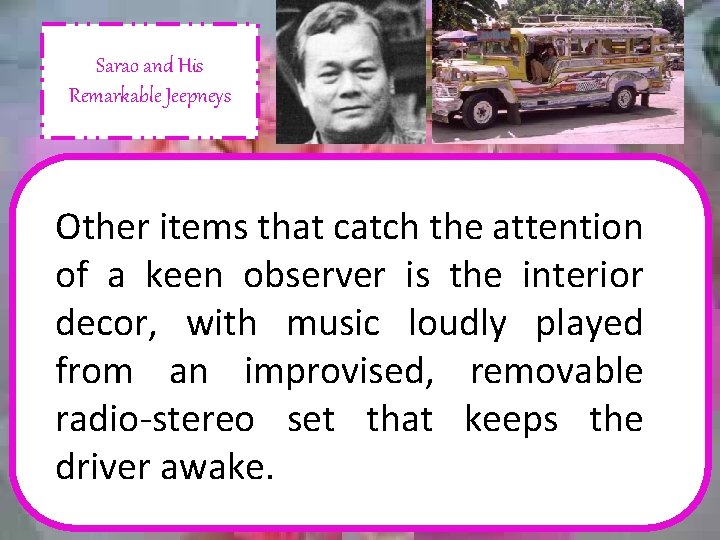
Sarao and His Remarkable Jeepneys Other items that catch the attention of a keen observer is the interior decor, with music loudly played from an improvised, removable radio-stereo set that keeps the driver awake.
Sarao and His Remarkable Jeepneys In front of the driver is a religious icon (usually a cross or a picture of Jesus Christ or the Virgin Mary), a lei made of fragrant sampaguita, and a "No Smoking" sign that the driver himself ironically ignores.
Sarao and His Remarkable Jeepneys In a sense, the jeepney is a testament to the Filipino ingenuity. It symbolizes the diasporic, religious and sometimes perplexing character of a people colonized by two European powers.
Thank u for listening