
Dominance and Status Hierarchies Evolutionary Psychology Spring 2021





- Slides: 20
Dominance and Status Hierarchies Evolutionary Psychology Spring 2021 Dr Chapman 1
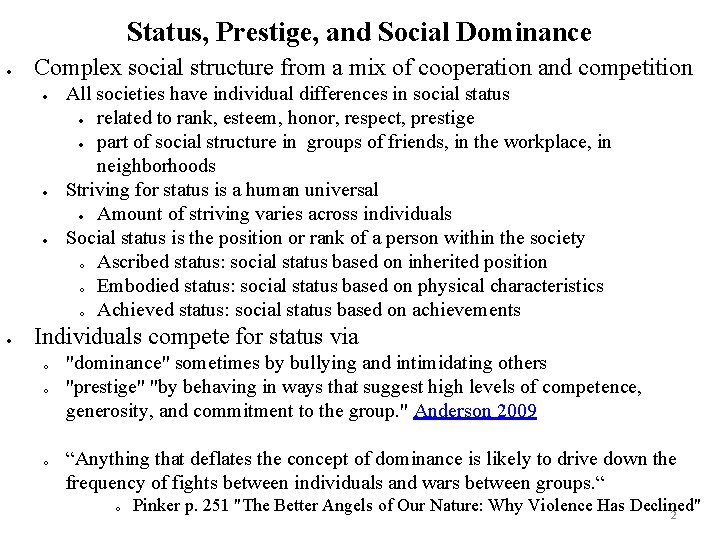
Status, Prestige, and Social Dominance Complex social structure from a mix of cooperation and competition All societies have individual differences in social status related to rank, esteem, honor, respect, prestige part of social structure in groups of friends, in the workplace, in neighborhoods Striving for status is a human universal Amount of striving varies across individuals Social status is the position or rank of a person within the society o Ascribed status: social status based on inherited position o Embodied status: social status based on physical characteristics o Achieved status: social status based on achievements Individuals compete for status via o o o "dominance" sometimes by bullying and intimidating others "prestige" "by behaving in ways that suggest high levels of competence, generosity, and commitment to the group. " Anderson 2009 “Anything that deflates the concept of dominance is likely to drive down the frequency of fights between individuals and wars between groups. “ o Pinker p. 251 "The Better Angels of Our Nature: Why Violence Has Declined" 2
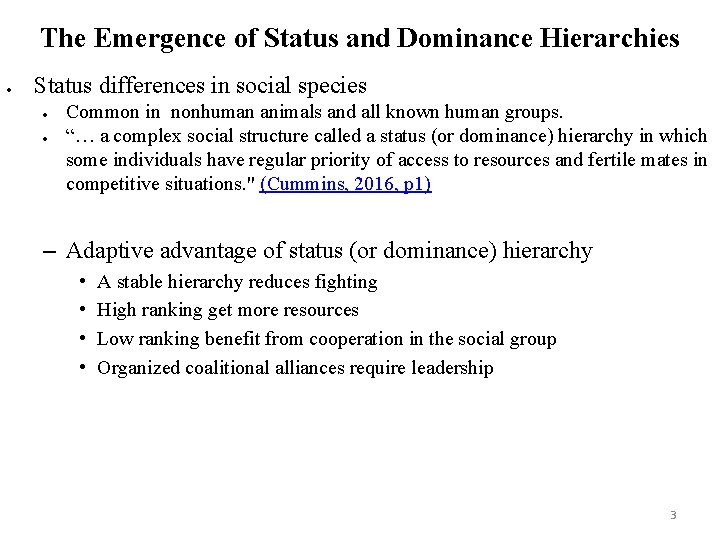
The Emergence of Status and Dominance Hierarchies Status differences in social species Common in nonhuman animals and all known human groups. “… a complex social structure called a status (or dominance) hierarchy in which some individuals have regular priority of access to resources and fertile mates in competitive situations. " (Cummins, 2016, p 1) – Adaptive advantage of status (or dominance) hierarchy • • A stable hierarchy reduces fighting High ranking get more resources Low ranking benefit from cooperation in the social group Organized coalitional alliances require leadership 3
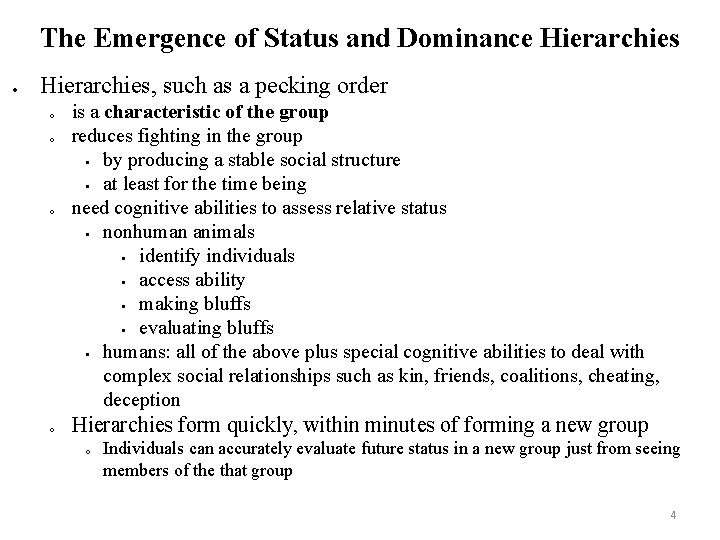
The Emergence of Status and Dominance Hierarchies, such as a pecking order o o is a characteristic of the group reduces fighting in the group by producing a stable social structure at least for the time being need cognitive abilities to assess relative status nonhuman animals identify individuals access ability making bluffs evaluating bluffs humans: all of the above plus special cognitive abilities to deal with complex social relationships such as kin, friends, coalitions, cheating, deception Hierarchies form quickly, within minutes of forming a new group o Individuals can accurately evaluate future status in a new group just from seeing members of the that group 4
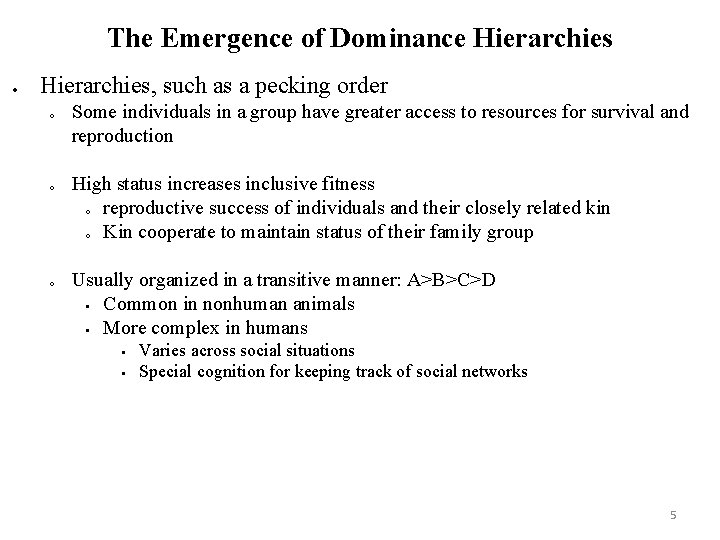
The Emergence of Dominance Hierarchies, such as a pecking order o o o Some individuals in a group have greater access to resources for survival and reproduction High status increases inclusive fitness o reproductive success of individuals and their closely related kin o Kin cooperate to maintain status of their family group Usually organized in a transitive manner: A>B>C>D Common in nonhuman animals More complex in humans Varies across social situations Special cognition for keeping track of social networks 5
Dominance and Status in Nonhuman Animals Crickets o o o Chickens o o the hens establish a pecking order through fighting dominance hierarchies occur in both males and females but usually separately Crayfish o o o those that tend to win become more aggressive those that tend to loose become submissive form an estimate of their own fighting ability is this cricket self-esteem? male crickets with a recent win are more likely to pursue sexual activity fight for territory which increases reproductive success establishing a stable hierarchy requires a series of competitions like a round robin dominate individuals do not easily submit Wolves o o nonsense of the alpha male (Mech 1999) requires alliances to head the pack sometimes females lead the pack breeding pair has higher status 6
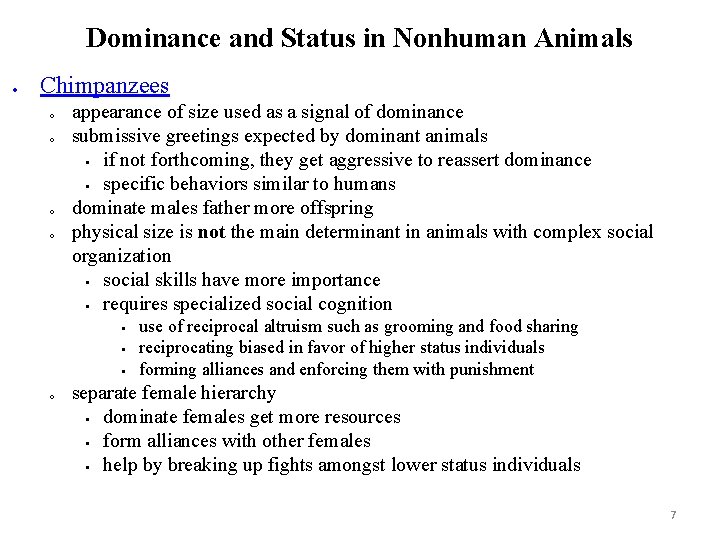
Dominance and Status in Nonhuman Animals Chimpanzees o o appearance of size used as a signal of dominance submissive greetings expected by dominant animals if not forthcoming, they get aggressive to reassert dominance specific behaviors similar to humans dominate males father more offspring physical size is not the main determinant in animals with complex social organization social skills have more importance requires specialized social cognition o use of reciprocal altruism such as grooming and food sharing reciprocating biased in favor of higher status individuals forming alliances and enforcing them with punishment separate female hierarchy dominate females get more resources form alliances with other females help by breaking up fights amongst lower status individuals 7
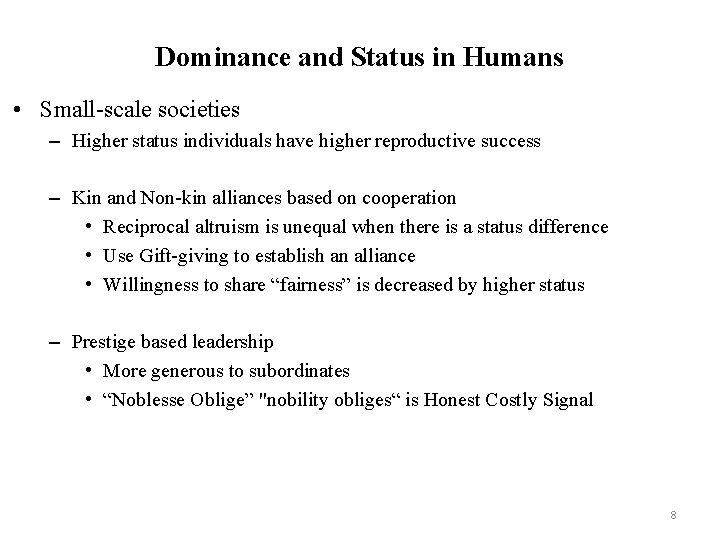
Dominance and Status in Humans • Small-scale societies – Higher status individuals have higher reproductive success – Kin and Non-kin alliances based on cooperation • Reciprocal altruism is unequal when there is a status difference • Use Gift-giving to establish an alliance • Willingness to share “fairness” is decreased by higher status – Prestige based leadership • More generous to subordinates • “Noblesse Oblige” "nobility obliges“ is Honest Costly Signal 8
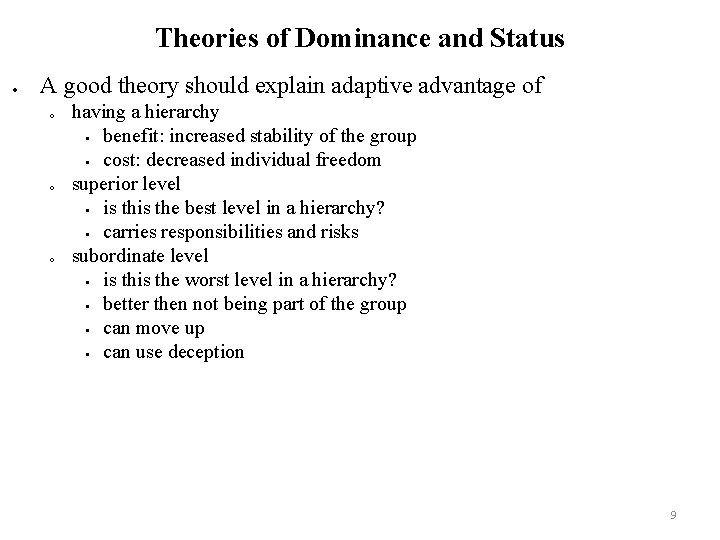
Theories of Dominance and Status A good theory should explain adaptive advantage of o o o having a hierarchy benefit: increased stability of the group cost: decreased individual freedom superior level is the best level in a hierarchy? carries responsibilities and risks subordinate level is the worst level in a hierarchy? better then not being part of the group can move up can use deception 9
Theories of Dominance and Status A good theory should explain o o tactics which form hierarchies tactics which maintain hierarchies dynamics of hierarchies sex differences in hierarchies o status striving differences o purpose of hierarchy o females: for food allocation males: for resource holding and access to females structure of hierarchy patrilocal: for chimpanzees and humans females usually migrate between groups males tend to stay in the natal group matrilocal: in other primates males tend to migrate between groups females tend to stay in the natal group 10
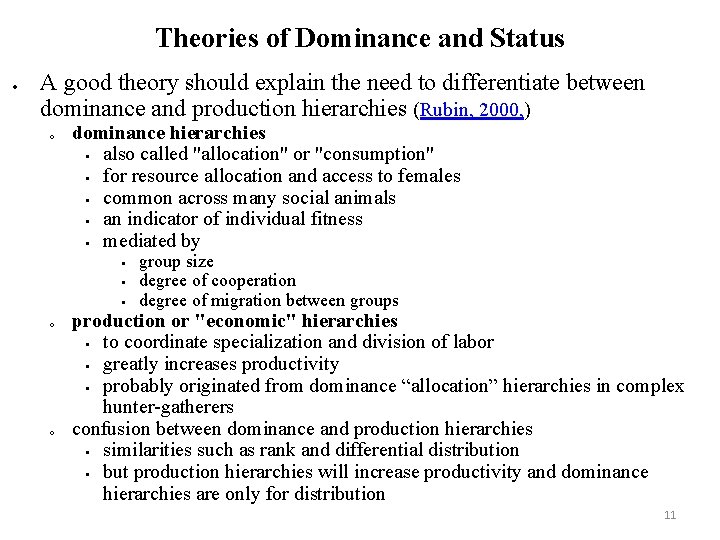
Theories of Dominance and Status A good theory should explain the need to differentiate between dominance and production hierarchies (Rubin, 2000, ) o dominance hierarchies also called "allocation" or "consumption" for resource allocation and access to females common across many social animals an indicator of individual fitness mediated by o o group size degree of cooperation degree of migration between groups production or "economic" hierarchies to coordinate specialization and division of labor greatly increases productivity probably originated from dominance “allocation” hierarchies in complex hunter-gatherers confusion between dominance and production hierarchies similarities such as rank and differential distribution but production hierarchies will increase productivity and dominance hierarchies are only for distribution 11
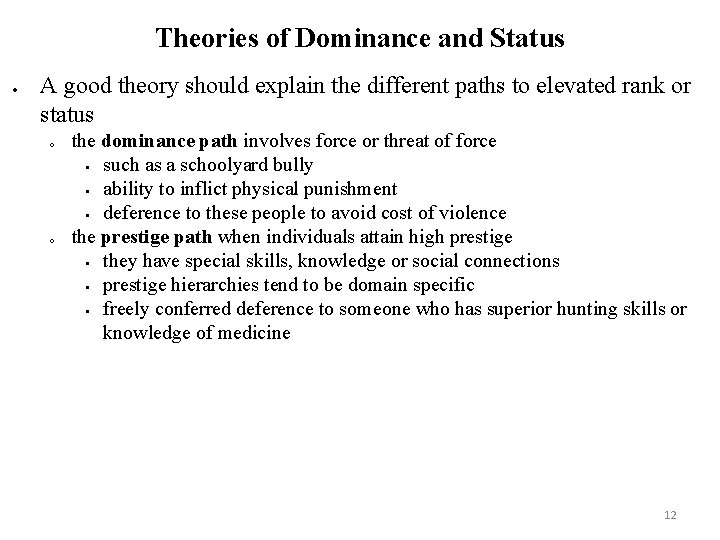
Theories of Dominance and Status A good theory should explain the different paths to elevated rank or status o o the dominance path involves force or threat of force such as a schoolyard bully ability to inflict physical punishment deference to these people to avoid cost of violence the prestige path when individuals attain high prestige they have special skills, knowledge or social connections prestige hierarchies tend to be domain specific freely conferred deference to someone who has superior hunting skills or knowledge of medicine 12
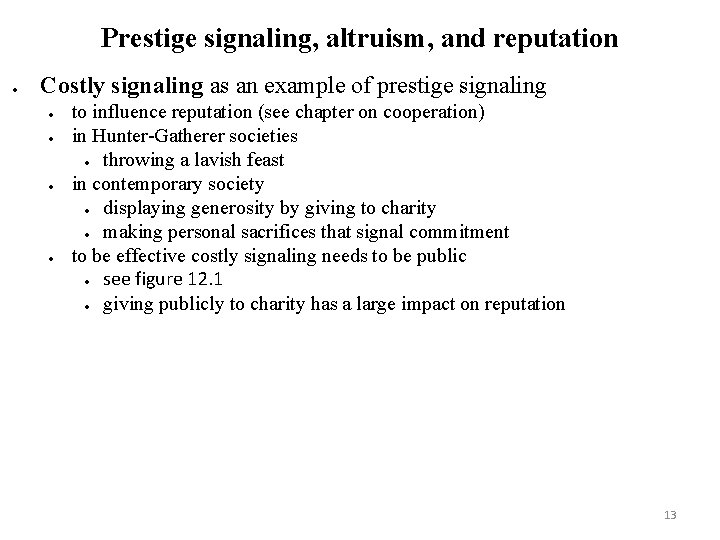
Prestige signaling, altruism, and reputation Costly signaling as an example of prestige signaling to influence reputation (see chapter on cooperation) in Hunter-Gatherer societies throwing a lavish feast in contemporary society displaying generosity by giving to charity making personal sacrifices that signal commitment to be effective costly signaling needs to be public see figure 12. 1 giving publicly to charity has a large impact on reputation 13
© 2015 Pearson Education, Inc. All rights reserved.
Dominance theory Our minds evolved mainly so we could compete with other minds socially Specialized social cognitive abilities for o o Selection for social intelligence o o o reciprocal altruism cheater detection altruistic punishment deception learn implicit rules that constrain behavior influencing behavior of others forecasting behavior of others Dominance hierarchies are a primary source of selection pressure for social reasoning A social hierarchy is a set of social norms o o rules that constrain behavior depends on rank of individual 15
Dominance theory Status Hierarchies in Adolescence o o During development individuals get social experience to learn o o School shootings “The jocks rule the school…” “Are they going to accept me? ” “It’s a rat race inside the school to see who’s going to be more popular. ” Hormonal change (testosterone) triggers aggression and risky behaviors in adolescent boys Physical maturity / Economic immaturity Willingness to take risks Necessary in status competition deontic reasoning about rights and obligations Permission: what is allowed with others Obligations: what you are expected to do with others Prohibitions: what not to do with others Use deontic reasoning to look for violators indicative reasoning about what is true or false o Use indicative reasoning to look for confirmation of rules These social strategies for dealing with dominance emerged separately from other social skills Mealey study: memory for cheaters as specialized social cognitive ability 16
Status, Prestige, and Social Dominance Special social cognitive mechanisms for dealing with problems of Dominance and Status Hierarchies Selection for social and political intelligence Reasoning problems High ranking defend status Low ranking try to gain status Perception of rank and kin Social Norm cognition Decision making in social interactions Use of deception 17
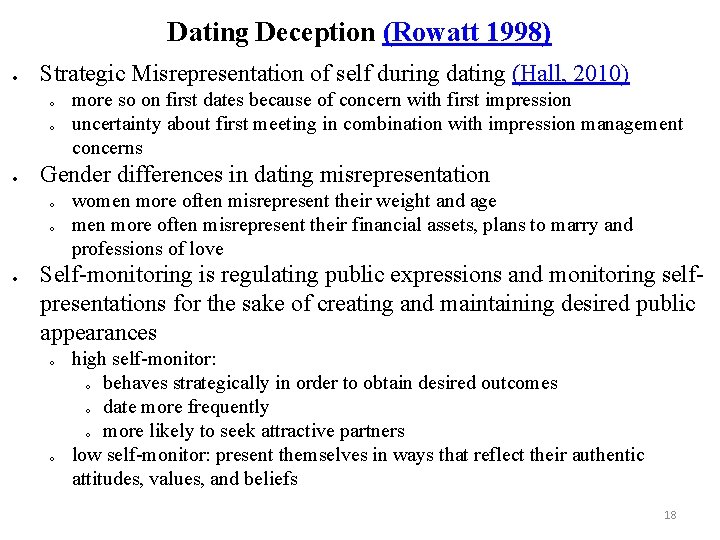
Dating Deception (Rowatt 1998) Strategic Misrepresentation of self during dating (Hall, 2010) o o Gender differences in dating misrepresentation o o more so on first dates because of concern with first impression uncertainty about first meeting in combination with impression management concerns women more often misrepresent their weight and age men more often misrepresent their financial assets, plans to marry and professions of love Self-monitoring is regulating public expressions and monitoring selfpresentations for the sake of creating and maintaining desired public appearances o o high self-monitor: o behaves strategically in order to obtain desired outcomes o date more frequently o more likely to seek attractive partners low self-monitor: present themselves in ways that reflect their authentic attitudes, values, and beliefs 18
Emotions influence social status Steckler 2014 Emotions function to facilitate navigation of the status hierarchy Emotions affect status outcomes through three distinct pathways: o o o their experience their nonverbal display the way their displays are perceived by others Emotions include certain highly social emotions (i. e. , pride, shame, envy, contempt, and admiration) More “basic” emotions such as happiness, sadness, anger, disgust, and fear/anxiety. 19
Society ". . . the primary motivation forming societies and living in societies is survival. " Dawson 2012 Social Behavior is Adaptive o o Advantages of protection, sharing Disadvantages of within-group competition, disease Social Structure o o the network of social relationship which is created among the human beings when they interact with each other according to their statuses in accordance with the patterns of society formation of social organization many types of groups, associations and institutions a complex combination of these constitute societies 20