
Domestic Violence and Trauma Informed Practice for Lawyers


- Slides: 43
Domestic Violence and Trauma Informed Practice for Lawyers CLCQ webinar Tuesday 24 April, 2018 Rachel Neil Principal Solicitor Women’s Legal Service
Domestic Violence and Trauma Informed Practice for Lawyers Overview Understanding domestic violence Trauma and the effect on victims of domestic violence Validating the victim - Trauma Informed Practice Interviewing and assessing safety Practices and procedures – tips for getting the best out of your client, minimising negative impact on clients o Helping your clients to safety plan: holistic legal response o Dealing with vicarious trauma o o o
Understanding Domestic Violence
Understanding Domestic Violence What is Domestic Violence? o Behaviour by one person in a relationship that is intended to instil fear in the other person o With the intention to control the other person o Ongoing pattern of behaviour
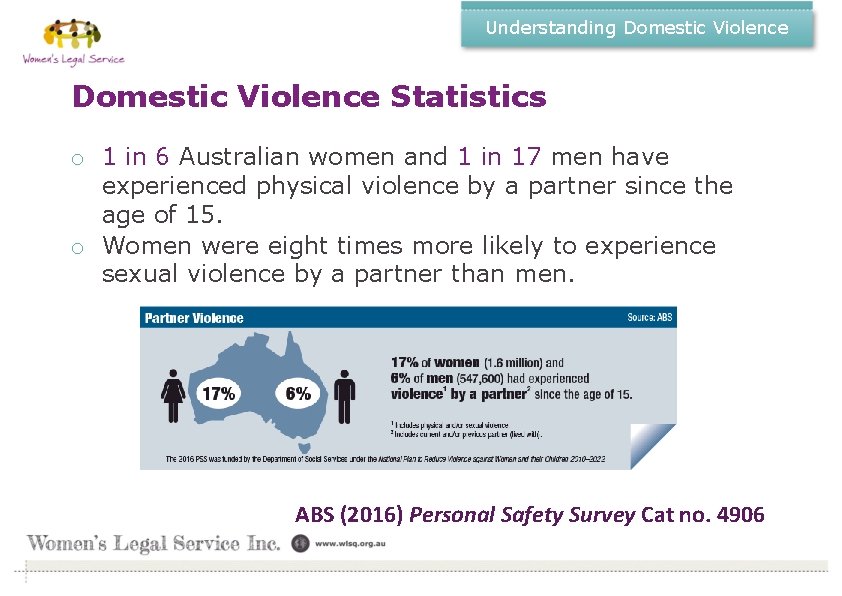
Understanding Domestic Violence Statistics o 1 in 6 Australian women and 1 in 17 men have experienced physical violence by a partner since the age of 15. o Women were eight times more likely to experience sexual violence by a partner than men. ABS (2016) Personal Safety Survey Cat no. 4906
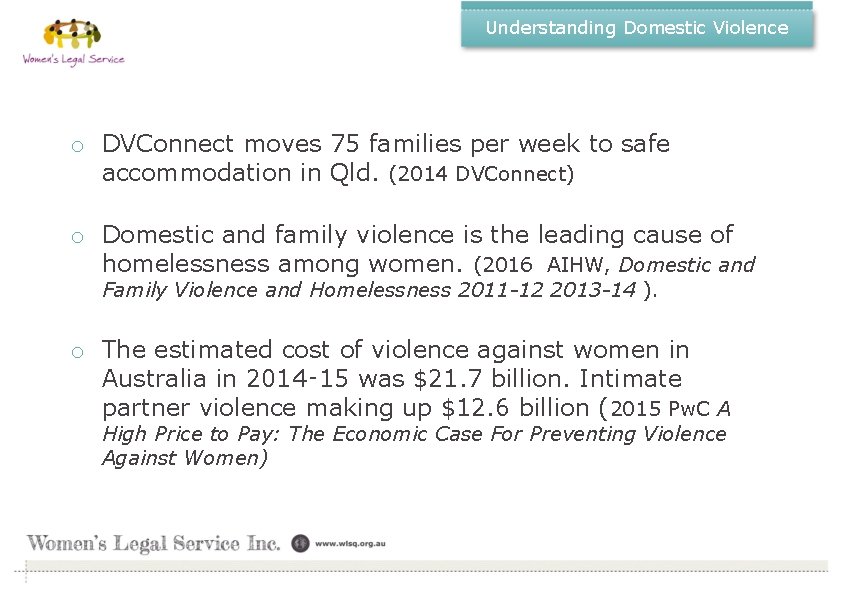
Understanding Domestic Violence o DVConnect moves 75 families per week to safe accommodation in Qld. (2014 DVConnect) o Domestic and family violence is the leading cause of homelessness among women. (2016 AIHW, Domestic and Family Violence and Homelessness 2011 -12 2013 -14 ). o The estimated cost of violence against women in Australia in 2014‑ 15 was $21. 7 billion. Intimate partner violence making up $12. 6 billion (2015 Pw. C A High Price to Pay: The Economic Case For Preventing Violence Against Women)
Trauma and Domestic Violence
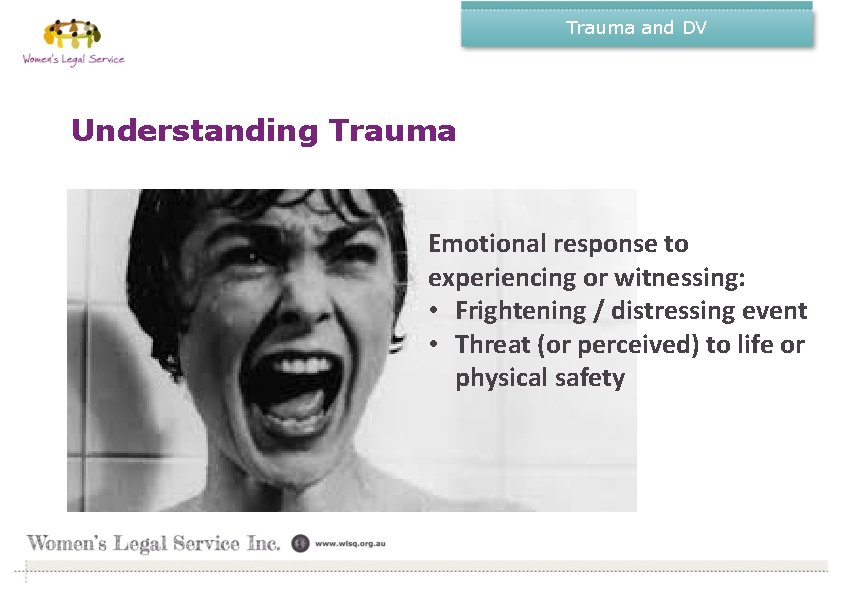
Trauma and DV Understanding Trauma Emotional response to experiencing or witnessing: • Frightening / distressing event • Threat (or perceived) to life or physical safety
Trauma and DV o https: //www. youtube. com/watch? v=4 -tc. KYx 24 a. A
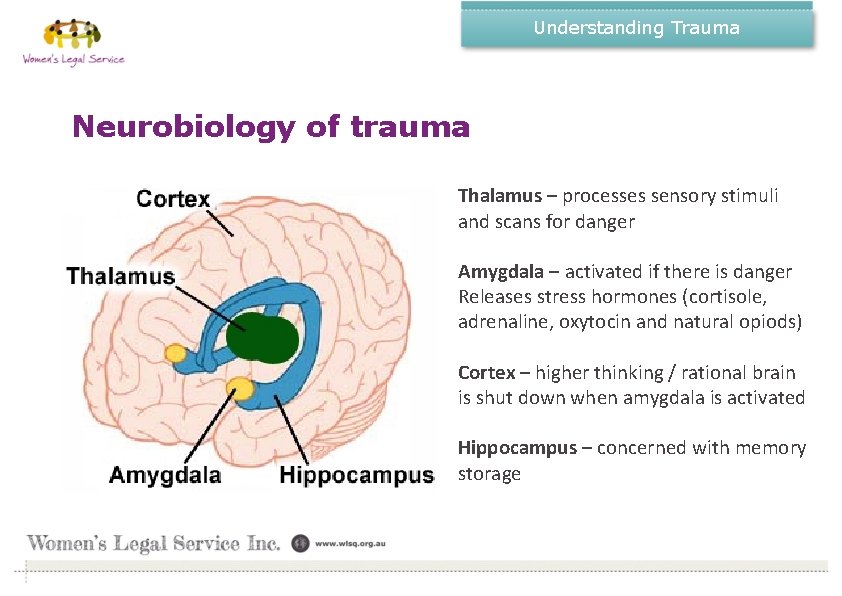
Understanding Trauma Neurobiology of trauma Thalamus – processes sensory stimuli and scans for danger Amygdala – activated if there is danger Releases stress hormones (cortisole, adrenaline, oxytocin and natural opiods) Cortex – higher thinking / rational brain is shut down when amygdala is activated Hippocampus – concerned with memory storage
Fragmented memories
Trauma and DV Impacts of Trauma o Emotional / Cognitive § § Fragmented memories Hyperarousal (incl. hypervigilance) Intrusion / re-experiencing Withdrawal / avoidance • Blunted emotions / dissociation § § § Difficulty concentrating Feelings of hopelessness / helplessness Emotional lability Loss of confidence / self esteem Increased risk mental illness
Trauma and DV Impacts of Trauma o Physiological § § § Sleep disturbance Appetite disturbance (weight loss / gain) Fatigue Weakened immune system (susceptibility to illness) Stress related health issues • Headache / cardiovascular / gastrointestinal etc
Trauma and DV Impacts of Trauma o Social / behavioural impacts § Substance misuse § Withdrawal / isolation Long term social impacts § Relationship breakdown (difficulties with trust) § Housing / Employment instability
Trauma Informed Practice
Trauma Informed Practice A shift in thinking from “What’s wrong with you? ” to “What happened to you? ”
Trauma Informed Practice o Trauma awareness § Understanding trauma presentation and impacts of trauma o Prioritise Safety § Physical environment safe and private § Processes promote safety and confidentiality o Respectful / trusting relationships § Clear messaging about service –manages expectations / min uncertainty § Continuity of staff providing advice – minimises re-telling o Choice and empowerment § Choice of time or method of consultation (eg, in-person or phone) § Client driving decision making o Collaboration § Client is expert in their situation
Trauma Informed Practice Working with Survivors of DV ü ü ü Believe her story Respect her as the expert in her own situation State perpetrator as responsible for the violence Provide information and choice Communicate clearly
Trauma and DV Interviewing people who have experienced DV o Their story may jump from place to place and not seem to make a lot of sense o They may repeat some things and leave out other things o They may have periods of “vague-ing out” o They may be emotional – crying, screaming and may even become personally abusive o They may seem emotionless and disconnected when describing awful things o They may minimise violence, e. g. with laughter o They may not immediately disclose violence
Trauma and DV Interviewing– Cultural Issues o Some clients may experience greater shame when talking about private matters and fear being stigmatised in their family and/or community o Some verbal abuse may be seen as worse in some cultures e. g. “prostitute” o Some clients may only want to see a lawyer of the same gender o Some clients may only want to see an interpreter of the same gender o Be aware that trauma from domestic violence may be overlaid with trauma from war, rape or torture
Trauma Informed Practice Practical tips for getting the best out of a traumatised person o Physical office set up § quiet, calm, private § tissues § Visible material (posters etc) that demonstrate awareness § § § of dv issues Consider making small things available for the client to touch e. g. stress balls, smooth stones Have a protocol for support people attending the interview and communicate this to the client in advance Ask the client if they want the door closed Ask the client where they want to sit if there is an option Tell the client that they can take a break at any time
Trauma Informed Practice Practical tips for getting the best out of a traumatised person cont o Don’t expect a linear story § What do you remember now? – sounds, smells, sensations § Grounding questions – do you want a glass of water? Do you want to take a break? o More time is usually needed o Ways to maximise your time with the client: § Any other documents that tell her story? § Utilise support people (with the client’s written consent) • • Can help client write her story May be able to provide you directly with some of the background Help with “homework” tasks for the client to complete Provide emotional support at court
Trauma Informed Practice After the appointment o Client may not retain information well § Shorter and more frequent appointments work well where possible § Write ‘to-do’ lists for the client – can also be provided to a support worker
Trauma Informed Practice Preparing a traumatised client for court o o Be clear about time and place to meet Suggest they take a support person Take them through what is likely to happen Refer clients to court website with videos § Magistrates Court • http: //www. courts. qld. gov. au/going-to-court/domesticviolence/videos-on-domestic-violence-court-process § FCC/Family Court • https: //youtu. be/ZHm. QBLIgr 70
Risk Assessment and Safety Planning
Safety Planning Universal Safe Practices o Prioritise safety in service delivery o Trauma informed practice framework o Screening questions § Language is important –may not identify DV § Know what to do if the answer is yes. o Appropriate referral pathways
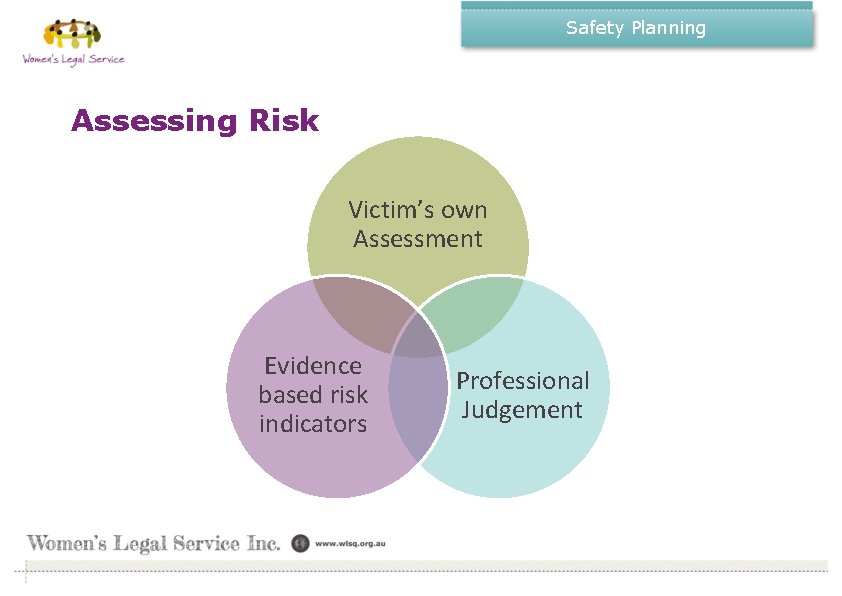
Safety Planning Assessing Risk Victim’s own Assessment Evidence based risk indicators Professional Judgement
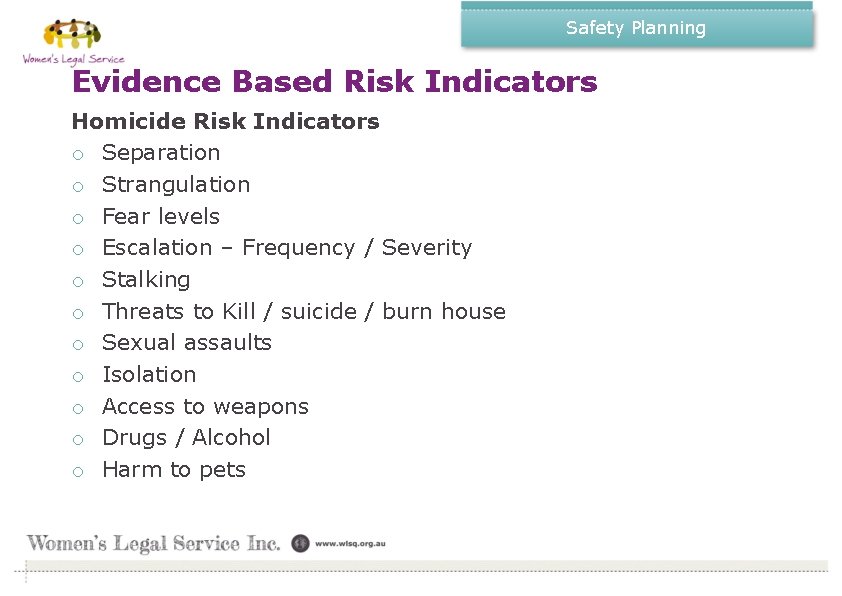
Safety Planning Evidence Based Risk Indicators Homicide Risk Indicators o Separation o Strangulation o Fear levels o Escalation – Frequency / Severity o Stalking o Threats to Kill / suicide / burn house o Sexual assaults o Isolation o Access to weapons o Drugs / Alcohol o Harm to pets
Safety Planning Non-lethal risks o o o o o Separation / Pregnancy Physical injury Emotional / psychological injury- trauma Risks to children – abuse / exposure / trauma Financial – damage, financial abuse, health, legal costs Homelessness Social isolation Cultural background Age Disability
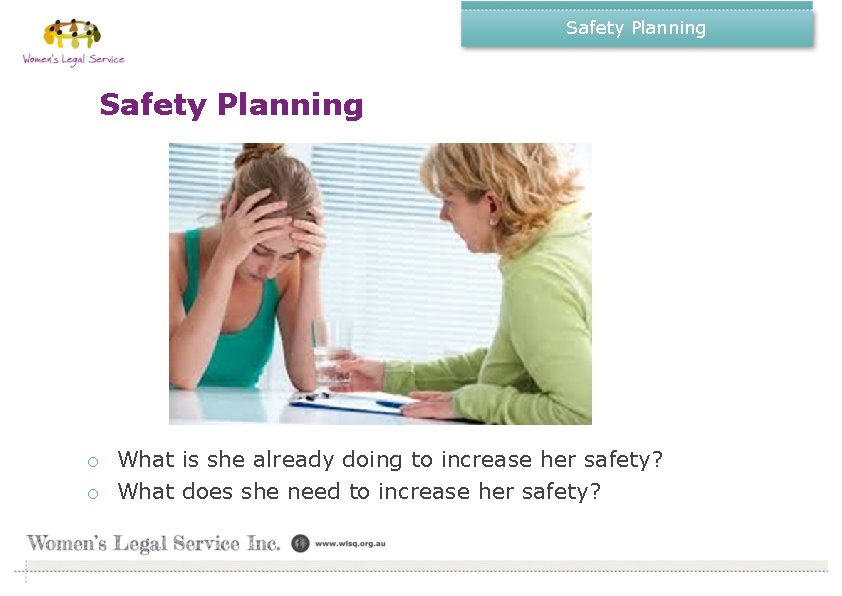
Safety Planning o What is she already doing to increase her safety? o What does she need to increase her safety?
Safety Planning o Not a checklist - every situation is different / situations change o Education / awareness – to inform her choices o Challenges § Risks involved in safety strategies § Separation is high risk § Limit his opportunities = seeking alternative avenues o Legal options also have risks § Eg, DVO § Stopping time with children
Safety Planning Safety planning in the office o Consider face to face or telephone consultations o Important to find out about safe methods of contact where DV is an issue – does the other party have access to the client’s phone or emails? o Flag on each file if safe to call, leave a message, text, email or send post (needs to be clearly marked for all legal/admin staff who may not be familiar with the client’s matter) o Have a protocol for safely exiting a phone call if someone else answers your client’s phone your client doesn’t answer the phone e. g. pretend it’s a wrong number o Tech safety - ensure that confidential information isn’t disclosed due to phone/computer/home bugging § https: //www. esafety. gov. au/women § http: //wesnet. org. au/safetynet/technology-safety/
Safety Planning and court applications o Domestic Violence orders § Timing is crucial § Ensure that confidential addresses are not divulged • Use form DV 01 C – Aggrieved details form to provide contact details to the court that will not be disclosed to the respondent § Find out the timing between filing, serving and listing. Will the other party be served before the court can grant a temporary protection order? § Consider requesting an urgent ex-parte court date for TPO and for the Respondent not to be served until after first date – court’s discretion § Carefully consider the conditions sought
Safety Planning and court applications o Federal Circuit Court Applications § Court applications can be a trigger for more violence, and this needs to be taken into account in the safety plan § Each time new material is filed, this may trigger violence § If the client’s address is confidential double check that the address is not disclosed in any affidavit material, in particular annexed letters from doctors, school etc § This also applies to DV affidavits
Safety Planning Safety at court o Most Magistrates Courts provide safe rooms for women to wait in for domestic violence matters § Call ahead to check if this is an option § May be security officers specifically for the DV court at court, they may help to escort people to their cars after court § DV support services are at most Magistrates Courts, can help with safety planning o With notice, safety plans can be implemented at family law courts – our clients’ experiences have been positive
Safety Planning Resources 1800 RESPECT https: //www. 1800 respect. org. au/get-help/staying-safeunderstanding-safety-planning/ Digital Safety Australian Government resources o https: //www. esafety. gov. au/women o http: //www. smartsafe. org. au/ WESNET o http: //wesnet. org. au/safetynet/technology-safety/
Vicarious Trauma
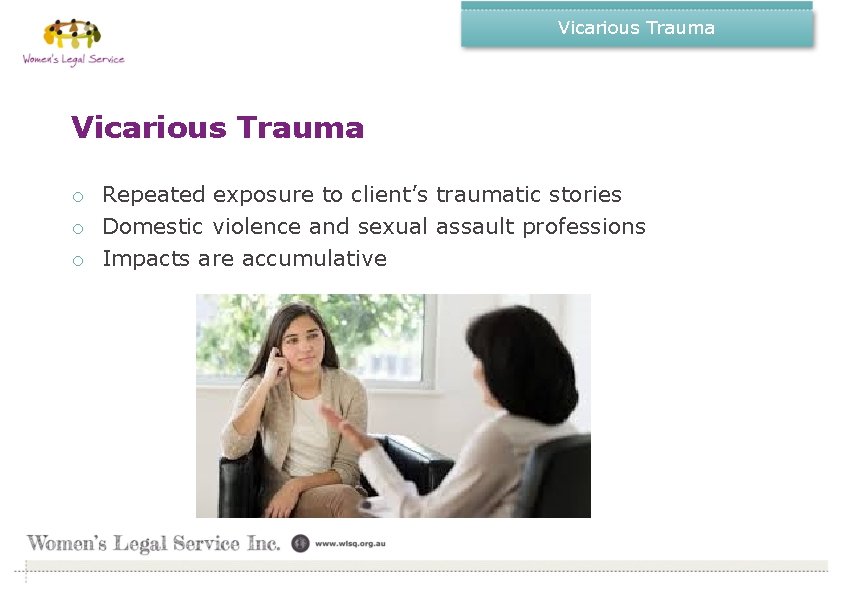
Vicarious Trauma o Repeated exposure to client’s traumatic stories o Domestic violence and sexual assault professions o Impacts are accumulative
Vicarious Trauma Impacts of Vicarious Trauma o Emotional § Numbness § Mood swings § Loss of professional confidence o Cognitive § Changes in self identity § Changes in world view (beliefs about spirituality and human nature) § Perceptions of our own safety § Intrusive thoughts (unable to switch off) o Physical § Sleep disturbance § Appetite § Stress symptoms (eg headache) o Behavioural / Social § Work / life boundaries (withdrawal or over involvement in work) § Alcohol use § Personal relationship strain
Vicarious Trauma Informed Practice o Trauma awareness § Understanding vicarious trauma and impacts o Prioritise Safety § Building security § Safety procedures for outreach (eg, visits in pairs, mobile phone) § External supports available (EAP, external supervision) o Respectful / trusting relationships § Organisational commitment to staff wellbeing § Clear communication / supervisory structures / confidentiality o Choice and empowerment § Staff development opportunities offered § Professional development and skill building § Translating direct service delivery to law reform o Collaboration § Staff involvement in strategic planning § Consultative structures in place
Vicarious Trauma Prevention of Vicarious Trauma o Supportive work context § Formal support mechanisms § Informal support / workplace culture o Individual responsibility § Awareness of signs of VT § Self Care strategies
Vicarious Trauma Resources for prevention of vicarious trauma o Blue Knot Foundation http: //www. blueknot. org. au/ o Tristan Jepson Memorial Foundation http: //www. tjmf. org. au/ o Trauma Informed Care Agency Self Assessment http: //www. traumainformedcareproject. org/
Rachel Neil rneil@wlsq. org. au www. wlsq. org. au