
Domestic violence and abuse Understanding Engagement and Assessment
Domestic violence and abuse: Understanding, Engagement and Assessment Chris Newman & Kate Iwi iwikate@gmail. com chris@fsa. me. uk Partner Abuse Consultancy and Training (PACT) 2020
Prevalence • Overall, 31% of women and 18% of men aged 16 to 59 reported that they had experienced one or more types of abuse at the hands of a current or former partner at some time since age 16. • One in five women (19%) and one in ten men (10%) reported that they had experienced physical force by a partner or former partner at some time since age 16. • Domestic violence accounts for 10% of emergency calls 15% of all violent crime.
• those aged 16 -19 or 20 -24 were more likely to be victims of domestic abuse or stalking. • sexual assault was most likely to occur to women aged 16 -19. • the highest risk group for domestic abuse amongst women were those that were separated, who made up 1 in 5 victims
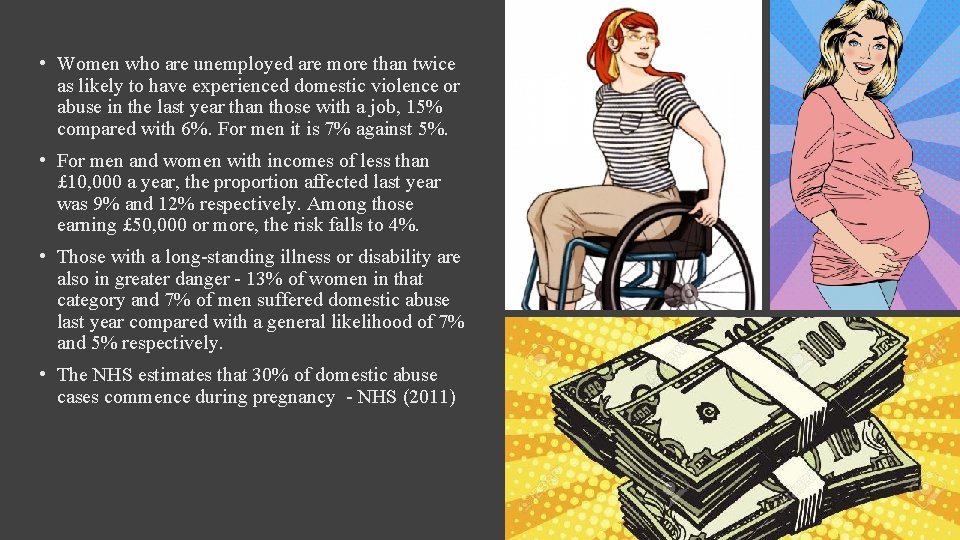
• Women who are unemployed are more than twice as likely to have experienced domestic violence or abuse in the last year than those with a job, 15% compared with 6%. For men it is 7% against 5%. • For men and women with incomes of less than £ 10, 000 a year, the proportion affected last year was 9% and 12% respectively. Among those earning £ 50, 000 or more, the risk falls to 4%. • Those with a long-standing illness or disability are also in greater danger - 13% of women in that category and 7% of men suffered domestic abuse last year compared with a general likelihood of 7% and 5% respectively. • The NHS estimates that 30% of domestic abuse cases commence during pregnancy - NHS (2011)
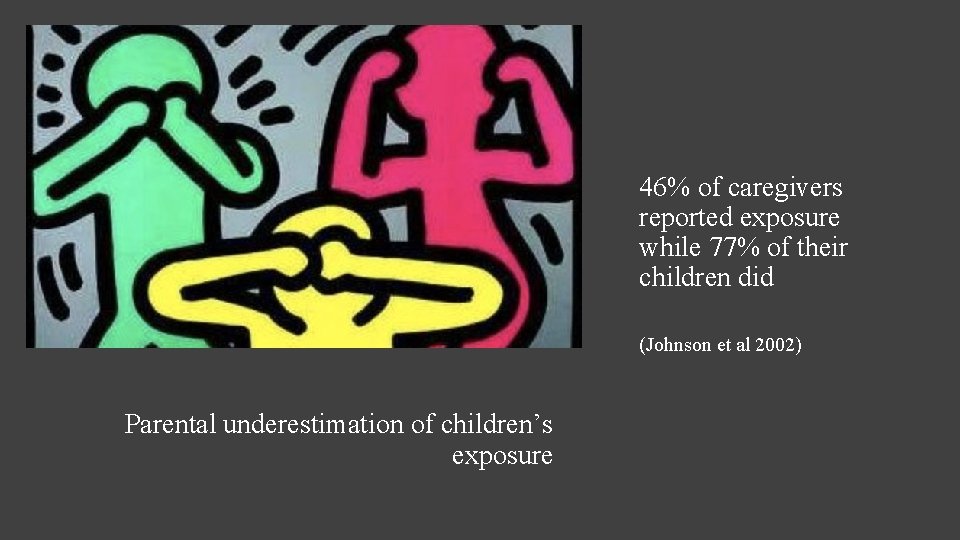
46% of caregivers reported exposure while 77% of their children did (Johnson et al 2002) Parental underestimation of children’s exposure
Learning from Serious case reviews of child homicides Where the information was available, well over half of the children had been living with domestic violence or parental mental ill health, or parental substance abuse. These three problems often coexisted. Brandon et al 2008
Gender • British Crime Survey - 13% of women and 9% of men reported being victim of DV (excludes sexual violence) • People subject to 4 or more incidents of DV 89% women. • Women twice as likely to be injured and 3 times as likely to report living in fear. • 37% of women homicides were committed by a partner or former partner compared to 8% of male homicides. • Recorded crime - 90% involve a female victim. • 2014 -2015 - MARAC dataset - 3% of the perpetrators were female, 95% were male and 2% data was missing.
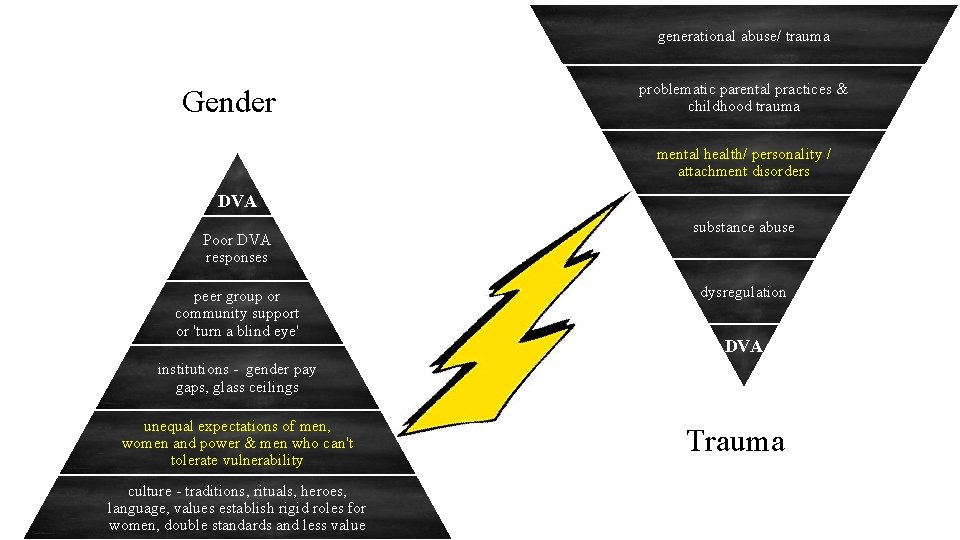
generational abuse/ trauma Gender problematic parental practices & childhood trauma mental health/ personality / attachment disorders DVA Poor DVA responses peer group or community support or 'turn a blind eye' substance abuse dysregulation DVA institutions - gender pay gaps, glass ceilings unequal expectations of men, women and power & men who can't tolerate vulnerability culture - traditions, rituals, heroes, language, values establish rigid roles for women, double standards and less value Trauma
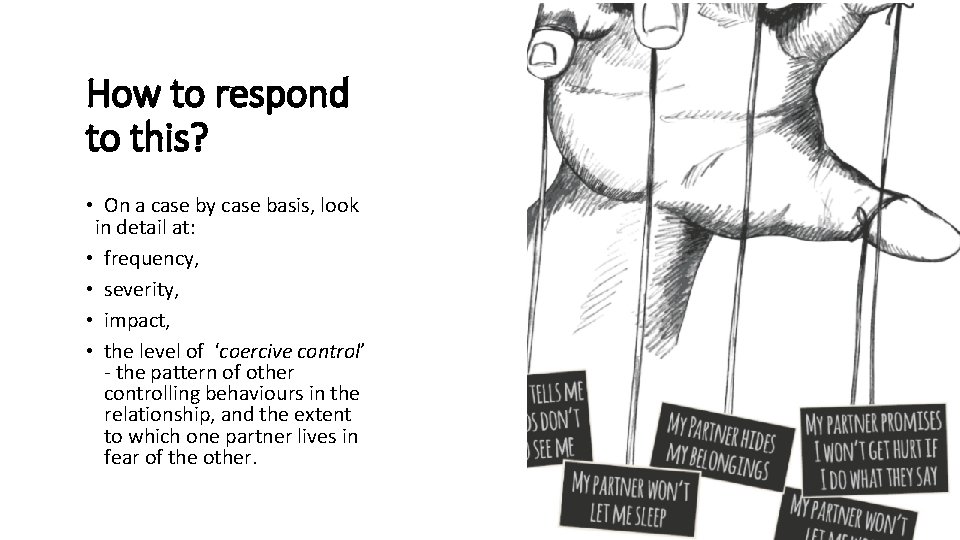
How to respond to this? • On a case by case basis, look in detail at: • frequency, • severity, • impact, • the level of ‘coercive control’ - the pattern of other controlling behaviours in the relationship, and the extent to which one partner lives in fear of the other.
Violence and abuse in young people’s relationships Of all age groups, aged 16 to 19 are the most likely to experience DA in the last year • 11. 9% of women • 6. 9% of men Sexual assault was most likely for women aged 16 -19 Physical violence - 14% same age, 70% > 2 yrs older Data from 2015 & 2017 Crime Surveys for England Wales Sexual violence 14% same age, 80% > 2 yrs older
• Girls experiencing violence from a partner are six times more likely to become pregnant in their teens (Rosen 2004) • 70% teenage mothers experienced violence from a partner

The interagency context
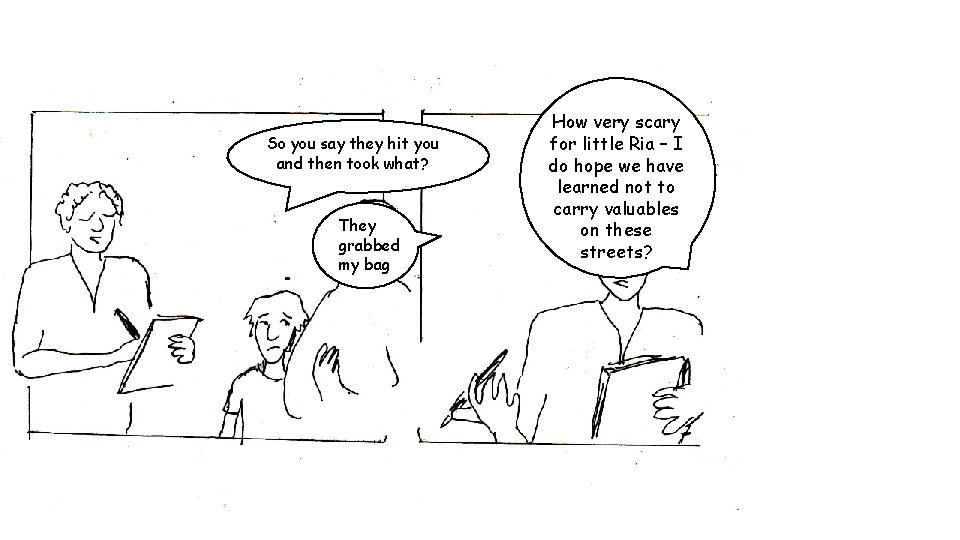
So you say they hit you and then took what? They grabbed my bag How very scary for little Ria – I do hope we have learned not to carry valuables on these streets?
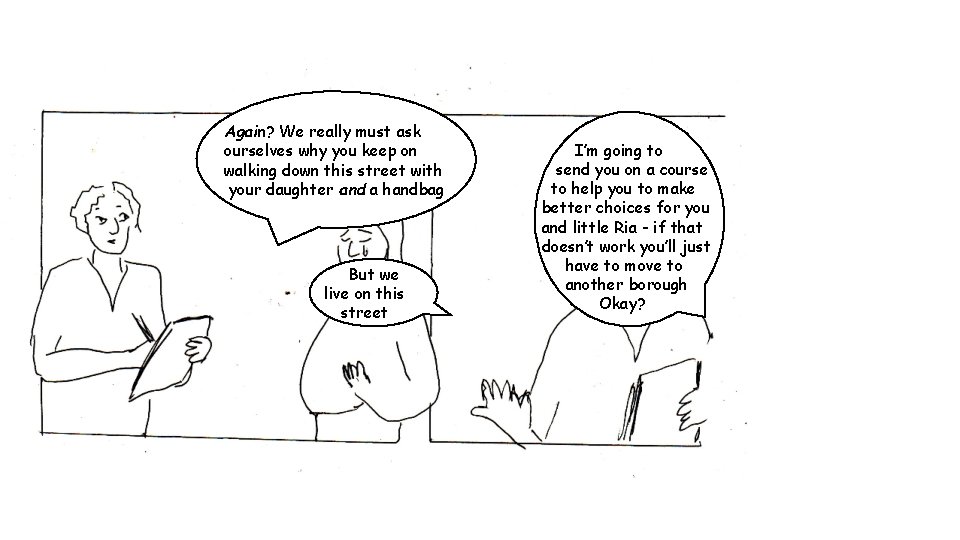
Again? We really must ask ourselves why you keep on walking down this street with your daughter and a handbag But we live on this street I’m going to send you on a course to help you to make better choices for you and little Ria - if that doesn’t work you’ll just have to move to another borough Okay?
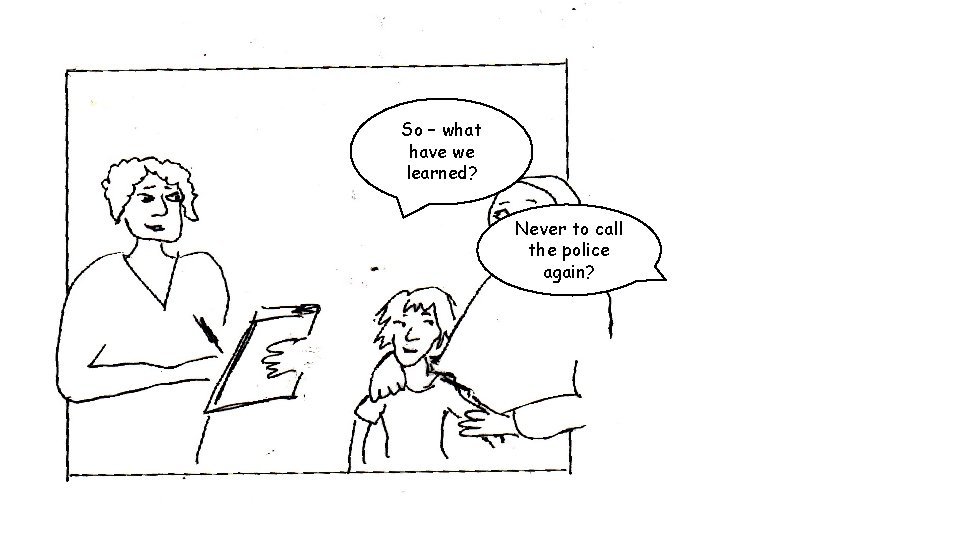
So – what have we learned? Never to call the police again?
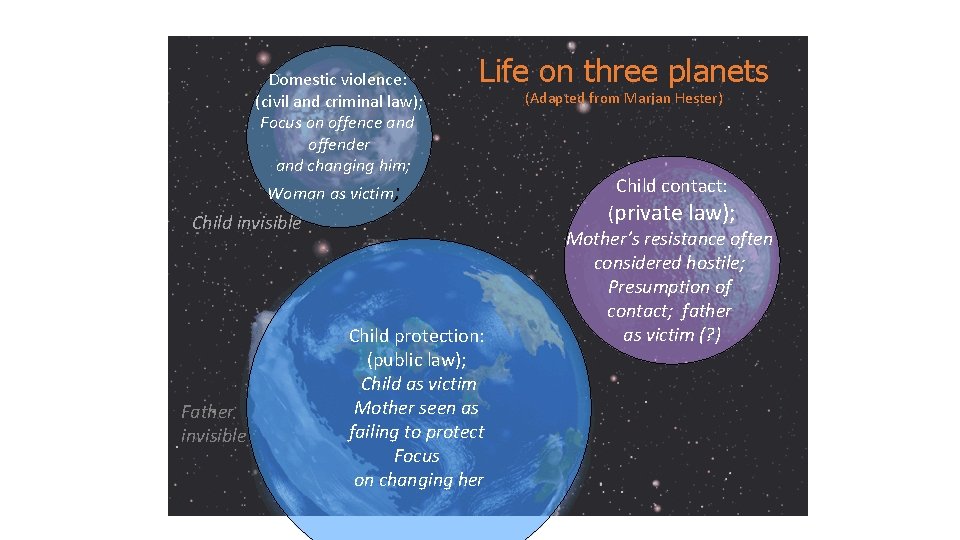
Domestic violence: (civil and criminal law); Focus on offence and offender and changing him; Life on three planets Woman as victim; Child invisible Father invisible Child protection: (public law); Child as victim Mother seen as failing to protect Focus on changing her (Adapted from Marian Hester) Child contact: (private law); Mother’s resistance often considered hostile; Presumption of contact; father as victim (? )

How to improve it • That there is no victim blaming language such as “failure to protect” • The perpetrator has been interviewed • Reports describe the pattern of control and abuse • Reports describe the victim’s efforts to promote the safety and wellbeing of the children • Reports take the impact of DV on victim’s parenting into account • Danger statements should be very clearly about the perpetrator – the protection plan and any mandation to programmes should mainly speak about the perpetrator rather than the victim.
A lot of this is about way we do things rather than what we do. How could the following be reframed/ done differently to decrease system generated risk? SW to mum 1. “if there’s another incident of abuse we’re going to take it to court” 2. “you need to separate from dad or we will not close the case” Report on case 3. “by reconciling with dad repeatedly, mum has failed to protect the children” 4. “Mum has been abused in the past 3 relationships and clearly chooses violent men”
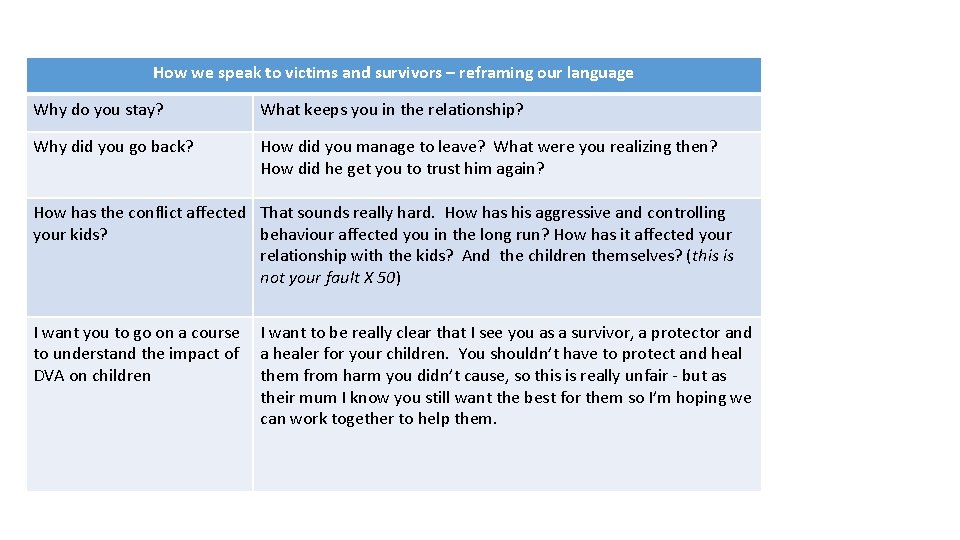
How we speak to victims and survivors – reframing our language Why do you stay? What keeps you in the relationship? Why did you go back? How did you manage to leave? What were you realizing then? How did he get you to trust him again? How has the conflict affected That sounds really hard. How has his aggressive and controlling your kids? behaviour affected you in the long run? How has it affected your relationship with the kids? And the children themselves? (this is not your fault X 50) I want you to go on a course to understand the impact of DVA on children I want to be really clear that I see you as a survivor, a protector and a healer for your children. You shouldn’t have to protect and heal them from harm you didn’t cause, so this is really unfair - but as their mum I know you still want the best for them so I’m hoping we can work together to help them.
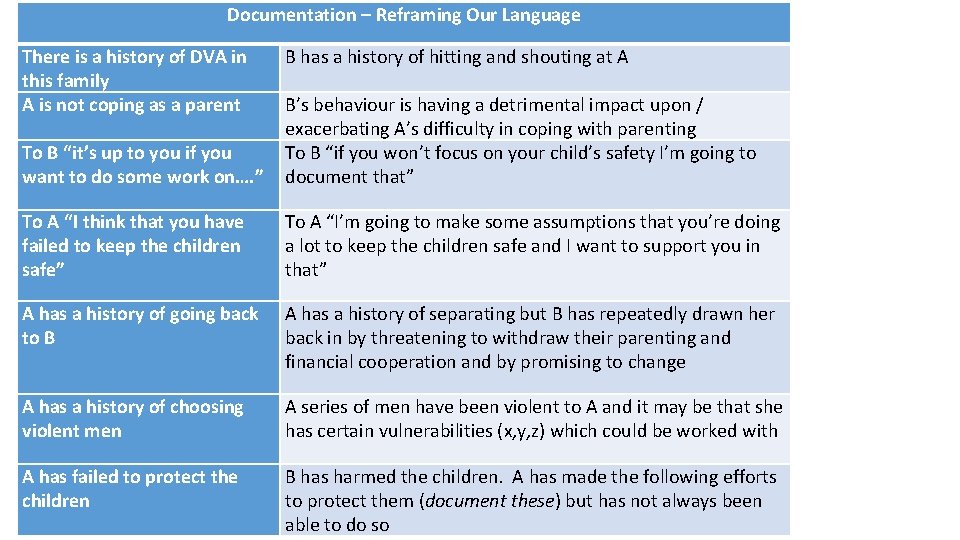
Documentation – Reframing Our Language There is a history of DVA in this family A is not coping as a parent B has a history of hitting and shouting at A To B “it’s up to you if you want to do some work on…. ” B’s behaviour is having a detrimental impact upon / exacerbating A’s difficulty in coping with parenting To B “if you won’t focus on your child’s safety I’m going to document that” To A “I think that you have failed to keep the children safe” To A “I’m going to make some assumptions that you’re doing a lot to keep the children safe and I want to support you in that” A has a history of going back to B A has a history of separating but B has repeatedly drawn her back in by threatening to withdraw their parenting and financial cooperation and by promising to change A has a history of choosing violent men A series of men have been violent to A and it may be that she has certain vulnerabilities (x, y, z) which could be worked with A has failed to protect the children B has harmed the children. A has made the following efforts to protect them (document these) but has not always been able to do so
Thinking about risk
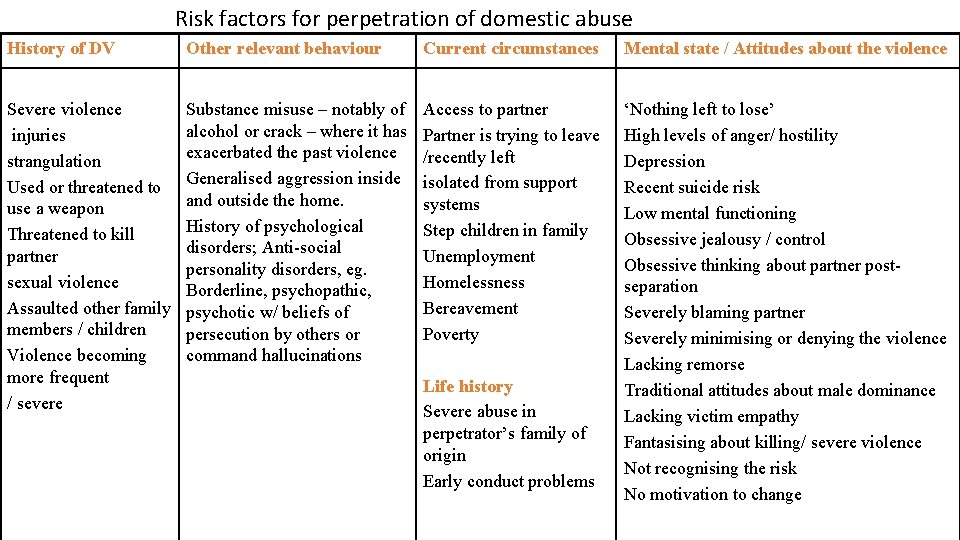
Risk factors for perpetration of domestic abuse History of DV Other relevant behaviour Current circumstances Mental state / Attitudes about the violence Severe violence injuries strangulation Used or threatened to use a weapon Threatened to kill partner sexual violence Assaulted other family members / children Violence becoming more frequent / severe Substance misuse – notably of alcohol or crack – where it has exacerbated the past violence Generalised aggression inside and outside the home. History of psychological disorders; Anti-social personality disorders, eg. Borderline, psychopathic, psychotic w/ beliefs of persecution by others or command hallucinations Access to partner Partner is trying to leave /recently left isolated from support systems Step children in family Unemployment Homelessness Bereavement Poverty ‘Nothing left to lose’ High levels of anger/ hostility Depression Recent suicide risk Low mental functioning Obsessive jealousy / control Obsessive thinking about partner postseparation Severely blaming partner Severely minimising or denying the violence Lacking remorse Traditional attitudes about male dominance Lacking victim empathy Fantasising about killing/ severe violence Not recognising the risk No motivation to change Life history Severe abuse in perpetrator’s family of origin Early conduct problems
• Maria, his partner of 4 years has reported a severe assault on her - (strangulation to the point of unconsciousness) other than that no violence but some controlling behaviour around jealousy • She has one child, had planned to live as a family with John. • reports happy childhood and good relationship with parents and regular employment as carpenter John - 45 • One previous marriage – still sees adult children – no reports at the start of the case of any violence or abuse in this relationship. • No substance misuse • Some reports of fights in pubs as a younger man • his ex-wife tells you that he used to grab her by the throat to control her.
• Grew up with violence and abuse in his childhood • Living in care home from 15 yrs – mum asked him to leave because he was using drugs and abusive to her • Met Anna (now 20) in hostel – she is a care leaver too Jamie - 21 • Dozens of reports of police being called to the hostel, and subsequently their flat – reports of shouting, smashing furniture, Anna has been seen with black eye on two occasions • Anna says they argue because they are both very jealous and that she ‘winds him up’ • They have one daughter and want to live together and care for her together
John – 45 yrs Maria, his partner of 4 years has reported a severe assault on her - (strangulation to the point of unconsciousness) Other than that no violence but some controlling behaviour around jealousy She has one child, had planned to live as a family with John. reports happy childhood and good relationship with parents and regular employment as carpenter One previous marriage – still sees adult children – no reports at the start of the case of any violence or abuse in this relationship. No substance misuse Some reports of fights in pubs as a younger man his ex-wife tells you that he used to grab her by the throat to control her. Jamie – 21 yrs Grew up with violence and abuse in his childhood Living in care home from 15 yrs – mum asked him to leave because he was using drugs and abusive to her Met Anna (now 20) in hostel – she is a care leaver too Dozens of reports of police being called to the hostel, and subsequently their flat – reports of shouting, smashing furniture, Anna has been seen with black eye on two occasions Anna says they argue because they are both very jealous and that she ‘winds him up’ They have one daughter and want to live together and care for her together
When making statements about risk we need to consider and untangle: • Risk to whom? - to partner, to child? • Risk of what? - physical harm, emotional harm, coercive control? • Likelihood of violence / abuse occurring • Severity of violence / abuse • When (in what period) the violence/ abuse might occur • Consequences of violence / abuse occurring • Credibility of different versions of events
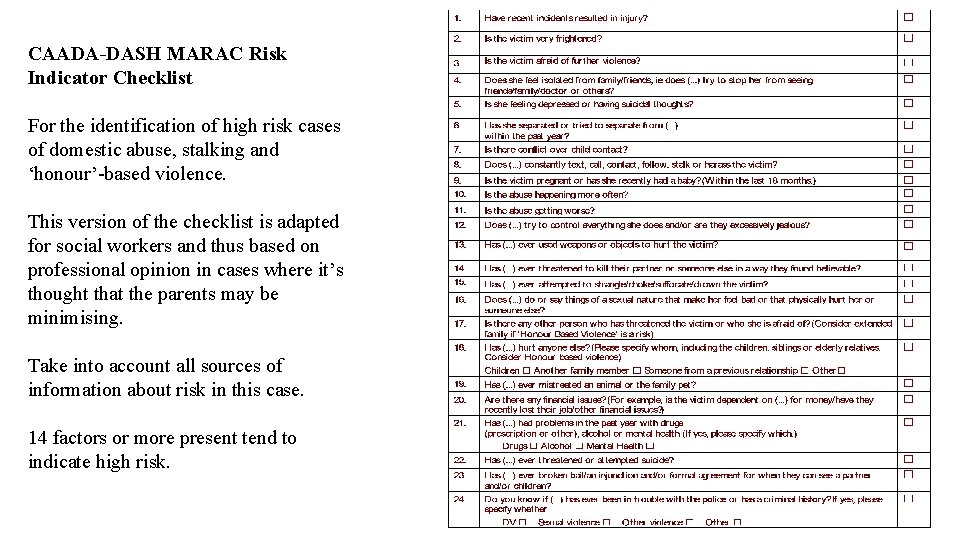
CAADA-DASH MARAC Risk Indicator Checklist For the identification of high risk cases of domestic abuse, stalking and ‘honour’-based violence. This version of the checklist is adapted for social workers and thus based on professional opinion in cases where it’s thought that the parents may be minimising. Take into account all sources of information about risk in this case. 14 factors or more present tend to indicate high risk.
What is domestic violence about?

Duluth Power & Control Wheel
Assessment stage
What are your feelings and fears about trying to speak to perpetrators of domestic abuse?
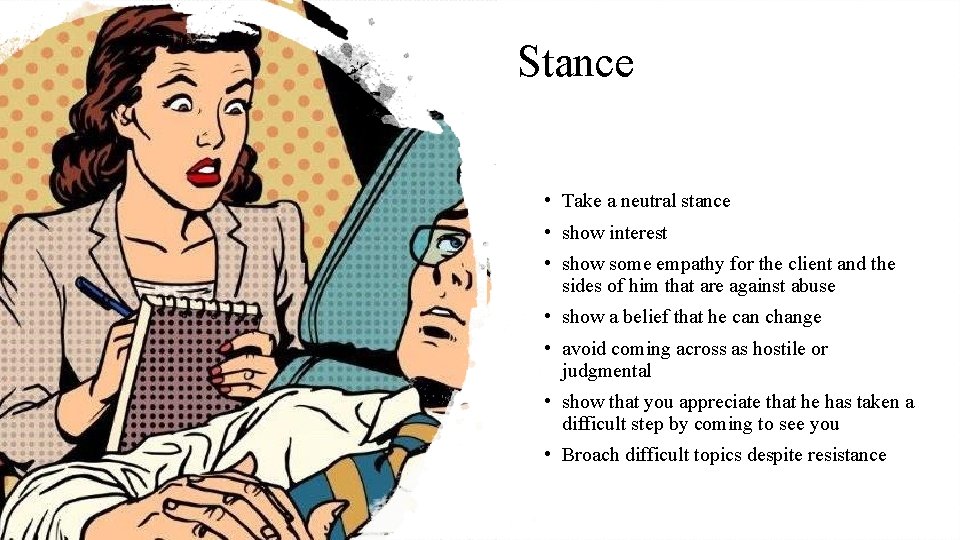
Stance • Take a neutral stance • show interest • show some empathy for the client and the sides of him that are against abuse • show a belief that he can change • avoid coming across as hostile or judgmental • show that you appreciate that he has taken a difficult step by coming to see you • Broach difficult topics despite resistance
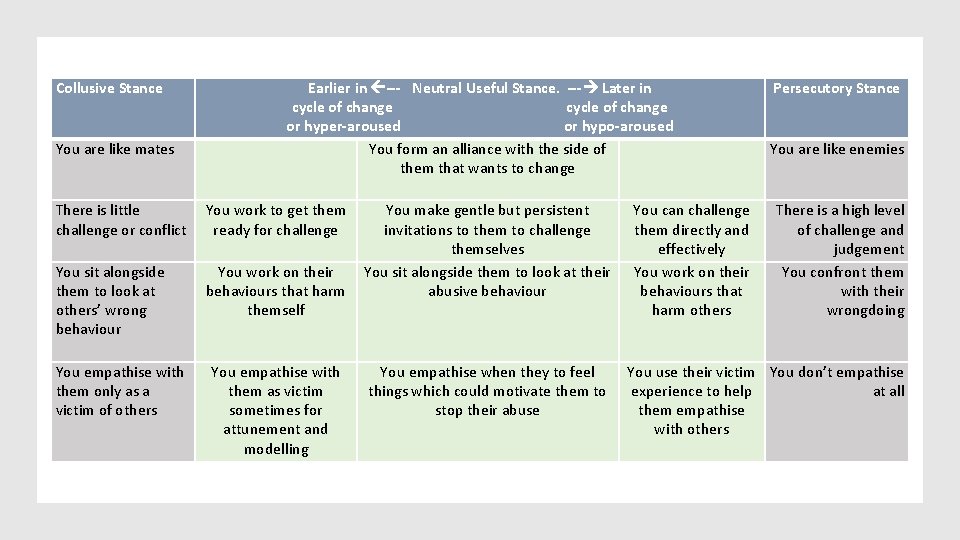
Collusive Stance You are like mates Earlier in --- Neutral Useful Stance. --- Later in cycle of change or hyper-aroused or hypo-aroused You form an alliance with the side of them that wants to change There is little challenge or conflict You work to get them ready for challenge You sit alongside them to look at others’ wrong behaviour You work on their behaviours that harm themself You empathise with them only as a victim of others You empathise with them as victim sometimes for attunement and modelling You make gentle but persistent invitations to them to challenge themselves You sit alongside them to look at their abusive behaviour You empathise when they to feel things which could motivate them to stop their abuse You can challenge them directly and effectively You work on their behaviours that harm others Persecutory Stance You are like enemies There is a high level of challenge and judgement You confront them with their wrongdoing You use their victim You don’t empathise experience to help at all them empathise with others
Safety planning with perpetrators • Lets assume your partner isn’t going to change - how can you keep yourself safer over the coming weeks ? • Do you know when it's going to happen? Is there a pattern? What are the usual trigger subjects and situations/ sore points? • What’s the most likely risky situations that could come up in the next week or two? • When you were building up to being abusive before what was the first sign you were angry - what did your body feel like? What sort of faces, gestures, movements were you making? What thoughts were running through your head? In particular how did you see her? How different is this to how you see her when you’re not angry with her? • What do you already do to try to talk yourself down and stay safe? • What’s the most effective single thing you can tell yourself to wind yourself down? • How early on in the situation do you have to start winding yourself down for it to be most effective? • How and when would you know that this wasn’t enough and that you were escalating towards frightening or abusive behaviour anyway?
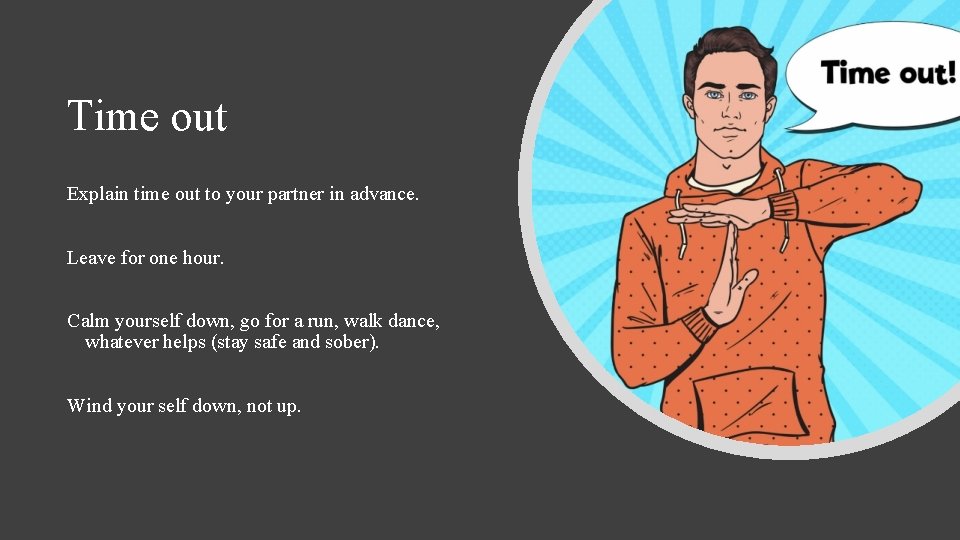
Time out Explain time out to your partner in advance. Leave for one hour. Calm yourself down, go for a run, walk dance, whatever helps (stay safe and sober). Wind your self down, not up.

Interviewing victims

Cycles of violence model
Safety planning with children
Safety planning with victims • Given his past use of violence, look at the level of risk. • When is she likely to be most at risk? What are her worst fears for herself /her children? • Does she know when it’s going to happen? Is there a pattern? • What does she already do to protect herself /her children? What works? • look at the options she has. Help her develop as wide a range of choices as possible. • Which options would be most realistic for her? What does she see herself actually being able to do? Focus on those.
- Slides: 39