
Domesday Book The Middle English spelling of Domesday
Domesday Book (The Middle English spelling of Domesday is Doomsday) Less than twenty years after his coronation William the Conqueror ordered a survey and valuation to be made of the whole realm outside of London. The only exceptions were certain border counties on the north where war had left little to record except for heaps of ruins and ridges of grass-grown graves. This survey was known as the Domesday or Doomsday Book. The first draft was completed in 1085 and the document was completed by 1086
What is the Domesday book? The survey, or census, was intended to document, "What, or how much, each man had, who was an occupier of land in England, either in land or in stock, and how much money it were worth". This enormous survey enabled the Normans and William the Conqueror to do three things: • administer England levy taxes. • determine what military resources were directly available for defense. • enabled William to ensure that all landholders and tenants swore allegiance to him - a major requirement of feudalism or the Feudal System.
Why was the Domesday survey given this name? The English people said this name was given to the survey, because, like the Day of Judgement, it spared no one. It recorded every piece of property and every item on it. As the "Anglo-Saxon Chronicle" indignantly declared, "not a rood of land, not a peasant's hut, not an ox, cow, pig, or even a hive of bees escaped. ” The census and assessment proved of the highest importance to William the Conqueror and his successors. The people said bitterly that the King kept the Doomsday, or Domesday book constantly by him, in order "that he might be able to see at any time of day how much more wool the English flock would bear fleecing. ”
Domesday Book The people in England spoke Saxon English and the Norman inspectors spoke French and Latin. A jury, which included the local important men such as the village priest and reeve who could understand the different. While the report showed the wealth of the country, it also showed the suffering it had passed through in the rebellions against William the Conqueror. Many towns had fallen into decay. Some were nearly depopulated. In the reign of Edward the Confessor the city of York had 1607 houses; at the date of the survey it had only 967, while Oxford, which had 721 houses, now only had 243.
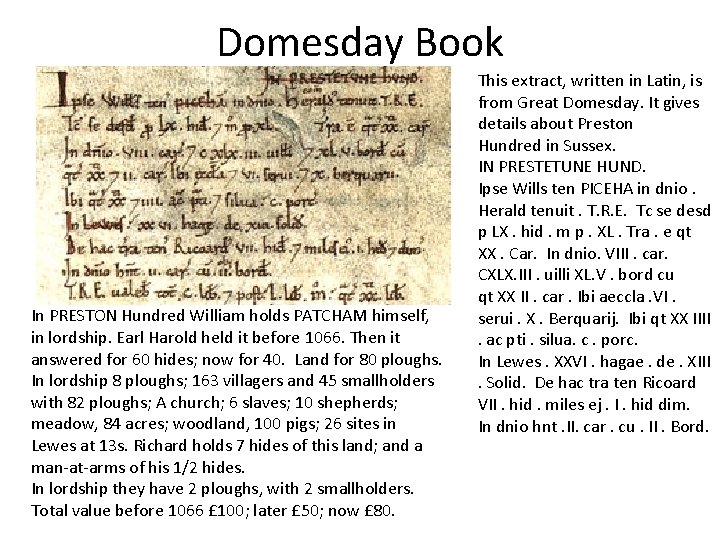
Domesday Book In PRESTON Hundred William holds PATCHAM himself, in lordship. Earl Harold held it before 1066. Then it answered for 60 hides; now for 40. Land for 80 ploughs. In lordship 8 ploughs; 163 villagers and 45 smallholders with 82 ploughs; A church; 6 slaves; 10 shepherds; meadow, 84 acres; woodland, 100 pigs; 26 sites in Lewes at 13 s. Richard holds 7 hides of this land; and a man-at-arms of his 1/2 hides. In lordship they have 2 ploughs, with 2 smallholders. Total value before 1066 £ 100; later £ 50; now £ 80. This extract, written in Latin, is from Great Domesday. It gives details about Preston Hundred in Sussex. IN PRESTETUNE HUND. Ipse Wills ten PICEHA in dnio. Herald tenuit. T. R. E. Tc se desd p LX. hid. m p. XL. Tra. e qt XX. Car. In dnio. VIII. car. CXLX. III. uilli XL. V. bord cu qt XX II. car. Ibi aeccla. VI. serui. X. Berquarij. Ibi qt XX IIII. ac pti. silua. c. porc. In Lewes. XXVI. hagae. de. XIII. Solid. De hac tra ten Ricoard VII. hid. miles ej. I. hid dim. In dnio hnt. II. car. cu. II. Bord.
- Slides: 5