
Domain Name System DNS Shivkumar Kalyanaraman Rensselaer Polytechnic
- Slides: 26
Domain Name System (DNS) Shivkumar Kalyanaraman Rensselaer Polytechnic Institute shivkuma@ecse. rpi. edu http: //www. ecse. rpi. edu/Homepages/shivkuma Shivkumar Kalyanaraman Rensselaer Polytechnic Institute 1
Overview Naming hierarchy q Server hierarchy q Name resolution q Other information in name servers q Ref: Chap 14 q Shivkumar Kalyanaraman Rensselaer Polytechnic Institute 2
Why Names? Computers use addresses q Humans cannot remember IP addresses Need names Example, “shiva” for 128. 113. 50. 56 q Simplest Solution: Each computer has a unique name and has a built in table of name to address translation q Problem: Not scalable q Solution: DNS (Adopted in 1983) q Hierarchical Names: shiva. ecse. rpi. edu q Shivkumar Kalyanaraman Rensselaer Polytechnic Institute 3
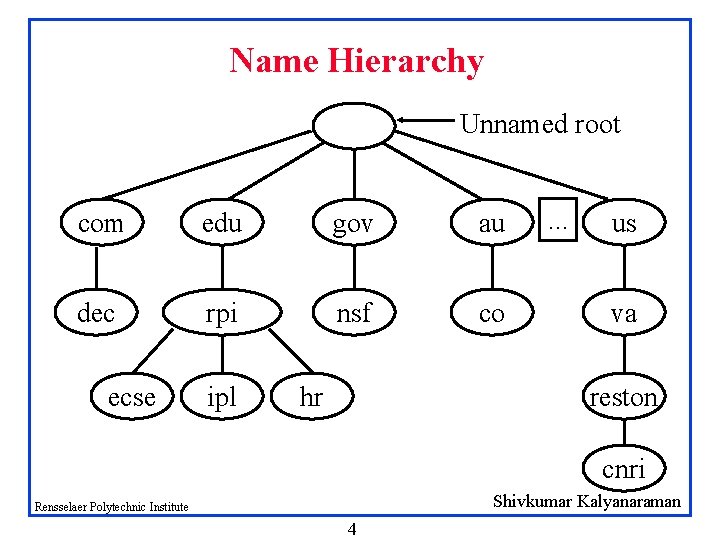
Name Hierarchy Unnamed root com edu gov au dec rpi nsf co ecse ipl hr . . . us va reston cnri Shivkumar Kalyanaraman Rensselaer Polytechnic Institute 4
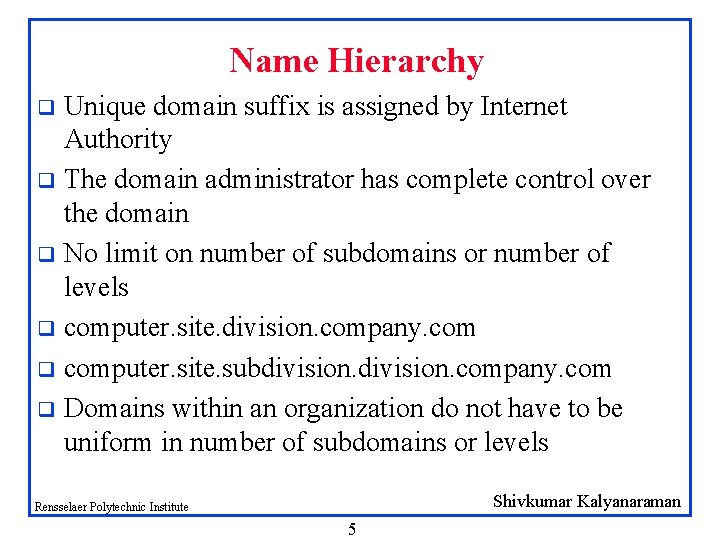
Name Hierarchy Unique domain suffix is assigned by Internet Authority q The domain administrator has complete control over the domain q No limit on number of subdomains or number of levels q computer. site. division. company. com q computer. site. subdivision. company. com q Domains within an organization do not have to be uniform in number of subdomains or levels q Shivkumar Kalyanaraman Rensselaer Polytechnic Institute 5
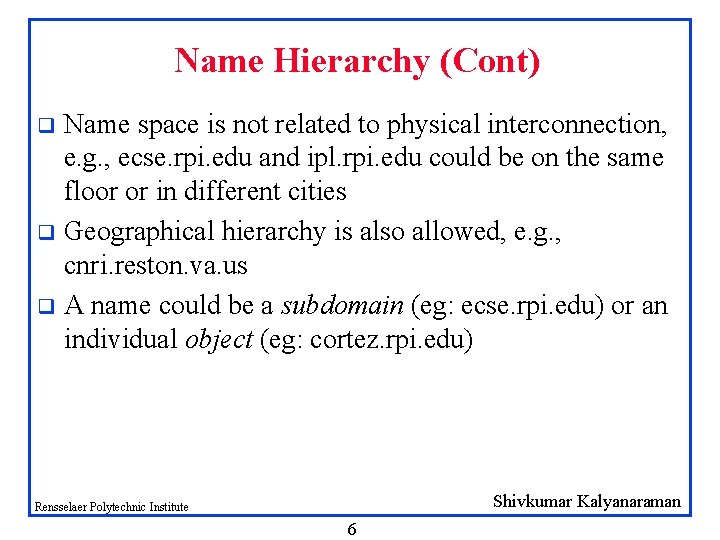
Name Hierarchy (Cont) Name space is not related to physical interconnection, e. g. , ecse. rpi. edu and ipl. rpi. edu could be on the same floor or in different cities q Geographical hierarchy is also allowed, e. g. , cnri. reston. va. us q A name could be a subdomain (eg: ecse. rpi. edu) or an individual object (eg: cortez. rpi. edu) q Shivkumar Kalyanaraman Rensselaer Polytechnic Institute 6
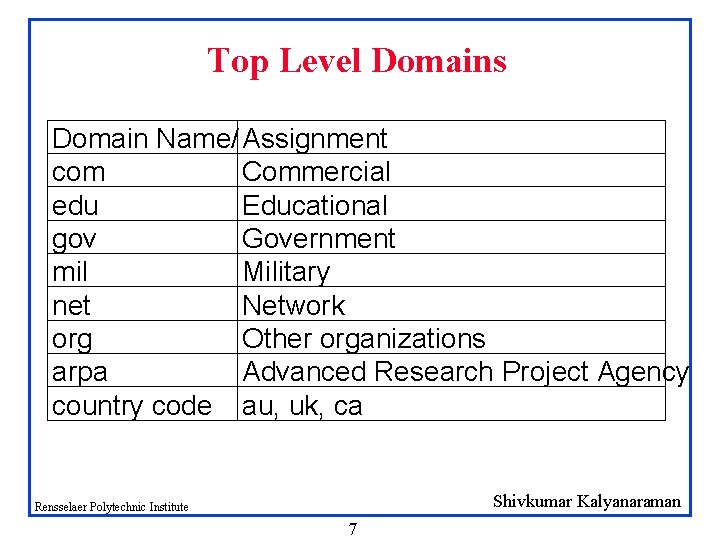
Top Level Domains Domain Name/ Assignment com Commercial edu Educational gov Government mil Military net Network org Other organizations arpa Advanced Research Project Agency country code au, uk, ca Shivkumar Kalyanaraman Rensselaer Polytechnic Institute 7
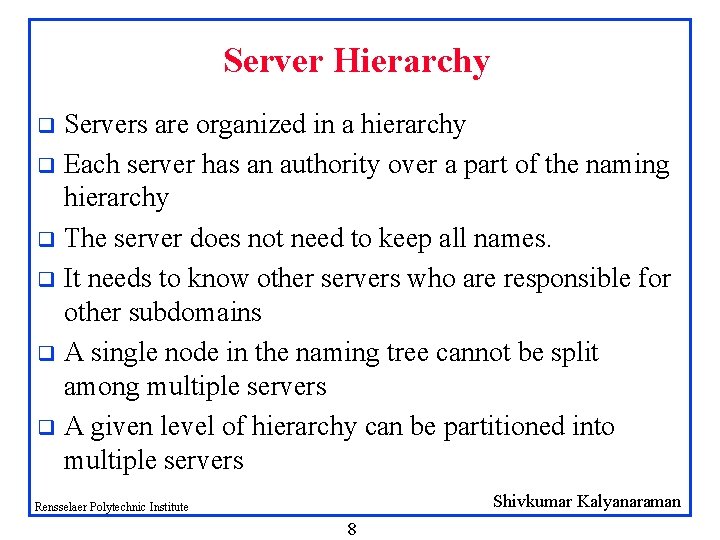
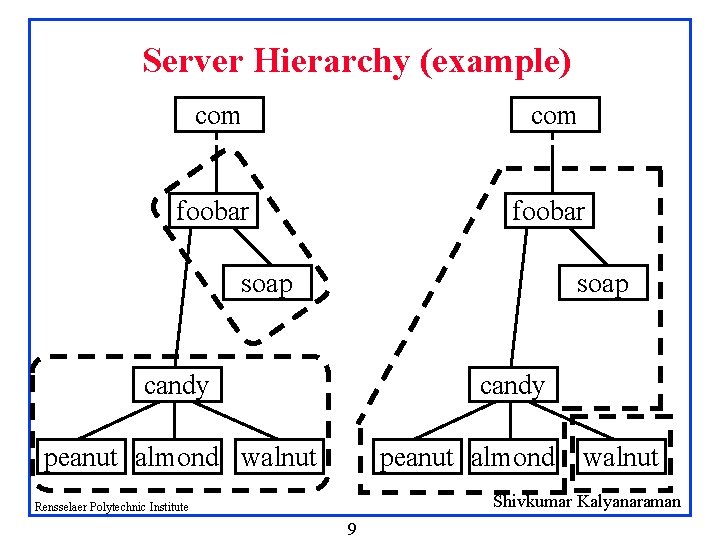
Server Hierarchy Servers are organized in a hierarchy q Each server has an authority over a part of the naming hierarchy q The server does not need to keep all names. q It needs to know other servers who are responsible for other subdomains q A single node in the naming tree cannot be split among multiple servers q A given level of hierarchy can be partitioned into multiple servers q Shivkumar Kalyanaraman Rensselaer Polytechnic Institute 8
Server Hierarchy (example) com foobar soap candy peanut almond walnut Shivkumar Kalyanaraman Rensselaer Polytechnic Institute 9
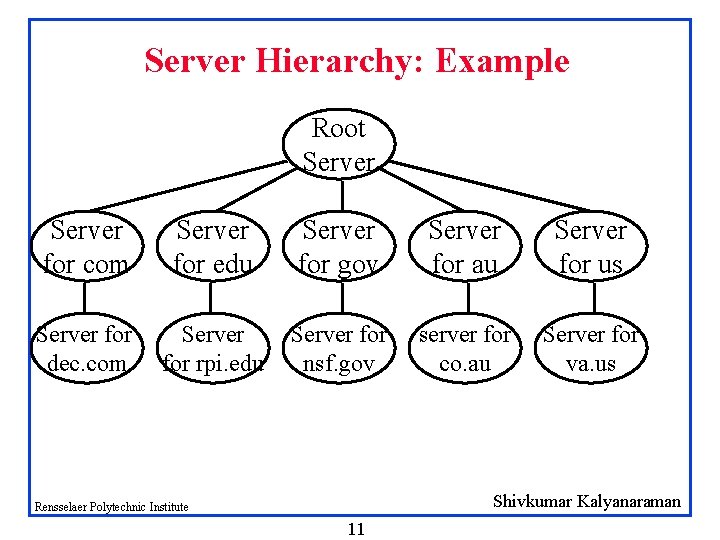
Server Hierarchy (Cont) Authority has the name to address translation table q Responsible Either has the name to address translation table or knows the server who has q But such a reply is called “non-authoritative” reply q A single server can serve multiple domains, e. g. , purdue. edu and laf. in. us q Root server knows about servers for top-level domains, e. g. , com q Each server knows the root server q Shivkumar Kalyanaraman Rensselaer Polytechnic Institute 10
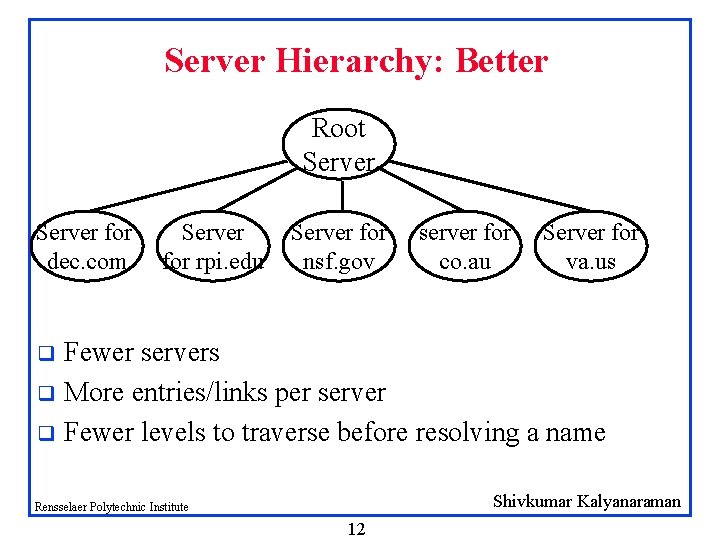
Server Hierarchy: Example Root Server for com Server for edu Server for gov Server for au Server for us Server for dec. com Server for rpi. edu Server for nsf. gov server for co. au Server for va. us Shivkumar Kalyanaraman Rensselaer Polytechnic Institute 11
Server Hierarchy: Better Root Server for dec. com Server for rpi. edu Server for nsf. gov server for co. au Server for va. us Fewer servers q More entries/links per server q Fewer levels to traverse before resolving a name q Shivkumar Kalyanaraman Rensselaer Polytechnic Institute 12
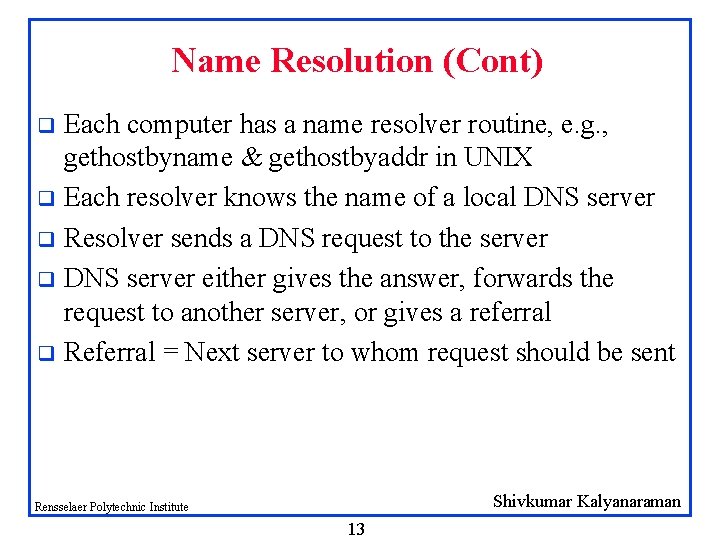
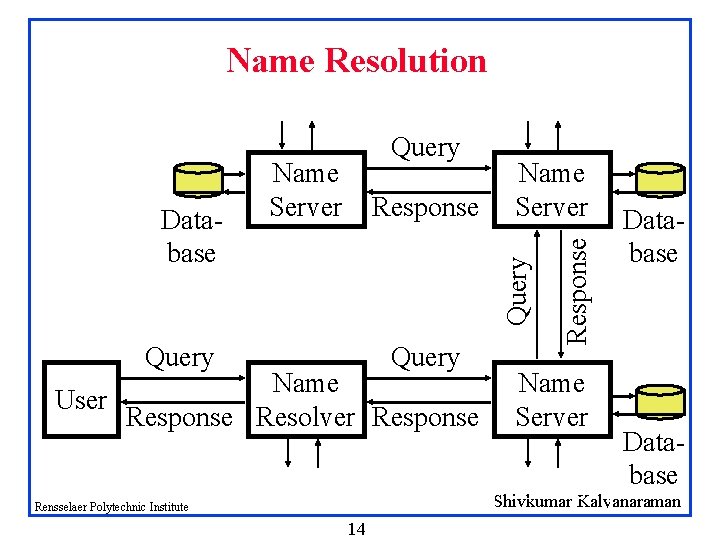
Name Resolution (Cont) Each computer has a name resolver routine, e. g. , gethostbyname & gethostbyaddr in UNIX q Each resolver knows the name of a local DNS server q Resolver sends a DNS request to the server q DNS server either gives the answer, forwards the request to another server, or gives a referral q Referral = Next server to whom request should be sent q Shivkumar Kalyanaraman Rensselaer Polytechnic Institute 13
Name Resolution Query Name Server Response Query Name User Response Resolver Response Rensselaer Polytechnic Institute Name Server Query Database Cache Response Cache Name Server Database Cache. Kalyanaraman Shivkumar 14
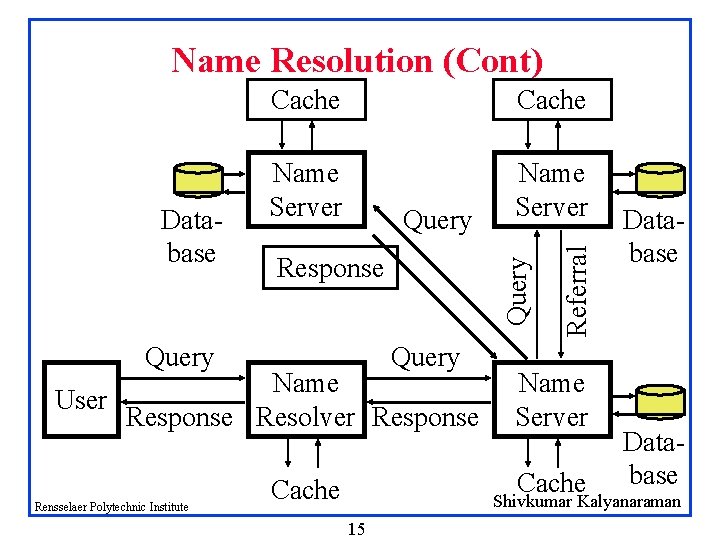
Name Resolution (Cont) Name Server Query Response Query Name User Response Resolver Response Rensselaer Polytechnic Institute Referral Cache Query Database Cache Name Server Cache Database Shivkumar Kalyanaraman 15
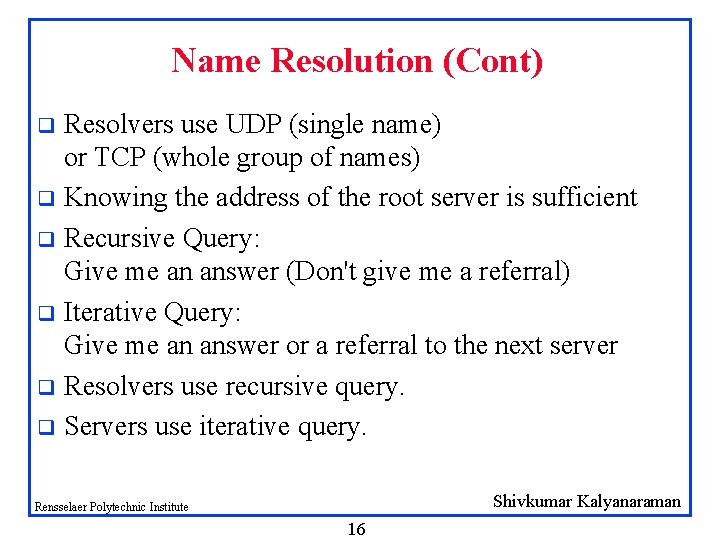
Name Resolution (Cont) Resolvers use UDP (single name) or TCP (whole group of names) q Knowing the address of the root server is sufficient q Recursive Query: Give me an answer (Don't give me a referral) q Iterative Query: Give me an answer or a referral to the next server q Resolvers use recursive query. q Servers use iterative query. q Shivkumar Kalyanaraman Rensselaer Polytechnic Institute 16
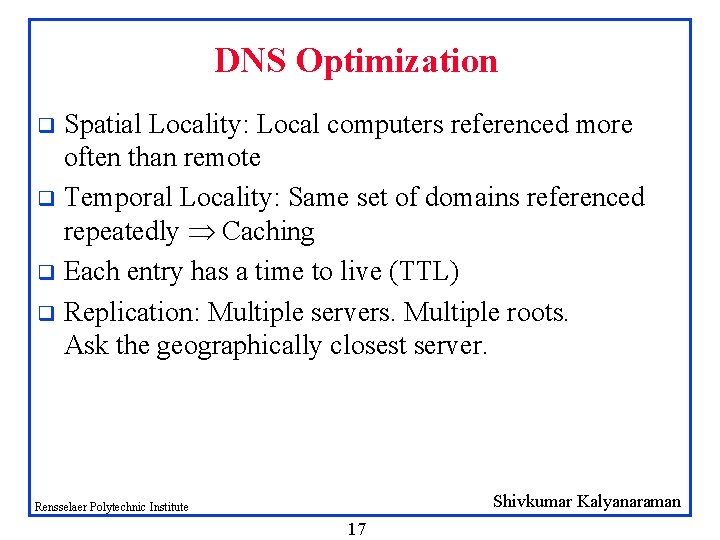
DNS Optimization Spatial Locality: Local computers referenced more often than remote q Temporal Locality: Same set of domains referenced repeatedly Caching q Each entry has a time to live (TTL) q Replication: Multiple servers. Multiple roots. Ask the geographically closest server. q Shivkumar Kalyanaraman Rensselaer Polytechnic Institute 17
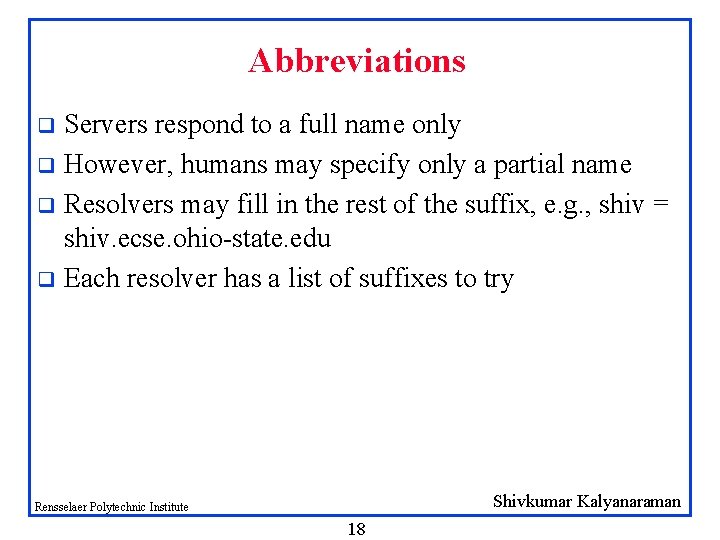
Abbreviations Servers respond to a full name only q However, humans may specify only a partial name q Resolvers may fill in the rest of the suffix, e. g. , shiv = shiv. ecse. ohio-state. edu q Each resolver has a list of suffixes to try q Shivkumar Kalyanaraman Rensselaer Polytechnic Institute 18
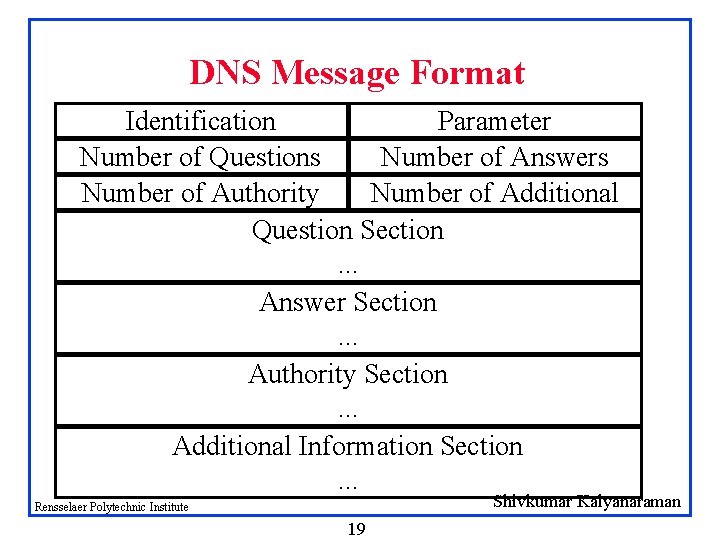
DNS Message Format Identification Parameter Number of Questions Number of Answers Number of Authority Number of Additional Question Section. . . Answer Section. . . Authority Section. . . Additional Information Section. . . Shivkumar Kalyanaraman Rensselaer Polytechnic Institute 19
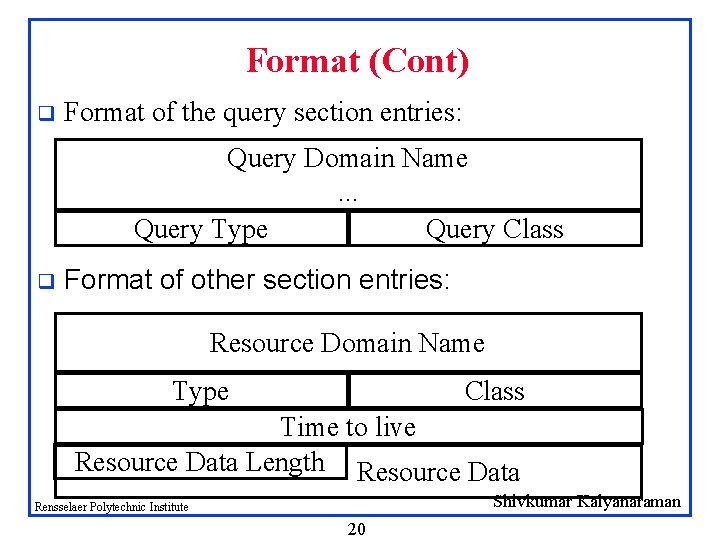
Format (Cont) q Format of the query section entries: Query Domain Name. . . Query Type Query Class q Format of other section entries: Resource Domain Name Type Class Time to live Resource Data Length Resource Data Shivkumar Kalyanaraman Rensselaer Polytechnic Institute 20
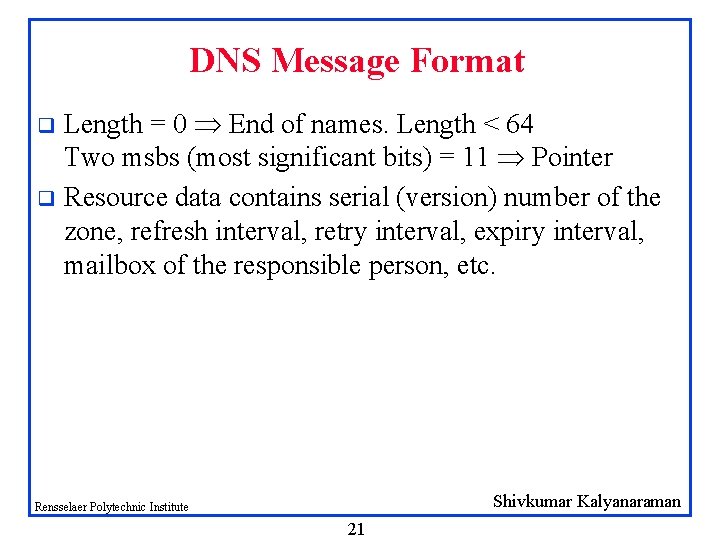
DNS Message Format Length = 0 End of names. Length < 64 Two msbs (most significant bits) = 11 Pointer q Resource data contains serial (version) number of the zone, refresh interval, retry interval, expiry interval, mailbox of the responsible person, etc. q Shivkumar Kalyanaraman Rensselaer Polytechnic Institute 21
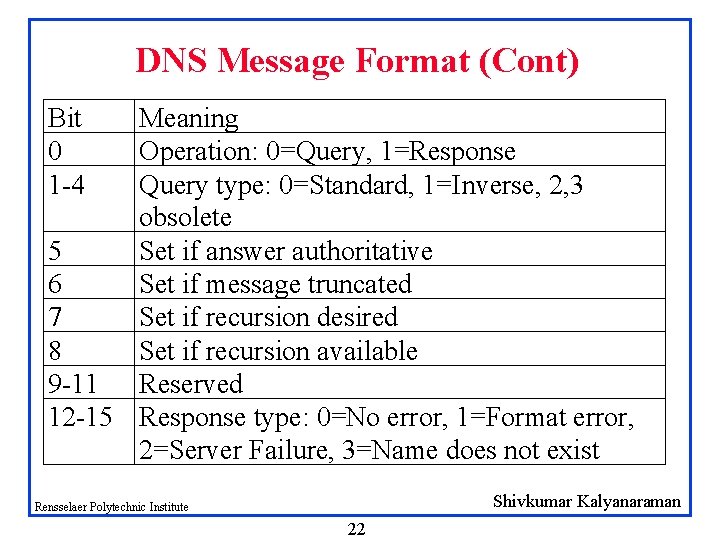
DNS Message Format (Cont) Bit 0 1 -4 Meaning Operation: 0=Query, 1=Response Query type: 0=Standard, 1=Inverse, 2, 3 obsolete 5 Set if answer authoritative 6 Set if message truncated 7 Set if recursion desired 8 Set if recursion available 9 -11 Reserved 12 -15 Response type: 0=No error, 1=Format error, 2=Server Failure, 3=Name does not exist Shivkumar Kalyanaraman Rensselaer Polytechnic Institute 22
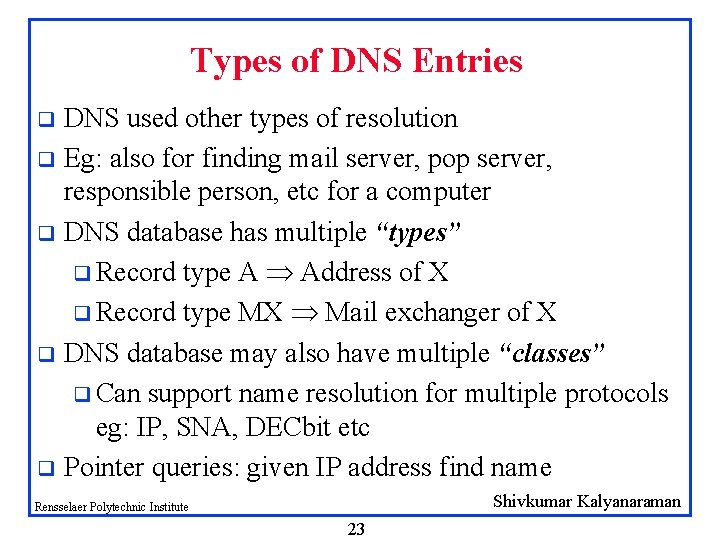
Types of DNS Entries DNS used other types of resolution q Eg: also for finding mail server, pop server, responsible person, etc for a computer q DNS database has multiple “types” q Record type A Address of X q Record type MX Mail exchanger of X q DNS database may also have multiple “classes” q Can support name resolution for multiple protocols eg: IP, SNA, DECbit etc q Pointer queries: given IP address find name q Shivkumar Kalyanaraman Rensselaer Polytechnic Institute 23
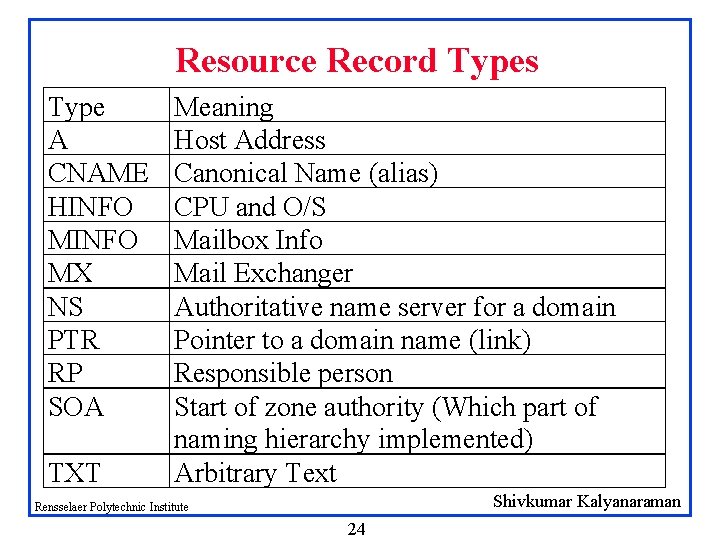
Resource Record Types Type A CNAME HINFO MX NS PTR RP SOA TXT Meaning Host Address Canonical Name (alias) CPU and O/S Mailbox Info Mail Exchanger Authoritative name server for a domain Pointer to a domain name (link) Responsible person Start of zone authority (Which part of naming hierarchy implemented) Arbitrary Text Shivkumar Kalyanaraman Rensselaer Polytechnic Institute 24
Summary DNS: Maps names to addresses q Names are hierarchical. Administration is also hierarchical. q No standard for number of levels q Replication and caching is used for performance optimization. q Shivkumar Kalyanaraman Rensselaer Polytechnic Institute 25
Informal Exercises q q /etc/hosts is a table of name-to-IP-address mappings q Find out approximately how many hosts, subnets and domains are there in the RPI campus net q Does this table give some addresses of root servers as well ? q Why does the /etc/hosts in ECSE have the entire table for the campus net. Lookup the file /etc/resolv. conf which gives the domain name and addresses of nameservers. q Why are multiple nameservers listed ? q Lookup the name of an IP address using nslookup. This generates a pointer query - you can watch it using tcpdump. What is unusual about pointer queries on the wire ? Shivkumar Kalyanaraman Rensselaer Polytechnic Institute 26