
DOMAIN Bacteria PHYLUM Proteobacteria CLASS Gamma Proteobacteria ORDER

DOMAIN Bacteria

PHYLUM Proteobacteria

CLASS Gamma Proteobacteria

ORDER Vibrionales

FAMILY Vibrionaceae

GENUS Vibrio
SPECIES Vibrio parahaemolyticus & Vibrio vulnificus
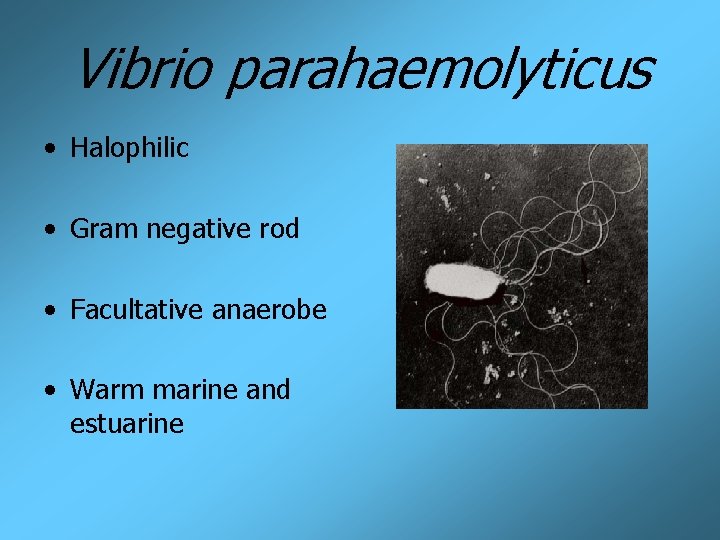
Vibrio parahaemolyticus • Halophilic • Gram negative rod • Facultative anaerobe • Warm marine and estuarine
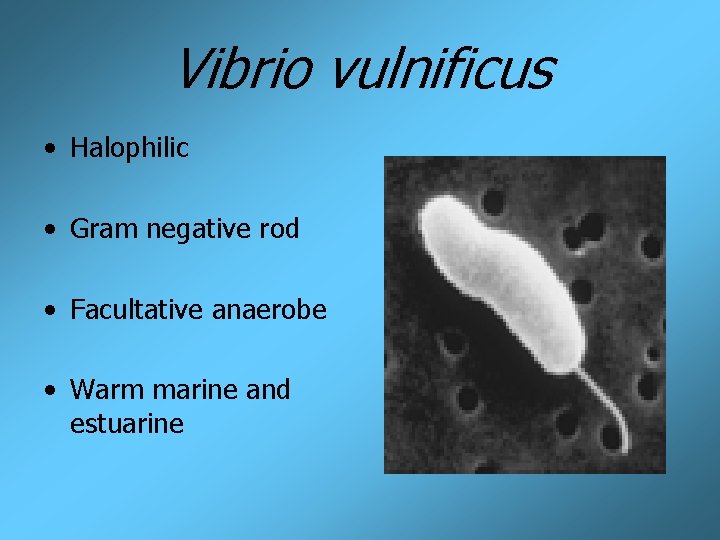
Vibrio vulnificus • Halophilic • Gram negative rod • Facultative anaerobe • Warm marine and estuarine
DISEASES V. parahaemolyticus V. vulnificus • Gastroenteritis • Wound infection • Gastroenteritis • Primary septicemia
INFECTION OF V. p. • Ingestion of un/under cooked shellfish, Exposure of Open Wound • Symptoms 4 -96 hours after ingestion • Attaches to the lining of the small intestine • Excretes an unidentified toxin
INFECTION OF V. v. • Ingestion of un/under cooked shellfish, Exposure of Open Wound • Symptoms 4 -96 hours after ingestion • Enters blood stream resulting in septic shock
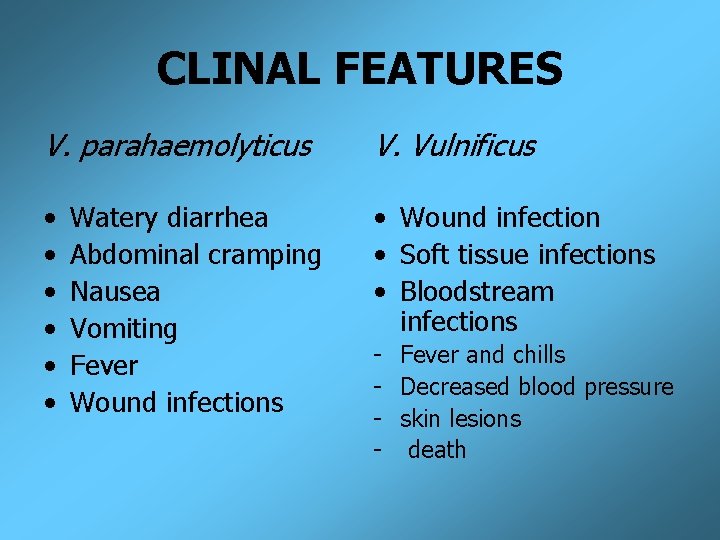
CLINAL FEATURES V. parahaemolyticus V. Vulnificus • • Wound infection • Soft tissue infections • Bloodstream infections Watery diarrhea Abdominal cramping Nausea Vomiting Fever Wound infections - Fever and chills - Decreased blood pressure - skin lesions - death
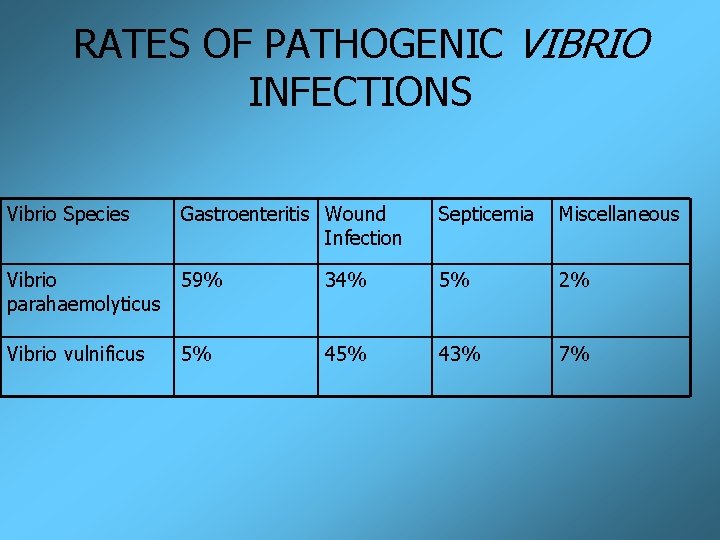
RATES OF PATHOGENIC VIBRIO INFECTIONS Vibrio Species Gastroenteritis Wound Infection Septicemia Miscellaneous Vibrio 59% parahaemolyticus 34% 5% 2% Vibrio vulnificus 45% 43% 7% 5%
TESTING • Isolation by stool culture • Thiosulfate, citrate, bile salts, and sucrose (TCBS) media necessary • Rarely used by clinical laboratories
EPIDEMIOLOGY • UNITED STATES Ø 8000 Vibrio infections Ø 60 Vibrio related deaths
EPIDEMIOLOGY V. parahaemolyticus YEARLY • 3000 cases of infection • 40 hospitalizations • 7 deaths
MAJOR OUTBREAKS • July – August, 1997 Oysters from CA, OR, WA and British Columbia 209 infections, 1 death • July – September, 1998 Oysters and Clams in Long Island Sound CT, NJ, and NY residents
EPIDEMIOLOGY V. vulnificus YEARLY • 95 cases of infection • 85 hospitalizations • 35 deaths
V. v. CONTINUED • No recorded major outbreaks • 30 – 40% of all deaths caused by Vibrios • 50% mortality rate for “primary septicemia”

RESEARCH Virulence factors Toxin production Antibiotic treatments
REFERENCES • • • Hatsumi Nasu, Tetsuya Iida, Tomomi Sugahara, Yoshiharu Yamaichi, Kwon-Sam Park, Katsushi Yokoyama, Kozo Makino, Hideo Shinagawa, and Takeshi Honda. “A Filamentous Phage Associated with Recent Pandemic Vibrio parahaemolyticus O 3: K 6 Strains. ” Journal of Clinical Microbiology. June 2000, Vol. 38, No. 6 p. 21562161, Vibrio parahaemolyticus. ” Online. Center for Disease Control. 23 November 2004. Available: http: //www. cdc. gov/ncidod/dbmd/diseaseinfo/vibrioparahaemolyticus_t. htm “Vibrio vulnificus. ” Online. Center for Disease Control. 23 November 2004. Available: http: //www. cdc. gov/ncidod/dbmd/diseaseinfo/vibriovulnificus_t. htm “Vibrio parahaemolyticus. ” Online. Center for Food Safety and Applied Nutrition. 2 December 2004. Available: http: //vm. cfsan. fda. gov/~mow/chap 9. html “Vibrio vulnificus. ” Online. Center for Food Safety and Applied Nutrition. 2 December 2004. Available: http: //vm. cfsan. fda. gov/~mow/chap 9. html “Vibrio Vulnificus Illness Fact Sheet. ” Online. Community Health Administration. 6 December 2004. Available: http: //edcp. org/factsheets/vibrio. html William B. Nilsson, Rohinee N. Paranjpye, Angelo De. Paola, and Mark S. Strom. “Sequence Polymorphism of the 16 S r. RNA Gene of Vibrio vulnificus Is a Possible Indicator of Strain Virulence. ” Journal of Clinical Microbiology. January 2003 Volume 41, no. 1, p. 442 -446
- Slides: 22