
Domain and Range Independent and Dependent Variables Vocabulary
Domain and Range & Independent and Dependent Variables

Vocabulary The Independent Quantity is the quantity that stands alone and is not changed by the other quantities. (input x idea) Domain: All of the independent values (input x values) Independent Dependent To State Domain from table, ordered pairs, or discrete graph: List all x values separated by commas in brackets { } Domain Range Domain {-5, 0, 5} The Dependent Quantity depends on the independent quantity. The independent quantity causes a change in dependent quantity (output y idea) Range: the All of the dependent values (output y values) To State Range from table, ordered pairs, or discrete graph: List all y values separated by commas in brackets { } Range {0, 10} don’t need to list repeat values, put in numerical order
Identify the dependent and independent quantities Your grade on a test and the number of hours you studied. The independent quantity is the number of hours you studied. This is the input idea (domain will be the x values, #s) The dependent quantity is your grade (because your grade depends on how long you studied (usually ). This is the output idea (range will be the y values) Caroline makes $8. 50 an hour babysitting for her neighbors’ children after school and on the weekends. The independent quantity is the total number of hours she babysits dependent quantity is the total amount of money Caroline earns (because her pay depends on how long she works)
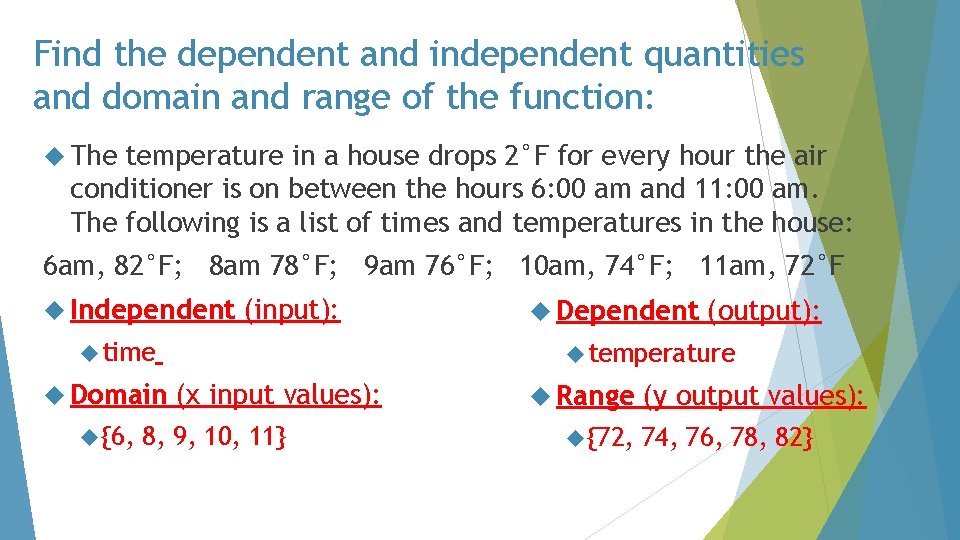
Find the dependent and independent quantities and domain and range of the function: The temperature in a house drops 2°F for every hour the air conditioner is on between the hours 6: 00 am and 11: 00 am. The following is a list of times and temperatures in the house: 6 am, 82°F; 8 am 78°F; 9 am 76°F; 10 am, 74°F; 11 am, 72°F Independent (input): time Domain {6, Dependent (output): temperature (x input values): 8, 9, 10, 11} Range {72, (y output values): 74, 76, 78, 82}
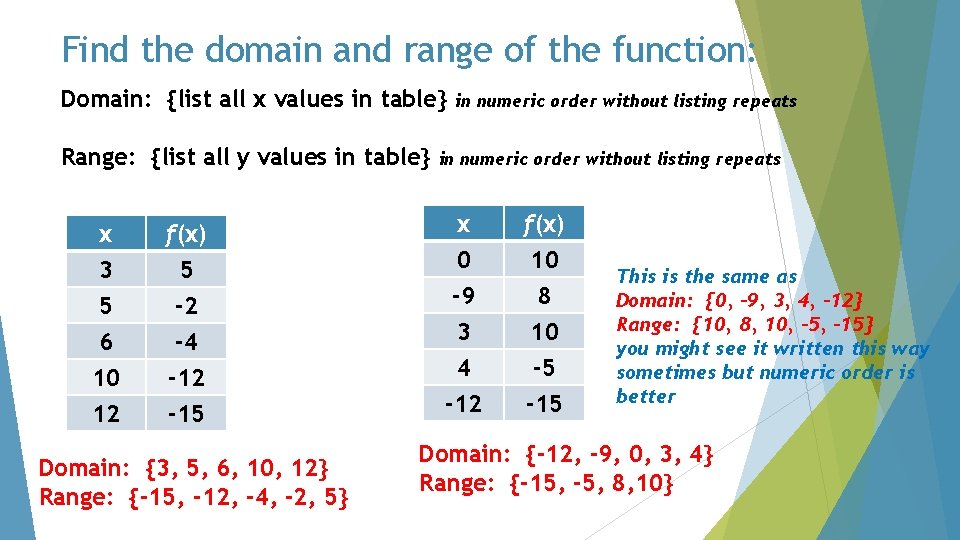
Find the domain and range of the function: Domain: {list all x values in table} Range: {list all y values in table} x 3 5 6 f(x) 5 -2 -4 10 12 -15 Domain: {3, 5, 6, 10, 12} Range: {-15, -12, -4, -2, 5} in numeric order without listing repeats x 0 -9 3 f(x) 10 8 10 4 -12 -5 -15 This is the same as Domain: {0, -9, 3, 4, -12} Range: {10, 8, 10, -5, -15} you might see it written this way sometimes but numeric order is better Domain: {-12, -9, 0, 3, 4} Range: {-15, -5, 8, 10}
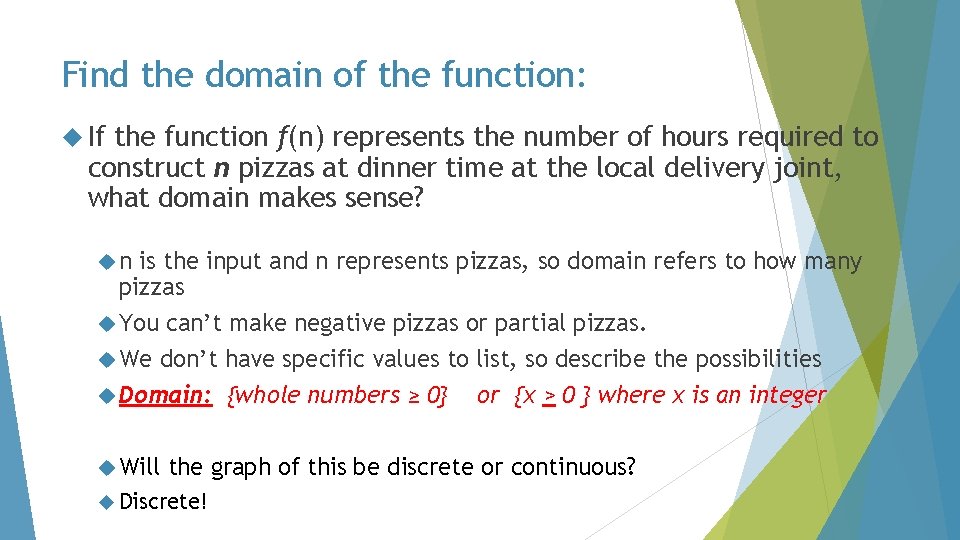
Find the domain of the function: If the function f(n) represents the number of hours required to construct n pizzas at dinner time at the local delivery joint, what domain makes sense? n is the input and n represents pizzas, so domain refers to how many pizzas You can’t make negative pizzas or partial pizzas. We don’t have specific values to list, so describe the possibilities Domain: {whole numbers ≥ 0} or {x > 0 } where x is an integer Will the graph of this be discrete or continuous? Discrete!
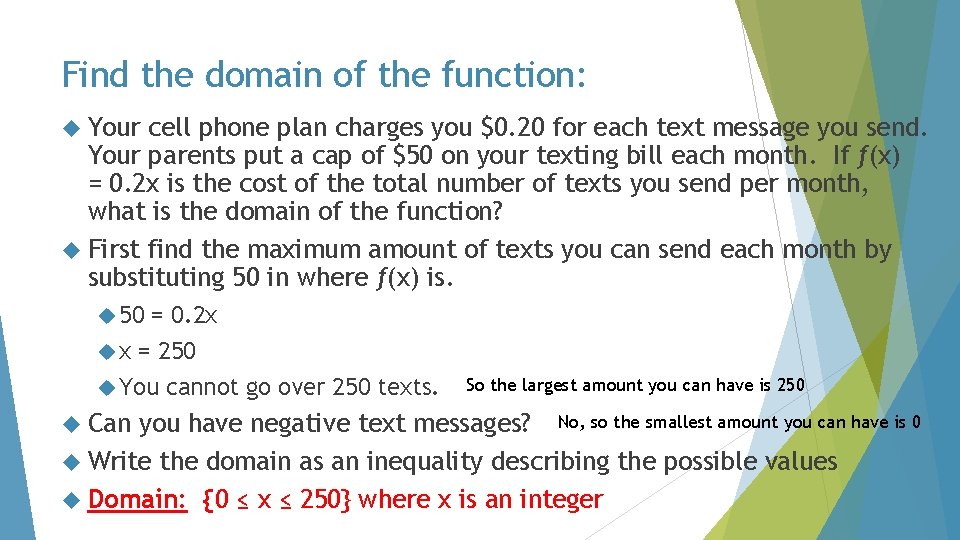
Find the domain of the function: Your cell phone plan charges you $0. 20 for each text message you send. Your parents put a cap of $50 on your texting bill each month. If f(x) = 0. 2 x is the cost of the total number of texts you send per month, what is the domain of the function? First find the maximum amount of texts you can send each month by substituting 50 in where f(x) is. 50 = 0. 2 x x = 250 You cannot go over 250 texts. Can So the largest amount you can have is 250 you have negative text messages? No, so the smallest amount you can have is 0 Write the domain as an inequality describing the possible values Domain: {0 ≤ x ≤ 250} where x is an integer
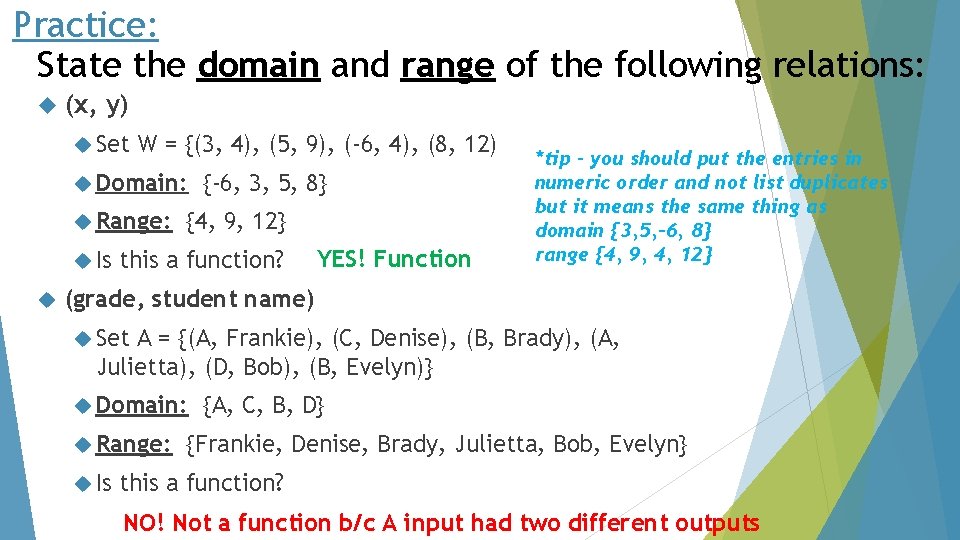
Practice: State the domain and range of the following relations: (x, y) Set W = {(3, 4), (5, 9), (-6, 4), (8, 12) Domain: Range: Is {-6, 3, 5, 8} {4, 9, 12} this a function? YES! Function *tip – you should put the entries in numeric order and not list duplicates but it means the same thing as domain {3, 5, -6, 8} range {4, 9, 4, 12} (grade, student name) Set A = {(A, Frankie), (C, Denise), (B, Brady), (A, Julietta), (D, Bob), (B, Evelyn)} Domain: Range: Is {A, C, B, D} {Frankie, Denise, Brady, Julietta, Bob, Evelyn} this a function? NO! Not a function b/c A input had two different outputs
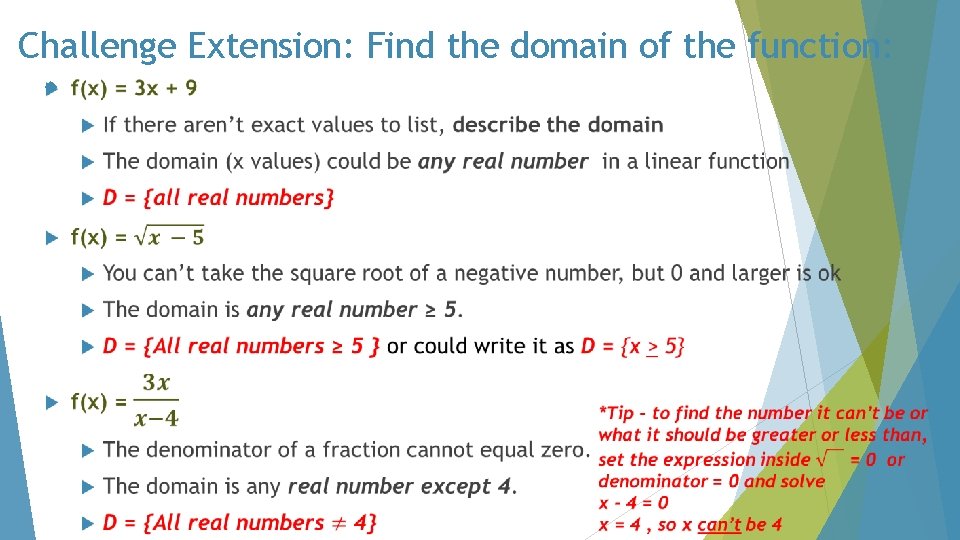
Challenge Extension: Find the domain of the function:
- Slides: 9