Doing things differently PostHarvest Innovation Learning Alliances in

- Slides: 19
Doing things differently: Post-Harvest Innovation Learning Alliances in Tanzania & Zimbabwe Brighton Mvumi, Mike Morris, Tanya Stathers, William Riwa http: //www. nri. org/PHILA/
Background (1) • Common denominator for research team was the problem of storage insect pests: – livelihoods of rural households in sub Saharan Africa undermined by storage insect pests; – many farmers rely on imported organophosphate-based pesticides to protect stored grain; safety and efficacy of these chemicals in doubt; – households using traditional control materials are faced with inconsistent and often poor results;
Background (2) • Appropriate technology (hardware) solution: – Diatomaceous Earths (DEs), inert fossil dusts, can be admixed with grain – Function by causing insects to dehydrate & die • Research established that: – DEs (imported & local) efficacious as grain protectants in range of Agro-Ecological Zones; – DEs readily usable by diverse smallholders in the different locations; – food stocks (maize, sorghum, beans & cowpeas) successfully protected for periods of > 8 months.
Background (3) • Getting DEs into use amongst rural HHs requires a multitude of changes in the institutional setting: – Farmers & extension staff have to fully understand the limitations and dangers of existing protectants, – Advisors have to be influenced & to recommend policy and regulation changes, – Registration authorities need to be persuaded to ‘buy into’ and support research findings, – Private sector needed to step forward and champion the registration process
The Problem • Why do things differently? – Conventional approaches to technology transfer within small-scale farming systems have frequently failed – DEs yet to take off; – HH food security remains precarious for many people in the rural areas and food production levels show little or no increase; – PH service provision & research focus on technology; less on understanding delivery system constraints, distinguishing between needs & priorities of different HHs, exploring farmers’ own research capabilities;
The Opportunities (1) • Innovation system thinking, which recognises that: – new products and processes are brought into use, not just by the activities of researchers , but through the activities of a number of widely different actors and organisations; – translation of ideas into use requires • appropriate technologies, • compatible mindsets and • favourable institutional settings
The Opportunities (2) Innovation system from farmer’s perspective
The Opportunities (3) • Learning Alliances (LAs) provide for alignment of the key components of innovation: – hardware – appropriate technologies; can be indigenous or imported; – software – action research to develop compatible mindsets and adaptive capacity; – system-ware – to address constraints in the institutional settings, outside the remit of conventional research approaches.
Learning Alliance functions (1) • Information sharing amongst membership: – stakeholder workshops, documentation, ICTs & regular communications, website etc. • Action research (case studies) to: – develop specific understanding of supply-side & demand-side issues; – develop compatible mindsets between partners, and local adaptive capacity – learning by doing
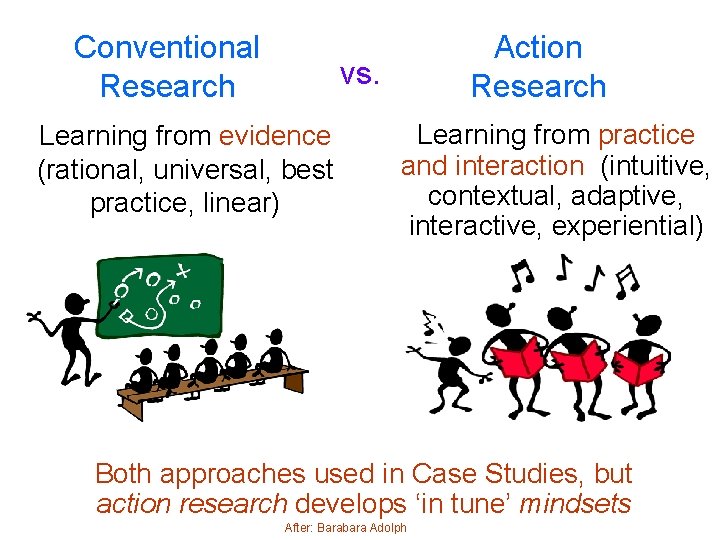
Conventional Research Action Research vs. Learning from evidence (rational, universal, best practice, linear) Learning from practice and interaction (intuitive, contextual, adaptive, interactive, experiential) Both approaches used in Case Studies, but action research develops ‘in tune’ mindsets After: Barabara Adolph
Learning Alliance functions (2) • LAs are influenced by and seek to influence the institutional environment – the rules & play of the game – including: – policy agendas, content & implementation; – R & D programmes; – staffing arrangements; – access to and use of ICTs • Management of information sharing, action research & advocacy functions.
Achievements (1) • PHILA members are relating & learning together in new ways – PHILA established in Tanzania & Zimbabwe – New CS tools & techniques shared & adopted – ICT training & promotion – New awareness & understanding of the need for institutional learning & change (i. e. systemware & software)
Achievements (2) • Practical insights & recommendations for service provision developed, based on: – Study of public service providers & research – Studies of public service & NGO service provision – Participatory planning exercises in 4 districts – Farmer & extension staff exchange visits – Enquiry visits to explore farmer diversity – Review of policies, their formulation & implementation
Achievements (3) • Understanding of ability of different stakeholders to access & utilise information: – Individuals in many farming households in multiple locations familiar with better storage practices (e. g. application DEs, ASD etc) – Exchange visits explored farmer-to-farmer & farmer-extension staff learning – Empowerment studies throwing light on demandled approaches – Study of agro-chemical companies & public service providers
Persisting Challenges (1) • Establishing LAs involves high front-end transaction costs – donors do a lot of policy pushing but are slow to pick up implementation costs • Innovation is essentially about changing institutional & social relationships – but is often confined to hardware; information is misconstrued as knowledge; knowledge management defined as technology uptake
Persisting Challenges (2) • Conflict inherent to rule (/inst. ) change – The elite will resist rule changes; use ‘poor’ communication to exclude other players etc. – private sector players, typically busy & costaware, are often reluctant to participate, have competing interests. • LAs need to build on existing platforms (parallel structures are out) which do not flag learning – building trust is better than subversion, but time consuming & usually costly.
Persisting Challenges (3) • LAs are about changing the dynamics within and between organisations, but – rely heavily on the skills & energies of individuals – documenting process learning is difficult • If they are to have sustained impact, then – LAs need to influence policy makers and other key stakeholders – LAs need to secure buy-in (membership) from policy makers and other key stakeholders
The Future • LAs offer a strategic approach to providing services which are demand-led, clientoriented, empowering etc. , but – continued support from the R&D communities and donors, essential; – commitment of statutory authorities (e. g. line ministries, local government), essential; – involvement of private sector, essential; and, – representation of diverse farmer-types, imperative
Thank You