
Doing The Right Thing Addressing Stigma and Discrimination
- Slides: 10
#Doing. The. Right. Thing: Addressing Stigma and Discrimination among Key Populations in Healthcare Settings 26 July 2017, 11: 00 - 12: 30 Policy approaches and guidance to address stigma and discrimination in healthcare settings Rachel Baggaley, coordinator Key Populations and Innovative Prevention, HIV dept. WHO, Geneva http: //www. who. int/hrh/news/2017/zero_discrimination-in-health-care/en/
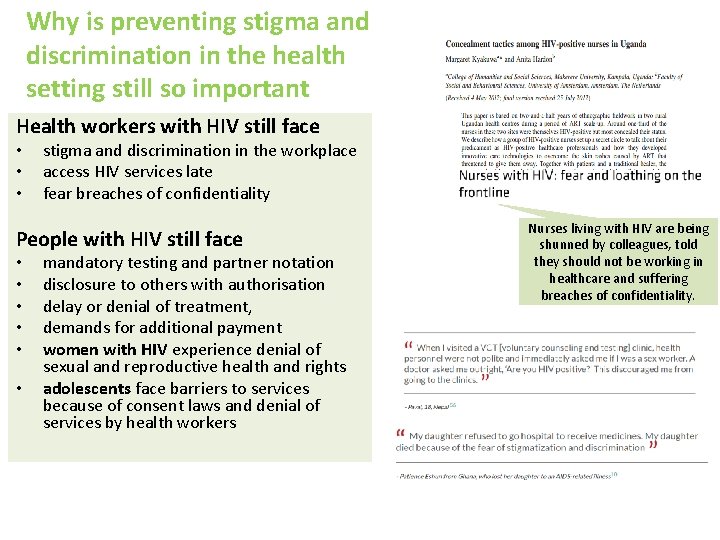
Why is preventing stigma and discrimination in the health setting still so important Health workers with HIV still face • • • stigma and discrimination in the workplace access HIV services late fear breaches of confidentiality People with HIV still face • • • mandatory testing and partner notation disclosure to others with authorisation delay or denial of treatment, demands for additional payment women with HIV experience denial of sexual and reproductive health and rights adolescents face barriers to services because of consent laws and denial of services by health workers Nurses living with HIV are being shunned by colleagues, told they should not be working in healthcare and suffering breaches of confidentiality.
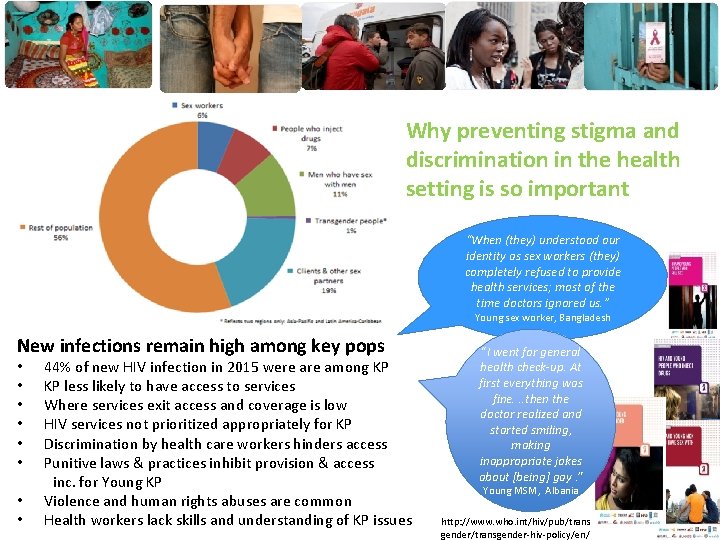
Why preventing stigma and discrimination in the health setting is so important “When (they) understood our identity as sex workers (they) completely refused to provide health services; most of the time doctors ignored us. ” Young sex worker, Bangladesh New infections remain high among key pops • • 44% of new HIV infection in 2015 were among KP KP less likely to have access to services Where services exit access and coverage is low HIV services not prioritized appropriately for KP Discrimination by health care workers hinders access Punitive laws & practices inhibit provision & access inc. for Young KP Violence and human rights abuses are common Health workers lack skills and understanding of KP issues “I went for general health check-up. At first everything was fine. . . then the doctor realized and started smiling, making inappropriate jokes about [being] gay. ” Young MSM, Albania http: //www. who. int/hiv/pub/trans gender/transgender-hiv-policy/en/
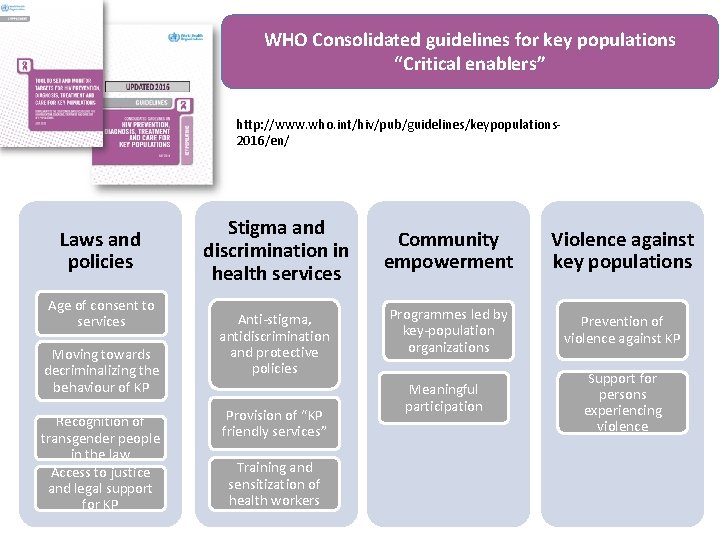
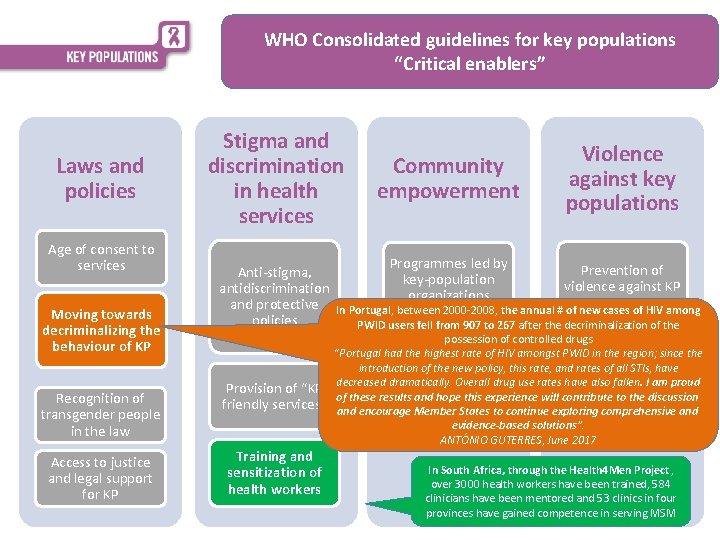
WHO Consolidated guidelines for key populations “Critical enablers” http: //www. who. int/hiv/pub/guidelines/keypopulations 2016/en/ Laws and policies Age of consent to services Moving towards decriminalizing the behaviour of KP Recognition of transgender people in the law Access to justice and legal support for KP Stigma and discrimination in health services Anti-stigma, antidiscrimination and protective policies Provision of “KP friendly services” Training and sensitization of health workers Community empowerment Violence against key populations Programmes led by key-population organizations Prevention of violence against KP Meaningful participation Support for persons experiencing violence
WHO Consolidated guidelines for key populations “Critical enablers” Laws and policies Age of consent to services Moving towards decriminalizing the behaviour of KP Recognition of transgender people in the law Access to justice and legal support for KP Stigma and discrimination in health services Anti-stigma, antidiscrimination and protective policies Provision of “KP friendly services” Training and sensitization of health workers Community empowerment Violence against key populations Programmes led by key-population organizations Prevention of violence against KP In Portugal, between 2000 -2008, the annual # of new cases of HIV among PWID users fell from 907 to 267 after the decriminalization of the possession of controlled drugs Support for “Portugal had the highest rate of HIV amongst PWID in the region; since the Meaningful introduction of the new policy, this rate, and ratespersons of all STIs, have participation experiencing decreased dramatically. Overall drug use rates have also fallen. I am proud violence of these results and hope this experience will contribute to the discussion and encourage Member States to continue exploring comprehensive and evidence-based solutions”. ANTÓNIO GUTERRES, June 2017 In South Africa, through the Health 4 Men Project, over 3000 health workers have been trained, 584 clinicians have been mentored and 53 clinics in four provinces have gained competence in serving MSM
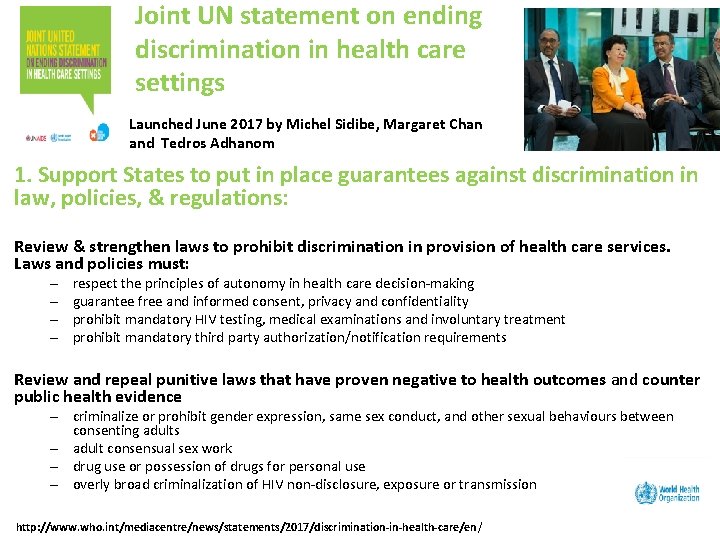
Joint UN statement on ending discrimination in health care settings Launched June 2017 by Michel Sidibe, Margaret Chan and Tedros Adhanom 1. Support States to put in place guarantees against discrimination in law, policies, & regulations: Review & strengthen laws to prohibit discrimination in provision of health care services. Laws and policies must: – – respect the principles of autonomy in health care decision-making guarantee free and informed consent, privacy and confidentiality prohibit mandatory HIV testing, medical examinations and involuntary treatment prohibit mandatory third party authorization/notification requirements Review and repeal punitive laws that have proven negative to health outcomes and counter public health evidence – criminalize or prohibit gender expression, same sex conduct, and other sexual behaviours between consenting adults – adult consensual sex work – drug use or possession of drugs for personal use – overly broad criminalization of HIV non-disclosure, exposure or transmission http: //www. who. int/mediacentre/news/statements/2017/discrimination-in-health-care/en/
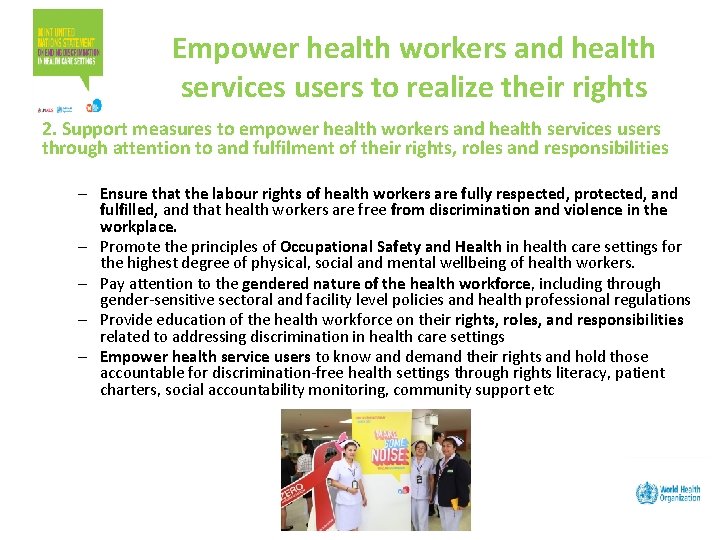
Empower health workers and health services users to realize their rights 2. Support measures to empower health workers and health services users through attention to and fulfilment of their rights, roles and responsibilities – Ensure that the labour rights of health workers are fully respected, protected, and fulfilled, and that health workers are free from discrimination and violence in the workplace. – Promote the principles of Occupational Safety and Health in health care settings for the highest degree of physical, social and mental wellbeing of health workers. – Pay attention to the gendered nature of the health workforce, including through gender-sensitive sectoral and facility level policies and health professional regulations – Provide education of the health workforce on their rights, roles, and responsibilities related to addressing discrimination in health care settings – Empower health service users to know and demand their rights and hold those accountable for discrimination-free health settings through rights literacy, patient charters, social accountability monitoring, community support etc
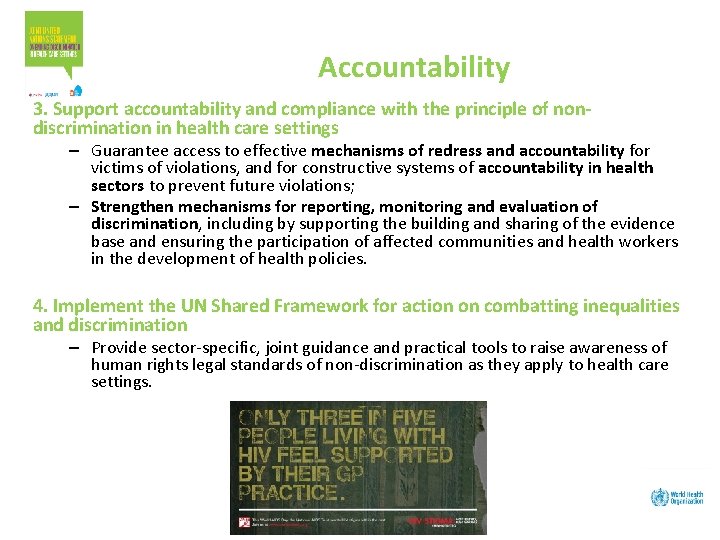
Accountability 3. Support accountability and compliance with the principle of nondiscrimination in health care settings – Guarantee access to effective mechanisms of redress and accountability for victims of violations, and for constructive systems of accountability in health sectors to prevent future violations; – Strengthen mechanisms for reporting, monitoring and evaluation of discrimination, including by supporting the building and sharing of the evidence base and ensuring the participation of affected communities and health workers in the development of health policies. 4. Implement the UN Shared Framework for action on combatting inequalities and discrimination – Provide sector-specific, joint guidance and practical tools to raise awareness of human rights legal standards of non-discrimination as they apply to health care settings.
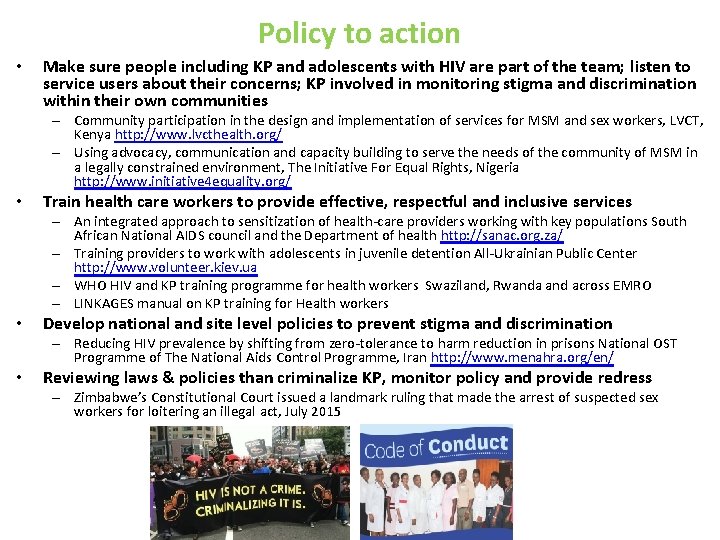
Policy to action • Make sure people including KP and adolescents with HIV are part of the team; listen to service users about their concerns; KP involved in monitoring stigma and discrimination within their own communities – Community participation in the design and implementation of services for MSM and sex workers, LVCT, Kenya http: //www. lvcthealth. org/ – Using advocacy, communication and capacity building to serve the needs of the community of MSM in a legally constrained environment, The Initiative For Equal Rights, Nigeria http: //www. initiative 4 equality. org/ • Train health care workers to provide effective, respectful and inclusive services – An integrated approach to sensitization of health-care providers working with key populations South African National AIDS council and the Department of health http: //sanac. org. za/ – Training providers to work with adolescents in juvenile detention All-Ukrainian Public Center http: //www. volunteer. kiev. ua – WHO HIV and KP training programme for health workers Swaziland, Rwanda and across EMRO – LINKAGES manual on KP training for Health workers • Develop national and site level policies to prevent stigma and discrimination – Reducing HIV prevalence by shifting from zero-tolerance to harm reduction in prisons National OST Programme of The National Aids Control Programme, Iran http: //www. menahra. org/en/ • Reviewing laws & policies than criminalize KP, monitor policy and provide redress – Zimbabwe’s Constitutional Court issued a landmark ruling that made the arrest of suspected sex workers for loitering an illegal act, July 2015
Acknowledgments • • • Gottfried Hirnschall, Director, HIV dept. , WHO Andrew Ball, HIV dept. , WHO Annette Verster, HIV dept. , WHO Virginia Macdonald, HIV dept. , WHO Julie Samuelson, HIV dept. , WHO Veronica Magar, Team lead, Gender, Equity and Human Rights, WHO Rebekah Thomas Bosco, Gender, Equity and Human Rights, WHO Mariângela Simão, Director, Rights, Gender, Prevention and Community Mobilization, UNAIDS Hally Mahler, LINKAGES http: //www. who. int/hiv/pub/popul Jason Reed, Jhpiego ations/key-populations-caseexamples/en/