
DOG PERSONALITY TRAITS AND HUMAN PERSONALITY TRAITS ALEX
- Slides: 12
DOG PERSONALITY TRAITS AND HUMAN PERSONALITY TRAITS ALEX WRIGHT PENNSYLVANIA STATE UNIVERSITY ’ 16 B. S. PSYCHOLOGY AEW 5296@PSU. EDU
PAST RESEARCH: BASIC FINDINGS • Little research has been conducted • Most used Eysenck’s PEN survey to asses personality • Positive correlation: An owner’s personality linked to a dog’s behavior • Neurotic owners – overexcited anxious dogs • Emotionally attached/involved owners – dominant or aggressive dogs • Submissive owners – dominant or aggressive dogs • Owner personality has an effect on attention
DOG BEHAVIOR • Dog behavior shaped based on the dog’s purpose • Interactive and extraverted owners may obtain dog for exercise, showing, or breeding – results in less aggressive behavior; established dominance • Reserved or territorial owner’s often acquire a dog as a guard or means of protection – results in aggressive and dominant behavior (JAGOE & SERPELL,
DOG PERSONALITY AND THE MATCHING HYPOTHESIS • Had students rate themselves and their dogs in terms of personality • Dogs were rated to a similar degree, suggesting their owner’s perceived them to have the same personalities • Supports matching hypothesis • Students with “personality disturbance(s)” more likely to have dog’s with behavioral problems • Neurotic owners had dogs that showed displacement and overexcited behaviors. • Psychological use and coping • Inconsistent reward and punishment (O’FARRELL, 1997)
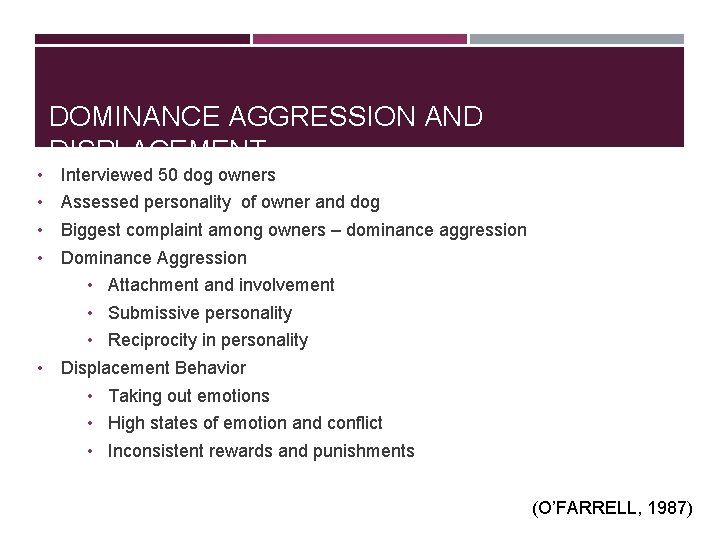
• DOMINANCE AGGRESSION AND DISPLACEMENT Interviewed 50 dog owners • Assessed personality of owner and dog • Biggest complaint among owners – dominance aggression • Dominance Aggression • Attachment and involvement • Submissive personality • Reciprocity in personality • Displacement Behavior • Taking out emotions • High states of emotion and conflict • Inconsistent rewards and punishments (O’FARRELL, 1987)
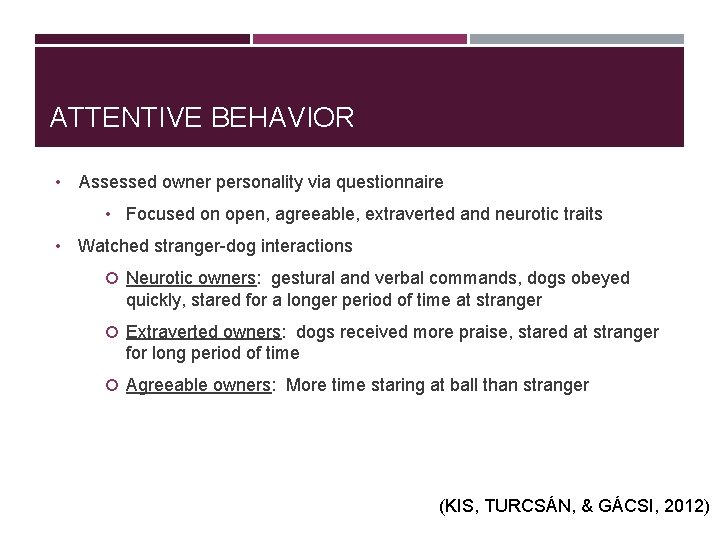
ATTENTIVE BEHAVIOR • Assessed owner personality via questionnaire • Focused on open, agreeable, extraverted and neurotic traits • Watched stranger-dog interactions Neurotic owners: gestural and verbal commands, dogs obeyed quickly, stared for a longer period of time at stranger Extraverted owners: dogs received more praise, stared at stranger for long period of time Agreeable owners: More time staring at ball than stranger (KIS, TURCSÁN, & GÁCSI, 2012)
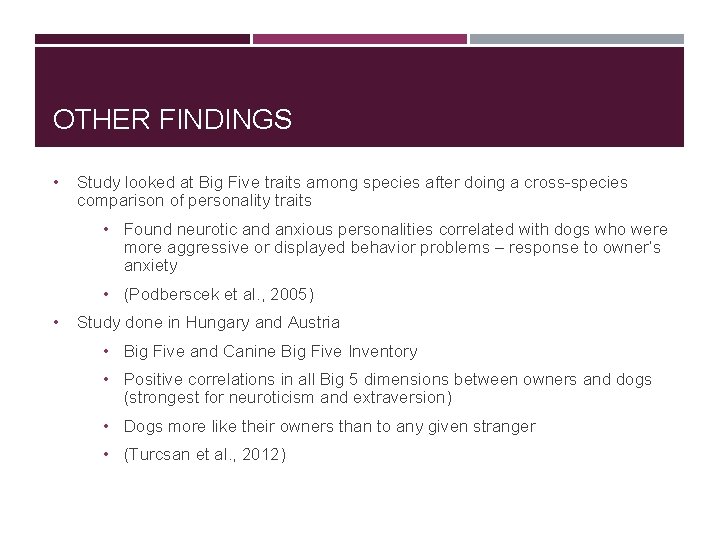
OTHER FINDINGS • Study looked at Big Five traits among species after doing a cross-species comparison of personality traits • Found neurotic and anxious personalities correlated with dogs who were more aggressive or displayed behavior problems – response to owner’s anxiety • (Podberscek et al. , 2005) • Study done in Hungary and Austria • Big Five and Canine Big Five Inventory • Positive correlations in all Big 5 dimensions between owners and dogs (strongest for neuroticism and extraversion) • Dogs more like their owners than to any given stranger • (Turcsan et al. , 2012)
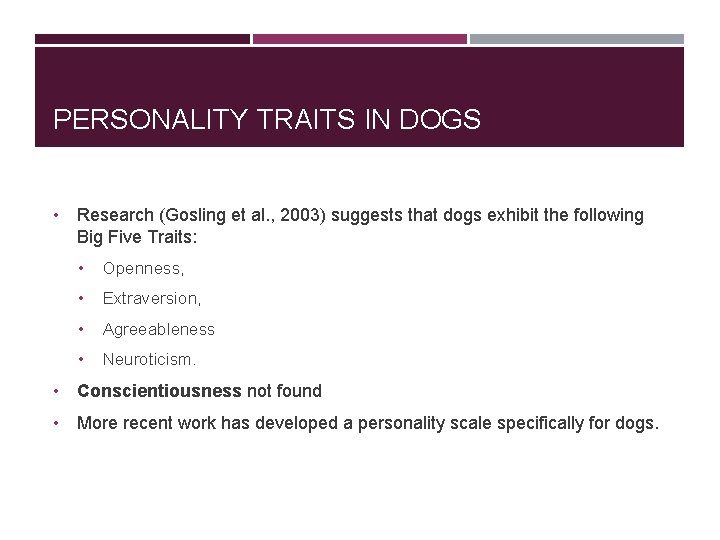
PERSONALITY TRAITS IN DOGS • Research (Gosling et al. , 2003) suggests that dogs exhibit the following Big Five Traits: • Openness, • Extraversion, • Agreeableness • Neuroticism. • Conscientiousness not found • More recent work has developed a personality scale specifically for dogs.
WHICH BIG FIVE FACTORS ARE PRESENT IN THE DPQ? • Aggression • Excitement • Fear • Attentiveness
PERSONALITY TRAITS IN DOGS AND HUMANS • Aggression • Low Agreeableness • Excitement • High Extraversion • Fear • High Neuroticism • Attentiveness • High Conscientiousness • High Openness to Experience
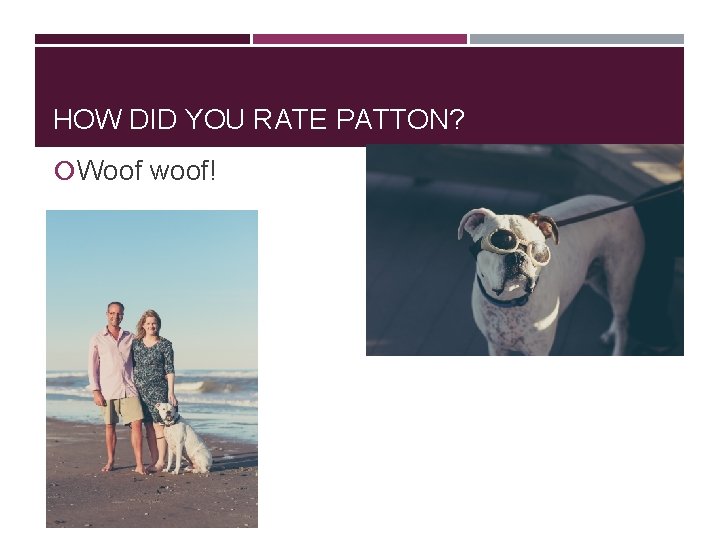
HOW DID YOU RATE PATTON? Woof woof!
LOVE ATTACHMENT STYLES AND PETS • Love Styles: Eros, Ludus, Storge, Pragma, Mania, Agape • Purpose: Apply romantic relationship love styles to the human-dog relationship. • Based on the original love attachment scale, a pet love attachment scale was developed • The pet love attachment scale will assess people’s love style/attitude towards pets • Hypothesis: Positive correlation between people’s human love styles and pet love styles • Ex: Storgic love style with romantic partner, also Storgic love style with pet.