
Does the patient require immediate life saving intervention


- Slides: 27
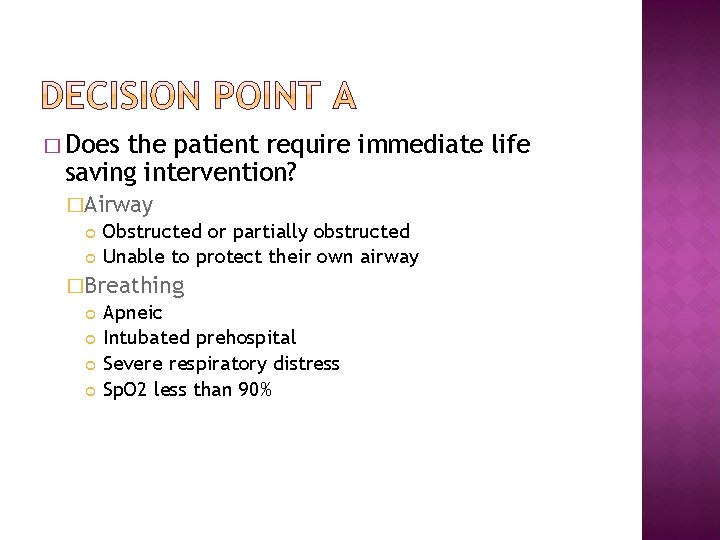
� Does the patient require immediate life saving intervention? �Airway Obstructed or partially obstructed Unable to protect their own airway �Breathing Apneic Intubated prehospital Severe respiratory distress Sp. O 2 less than 90%
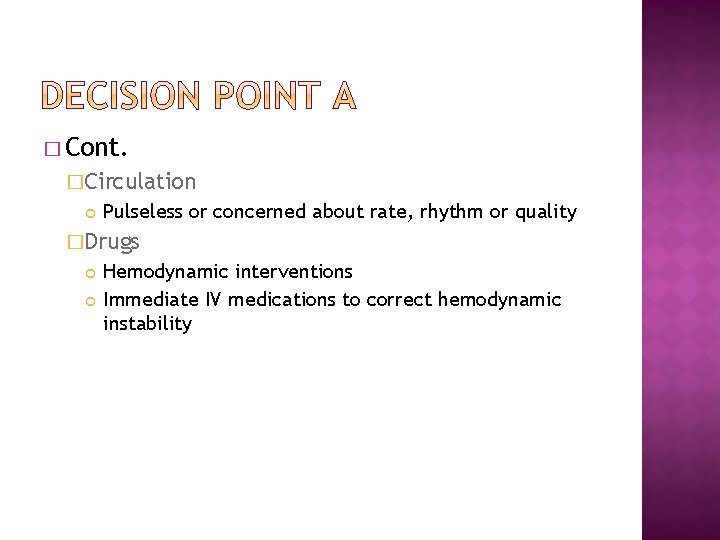
� Cont. �Circulation Pulseless or concerned about rate, rhythm or quality �Drugs Hemodynamic interventions Immediate IV medications to correct hemodynamic instability
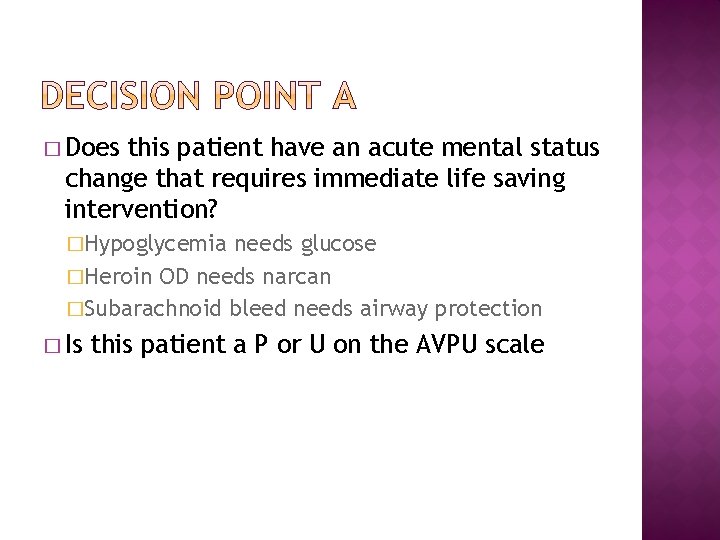
� Does this patient have an acute mental status change that requires immediate life saving intervention? �Hypoglycemia needs glucose �Heroin OD needs narcan �Subarachnoid bleed needs airway protection � Is this patient a P or U on the AVPU scale
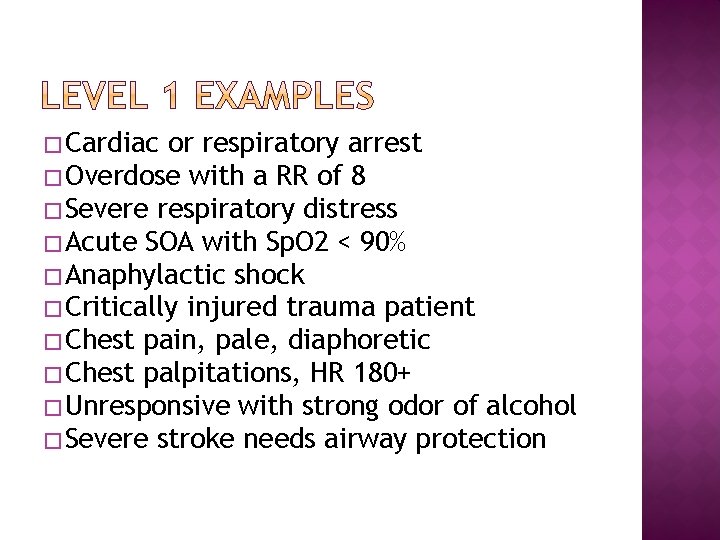
� Cardiac or respiratory arrest � Overdose with a RR of 8 � Severe respiratory distress � Acute SOA with Sp. O 2 < 90% � Anaphylactic shock � Critically injured trauma patient � Chest pain, pale, diaphoretic � Chest palpitations, HR 180+ � Unresponsive with strong odor of alcohol � Severe stroke needs airway protection
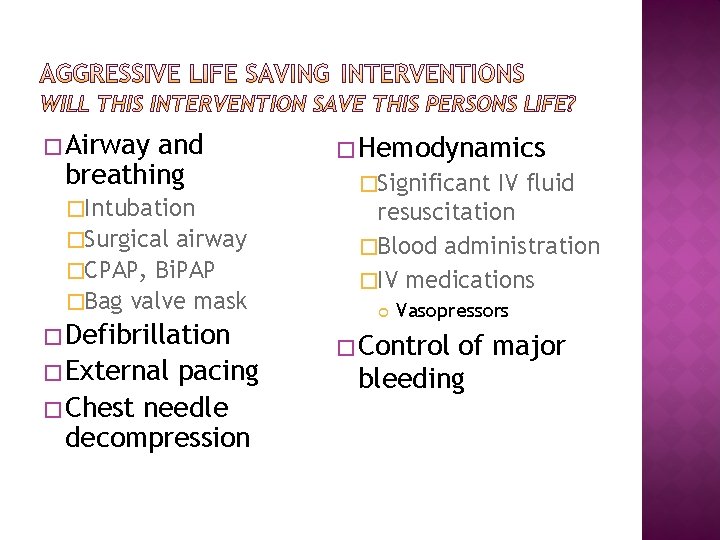
� Airway and breathing �Intubation �Surgical airway �CPAP, Bi. PAP �Bag valve mask � Defibrillation � External pacing � Chest needle decompression � Hemodynamics �Significant IV fluid resuscitation �Blood administration �IV medications Vasopressors � Control of major bleeding
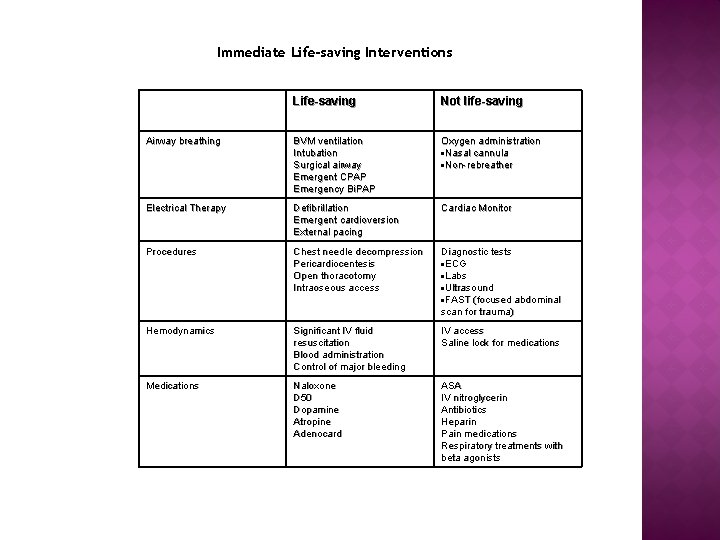
Immediate Life-saving Interventions Life-saving Not life-saving Airway breathing BVM ventilation Intubation Surgical airway Emergent CPAP Emergency Bi. PAP Oxygen administration Nasal cannula Non-rebreather Electrical Therapy Defibrillation Emergent cardioversion External pacing Cardiac Monitor Procedures Chest needle decompression Pericardiocentesis Open thoracotomy Intraoseous access Diagnostic tests ECG Labs Ultrasound FAST (focused abdominal scan for trauma) Hemodynamics Significant IV fluid resuscitation Blood administration Control of major bleeding IV access Saline lock for medications Medications Naloxone D 50 Dopamine Atropine Adenocard ASA IV nitroglycerin Antibiotics Heparin Pain medications Respiratory treatments with beta agonists
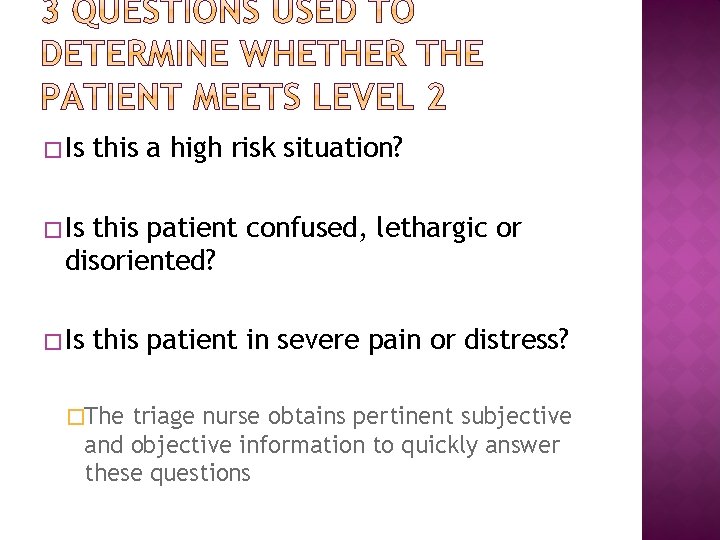
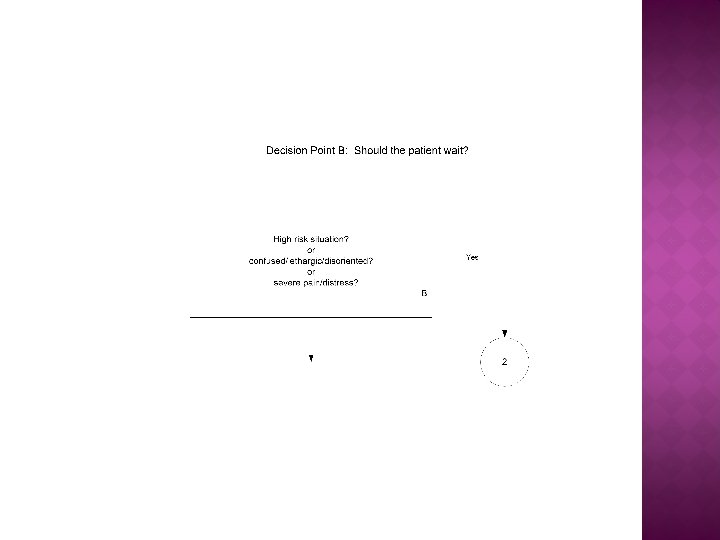
� Is this a high risk situation? � Is this patient confused, lethargic or disoriented? � Is this patient in severe pain or distress? �The triage nurse obtains pertinent subjective and objective information to quickly answer these questions
� Determination is based on a brief patient interview, gross observations, “sixth sense” � Do not require a full set of vital signs � Unsafe for the patient to wait �Suggestive of a condition that could easily deteriorate �Symptoms of a condition that’s treatment is time sensitive �Potential for major life or organ threat
� Episodes of chest pain, denies other symptoms, known cardiac history � R/O PE � Newborn with a fever � Rule out ectopic pregnancy � Neutropenia with a fever � Suicidal/homicidal
� Is there an acute change in level of consciousness? � Is this situation where the brain is structurally or chemically compromised?
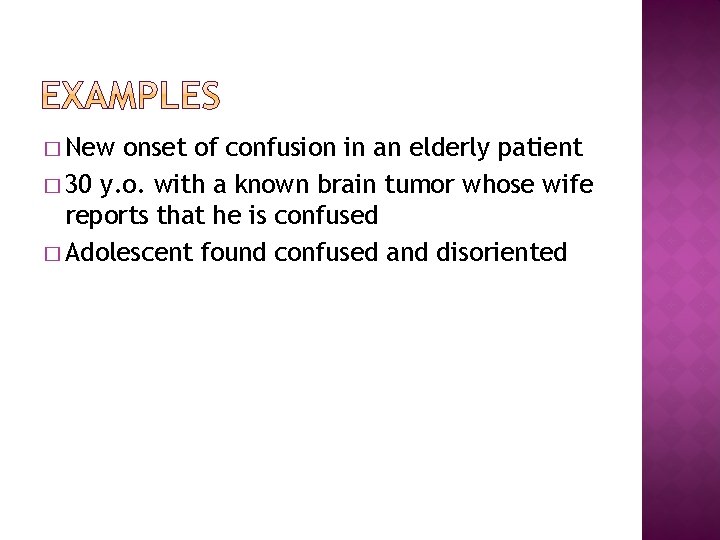
� New onset of confusion in an elderly patient � 30 y. o. with a known brain tumor whose wife reports that he is confused � Adolescent found confused and disoriented
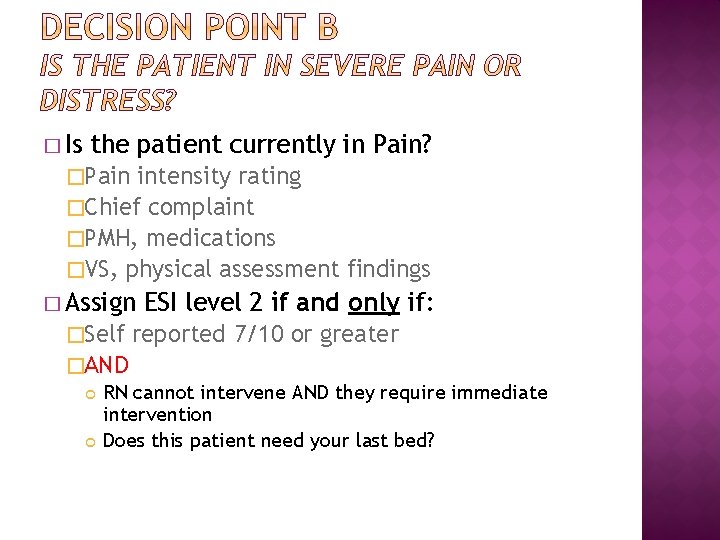
� Is the patient currently in Pain? �Pain intensity rating �Chief complaint �PMH, medications �VS, physical assessment findings � Assign �Self ESI level 2 if and only if: reported 7/10 or greater �AND RN cannot intervene AND they require immediate intervention Does this patient need your last bed?
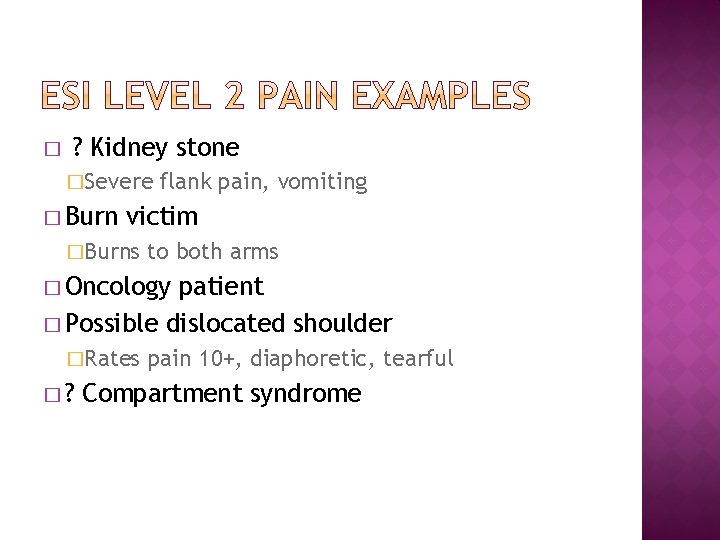
� ? Kidney stone �Severe � Burn flank pain, vomiting victim �Burns to both arms � Oncology patient � Possible dislocated shoulder �Rates �? pain 10+, diaphoretic, tearful Compartment syndrome
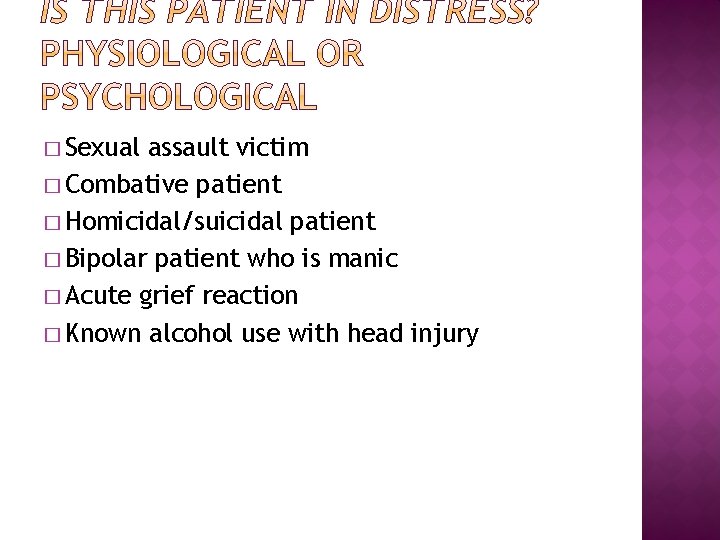
� Sexual assault victim � Combative patient � Homicidal/suicidal patient � Bipolar patient who is manic � Acute grief reaction � Known alcohol use with head injury
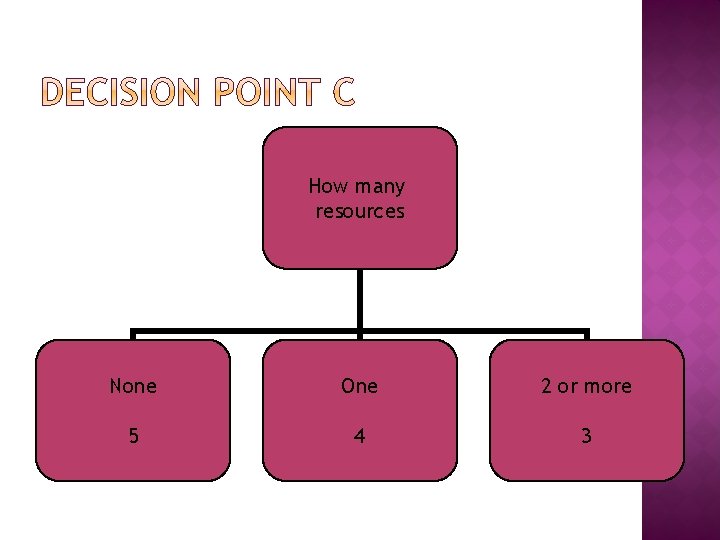
How many resources None One 2 or more 5 4 3
� Determined by the experienced ED RN at triage � Based on the standard of care � Independent of type of hospital, location, physician on duty, acuity of the department
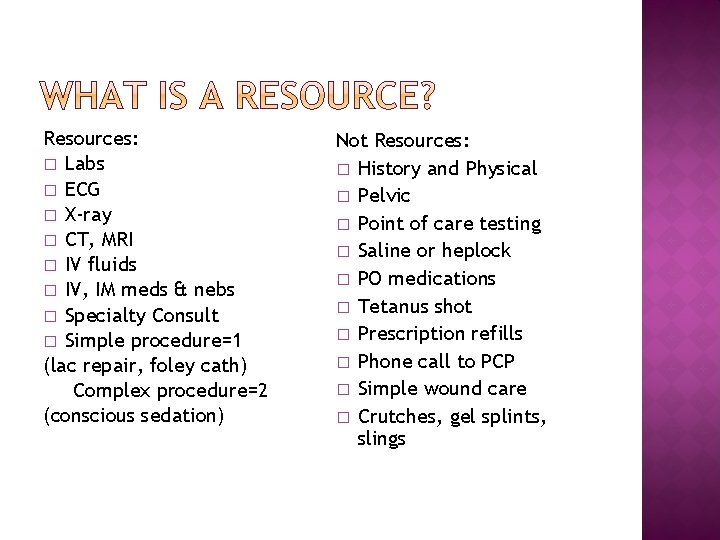
Resources: � Labs � ECG � X-ray � CT, MRI � IV fluids � IV, IM meds & nebs � Specialty Consult � Simple procedure=1 (lac repair, foley cath) Complex procedure=2 (conscious sedation) Not Resources: � History and Physical � Pelvic � Point of care testing � Saline or heplock � PO medications � Tetanus shot � Prescription refills � Phone call to PCP � Simple wound care � Crutches, gel splints, slings
� No Resources � Examples -Healthy 10 y. o. with “poison ivy” -Healthy 52 y. o. Who ran out of his BP med recently -22 y. o. involved in an MVC 2 days ago, just wants to get checked -46 y. o. with a cold
� Stable, can safely wait for hours to be seen � Care by mid-level providers in a fast track or urgent care setting � Requires a physical exam and one resource
� Examples: -Healthy 19 y. o. fever -Healthy 29 y. o. abdominal pain -Healthy 43 y. o. -Healthy 12 y. o. laceration with a sore throat and with a UTI, denies with a stubbed toe with a minor thumb
� 30 -40% of patients seen in the ED � Need 2 or more resources � Require in-depth evaluation � Long length of stay � Before assigning a patient to ESI level 3 the nurse must consider the patients vital signs
� ESI level 3 �Fractured ankle �Abdominal pain �Most migraines � ESI level 4 �Sprained ankle �Abscess � ESI level 5 �Toothache