
Does Structured Audit and Feedback Improve Accuracy of
Does Structured Audit and Feedback Improve Accuracy of Residents’ CPT E&M Coding Kelly Skelly, MD George Bergus, MD, MA Department of Family Medicine Carver College of Medicine, The University of Iowa City, IA, USA DEPARTMENT of FAMILY MEDICINE
Background… Family physicians often make mistakes when applying E&M codes *observation study of 138 family doctors, about half of the codes agreed with assigned codes *random group of family doctors reviewed 6 hypothetical notes, the doctors only agreed with coders about ½ the time DEPARTMENT of FAMILY MEDICINE
RRC requirement: Programs must provide training for residents in documentation and coding § No stipulation on how to do this § No previous study looking at impact of educational intervention on coding by residents DEPARTMENT of FAMILY MEDICINE

Changes in outcome can happen Interesting findings from our study DEPARTMENT of FAMILY MEDICINE
Methods § 6 year intervention § Annual didactic interactive coding conference § Random residents notes were recoded by faculty with § § coding expertise using standardized tool Recoded clinical notes returned to residents Accuracy of resident coding over time was assessed DEPARTMENT of FAMILY MEDICINE

Methods § Coding Error Scores § (resident coding) – (faculty coding) § Cross-sectional: coding error score dependent variable § One-way ANOVA § Resident training year independent variable § Longitudinal: coding error score dependent variable § Repeated measures ANOVA § Resident training year independent variable § Limited to residents with all 3 years participation DEPARTMENT of FAMILY MEDICINE
Methods § Control Group: Coding prior to first didactic session § Intervention vs. Control Group: One-way ANOVA § Coding error score as dependent variable § Resident training year and pre-post intervention § status as independent variables. p-value < 0. 05 was statistically significant DEPARTMENT of FAMILY MEDICINE
Now, the interesting part… Results § 429 return visit notes coded by 68 different residents § PGY 1: 150 clinical notes § PGY 2: 137 clinical notes § PGY 3: 132 clinical notes § Control notes and intervention notes had similar § distribution over the 3 years residency Mean 6. 3 clinical notes (range 1 -18) per resident § Median 4. 5 notes DEPARTMENT of FAMILY MEDICINE
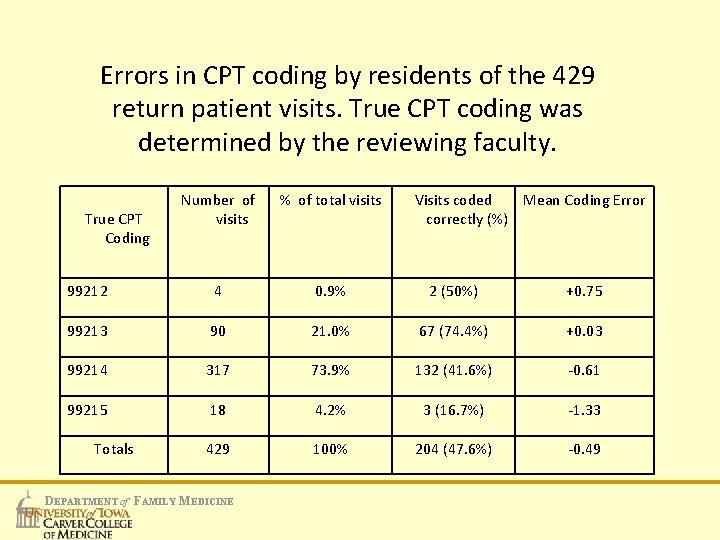
Errors in CPT coding by residents of the 429 return patient visits. True CPT coding was determined by the reviewing faculty. Number of visits % of total visits 99212 4 0. 9% 2 (50%) +0. 75 99213 90 21. 0% 67 (74. 4%) +0. 03 99214 317 73. 9% 132 (41. 6%) -0. 61 99215 18 4. 2% 3 (16. 7%) -1. 33 429 100% 204 (47. 6%) -0. 49 True CPT Coding Totals DEPARTMENT of FAMILY MEDICINE Visits coded Mean Coding Error correctly (%)
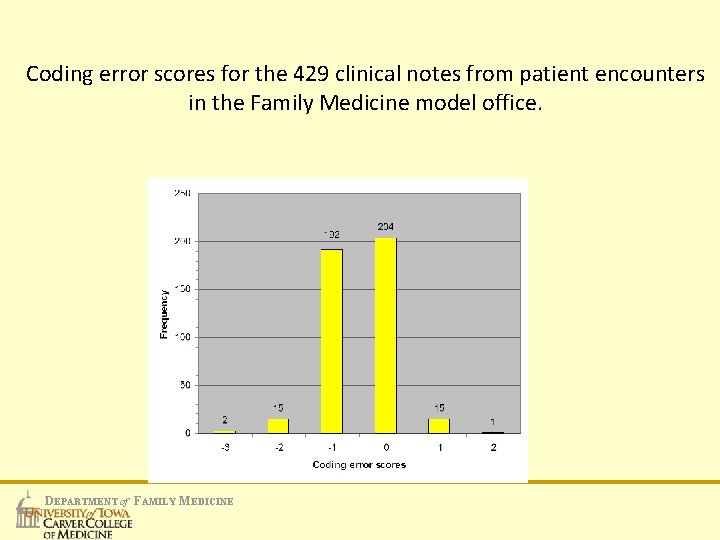
Coding error scores for the 429 clinical notes from patient encounters in the Family Medicine model office. DEPARTMENT of FAMILY MEDICINE
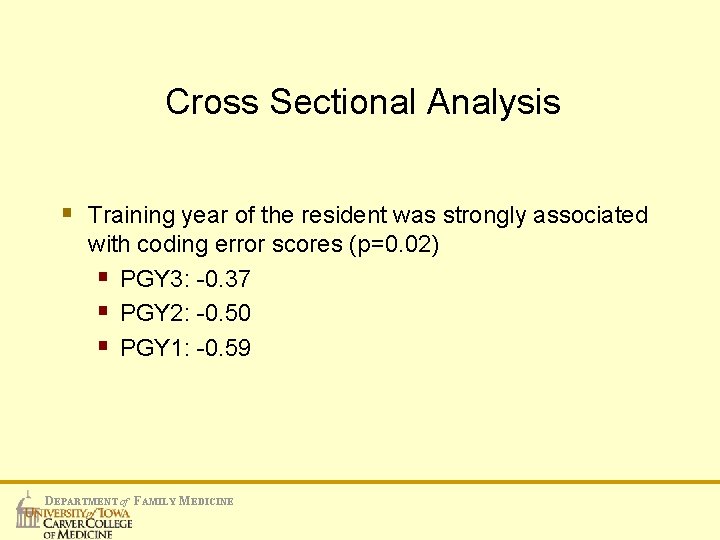
Cross Sectional Analysis § Training year of the resident was strongly associated with coding error scores (p=0. 02) § PGY 3: -0. 37 § PGY 2: -0. 50 § PGY 1: -0. 59 DEPARTMENT of FAMILY MEDICINE
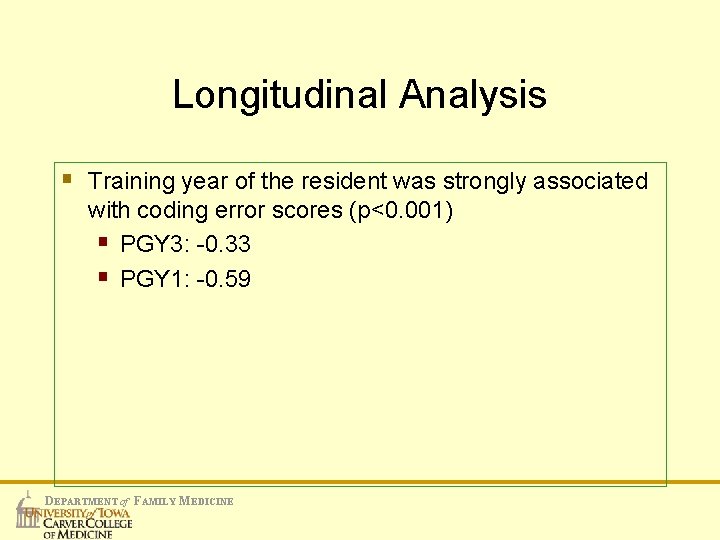
Longitudinal Analysis § Training year of the resident was strongly associated with coding error scores (p<0. 001) § PGY 3: -0. 33 § PGY 1: -0. 59 DEPARTMENT of FAMILY MEDICINE
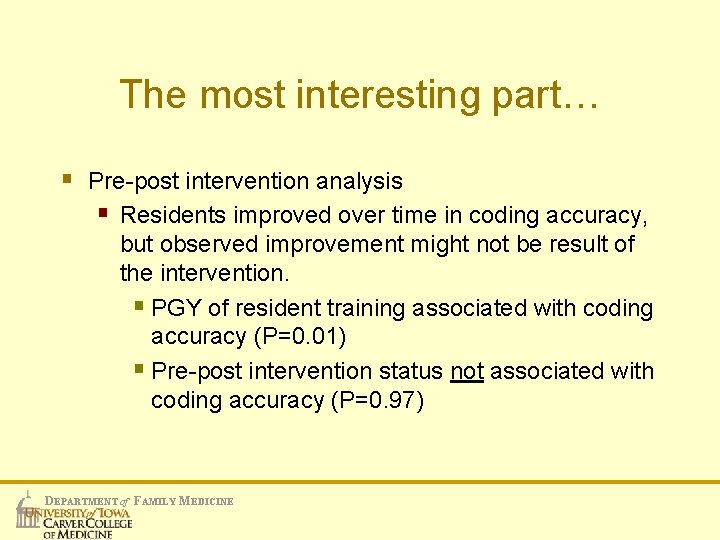
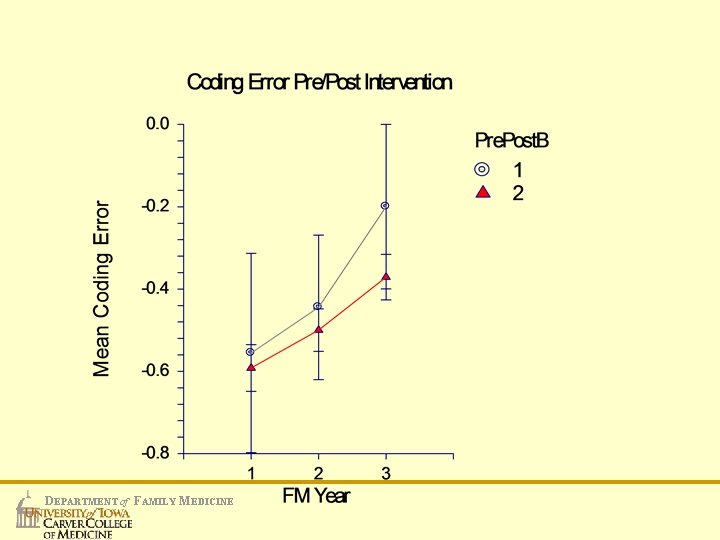
The most interesting part… § Pre-post intervention analysis § Residents improved over time in coding accuracy, but observed improvement might not be result of the intervention. § PGY of resident training associated with coding accuracy (P=0. 01) § Pre-post intervention status not associated with coding accuracy (P=0. 97) DEPARTMENT of FAMILY MEDICINE
DEPARTMENT of FAMILY MEDICINE
Summary and discussion § Residents routinely undercode patient visits in family § § medicine clinic Audit and feedback interventions (as we used) are used widely, and research suggests they can improve professional practice, but are not always effective Coding improves as residents advance in training DEPARTMENT of FAMILY MEDICINE
However Our intervention may not be responsible for the improvement in coding accuracy. DEPARTMENT of FAMILY MEDICINE
Residents still DO need structured instruction on coding § While we didn’t demonstrate positive impact of our intervention, others have had success § Resident performance was shorter period of time § Interventions generally more intense DEPARTMENT of FAMILY MEDICINE
Most resident errors § Although residents accurately coded majority of 99213 visits, most undercoded complex visits were undercoded by residents as 99213 § Consider focus reviews on visits residents code as 99213 DEPARTMENT of FAMILY MEDICINE
Limitations § Only one residency program § Pre-intervention codings is small- only 5%- larger control group would increase confidence DEPARTMENT of FAMILY MEDICINE
Other suggestions § Implementing clinician-coder double reading § § improves accuracy and increases revenue (cost associated, but increased revenue captured) Different coding tools Note templates can improve CPT coding DEPARTMENT of FAMILY MEDICINE
Conclusions § Residents improved in CPT E&M coding as they § § § progressed in residency This occurred concurrently with our educational intervention (workshops, formative feedback) Improved coding accuracy might not be the result of our intervention Development of effective educational interventions should be pursued using rigorous research methodologies DEPARTMENT of FAMILY MEDICINE
§ § § references Kikano GE, Goodwin MA, Stange KC. Evaluation and management services. A comparison of medical record documentation with actual billing in a community family practice. Arch Fam Med 2000; 9: 68 -71. King MS, Sharp L, Lipsky MS. Accuracy of CPT evaluation and management coding by family physicians. J Am Board Fam Pract. 2001; 14(3): 184 -92. As-Sanie S, Zolnoun D, Wechter ME, Lamvu G, Tu F, Steege J. Teaching residents coding and documentation: Effectiveness of a problem-oriented approach. Am J Ob &Gyn 2005; 193: 1790 -3. Carter KA, Dawson BC, Brewer K, Lawson L. RVU Ready? Preparing Emergency Medicine Resident Physicians in Documentation for an Incentive-based Work Environment. Acad Emerg Med 2009; 16: 423 -428. Jones K, Lebron RA, Mangram A. Practice management education during surgical residency. Am J Surgery 2008; 196: 878 -882. Nouraei SA, O’Hanlon S. Butler CR, Hadovsky A, Donald E, Benjamin E, Sandhu GS. A multidisciplinary audit of clinical coding accuracy in otolaryngology: financial, managerial and clinical governance considerations under payment-by-results. Clin Otolaryng. 2009; 34: 43 -51. Sosa RE, Cascardo D. Between a rock and a hard place with E/M coding: dilemmas of compliance and practice financial viability. J Med Pract Manage. 2000; 16(1): 22 -26. Staiger TO, Chew LD, Helenius I. A case-based approach to outpatient evaluation and management service coding. Postgrad Med. 2008; 120(4): 101 -106. Sprtel SJ, Zlabek JA. Does the use of standardized history and physical forms improve billable income and resident physician awareness of billing codes? South Med J. 2005 May; 98(5): 524 -527. Grogan EL, Speroff T, Deppen SA, Roumie CL, Elasy TA, Dittus RS, Rosenbloom ST, Holzman MD. Improving documentation of patient acuity level using a progress note template. J Am Coll Surg. 2004 Sep; 199(3): 468 -75. Mulvehill S, Schneider G, Cullen CM, Roaten S, Foster B, Porter A. Template-guided versus undirected written medical documentation: a prospective, randomized trial in a family medicine residency clinic. J Am Board Fam Pract. 2005 Nov-Dec; 18(6): 464 -67. Silfen E. Documentation and coding of ED patient encounters: an evaluation of the accuracy of an electronic medical record. Am J Emerg Med. 2006; 24(6): 664 -78. DEPARTMENT of FAMILY MEDICINE
- Slides: 22