
Does risk aversion give us a good reason


- Slides: 22
Does risk aversion give us a good reason to diversify our charitable portfolio? James Snowden
Structure • Risk aversion in economics • Maximising expected utility means donating to only one charity • Do we have to maximise expected utility? – With self-interested preferences – With altruistic preferences • Conclude that, in the central case, there is no good reason for a pure altruist to donate to multiple charities
RISK AVERSION IN ECONOMICS
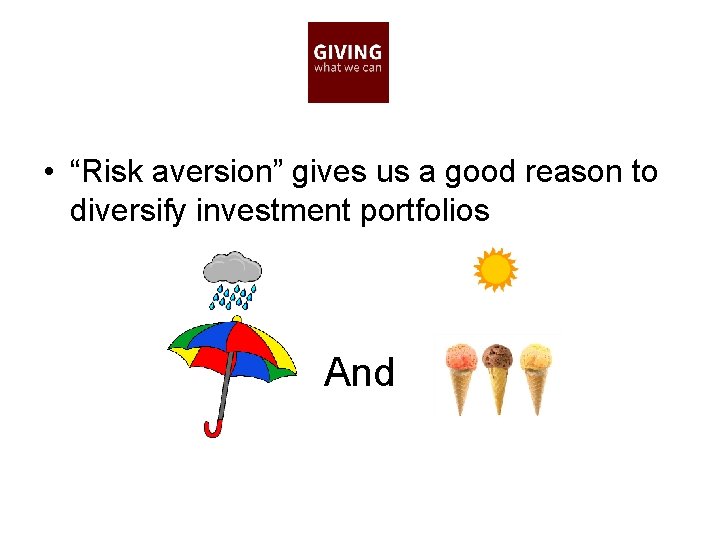
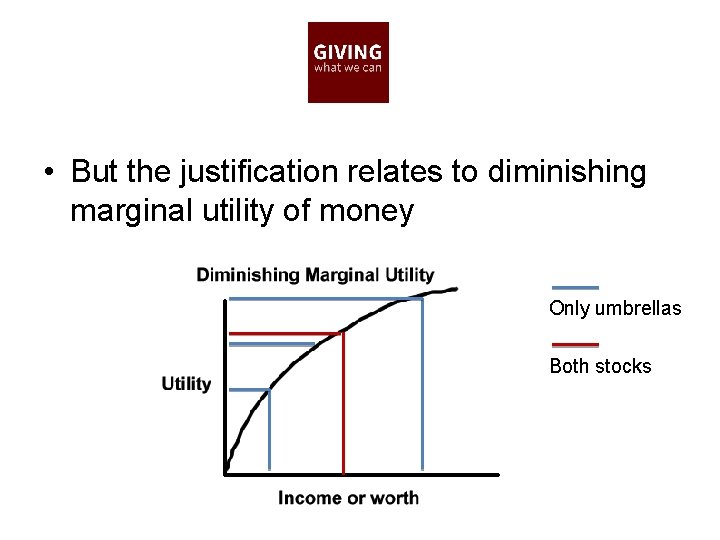
• “Risk aversion” gives us a good reason to diversify investment portfolios And
• But the justification relates to diminishing marginal utility of money Only umbrellas Both stocks
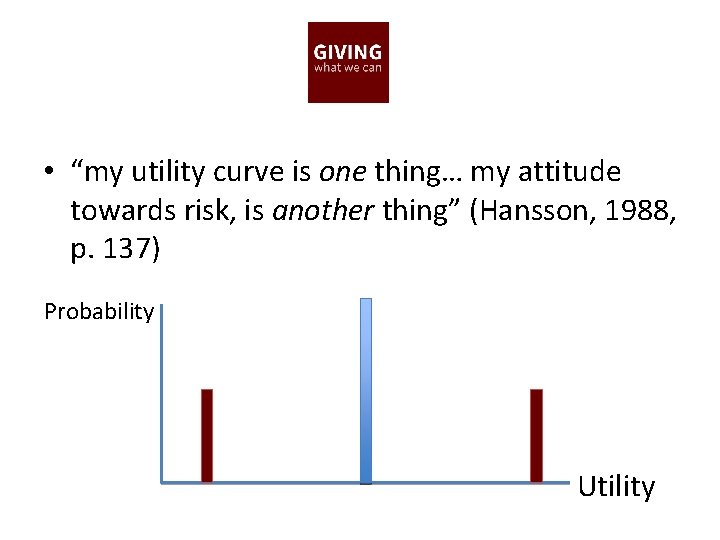
• “my utility curve is one thing… my attitude towards risk, is another thing” (Hansson, 1988, p. 137) Probability Utility
MALARIA CHARITY VS. ANIMAL CHARITY
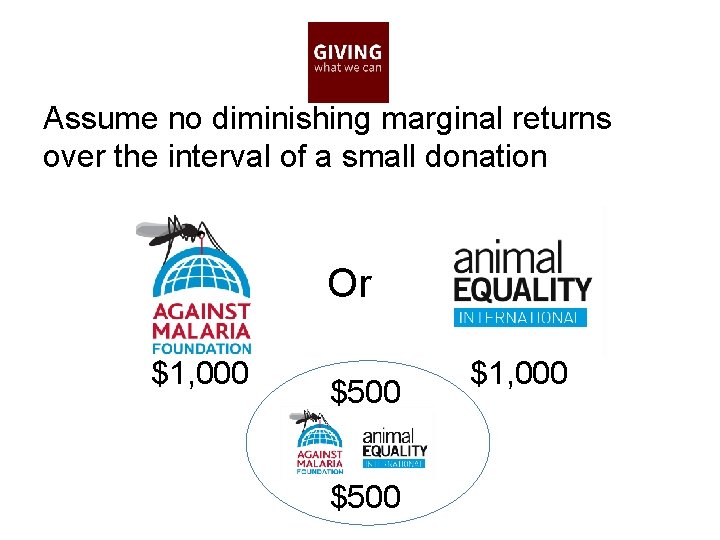
Assume no diminishing marginal returns over the interval of a small donation Or $1, 000 $500 $1, 000
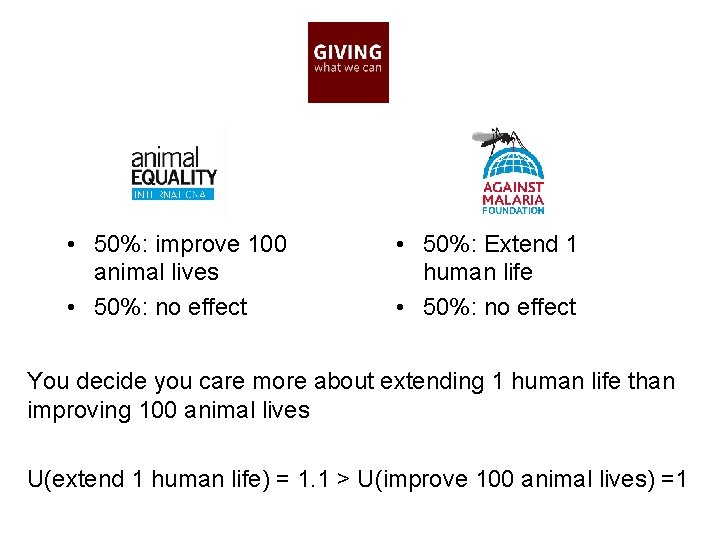
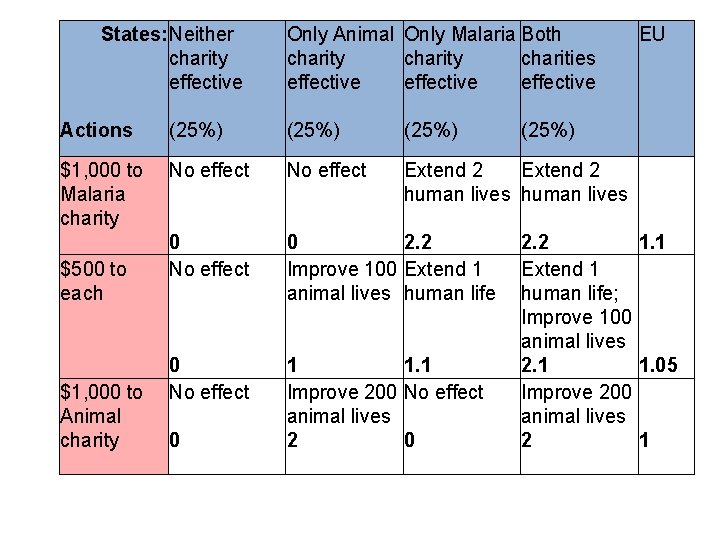
• 50%: improve 100 animal lives • 50%: no effect • 50%: Extend 1 human life • 50%: no effect You decide you care more about extending 1 human life than improving 100 animal lives U(extend 1 human life) = 1. 1 > U(improve 100 animal lives) =1
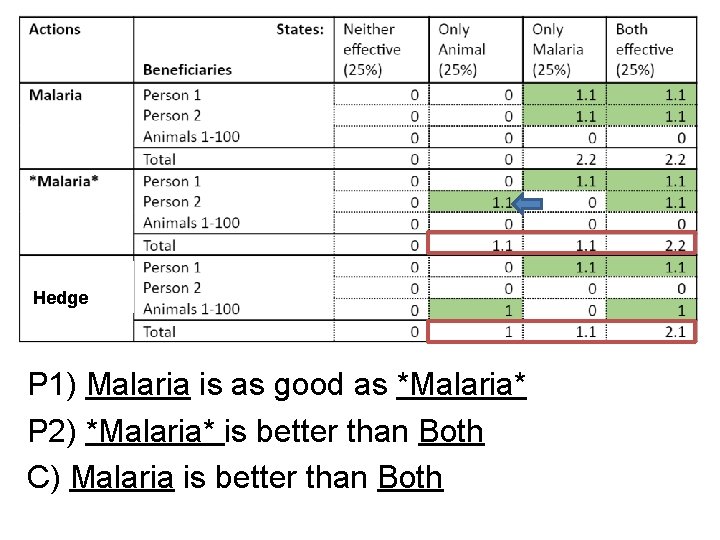
States: Neither charity effective Only Animal Only Malaria Both charity charities effective Actions (25%) $1, 000 to Malaria charity No effect Extend 2 human lives 0 No effect 0 2. 2 Improve 100 Extend 1 animal lives human life 0 No effect 1 1. 1 Improve 200 No effect animal lives 2 0 $500 to each $1, 000 to Animal charity 0 EU (25%) 2. 2 1. 1 Extend 1 human life; Improve 100 animal lives 2. 1 1. 05 Improve 200 animal lives 2 1
DO WE HAVE TO MAXIMISE EXPECTED UTILITY?
So do we have to maximise expected utility? • Economists normally say yes! – Vn. M axioms prescribe maximising expected utility in cases of risk – Savage axioms prescribe maximising expected utility in cases of uncertainty
So do we have to maximise expected utility? • But most people are risk averse over utilities and this may be permissible – Savage / Vn. M axioms have been challenged by Buchak (2013) and Mc. Clennen (1983) – Allais paradox clearly shows that most people are in fact risk averse over utilities
So do we have to maximise expected utility? • New decision theories have been proposed which allow some non-linear weighting of probabilities, accounting for risk aversion – Prospect theory (Kahneman & Tversky, 1979) – Rank-dependent expected utility theory (Quiggin, 1993) – Risk-weighted expected utility theory (Buchak, 2013)
So do we have to maximise expected utility? • There may be more than one way of aggregating states so as to achieve the means to ones ends. • Attitude to risk is just another subjective preference. There is no right answer
So do we have to maximise expected utility? • Even if this is true for self-interested preferences, it is not true for altruistic preferences
THINGS ARE DIFFERENT WITH ALTRUISTIC PREFERENCES
Hedge P 1) Malaria is as good as *Malaria* P 2) *Malaria* is better than Both C) Malaria is better than Both
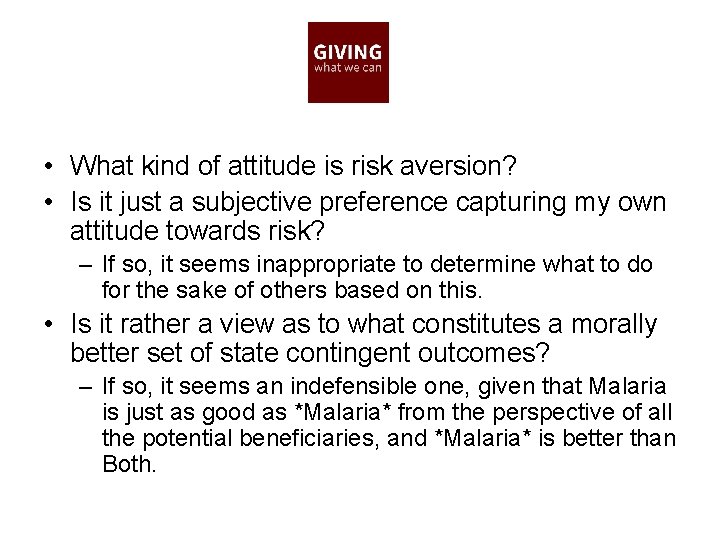
• What kind of attitude is risk aversion? • Is it just a subjective preference capturing my own attitude towards risk? – If so, it seems inappropriate to determine what to do for the sake of others based on this. • Is it rather a view as to what constitutes a morally better set of state contingent outcomes? – If so, it seems an indefensible one, given that Malaria is just as good as *Malaria* from the perspective of all the potential beneficiaries, and *Malaria* is better than Both.
Recap • Maximising expected utility gives us a reason to donate to only one charity • Maximising expected utility might not be required with self-interested preferences • But there is more reason that it might hold for altruistic preferences
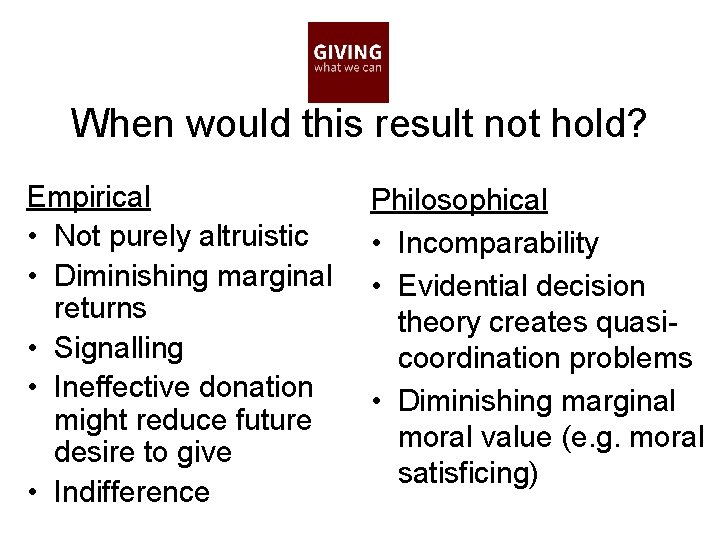
When would this result not hold? Empirical • Not purely altruistic • Diminishing marginal returns • Signalling • Ineffective donation might reduce future desire to give • Indifference Philosophical • Incomparability • Evidential decision theory creates quasicoordination problems • Diminishing marginal moral value (e. g. moral satisficing)
QUESTIONS