
Does Maternal Age Impact Nuchal Translucency Utilization since
- Slides: 1
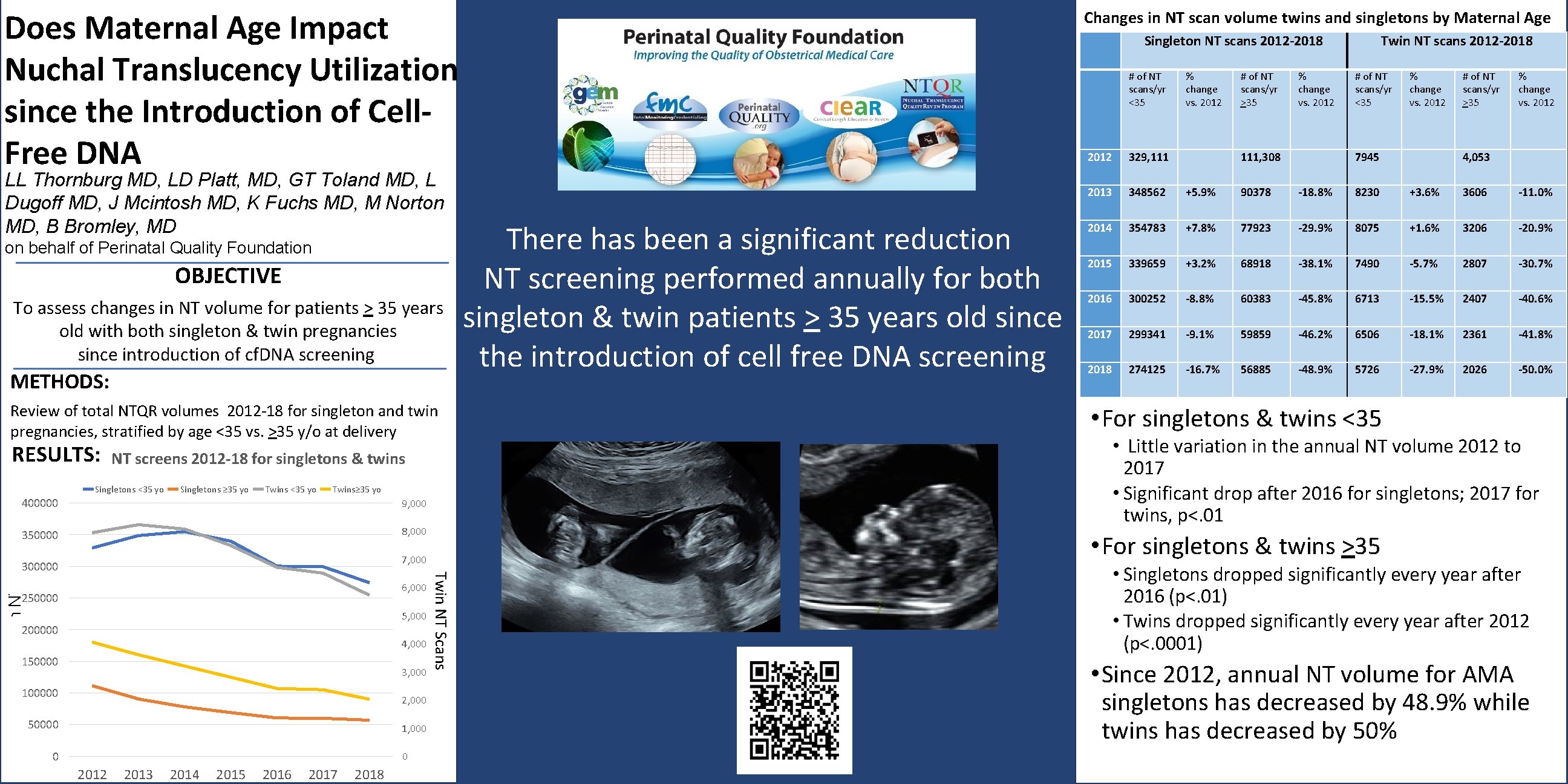
Does Maternal Age Impact Nuchal Translucency Utilization since the Introduction of Cell. Free DNA LL Thornburg MD, LD Platt, MD, GT Toland MD, L Dugoff MD, J Mcintosh MD, K Fuchs MD, M Norton MD, B Bromley, MD on behalf of Perinatal Quality Foundation OBJECTIVE To assess changes in NT volume for patients > 35 years old with both singleton & twin pregnancies since introduction of cf. DNA screening METHODS: Review of total NTQR volumes 2012 -18 for singleton and twin pregnancies, stratified by age <35 vs. >35 y/o at delivery RESULTS: NT screens 2012 -18 for singletons & twins Singletons <35 yo Singletons ≥ 35 yo Twins <35 yo Twins≥ 35 yo 9, 000 350000 8, 000 Singleton NT Scans 400000 250000 5, 000 200000 4, 000 150000 3, 000 100000 2, 000 50000 1, 000 0 0 2012 2013 2014 2015 2016 2017 2018 Twin NT Scans 6, 000 Singleton NT scans 2012 -2018 # of NT scans/yr <35 There has been a significant reduction NT screening performed annually for both singleton & twin patients > 35 years old since the introduction of cell free DNA screening % change vs. 2012 # of NT scans/yr >35 % change vs. 2012 111, 308 Twin NT scans 2012 -2018 # of NT scans/yr <35 % change vs. 2012 7945 # of NT scans/yr >35 % change vs. 2012 329, 111 4, 053 2013 348562 +5. 9% 90378 -18. 8% 8230 +3. 6% 3606 -11. 0% 2014 354783 +7. 8% 77923 -29. 9% 8075 +1. 6% 3206 -20. 9% 2015 339659 +3. 2% 68918 -38. 1% 7490 -5. 7% 2807 -30. 7% 2016 300252 -8. 8% 60383 -45. 8% 6713 -15. 5% 2407 -40. 6% 2017 299341 -9. 1% 59859 -46. 2% 6506 -18. 1% 2361 -41. 8% 2018 274125 -16. 7% 56885 -48. 9% 5726 -27. 9% 2026 -50. 0% • For singletons & twins <35 • Little variation in the annual NT volume 2012 to 2017 • Significant drop after 2016 for singletons; 2017 for twins, p<. 01 • For singletons & twins >35 7, 000 300000 Changes in NT scan volume twins and singletons by Maternal Age • Singletons dropped significantly every year after 2016 (p<. 01) • Twins dropped significantly every year after 2012 (p<. 0001) • Since 2012, annual NT volume for AMA singletons has decreased by 48. 9% while twins has decreased by 50%