
DOES LOGGING INDUSTRY ENHANCE ECONOMIC BENEFITS TO LOCAL
DOES LOGGING INDUSTRY ENHANCE ECONOMIC BENEFITS TO LOCAL COMMUNITIES IN SOLOMON ISLANDS? Authors: Lucia Škvareninová, M. S. S. doc. Ing. Petr Kupec, Ph. D.
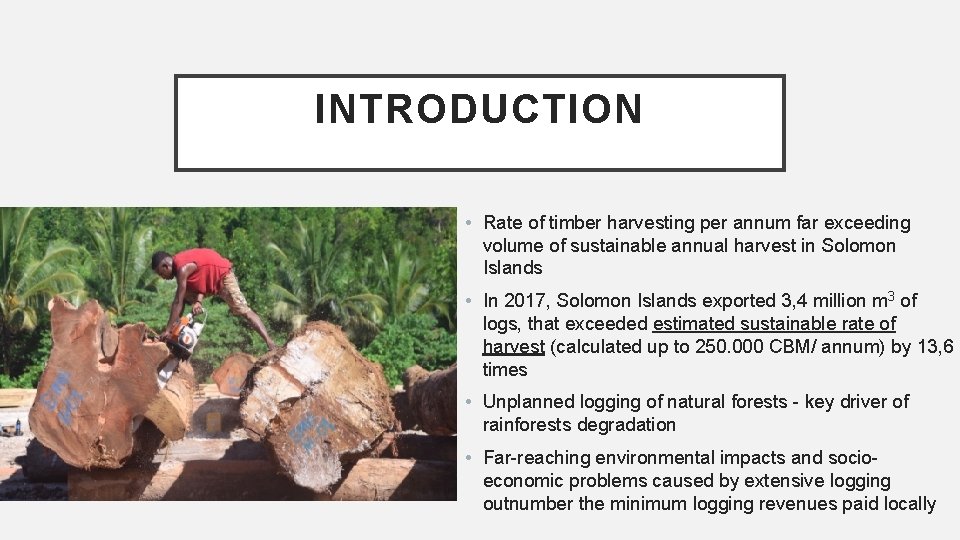
INTRODUCTION • Rate of timber harvesting per annum far exceeding volume of sustainable annual harvest in Solomon Islands • In 2017, Solomon Islands exported 3, 4 million m 3 of logs, that exceeded estimated sustainable rate of harvest (calculated up to 250. 000 CBM/ annum) by 13, 6 times • Unplanned logging of natural forests - key driver of rainforests degradation • Far-reaching environmental impacts and socioeconomic problems caused by extensive logging outnumber the minimum logging revenues paid locally
PROBLEMS RELATED TO CUSTOMARY LAND • In SI 87% of the land is under customary ownership, means indigenous people and local tribes practice the rights over the land, beyond control of government • Such land is not defined by any legal boundaries • Lack of sustainable resource management , therefore logging companies take advantage of communities’ inability to control resources • As a result, timber harvesting is often practiced beyond the scope of the contract = LAND DISPUTES, ILLEGAL LOGGING • Intense social impacts: (1) unstable social order (caused by alcoholism, drug addiction, domestic violence, sexual abuse) • (2) lack of job opportunities/ limited access to job and gender inequality • (3) corruption cases

MATERIALS AND METHODS • Study based on assessment of five economic indicators that define economic impact of logging industry in SI (and evaluate to what extent has logging industry brought economic benefits and how it improved living standards in the local communities): • (1) Economic growth • (2) Export volumes • (3) Job opportunities • (4) Royalties, license fees and payments • (5) Living standards, access to essential services • Additional (6) Potential risks in the logging industry • 80% out of total SI population live in rural areas- local communities heavily depend on natural resources, unlike the people from the capital city – Honiara
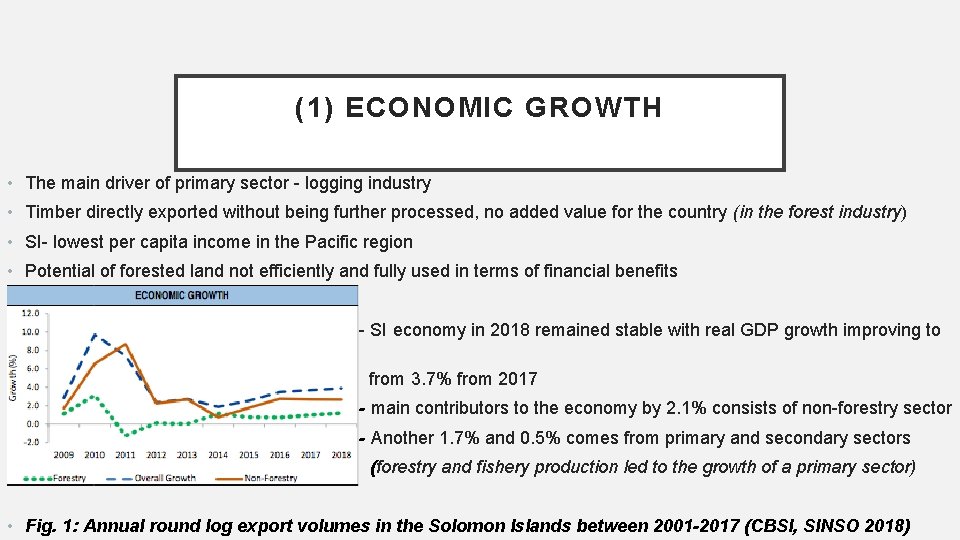
(1) ECONOMIC GROWTH • The main driver of primary sector - logging industry • Timber directly exported without being further processed, no added value for the country (in the forest industry) • SI- lowest per capita income in the Pacific region • Potential of forested land not efficiently and fully used in terms of financial benefits • • 3. 9% - SI economy in 2018 remained stable with real GDP growth improving to from 3. 7% from 2017 • - main contributors to the economy by 2. 1% consists of non-forestry sector • - Another 1. 7% and 0. 5% comes from primary and secondary sectors • (forestry and fishery production led to the growth of a primary sector) • Fig. 1: Annual round log export volumes in the Solomon Islands between 2001 -2017 (CBSI, SINSO 2018)
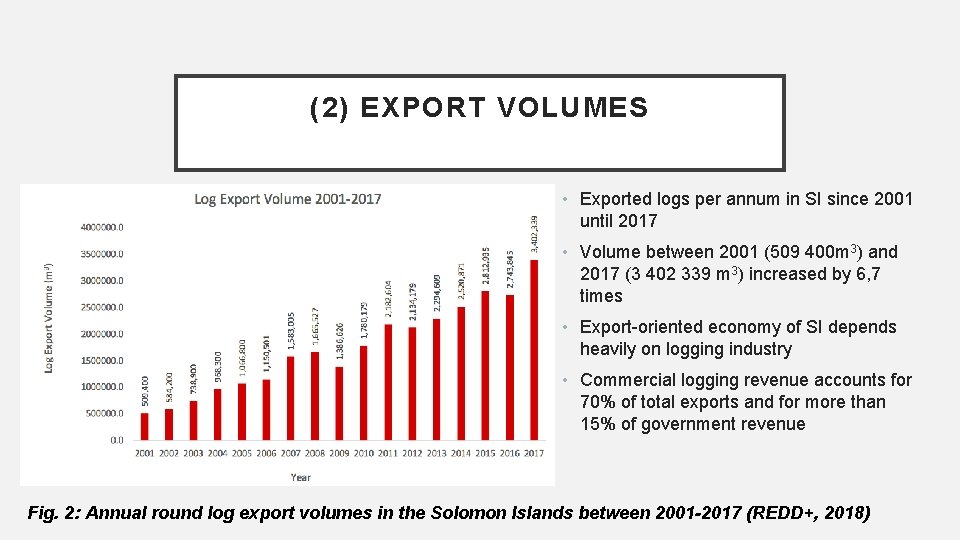
(2) EXPORT VOLUMES • Exported logs per annum in SI since 2001 until 2017 • Volume between 2001 (509 400 m 3) and 2017 (3 402 339 m 3) increased by 6, 7 times • Export-oriented economy of SI depends heavily on logging industry • Commercial logging revenue accounts for 70% of total exports and for more than 15% of government revenue Fig. 2: Annual round log export volumes in the Solomon Islands between 2001 -2017 (REDD+, 2018)
(3) JOB OPPORTUNITIES • Logging industry experienced boom over the given period , however it did not lead to a commensurate increase in employment • Limitations: • (1) Foreign employment- foreign workers employed in the local logging projectslower chances for locals to get a job in the logging industry • (2) Underdeveloped rural infrastructure - rural economy is limited due to the lack of infrastructure such as roads, markets, schools, hospitals, airstrips. Unless government improves infrastructure, rural areas won’t become attractive for future economic development related to new job opportunities
(4) ROYALTIES, LICENSE FEES AND PAYMENTS • In 2018 royalties, license fees and payments in SI reached 4356952 USD • Royalties (fee paid by logging company to the community) are distributed disproportionately and unequally among all landowners • Payments often inadequately low compared to the market value of timber • Local landowners receive 1/10 of export log prices • Common practice by foreign companies- timber harvested without returning something back to the community (roads, schools, hospitals…)
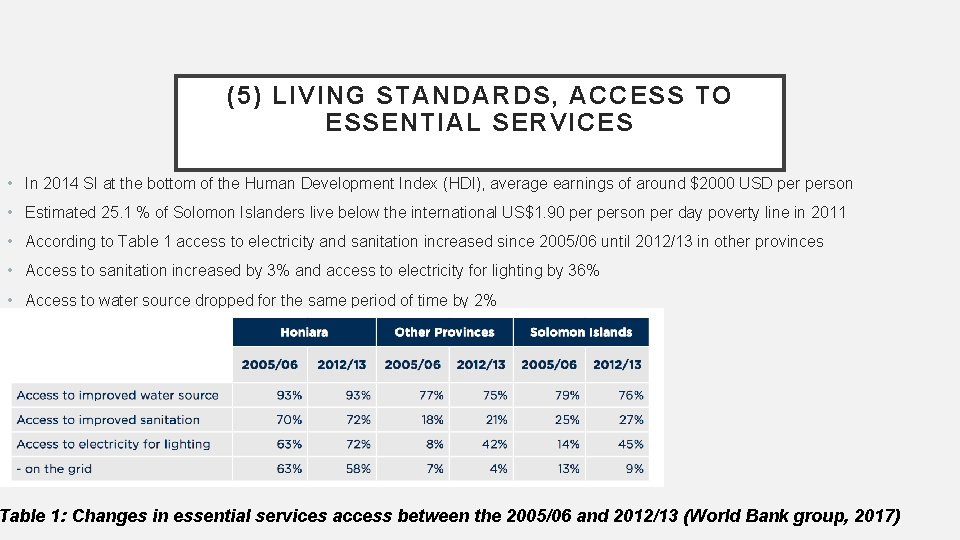
(5) LIVING STANDARDS, ACCESS TO ESSENTIAL SERVICES • In 2014 SI at the bottom of the Human Development Index (HDI), average earnings of around $2000 USD person • Estimated 25. 1 % of Solomon Islanders live below the international US$1. 90 person per day poverty line in 2011 • According to Table 1 access to electricity and sanitation increased since 2005/06 until 2012/13 in other provinces • Access to sanitation increased by 3% and access to electricity for lighting by 36% • Access to water source dropped for the same period of time by 2% Table 1: Changes in essential services access between the 2005/06 and 2012/13 (World Bank group, 2017)
(6) POTENTIAL RISKS IN THE LOGGING INDUSTRY • Corruption, illegal practices and the inequitable distribution of payments • Government and locals deprived of profits from logging industry • According to NEPCon’s Risk assessment, numerous problems identified with legal rights to harvest in SI • (I) Risk of corruption, conflicts of interests when granting tenure rights • (II) Risk of harvesting occurring without the necessary Felling/Milling license • (III) Risk of non-conformance with the legal requirements related to harvesting management and planning • (IV) Risk of non-compliance with annual plans (due to lack of government’s control and monitoring) • SI scored 42 out of 100 points on 2019 Corruption Perceptions Index reported by
RESULTS • Logging industry in SI deeply affects life of local communities, especially rural areas (80% of population concentrated there) • Rural population - limited alternatives of employment, therefore logging sector plays important role in their life • Royalties - people afford basic access to health care, schooling, food, electricity… • Living standards over given period slightly improved, but logging practices cause serious socioeconomic problems • Price of exported logs not based on its real market value • Greatest benefits/ income taken by foreign logging companies, not local communities and government • Negative impact on future economic development in the country
DISCUSSION • SI economy heavily depends on logging industry • Revenue distributed unequally among communities • Due to limited job opportunities, job diversification in rural areas expected • Different alternatives of income= less dependence on logging industry • Urgent issues to be solved by government • (1) monitor all natural forests under customary ownership, thus avoiding illegal logging, serious environmental degradation (due to over harvesting) • (2) law enforcement functions in the state
CONCLUSION • Legally binding contracts btw. landowners and foreign comp. - to ensure logging operations are in accordance with law • Current logging situation definitely not in a favor of local landowners • Logging industry doesn’t serve national interest • Logging practices not properly managed and monitored • Extensive harvesting across SI causes irreplaceable and devastating impact on the environment • Immediate actions needed– to revert the current trend of overharvesting (eco. losses, enviro. degradation)

THANK YOU FOR ATTENTION
- Slides: 14