
Does globalization cause inequality in Developed Countries Evidence
Does globalization cause inequality in Developed Countries? Evidence from the OECD economies Sadhana Srivastava Auckland University of Technology (AUT), School of Economics Email: sadhana. srivastava@aut. ac. nz Co-authors : Gulasekaran Rajaguru, (Bond University), Rahul Sen (AUT University) and Pundarik Mukhopadhaya (Macquarie University, Economics) PRESENTED AT THE ACE ANNUAL CONFERENCE 2021 JULY 13, 2021

Outline ØIntroduction ØLiterature ØData, Variables ØMethodology and Results ØConclusions

Introduction heterogeneous effects of globalization on income inequality hugely debated (Heimberger, 2020; Nolan et al. , 2019). Recent disruptions in the global economy, (Brexit, the Global Trade tensions, and ongoing COVID‐ 19 pandemic, sparked anti‐globalization sentiments, trade and globalization forces blamed for increased income inequality within developed economies (Coyle, 2016; Rodrik, 2018; Bourguinon, 2016 and Milanovic, 2016; Gozgor and Ranjan, 2017). We revisit long‐run relationship and existence of causal linkages between globalization and income inequality for 23 OECD member countries across different geographical regions over 1970‐ 2016.
Introduction empirical analysis, involves applying the Yamamoto and Kurozumi (2006) approach to test for the presence of long‐run Granger non‐causality between our chosen variables advantages ‐ ability to estimate in one step the multilateral relationships between all the variables being studied; helps to examine the long‐run block non‐causality between the variables sign rule proposed by Rajaguru and Abeysinghe (2008) further establishes the genuine long‐run causal relationships between the variables of interest. We focus on the long and short‐run causal relationships underpinning key interactive variables in this relationship between globalization and inequality
Recent literature Tamasauskiene & Žičkienė (T and Z) (2021), Heimberger (2020) and Dorn et al. (2018) are among the latest empirical studies that revisit the link between globalization and income inequality. T & Ž (2021) ‐ impact of all three dimensions of globalization separately on income inequality in the context of EU as a whole over 1998‐ 2017 in a panel framework ‐ concludes economic and political globalization dimensions have had a significant impact compared to social globalization on increasing overall income inequality within the EU. Dorn et. al. (2018) ‐ for 140 countries over 1970‐ 2014, instrumental variable (IV) econometric approach; subsample of advanced countries , confirm absence of systematic effect of globalization on income inequality, argue moderated effect could be due to stable political and democratic institutions, education opportunities but did not analyze causal relationships.
Recent literature Dorn et. al (2018) findings are corroborated using meta‐analysis and meta‐regression methods in Heimberger (2020), emphasizing the importance of education and technology moderating the impact of globalization on income inequalities for developed countries. considerable uncertainty regarding the predicted effects of globalization on income inequality ; different subcomponents of globalization affect income inequality differently and opens room for subsequent investigation. We contribute by looking at almost half a century of data and focusing on the causal relationships, expecting some mixed findings
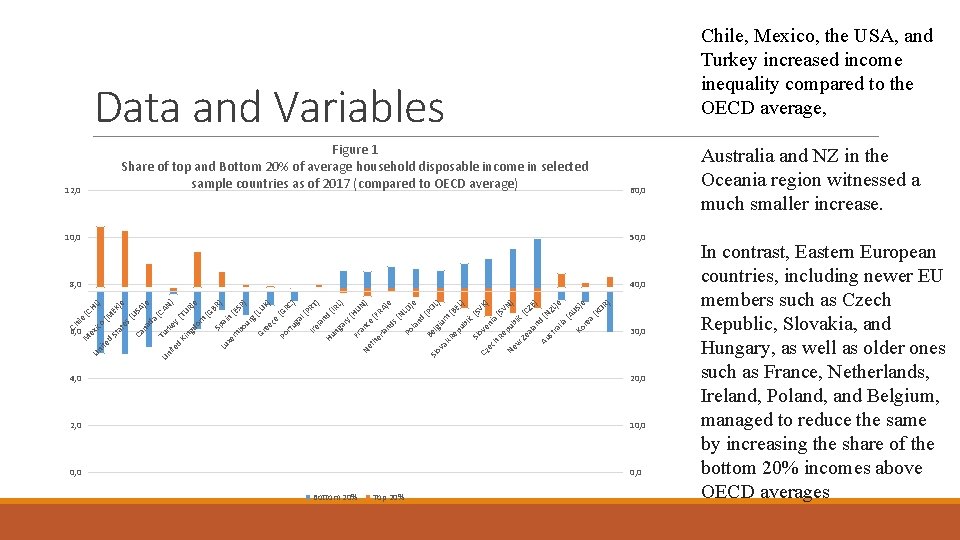
Chile, Mexico, the USA, and Turkey increased income inequality compared to the OECD average, Data and Variables Figure 1 Share of top and Bottom 20% of average household disposable income in selected sample countries as of 2017 (compared to OECD average) 12, 0 60, 0 8, 0 40, 0 es (M EX (C HL 30, 0 Un ite d St at ico ile ex Ch M 6, 0 )e (U SA Ca )e na da ( CA Tu Un rk N) ite ey d (T Ki UR ng )e do m (G Sp BR) Lu ai n xe (E m SP bo ) ur g( L Gr UX ee ) ce (G Po RC rtu ) ga l( PR Ire T) la nd Hu (IR ng L) ar y( HU Fr N) Ne anc e th ( FR er A) la nd e s( NL Po D) e la nd ( PO Slo Belg L) iu va m k. R ( BE ep L) ub lic ( Slo SV ve K) Cz ni ec a( h Re SV pu N) Ne b lic w Ze (C al an ZE) d Au (N st ZL ra )e lia (A US Ko )e re a( KO R) 50, 0 ) 10, 0 4, 0 20, 0 2, 0 10, 0 Bottom 20% Top 20% Australia and NZ in the Oceania region witnessed a much smaller increase. In contrast, Eastern European countries, including newer EU members such as Czech Republic, Slovakia, and Hungary, as well as older ones such as France, Netherlands, Ireland, Poland, and Belgium, managed to reduce the same by increasing the share of the bottom 20% incomes above OECD averages
Data and Variables Income inequality statistics use the Gini coefficient for pre‐tax income, which we label as Gini We calculate Gini by comparing the actual distribution of income to the complete equality benchmark Wide ranging variation noted in median inequality across countries even after separating pre and post GFC We choose globalization, trade competitiveness, labour market legislation, and unionization dynamics affecting income inequality, following the literature
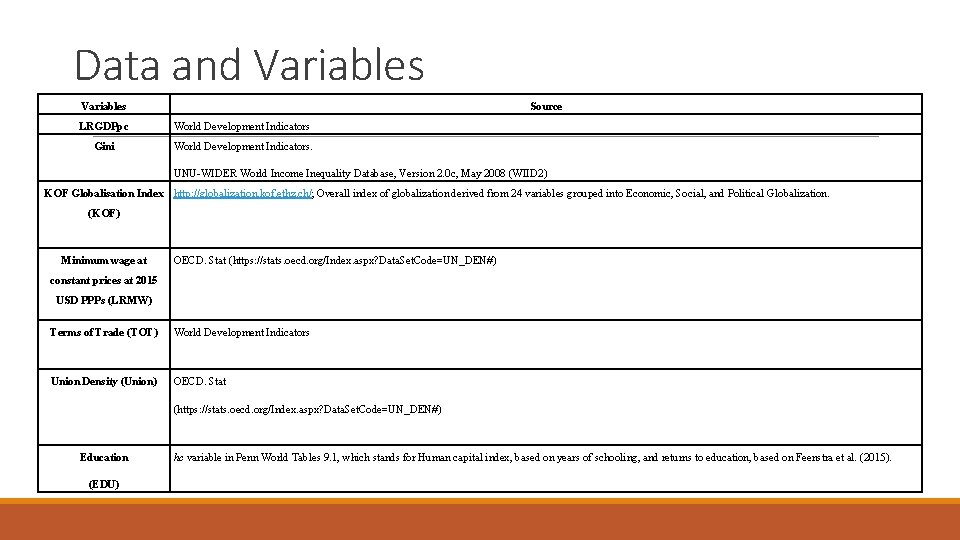
Data and Variables Source LRGDPpc World Development Indicators Gini World Development Indicators. UNU-WIDER World Income Inequality Database, Version 2. 0 c, May 2008 (WIID 2) KOF Globalisation Index http: //globalization. kof. ethz. ch/; Overall index of globalization derived from 24 variables grouped into Economic, Social, and Political Globalization. (KOF) Minimum wage at OECD. Stat (https: //stats. oecd. org/Index. aspx? Data. Set. Code=UN_DEN#) constant prices at 2015 USD PPPs (LRMW) Terms of Trade (TOT) World Development Indicators Union Density (Union) OECD. Stat (https: //stats. oecd. org/Index. aspx? Data. Set. Code=UN_DEN#) Education (EDU) hc variable in Penn World Tables 9. 1, which stands for Human capital index, based on years of schooling, and returns to education, based on Feenstra et al. (2015).
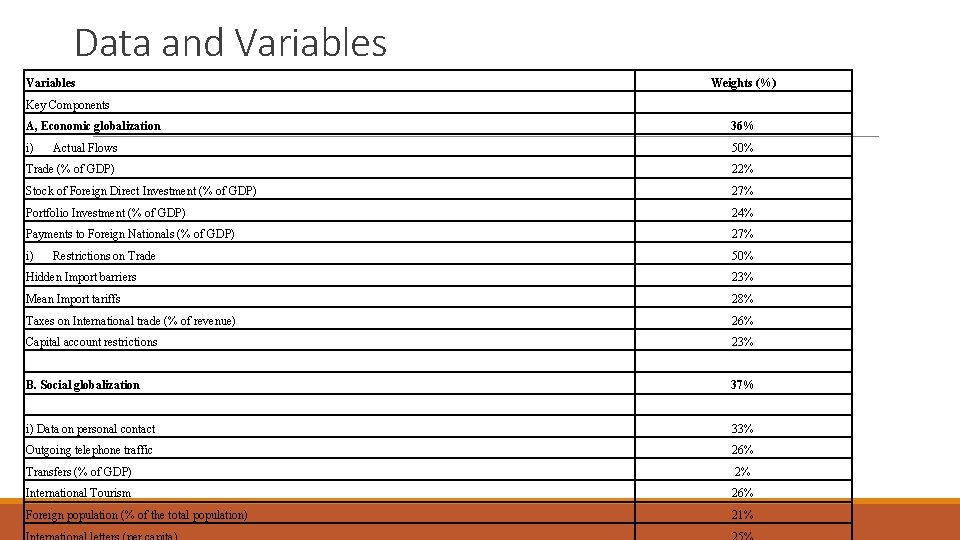
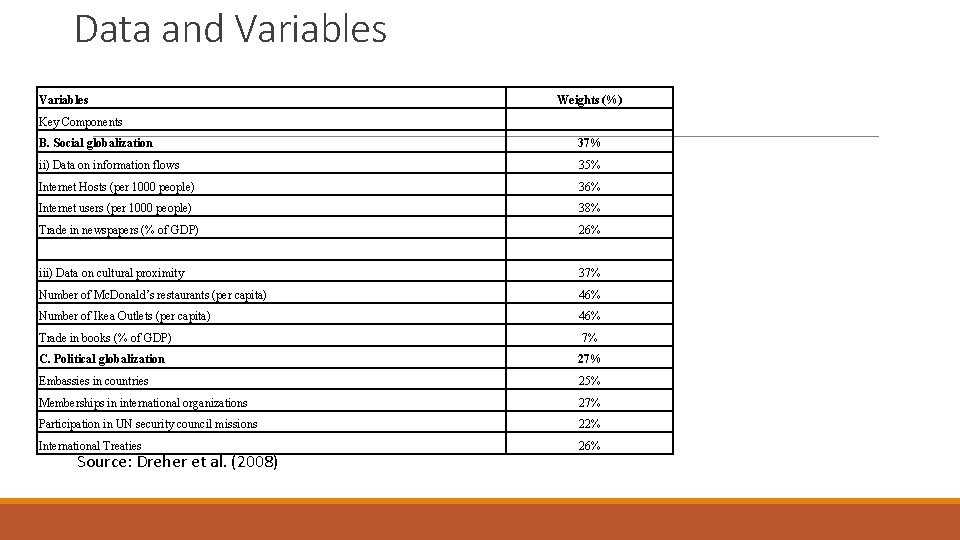
Data and Variables Weights (%) Key Components A, Economic globalization 36% i) Actual Flows 50% Trade (% of GDP) 22% Stock of Foreign Direct Investment (% of GDP) 27% Portfolio Investment (% of GDP) 24% Payments to Foreign Nationals (% of GDP) 27% i) 50% Restrictions on Trade Hidden Import barriers 23% Mean Import tariffs 28% Taxes on International trade (% of revenue) 26% Capital account restrictions 23% B. Social globalization 37% i) Data on personal contact 33% Outgoing telephone traffic 26% Transfers (% of GDP) 2% International Tourism 26% Foreign population (% of the total population) 21%
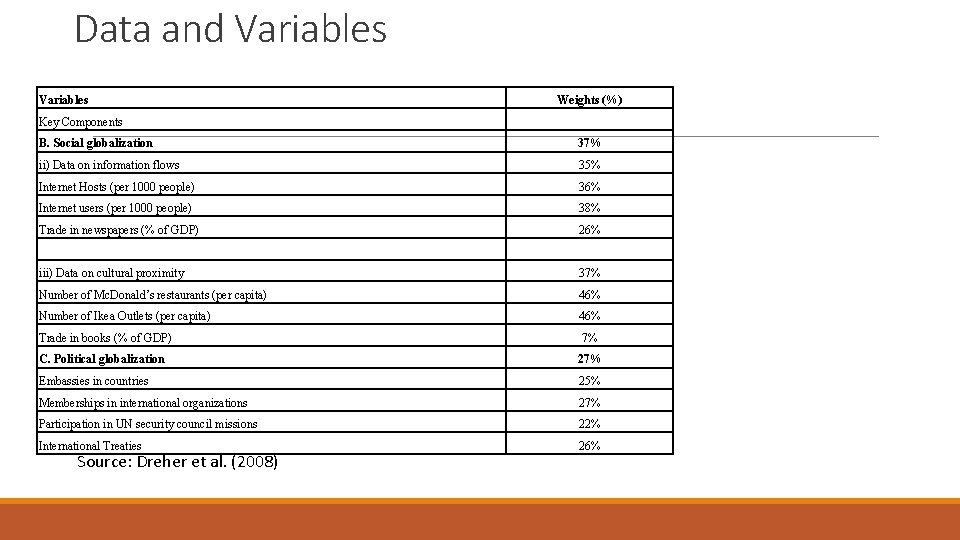
Data and Variables Weights (%) Key Components B. Social globalization 37% ii) Data on information flows 35% Internet Hosts (per 1000 people) 36% Internet users (per 1000 people) 38% Trade in newspapers (% of GDP) 26% iii) Data on cultural proximity 37% Number of Mc. Donald’s restaurants (per capita) 46% Number of Ikea Outlets (per capita) 46% Trade in books (% of GDP) 7% C. Political globalization 27% Embassies in countries 25% Memberships in international organizations 27% Participation in UN security council missions 22% International Treaties 26% Source: Dreher et al. (2008)
Data and Variables Weights (%) Key Components B. Social globalization 37% ii) Data on information flows 35% Internet Hosts (per 1000 people) 36% Internet users (per 1000 people) 38% Trade in newspapers (% of GDP) 26% iii) Data on cultural proximity 37% Number of Mc. Donald’s restaurants (per capita) 46% Number of Ikea Outlets (per capita) 46% Trade in books (% of GDP) 7% C. Political globalization 27% Embassies in countries 25% Memberships in international organizations 27% Participation in UN security council missions 22% International Treaties 26% Source: Dreher et al. (2008)
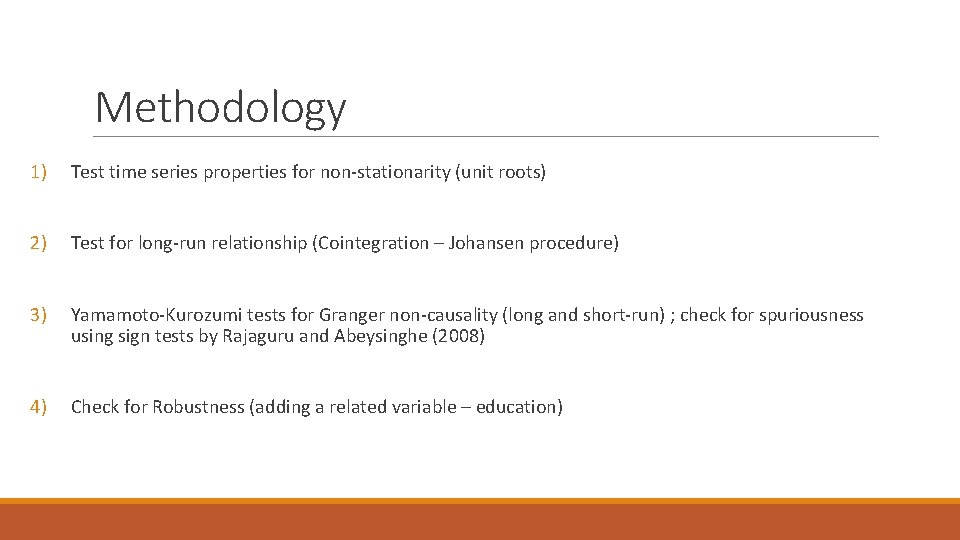
Methodology 1) Test time series properties for non‐stationarity (unit roots) 2) Test for long‐run relationship (Cointegration – Johansen procedure) 3) Yamamoto‐Kurozumi tests for Granger non‐causality (long and short‐run) ; check for spuriousness using sign tests by Rajaguru and Abeysinghe (2008) 4) Check for Robustness (adding a related variable – education)
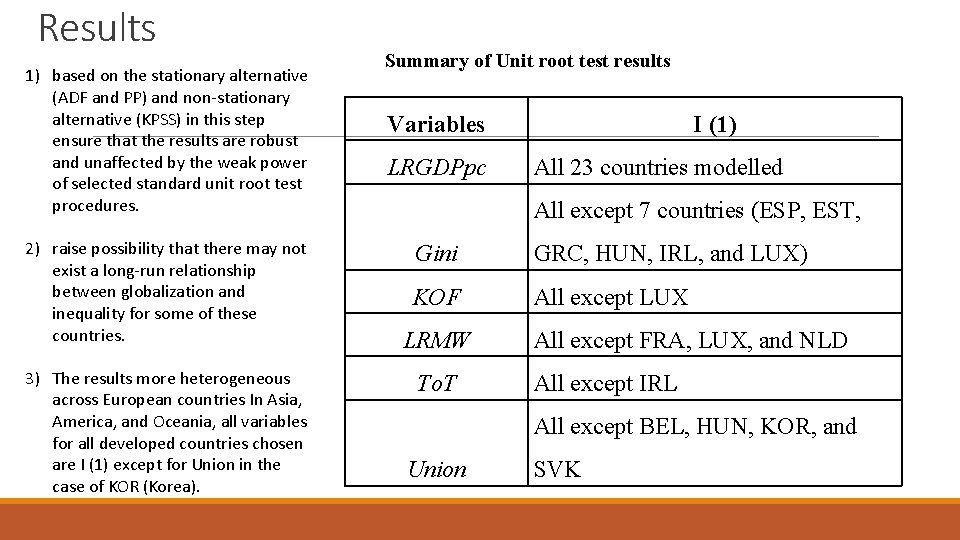
Results 1) based on the stationary alternative (ADF and PP) and non‐stationary alternative (KPSS) in this step ensure that the results are robust and unaffected by the weak power of selected standard unit root test procedures. 2) raise possibility that there may not exist a long‐run relationship between globalization and inequality for some of these countries. 3) The results more heterogeneous across European countries In Asia, America, and Oceania, all variables for all developed countries chosen are I (1) except for Union in the case of KOR (Korea). Summary of Unit root test results Variables LRGDPpc I (1) All 23 countries modelled All except 7 countries (ESP, EST, Gini GRC, HUN, IRL, and LUX) KOF All except LUX LRMW To. T All except FRA, LUX, and NLD All except IRL All except BEL, HUN, KOR, and Union SVK
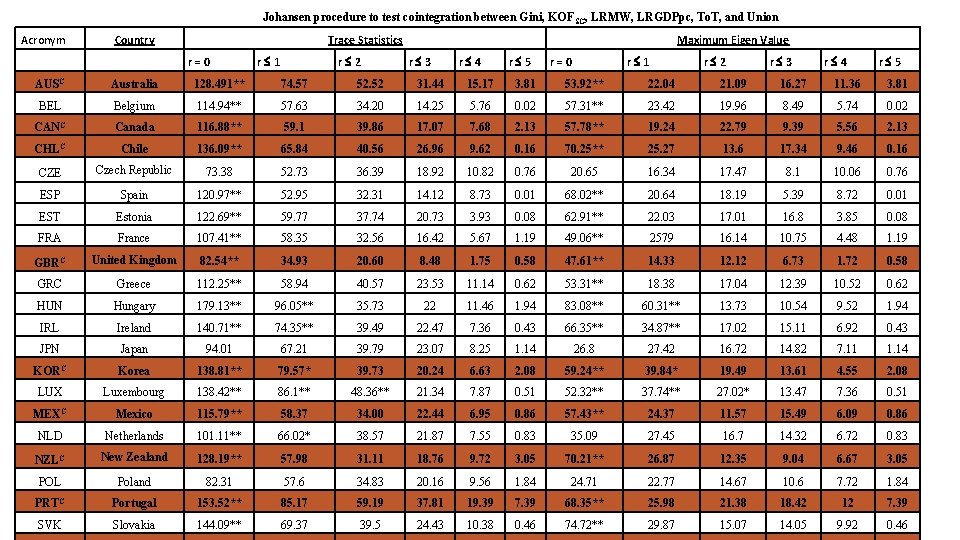
Johansen procedure to test cointegration between Gini, KOF SG, LRMW, LRGDPpc, To. T, and Union Acronym Country Trace Statistics r=0 r£ 1 r£ 2 Maximum Eigen Value r£ 3 r£ 4 r£ 5 r£ 1 r=0 r£ 2 r£ 3 r£ 4 r£ 5 AUSC Australia 128. 491** 74. 57 52. 52 31. 44 15. 17 3. 81 53. 92** 22. 04 21. 09 16. 27 11. 36 3. 81 BEL Belgium 114. 94** 57. 63 34. 20 14. 25 5. 76 0. 02 57. 31** 23. 42 19. 96 8. 49 5. 74 0. 02 CANC Canada 116. 88** 59. 1 39. 86 17. 07 7. 68 2. 13 57. 78** 19. 24 22. 79 9. 39 5. 56 2. 13 CHLC Chile 136. 09** 65. 84 40. 56 26. 96 9. 62 0. 16 70. 25** 25. 27 13. 6 17. 34 9. 46 0. 16 CZE Czech Republic 73. 38 52. 73 36. 39 18. 92 10. 82 0. 76 20. 65 16. 34 17. 47 8. 1 10. 06 0. 76 ESP Spain 120. 97** 52. 95 32. 31 14. 12 8. 73 0. 01 68. 02** 20. 64 18. 19 5. 39 8. 72 0. 01 EST Estonia 122. 69** 59. 77 37. 74 20. 73 3. 93 0. 08 62. 91** 22. 03 17. 01 16. 8 3. 85 0. 08 FRA France 107. 41** 58. 35 32. 56 16. 42 5. 67 1. 19 49. 06** 2579 16. 14 10. 75 4. 48 1. 19 GBRC United Kingdom 82. 54** 34. 93 20. 60 8. 48 1. 75 0. 58 47. 61** 14. 33 12. 12 6. 73 1. 72 0. 58 GRC Greece 112. 25** 58. 94 40. 57 23. 53 11. 14 0. 62 53. 31** 18. 38 17. 04 12. 39 10. 52 0. 62 HUN Hungary 179. 13** 96. 05** 35. 73 22 11. 46 1. 94 83. 08** 60. 31** 13. 73 10. 54 9. 52 1. 94 IRL Ireland 140. 71** 74. 35** 39. 49 22. 47 7. 36 0. 43 66. 35** 34. 87** 17. 02 15. 11 6. 92 0. 43 JPN Japan 94. 01 67. 21 39. 79 23. 07 8. 25 1. 14 26. 8 27. 42 16. 72 14. 82 7. 11 1. 14 KORC Korea 138. 81** 79. 57* 39. 73 20. 24 6. 63 2. 08 59. 24** 39. 84* 19. 49 13. 61 4. 55 2. 08 LUX Luxembourg 138. 42** 86. 1** 48. 36** 21. 34 7. 87 0. 51 52. 32** 37. 74** 27. 02* 13. 47 7. 36 0. 51 MEXC Mexico 115. 79** 58. 37 34. 00 22. 44 6. 95 0. 86 57. 43** 24. 37 11. 57 15. 49 6. 09 0. 86 NLD Netherlands 101. 11** 66. 02* 38. 57 21. 87 7. 55 0. 83 35. 09 27. 45 16. 7 14. 32 6. 72 0. 83 NZLC New Zealand 128. 19** 57. 98 31. 11 18. 76 9. 72 3. 05 70. 21** 26. 87 12. 35 9. 04 6. 67 3. 05 POL Poland 82. 31 57. 6 34. 83 20. 16 9. 56 1. 84 24. 71 22. 77 14. 67 10. 6 7. 72 1. 84 PRTC Portugal 153. 52** 85. 17 59. 19 37. 81 19. 39 7. 39 68. 35** 25. 98 21. 38 18. 42 12 7. 39 SVK Slovakia 144. 09** 69. 37 39. 5 24. 43 10. 38 0. 46 74. 72** 29. 87 15. 07 14. 05 9. 92 0. 46
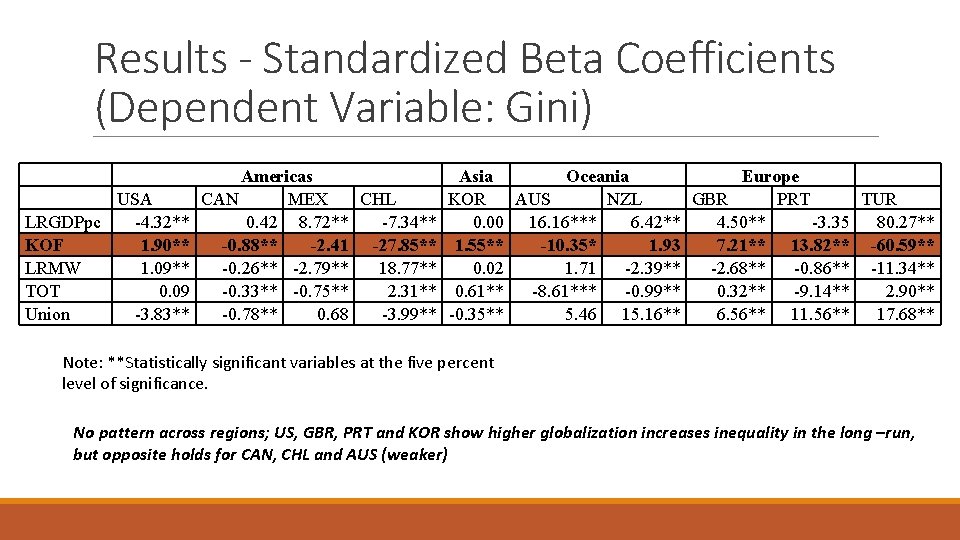
Results - Standardized Beta Coefficients (Dependent Variable: Gini) USA LRGDPpc -4. 32** KOF 1. 90** LRMW 1. 09** TOT 0. 09 Union -3. 83** Americas CAN MEX CHL 0. 42 8. 72** -7. 34** -0. 88** -2. 41 -27. 85** -0. 26** -2. 79** 18. 77** -0. 33** -0. 75** 2. 31** -0. 78** 0. 68 -3. 99** Asia Oceania Europe KOR AUS NZL GBR PRT TUR 0. 00 16. 16*** 6. 42** 4. 50** -3. 35 80. 27** 1. 55** -10. 35* 1. 93 7. 21** 13. 82** -60. 59** 0. 02 1. 71 -2. 39** -2. 68** -0. 86** -11. 34** 0. 61** -8. 61*** -0. 99** 0. 32** -9. 14** 2. 90** -0. 35** 5. 46 15. 16** 6. 56** 11. 56** 17. 68** Note: **Statistically significant variables at the five percent level of significance. No pattern across regions; US, GBR, PRT and KOR show higher globalization increases inequality in the long –run, but opposite holds for CAN, CHL and AUS (weaker)
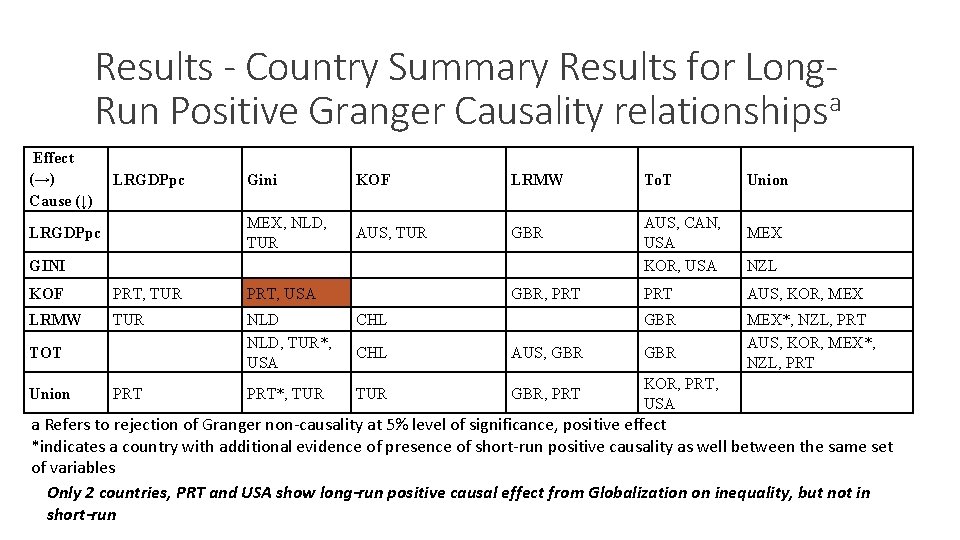
Results - Country Summary Results for Long. Run Positive Granger Causality relationshipsa Effect (→) Cause (↓) LRGDPpc Gini KOF LRMW MEX, NLD, TUR AUS, TUR GBR GINI AUS, CAN, USA KOR, USA KOF PRT, TUR PRT, USA LRMW TUR NLD, TUR*, USA CHL AUS, GBR PRT*, TUR GBR, PRT KOR, PRT, USA TOT Union PRT GBR, PRT To. T Union MEX NZL PRT AUS, KOR, MEX GBR MEX*, NZL, PRT AUS, KOR, MEX*, NZL, PRT a Refers to rejection of Granger non‐causality at 5% level of significance, positive effect *indicates a country with additional evidence of presence of short‐run positive causality as well between the same set of variables Only 2 countries, PRT and USA show long-run positive causal effect from Globalization on inequality, but not in short-run
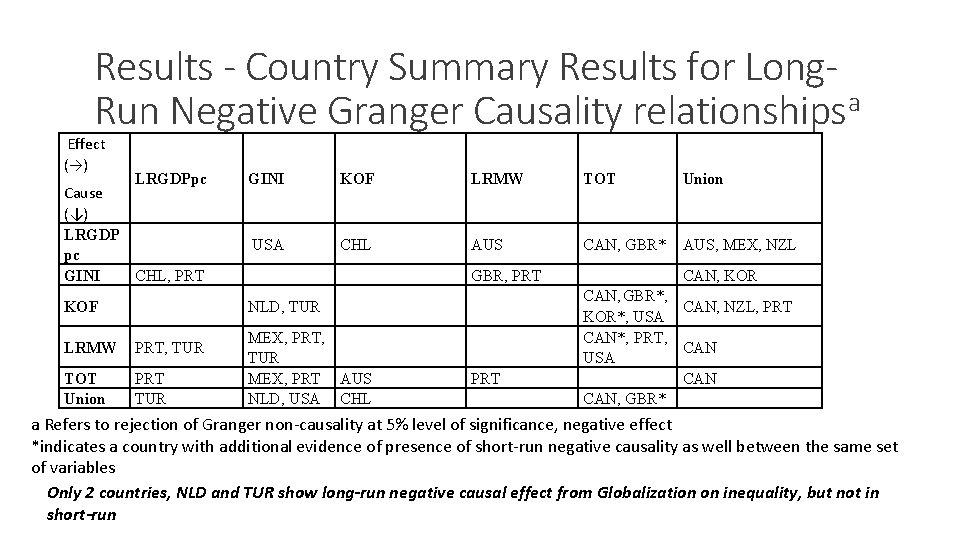
Results - Country Summary Results for Long. Run Negative Granger Causality relationshipsa Effect (→) LRGDPpc Cause (↓) LRGDP pc GINI CHL, PRT GINI KOF LRMW TOT Union USA CHL AUS CAN, GBR* AUS, MEX, NZL KOF NLD, TUR LRMW PRT, TUR TOT Union PRT TUR GBR, PRT MEX, PRT, TUR MEX, PRT AUS NLD, USA CHL PRT CAN, KOR CAN, GBR*, CAN, NZL, PRT KOR*, USA CAN*, PRT, CAN USA CAN, GBR* a Refers to rejection of Granger non‐causality at 5% level of significance, negative effect *indicates a country with additional evidence of presence of short‐run negative causality as well between the same set of variables Only 2 countries, NLD and TUR show long-run negative causal effect from Globalization on inequality, but not in short-run
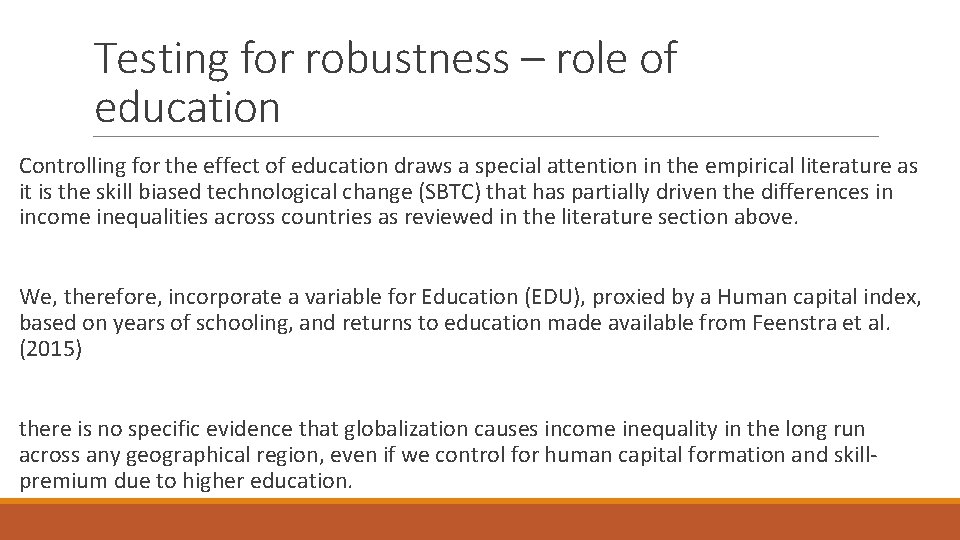
Testing for robustness – role of education Controlling for the effect of education draws a special attention in the empirical literature as it is the skill biased technological change (SBTC) that has partially driven the differences in income inequalities across countries as reviewed in the literature section above. We, therefore, incorporate a variable for Education (EDU), proxied by a Human capital index, based on years of schooling, and returns to education made available from Feenstra et al. (2015) there is no specific evidence that globalization causes income inequality in the long run across any geographical region, even if we control for human capital formation and skill‐ premium due to higher education.
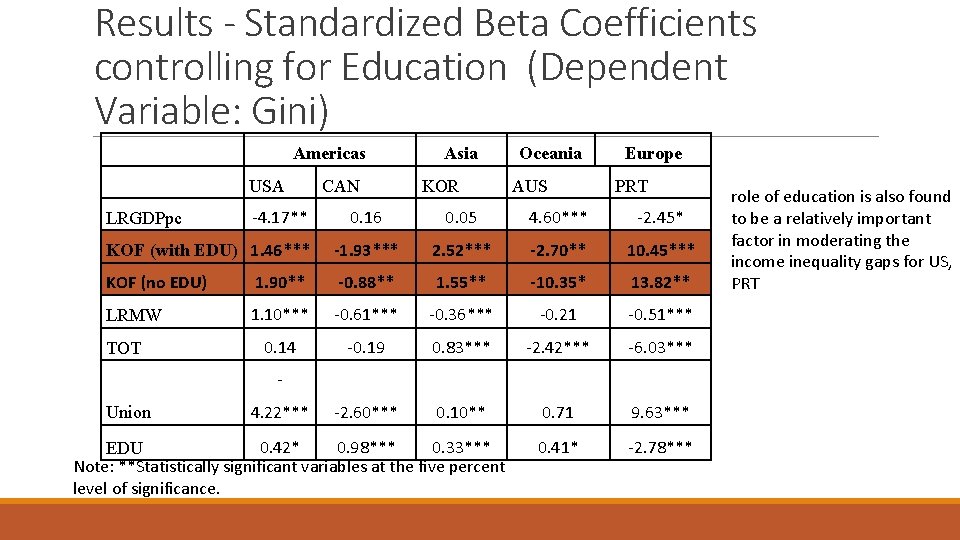
Results - Standardized Beta Coefficients controlling for Education (Dependent Variable: Gini) Americas USA KOR Oceania AUS Europe PRT 0. 16 0. 05 4. 60*** ‐ 2. 45* KOF (with EDU) 1. 46*** -1. 93*** 2. 52*** -2. 70** 10. 45*** KOF (no EDU) 1. 90** -0. 88** 1. 55** -10. 35* 13. 82** LRMW 1. 10*** ‐ 0. 61*** ‐ 0. 36*** ‐ 0. 21 ‐ 0. 51*** 0. 14 ‐ 0. 19 0. 83*** ‐ 2. 42*** ‐ 6. 03*** ‐ 2. 60*** 0. 10** 0. 71 9. 63*** 0. 41* ‐ 2. 78*** LRGDPpc TOT ‐ 4. 17** CAN Asia ‐ Union 4. 22*** 0. 42* 0. 98*** 0. 33*** EDU Note: **Statistically significant variables at the five percent level of significance. role of education is also found to be a relatively important factor in moderating the income inequality gaps for US, PRT
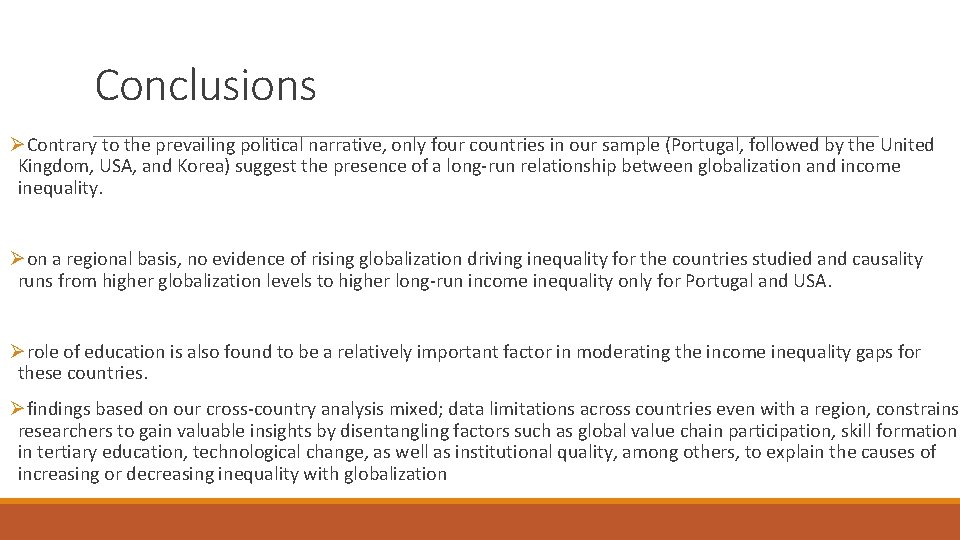
Conclusions ØContrary to the prevailing political narrative, only four countries in our sample (Portugal, followed by the United Kingdom, USA, and Korea) suggest the presence of a long‐run relationship between globalization and income inequality. Øon a regional basis, no evidence of rising globalization driving inequality for the countries studied and causality runs from higher globalization levels to higher long‐run income inequality only for Portugal and USA. Ørole of education is also found to be a relatively important factor in moderating the income inequality gaps for these countries. Øfindings based on our cross‐country analysis mixed; data limitations across countries even with a region, constrains researchers to gain valuable insights by disentangling factors such as global value chain participation, skill formation in tertiary education, technological change, as well as institutional quality, among others, to explain the causes of increasing or decreasing inequality with globalization

THANK YOU !!!
- Slides: 22