
Does Birmingham Vasculitis Activity Score BVAS Influence the
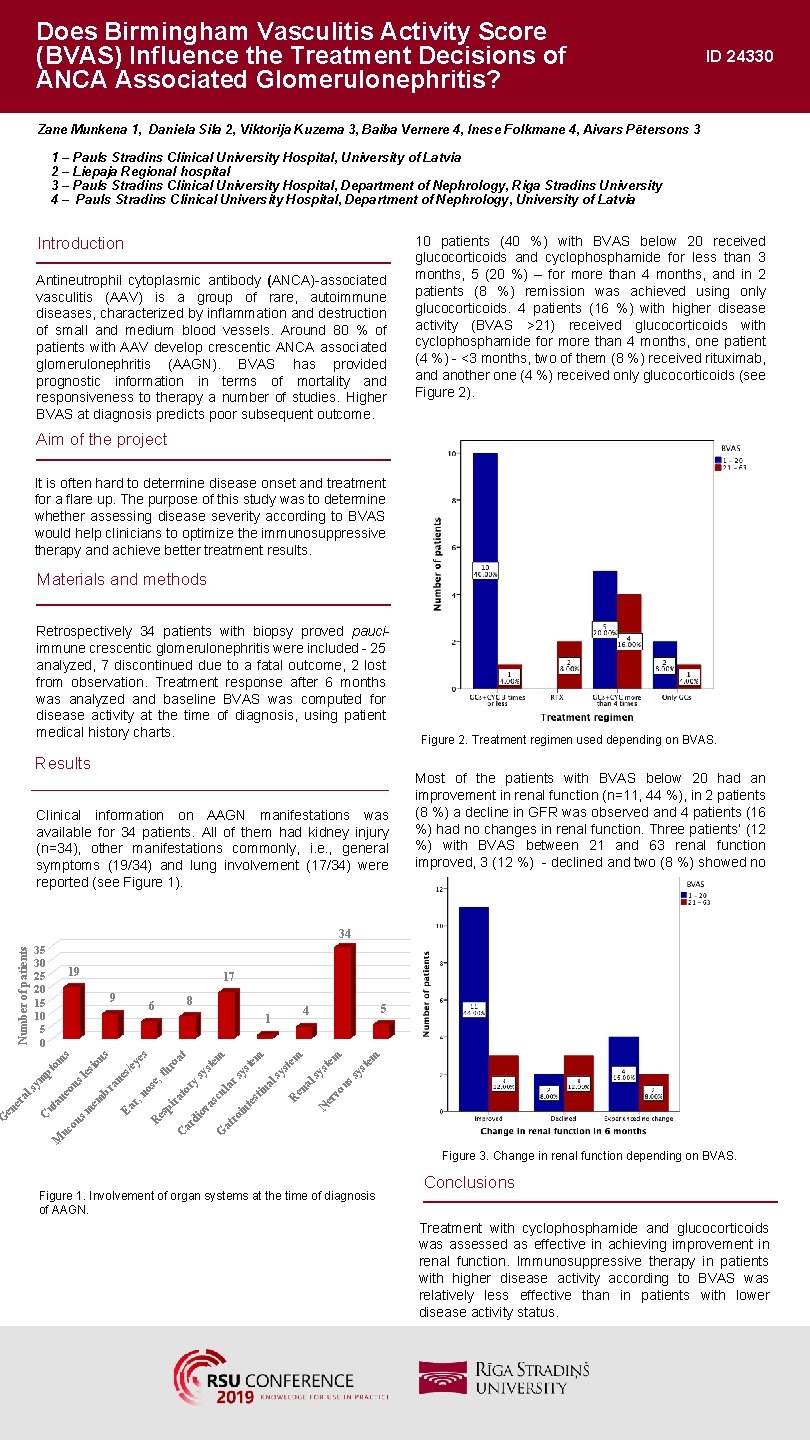
Does Birmingham Vasculitis Activity Score (BVAS) Influence the Treatment Decisions of ANCA Associated Glomerulonephritis? Zane Munkena 1, Daniela Sila 2, Viktorija Kuzema 3, Baiba Vernere 4, Inese Folkmane 4, Aivars Pētersons 3 1 – Pauls Stradins Clinical University Hospital, University of Latvia 2 – Liepaja Regional hospital 3 – Pauls Stradins Clinical University Hospital, Department of Nephrology, Riga Stradins University 4 – Pauls Stradins Clinical University Hospital, Department of Nephrology, University of Latvia Introduction Antineutrophil cytoplasmic antibody (ANCA)-associated vasculitis (AAV) is a group of rare, autoimmune diseases, characterized by inflammation and destruction of small and medium blood vessels. Around 80 % of patients with AAV develop crescentic ANCA associated glomerulonephritis (AAGN). BVAS has provided prognostic information in terms of mortality and responsiveness to therapy a number of studies. Higher BVAS at diagnosis predicts poor subsequent outcome. 10 patients (40 %) with BVAS below 20 received glucocorticoids and cyclophosphamide for less than 3 months, 5 (20 %) – for more than 4 months, and in 2 patients (8 %) remission was achieved using only glucocorticoids. 4 patients (16 %) with higher disease activity (BVAS >21) received glucocorticoids with cyclophosphamide for more than 4 months, one patient (4 %) - <3 months, two of them (8 %) received rituximab, and another one (4 %) received only glucocorticoids (see Figure 2). Aim of the project It is often hard to determine disease onset and treatment for a flare up. The purpose of this study was to determine whether assessing disease severity according to BVAS would help clinicians to optimize the immunosuppressive therapy and achieve better treatment results. Materials and methods Retrospectively 34 patients with biopsy proved pauciimmune crescentic glomerulonephritis were included - 25 analyzed, 7 discontinued due to a fatal outcome, 2 lost from observation. Treatment response after 6 months was analyzed and baseline BVAS was computed for disease activity at the time of diagnosis, using patient medical history charts. Results Clinical information on AAGN manifestations was available for 34 patients. All of them had kidney injury (n=34), other manifestations commonly, i. e. , general symptoms (19/34) and lung involvement (17/34) were reported (see Figure 1). Figure 2. Treatment regimen used depending on BVAS. Most of the patients with BVAS below 20 had an improvement in renal function (n=11, 44 %), in 2 patients (8 %) a decline in GFR was observed and 4 patients (16 %) had no changes in renal function. Three patients’ (12 %) with BVAS between 21 and 63 renal function improved, 3 (12 %) - declined and two (8 %) showed no change (see Figure 3). 34 19 17 sy st em m us al sy st e em st er vo en N te in G at ro R st in al sy ys rs la cu as ov di ar C te te sy s ry to ra pi es R m m t oa hr , t se no r, Ea br em sm ou 5 4 1 M uc ye an le us eo an ut C es /e sio om pt m sy 8 6 s ns 9 s Number of patients 35 30 25 20 15 10 5 0 al er en G ID 24330 Figure 3. Change in renal function depending on BVAS. Figure 1. Involvement of organ systems at the time of diagnosis of AAGN. Conclusions Treatment with cyclophosphamide and glucocorticoids was assessed as effective in achieving improvement in renal function. Immunosuppressive therapy in patients with higher disease activity according to BVAS was relatively less effective than in patients with lower disease activity status.
- Slides: 1