
Does Aerosol Loading in a Convective Environment Influence
- Slides: 13
Does Aerosol Loading in a Convective Environment Influence Cirrus Anvil Properties? Betsy Berry and Jay Mace University of Utah American Geophysical Union 2011 Fall Meeting
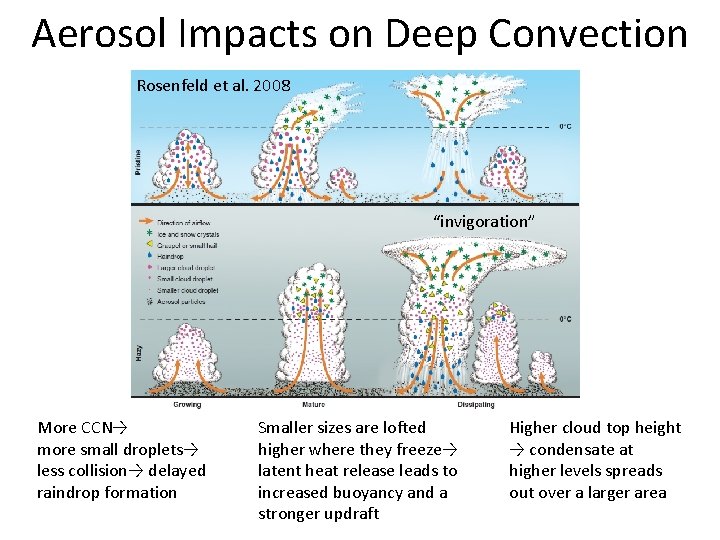
Aerosol Impacts on Deep Convection Rosenfeld et al. 2008 “invigoration” More CCN→ more small droplets→ less collision→ delayed raindrop formation Smaller sizes are lofted higher where they freeze→ latent heat release leads to increased buoyancy and a stronger updraft Higher cloud top height → condensate at higher levels spreads out over a larger area
Motivation • Recent studies give conflicting results that aerosols can either invigorate or weaken convective cloud growth • Anvils in polluted environments have smaller ice particle sizes and smaller fall velocities compared to pristine environments (Morrison and Grabowski, 2011) • Can we see this effect in observations?
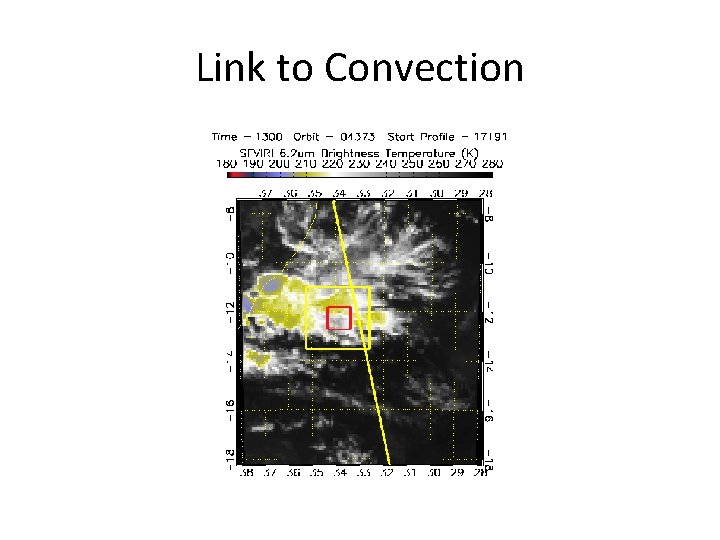
Data: multi-platform approach • Cloud. Sat and CALIPSO to define cirrus and obtain microphysical properties from 2 C-ICE data product (Deng et al. , 2010) • Geostationary satellite data to track cirrus in time (Soden, 1998) and link to convection (Tb<210 K) • MODIS Atmosphere L 2 Joint Product: Aerosol Optical Thickness (AOT) within 50 km of Cloud. Sat • Large-scale dynamics from NCEP/NCAR reanalysis
Limitations and Assumptions • Difficult to measure aerosol-cloud interactions • We assume that aerosol in nearby clear air is representative of aerosol in cirrus anvil • Potential contamination of AOT from optically thin cirrus • We don’t know what the aerosol loading was at the time of convective initiation
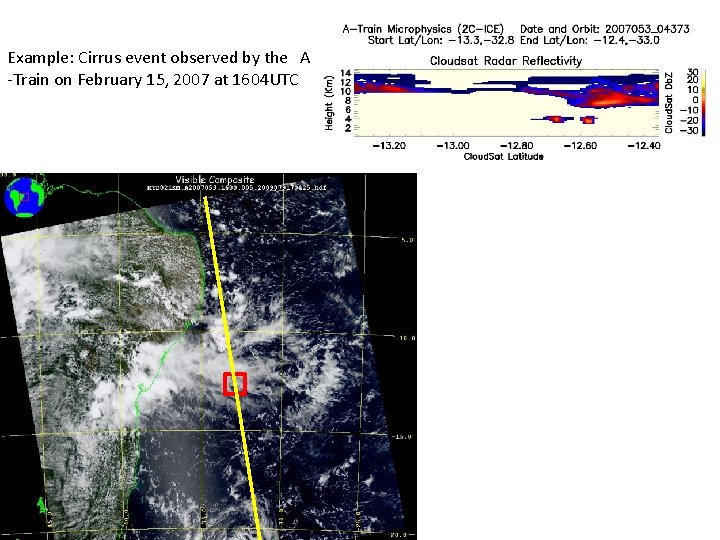
Example: Cirrus event observed by the A -Train on February 15, 2007 at 1604 UTC
Link to Convection
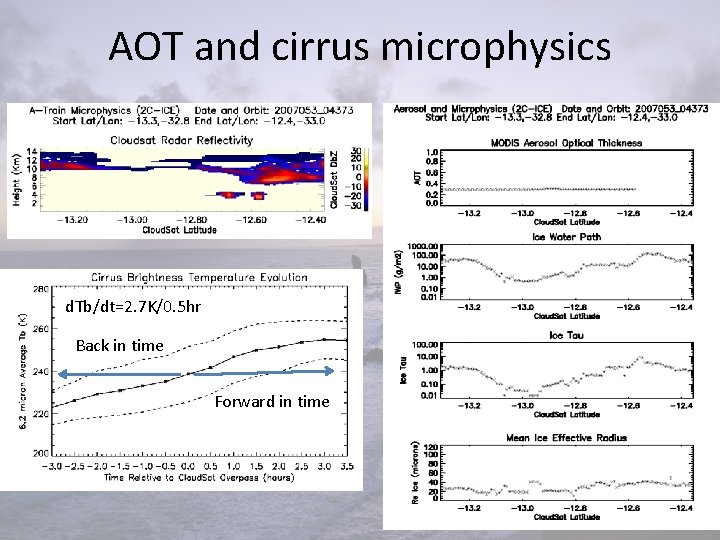
AOT and cirrus microphysics d. Tb/dt=2. 7 K/0. 5 hr Back in time Forward in time
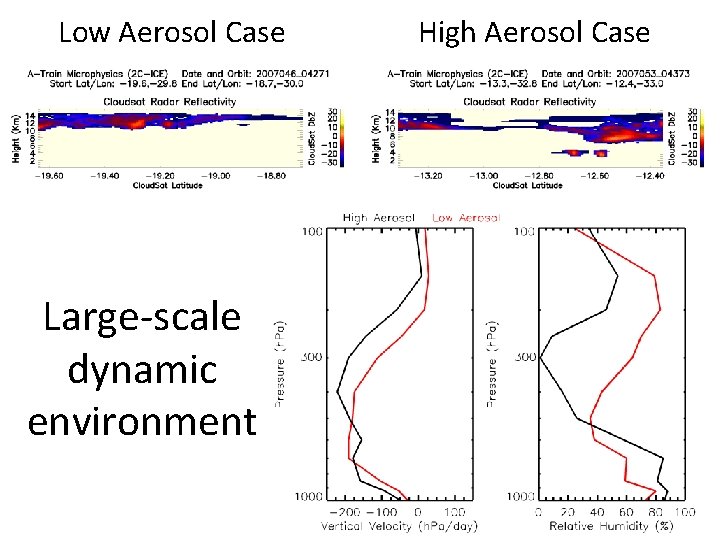
Low Aerosol Case Large-scale dynamic environment High Aerosol Case
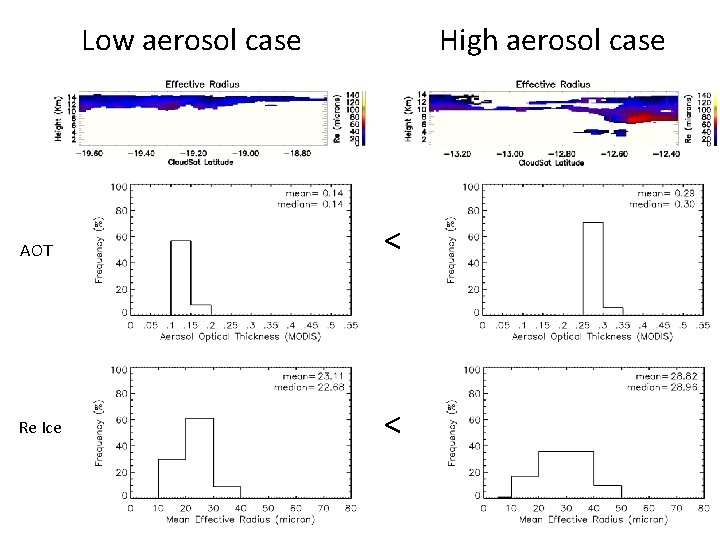
Low aerosol case High aerosol case AOT < Re Ice <
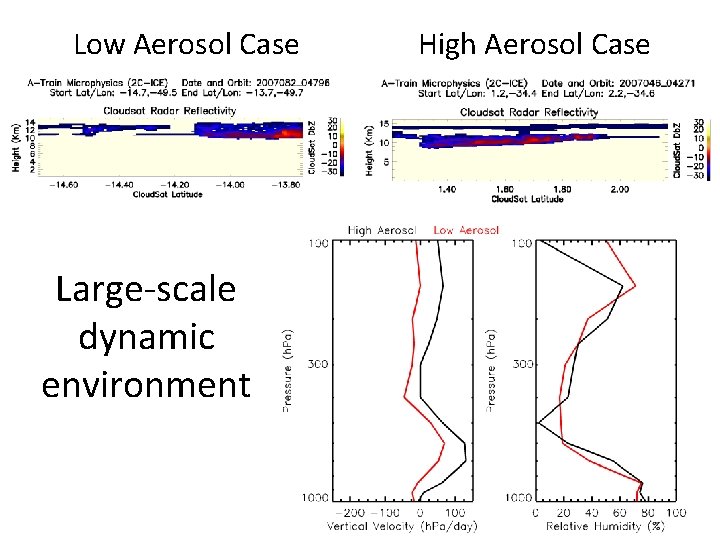
Low Aerosol Case Large-scale dynamic environment High Aerosol Case
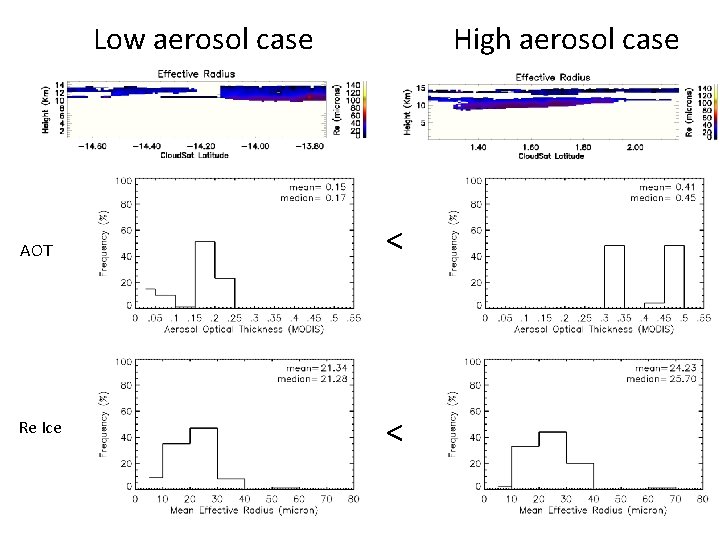
Low aerosol case AOT Re Ice High aerosol case < <
Conclusions • In both sets of cases we found that anvils with higher aerosol loading are characterized by larger ice effective radius (3 -6 microns) • Need to incorporate many cases to develop statistics • Use CALIPSO and OMI data for information about vertical distribution of aerosol and aerosol properties