
DOENNSA Office of Radiological Security ORS David Martin
- Slides: 17
DOE/NNSA Office of Radiological Security (ORS) David Martin, NNSA-ORS/Energetics Inc. 2019 Fall LLW Forum
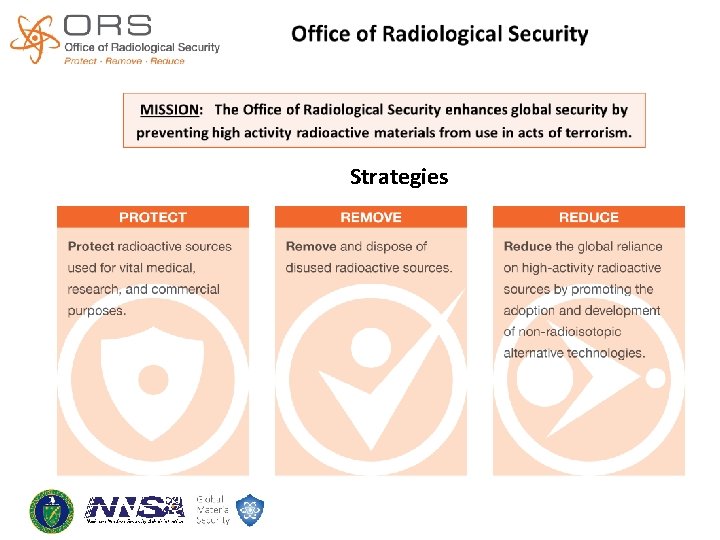
Strategies
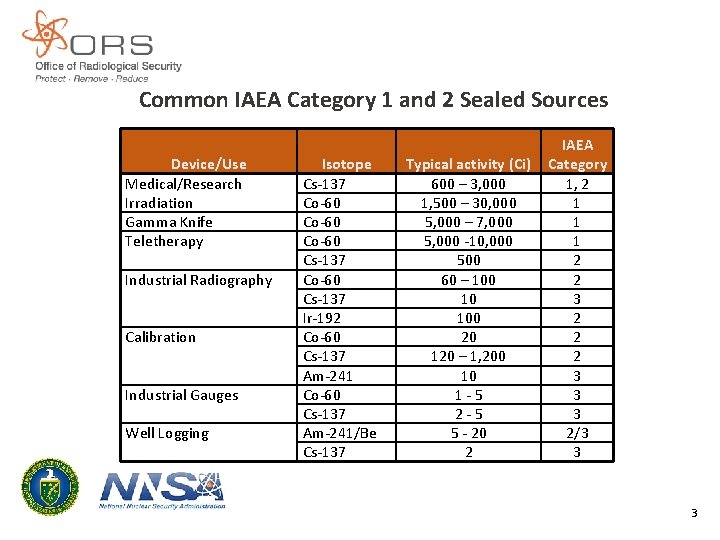
Common IAEA Category 1 and 2 Sealed Sources Device/Use Medical/Research Irradiation Gamma Knife Teletherapy Industrial Radiography Calibration Industrial Gauges Well Logging Isotope Cs-137 Co-60 Cs-137 Ir-192 Co-60 Cs-137 Am-241/Be Cs-137 Typical activity (Ci) 600 – 3, 000 1, 500 – 30, 000 5, 000 – 7, 000 5, 000 -10, 000 500 60 – 100 10 100 20 120 – 1, 200 10 1 -5 2 -5 5 - 20 2 IAEA Category 1, 2 1 1 1 2 2 3 2 2 2 3 3 3 2/3 3 3
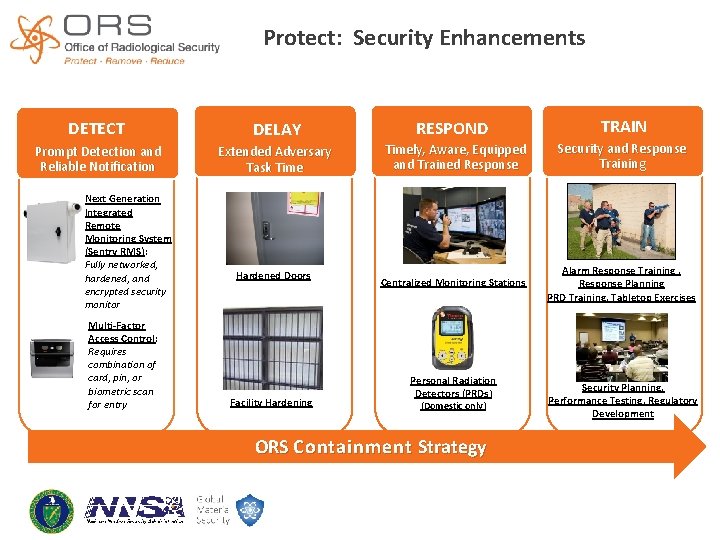
Protect: Security Enhancements DETECT DELAY RESPOND TRAIN Prompt Detection and Reliable Notification Extended Adversary Task Timely, Aware, Equipped and Trained Response Security and Response Training Centralized Monitoring Stations Alarm Response Training. Response Planning PRD Training, Tabletop Exercises Next Generation Integrated Remote Monitoring System (Sentry RMS): Fully networked, hardened, and encrypted security monitor Multi-Factor Access Control: Requires combination of card, pin, or biometric scan for entry Hardened Doors Facility Hardening Personal Radiation Detectors (PRDs) (Domestic only) ORS Containment Strategy Security Planning, Performance Testing, Regulatory Development
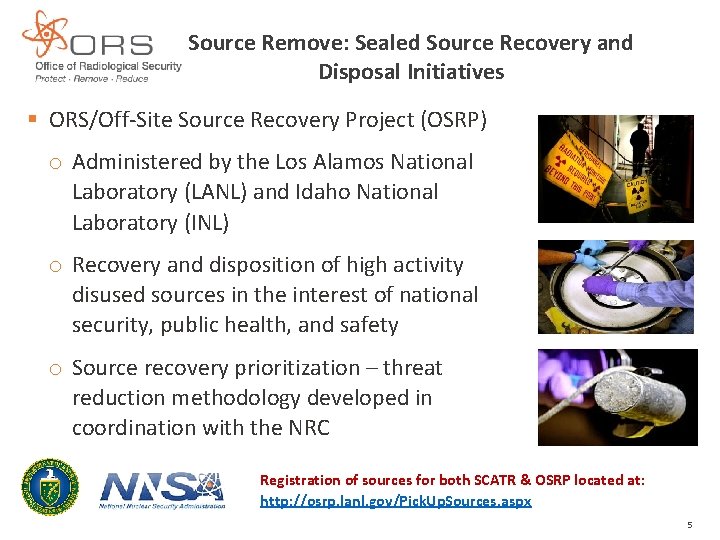
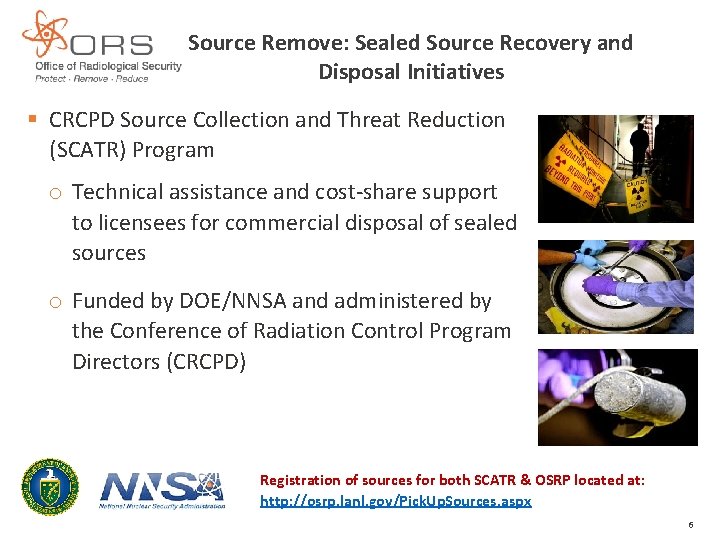
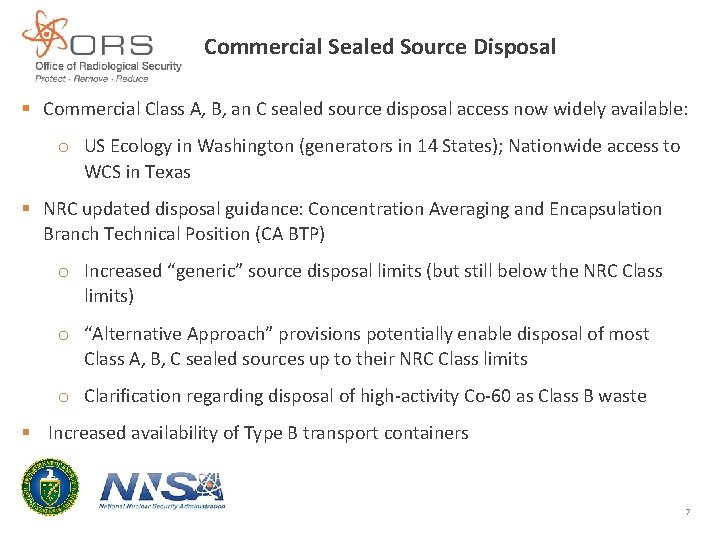
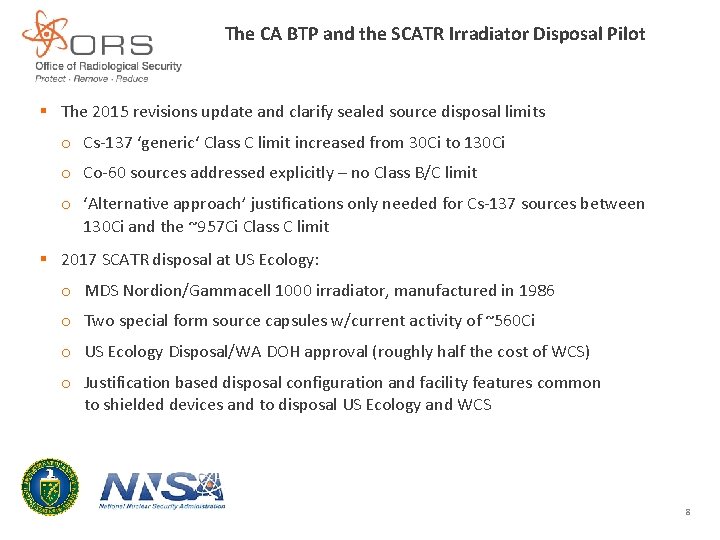
Source Remove: Sealed Source Recovery and Disposal Initiatives § ORS/Off-Site Source Recovery Project (OSRP) o Administered by the Los Alamos National Laboratory (LANL) and Idaho National Laboratory (INL) o Recovery and disposition of high activity disused sources in the interest of national security, public health, and safety o Source recovery prioritization – threat reduction methodology developed in coordination with the NRC Registration of sources for both SCATR & OSRP located at: http: //osrp. lanl. gov/Pick. Up. Sources. aspx 5
Source Remove: Sealed Source Recovery and Disposal Initiatives § CRCPD Source Collection and Threat Reduction (SCATR) Program o Technical assistance and cost-share support to licensees for commercial disposal of sealed sources o Funded by DOE/NNSA and administered by the Conference of Radiation Control Program Directors (CRCPD) Registration of sources for both SCATR & OSRP located at: http: //osrp. lanl. gov/Pick. Up. Sources. aspx 6
Commercial Sealed Source Disposal § Commercial Class A, B, an C sealed source disposal access now widely available: o US Ecology in Washington (generators in 14 States); Nationwide access to WCS in Texas § NRC updated disposal guidance: Concentration Averaging and Encapsulation Branch Technical Position (CA BTP) o Increased “generic” source disposal limits (but still below the NRC Class limits) o “Alternative Approach” provisions potentially enable disposal of most Class A, B, C sealed sources up to their NRC Class limits o Clarification regarding disposal of high-activity Co-60 as Class B waste § Increased availability of Type B transport containers 7
The CA BTP and the SCATR Irradiator Disposal Pilot § The 2015 revisions update and clarify sealed source disposal limits o Cs-137 ‘generic‘ Class C limit increased from 30 Ci to 130 Ci o Co-60 sources addressed explicitly – no Class B/C limit o ‘Alternative approach’ justifications only needed for Cs-137 sources between 130 Ci and the ~957 Ci Class C limit § 2017 SCATR disposal at US Ecology: o MDS Nordion/Gammacell 1000 irradiator, manufactured in 1986 o Two special form source capsules w/current activity of ~560 Ci o US Ecology Disposal/WA DOH approval (roughly half the cost of WCS) o Justification based disposal configuration and facility features common to shielded devices and to disposal US Ecology and WCS 8
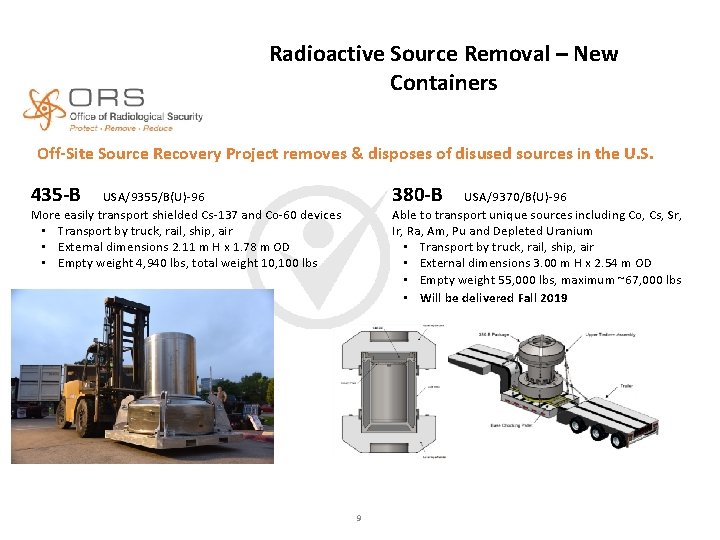
Radioactive Source Removal – New Containers Off-Site Source Recovery Project removes & disposes of disused sources in the U. S. 435 -B 380 -B USA/9355/B(U)-96 More easily transport shielded Cs-137 and Co-60 devices • Transport by truck, rail, ship, air • External dimensions 2. 11 m H x 1. 78 m OD • Empty weight 4, 940 lbs, total weight 10, 100 lbs USA/9370/B(U)-96 Able to transport unique sources including Co, Cs, Sr, Ir, Ra, Am, Pu and Depleted Uranium • Transport by truck, rail, ship, air • External dimensions 3. 00 m H x 2. 54 m OD • Empty weight 55, 000 lbs, maximum ~67, 000 lbs • Will be delivered Fall 2019 9
Remaining Challenges § Greater-than-Class C (GTCC) commercial disposal not yet available o NRC draft regulatory basis review underway § Impact of the 2015 NRC BTP sealed source provisions remains uncertain: o Limited use to date of the “Alternative Approaches” for disposal of high-activity Class B/C sources o Alternative approach pilots o Commercial disposal of sources is a significant expense for generators relative to storage § Disposal of foreign origin transuranic sources remains problematic 10
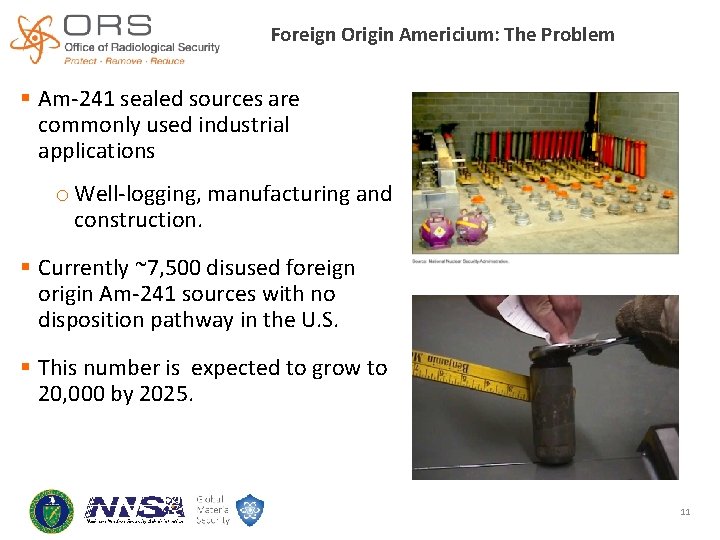
Foreign Origin Americium: The Problem § Am-241 sealed sources are commonly used industrial applications o Well-logging, manufacturing and construction. § Currently ~7, 500 disused foreign origin Am-241 sources with no disposition pathway in the U. S. § This number is expected to grow to 20, 000 by 2025. 11
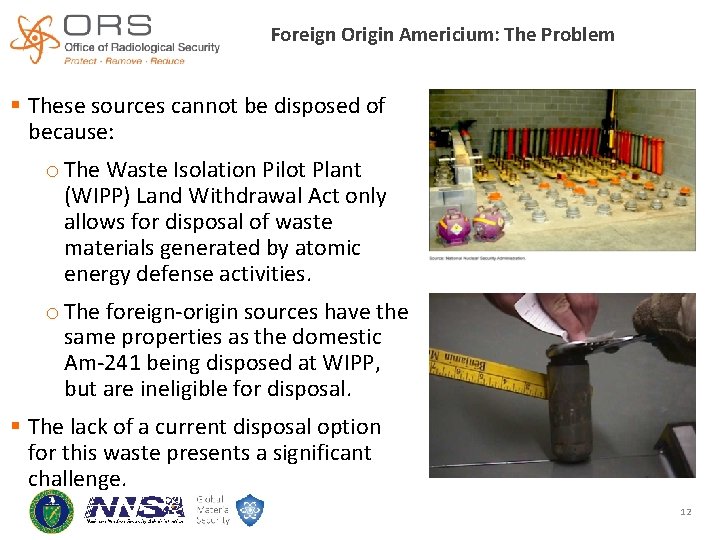
Foreign Origin Americium: The Problem § These sources cannot be disposed of because: o The Waste Isolation Pilot Plant (WIPP) Land Withdrawal Act only allows for disposal of waste materials generated by atomic energy defense activities. o The foreign-origin sources have the same properties as the domestic Am-241 being disposed at WIPP, but are ineligible for disposal. § The lack of a current disposal option for this waste presents a significant challenge. 12
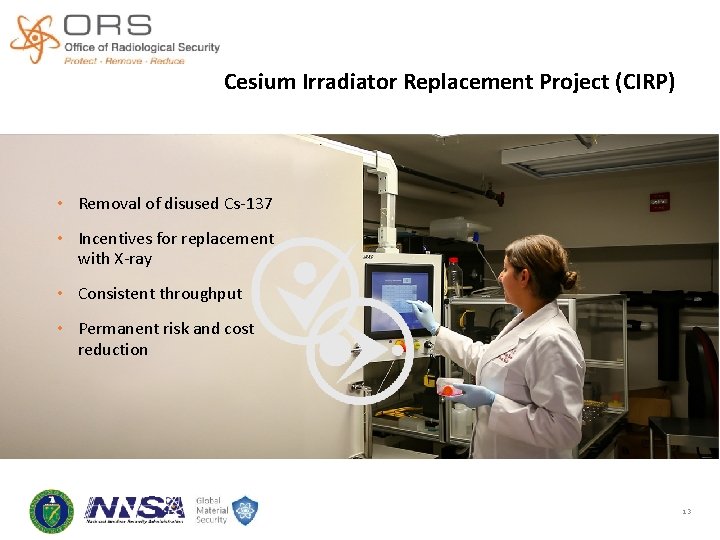
Cesium Irradiator Replacement Project (CIRP) • Removal of disused Cs-137 • Incentives for replacement with X-ray • Consistent throughput • Permanent risk and cost reduction 13
Congressional Support for Permanent Risk Reduction § The FY 19 National Defense Authorization Act sets the goal of eliminating cesium blood irradiators in the US by the end of 2027. § This is a voluntary effort for owners of blood irradiation devices. § Our ability to meet the 2027 goal is dependent on continued funding and volunteers. § The Authorization Act supports the established CIRP incentive structure and process 14
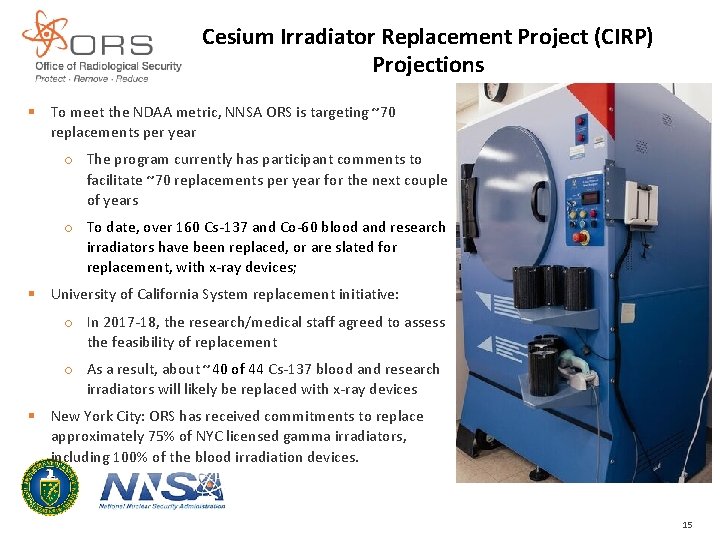
Cesium Irradiator Replacement Project (CIRP) Projections § To meet the NDAA metric, NNSA ORS is targeting ~70 replacements per year o The program currently has participant comments to facilitate ~70 replacements per year for the next couple of years o To date, over 160 Cs-137 and Co-60 blood and research irradiators have been replaced, or are slated for replacement, with x-ray devices; § University of California System replacement initiative: o In 2017 -18, the research/medical staff agreed to assess the feasibility of replacement o As a result, about ~40 of 44 Cs-137 blood and research irradiators will likely be replaced with x-ray devices § New York City: ORS has received commitments to replace approximately 75% of NYC licensed gamma irradiators, including 100% of the blood irradiation devices. 15
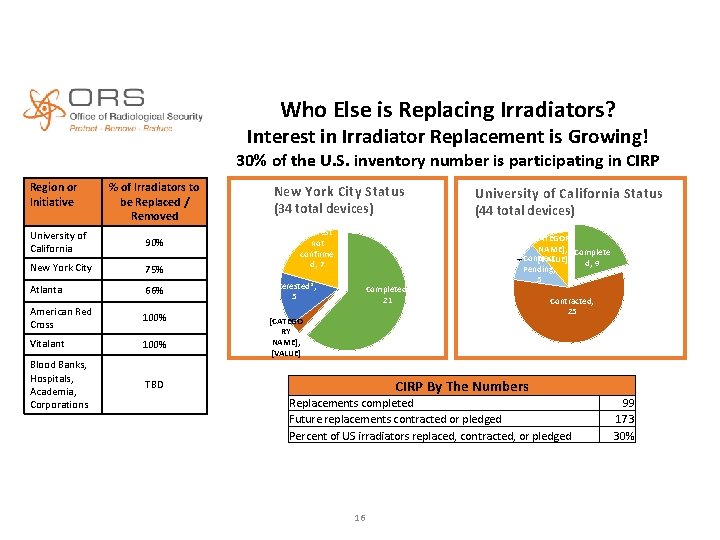
Who Else is Replacing Irradiators? Interest in Irradiator Replacement is Growing! 30% of the U. S. inventory number is participating in CIRP Region or Initiative % of Irradiators to be Replaced / Removed University of California 90% New York City 75% Atlanta 66% American Red Cross 100% Vitalant 100% Blood Banks, Hospitals, Academia, Corporations New York City Status (34 total devices) Interest not confirme d; 7 Interested*; 5 Completed; 21 University of California Status (44 total devices) [CATEGORY NAME], Complete Contract [VALUE] d; 9 Pending; 5 [CATEGO RY NAME], [VALUE] Contracted; 25 CIRP By The Numbers TBD Replacements completed Future replacements contracted or pledged Percent of US irradiators replaced, contracted, or pledged 16 99 173 30%
Questions? Temeka Taplin Federal Program Manager temeka. Taplin@nnsa. doe. gov (202) 586 -9265 17