
Documenting Teacher Performance 0 May 2011 0 Teacher


- Slides: 18
Documenting Teacher Performance 0 May 2011 0
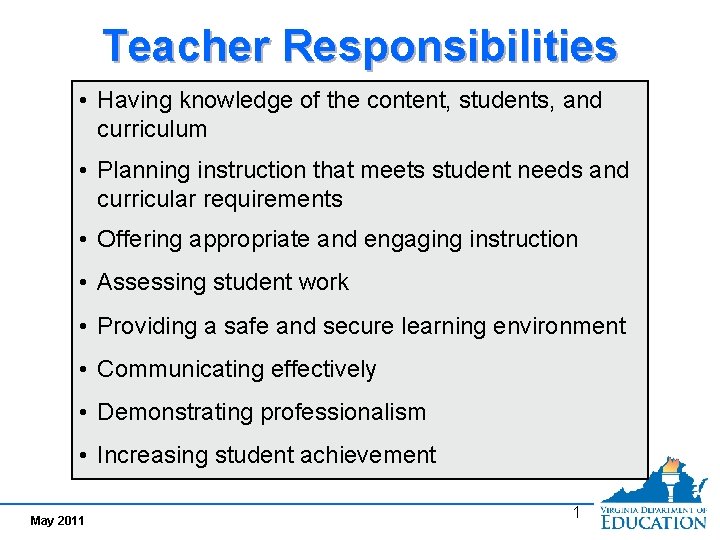
Teacher Responsibilities • Having knowledge of the content, students, and curriculum • Planning instruction that meets student needs and curricular requirements • Offering appropriate and engaging instruction • Assessing student work • Providing a safe and secure learning environment • Communicating effectively • Demonstrating professionalism • Increasing student achievement May 2011 1
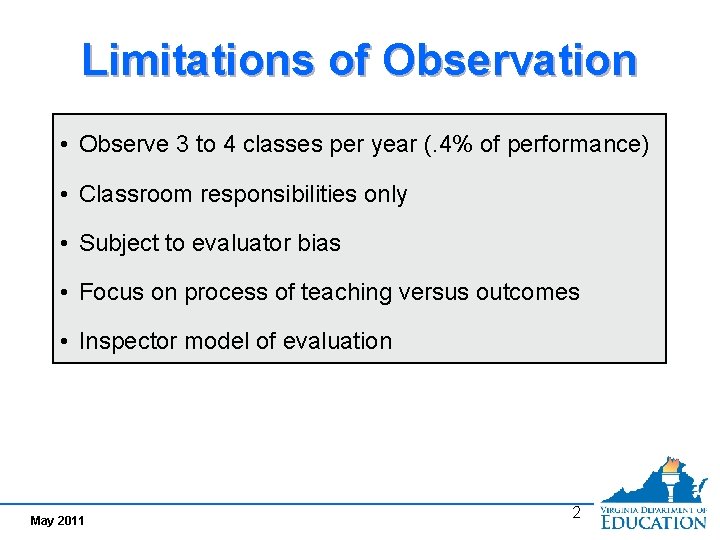
Limitations of Observation • Observe 3 to 4 classes per year (. 4% of performance) • Classroom responsibilities only • Subject to evaluator bias • Focus on process of teaching versus outcomes • Inspector model of evaluation May 2011 2
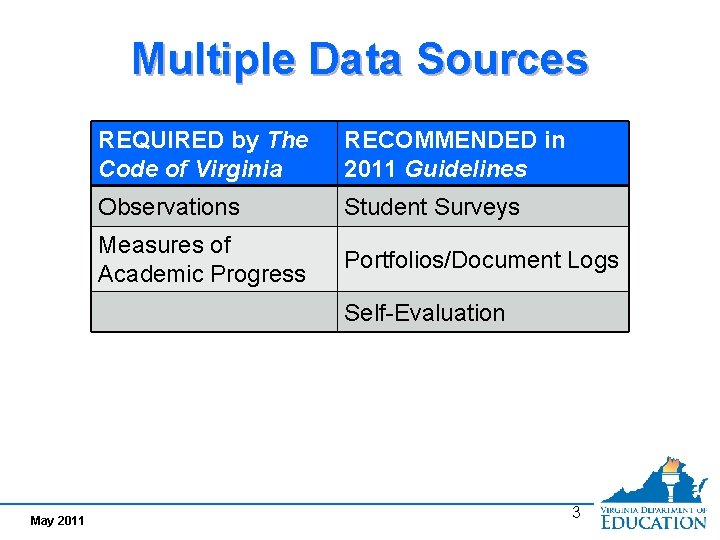
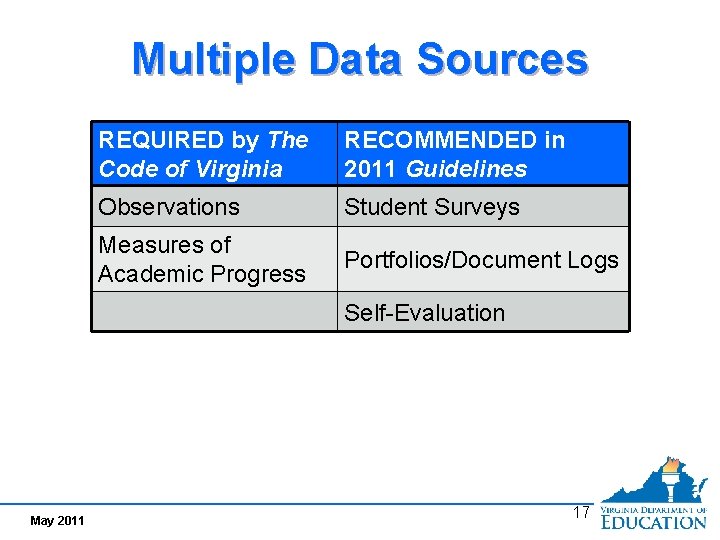
Multiple Data Sources REQUIRED by The Code of Virginia RECOMMENDED in 2011 Guidelines Observations Student Surveys Measures of Academic Progress Portfolios/Document Logs Self-Evaluation May 2011 3
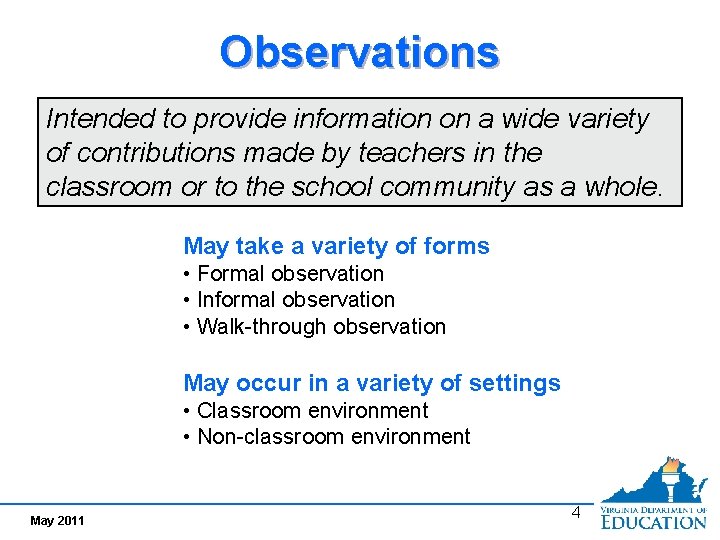
Observations Intended to provide information on a wide variety of contributions made by teachers in the classroom or to the school community as a whole. May take a variety of forms • Formal observation • Informal observation • Walk-through observation May occur in a variety of settings • Classroom environment • Non-classroom environment May 2011 4
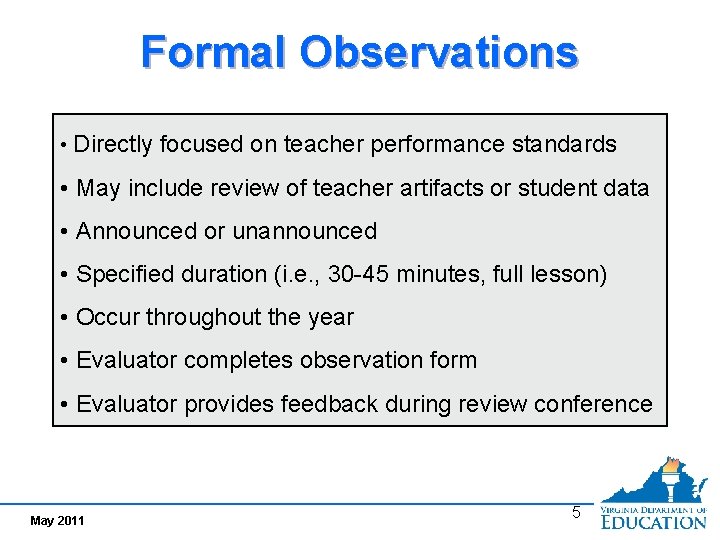
Formal Observations • Directly focused on teacher performance standards • May include review of teacher artifacts or student data • Announced or unannounced • Specified duration (i. e. , 30 -45 minutes, full lesson) • Occur throughout the year • Evaluator completes observation form • Evaluator provides feedback during review conference May 2011 5
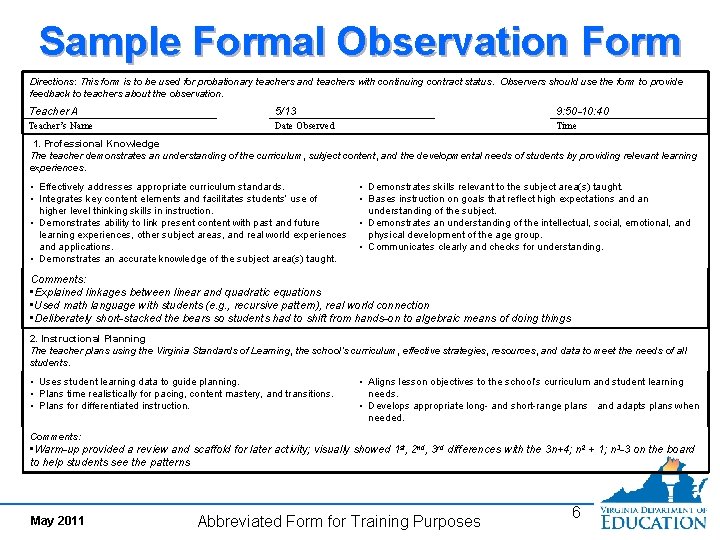
Sample Formal Observation Form Directions: This form is to be used for probationary teachers and teachers with continuing contract status. Observers should use the form to provide feedback to teachers about the observation. Teacher A 5/13 9: 50 -10: 40 Teacher’s Name Date Observed Time 1. Professional Knowledge The teacher demonstrates an understanding of the curriculum, subject content, and the developmental needs of students by providing relevant learning experiences. • Effectively addresses appropriate curriculum standards. • Integrates key content elements and facilitates students’ use of higher level thinking skills in instruction. • Demonstrates ability to link present content with past and future learning experiences, other subject areas, and real world experiences and applications. • Demonstrates an accurate knowledge of the subject area(s) taught. • Demonstrates skills relevant to the subject area(s) taught. • Bases instruction on goals that reflect high expectations and an understanding of the subject. • Demonstrates an understanding of the intellectual, social, emotional, and physical development of the age group. • Communicates clearly and checks for understanding. Comments: • Explained linkages between linear and quadratic equations • Used math language with students (e. g. , recursive pattern), real world connection • Deliberately short-stacked the bears so students had to shift from hands-on to algebraic means of doing things 2. Instructional Planning The teacher plans using the Virginia Standards of Learning, the school’s curriculum, effective strategies, resources, and data to meet the needs of all students. • Uses student learning data to guide planning. • Plans time realistically for pacing, content mastery, and transitions. • Plans for differentiated instruction. • Aligns lesson objectives to the school’s curriculum and student learning needs. • Develops appropriate long- and short-range plans and adapts plans when needed. Comments: • Warm-up provided a review and scaffold for later activity; visually showed 1 st, 2 nd, 3 rd differences with the 3 n+4; n 2 + 1; n 3 -3 on the board to help students see the patterns May 2011 Abbreviated Form for Training Purposes 6
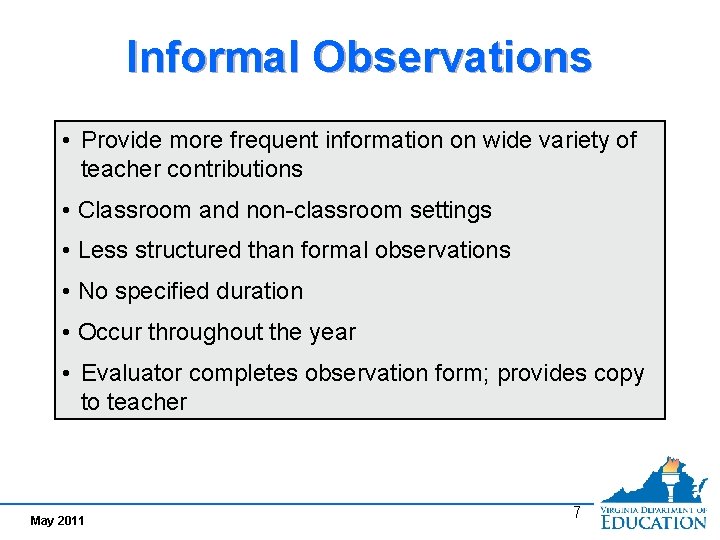
Informal Observations • Provide more frequent information on wide variety of teacher contributions • Classroom and non-classroom settings • Less structured than formal observations • No specified duration • Occur throughout the year • Evaluator completes observation form; provides copy to teacher May 2011 7
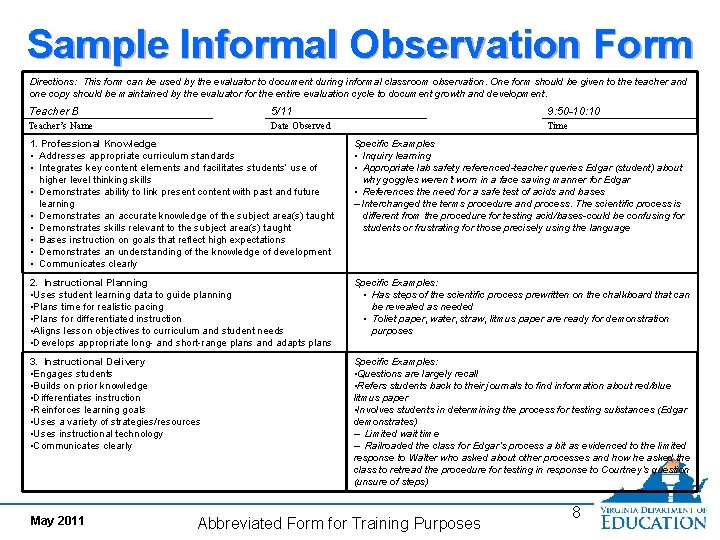
Sample Informal Observation Form Directions: This form can be used by the evaluator to document during informal classroom observation. One form should be given to the teacher and one copy should be maintained by the evaluator for the entire evaluation cycle to document growth and development. Teacher B 5/11 9: 50 -10: 10 Teacher’s Name Date Observed Time 1. Professional Knowledge • Addresses appropriate curriculum standards • Integrates key content elements and facilitates students’ use of higher level thinking skills • Demonstrates ability to link present content with past and future learning • Demonstrates an accurate knowledge of the subject area(s) taught • Demonstrates skills relevant to the subject area(s) taught • Bases instruction on goals that reflect high expectations • Demonstrates an understanding of the knowledge of development • Communicates clearly Specific Examples • Inquiry learning • Appropriate lab safety referenced-teacher queries Edgar (student) about why goggles weren’t worn in a face saving manner for Edgar • References the need for a safe test of acids and bases – Interchanged the terms procedure and process. The scientific process is different from the procedure for testing acid/bases-could be confusing for students or frustrating for those precisely using the language 2. Instructional Planning • Uses student learning data to guide planning • Plans time for realistic pacing • Plans for differentiated instruction • Aligns lesson objectives to curriculum and student needs • Develops appropriate long- and short-range plans and adapts plans Specific Examples: • Has steps of the scientific process prewritten on the chalkboard that can be revealed as needed • Toliet paper, water, straw, litmus paper are ready for demonstration purposes 3. Instructional Delivery • Engages students • Builds on prior knowledge • Differentiates instruction • Reinforces learning goals • Uses a variety of strategies/resources • Uses instructional technology • Communicates clearly Specific Examples: • Questions are largely recall • Refers students back to their journals to find information about red/blue litmus paper • Involves students in determining the process for testing substances (Edgar demonstrates) – Limited wait time – Railroaded the class for Edgar’s process a bit as evidenced to the limited response to Walter who asked about other processes and how he asked the class to retread the procedure for testing in response to Courtney’s question (unsure of steps) May 2011 Abbreviated Form for Training Purposes 8
Walk-Through Observations • Provide a means to document and assess practices and trends throughout a school • Typically brief (3 -5 min) visits in multiple classrooms • Not designed for individual teacher evaluation May 2011 9
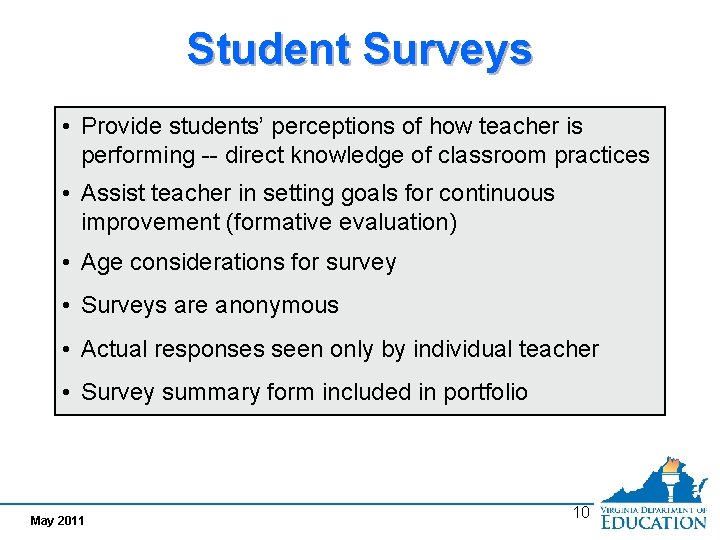
Student Surveys • Provide students’ perceptions of how teacher is performing -- direct knowledge of classroom practices • Assist teacher in setting goals for continuous improvement (formative evaluation) • Age considerations for survey • Surveys are anonymous • Actual responses seen only by individual teacher • Survey summary form included in portfolio May 2011 10
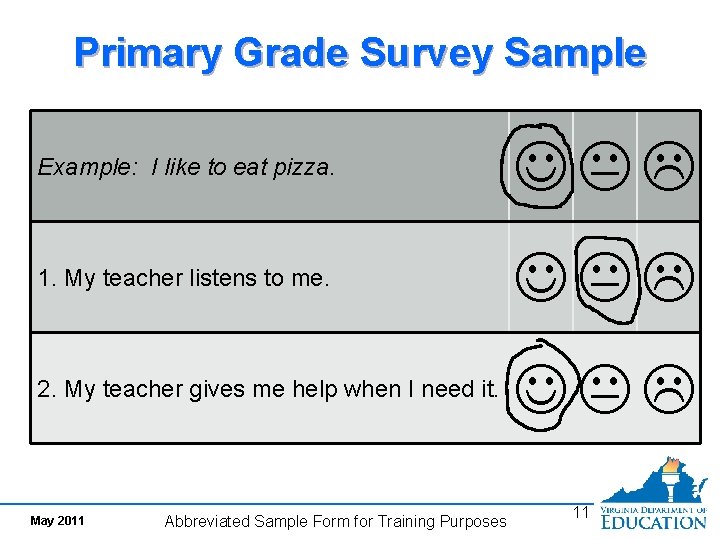
Primary Grade Survey Sample Example: I like to eat pizza. 1. My teacher listens to me. 2. My teacher gives me help when I need it. May 2011 Abbreviated Sample Form for Training Purposes 11
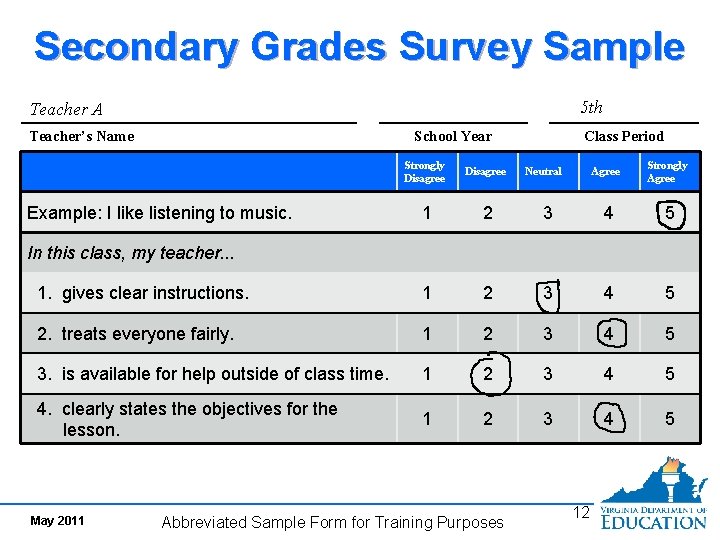
Secondary Grades Survey Sample 5 th Teacher A Teacher’s Name School Year Class Period Strongly Disagree 1 2 3 4 5 1. gives clear instructions. 1 2 3 4 5 2. treats everyone fairly. 1 2 3 4 5 3. is available for help outside of class time. 1 2 3 4 5 4. clearly states the objectives for the lesson. 1 2 3 4 5 Example: I like listening to music. Neutral Agree Strongly Agree In this class, my teacher. . . May 2011 Abbreviated Sample Form for Training Purposes 12
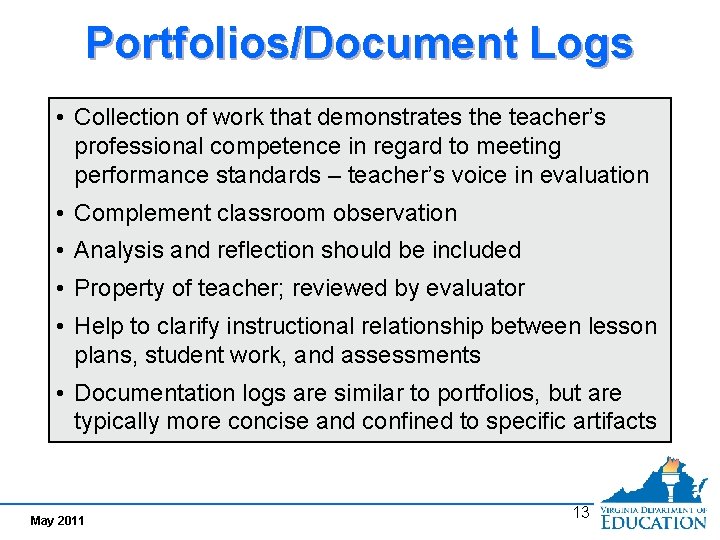
Portfolios/Document Logs • Collection of work that demonstrates the teacher’s professional competence in regard to meeting performance standards – teacher’s voice in evaluation • Complement classroom observation • Analysis and reflection should be included • Property of teacher; reviewed by evaluator • Help to clarify instructional relationship between lesson plans, student work, and assessments • Documentation logs are similar to portfolios, but are typically more concise and confined to specific artifacts May 2011 13
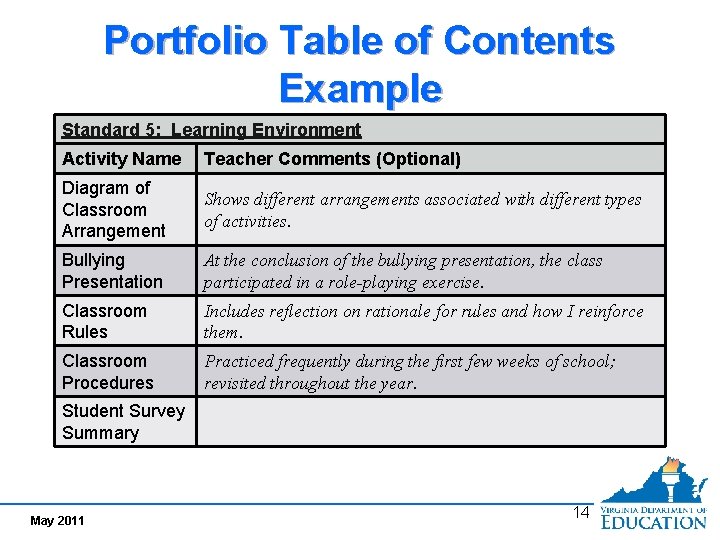
Portfolio Table of Contents Example Standard 5: Learning Environment Activity Name Teacher Comments (Optional) Diagram of Classroom Arrangement Shows different arrangements associated with different types of activities. Bullying Presentation At the conclusion of the bullying presentation, the class participated in a role-playing exercise. Classroom Rules Includes reflection on rationale for rules and how I reinforce them. Classroom Procedures Practiced frequently during the first few weeks of school; revisited throughout the year. Student Survey Summary May 2011 14
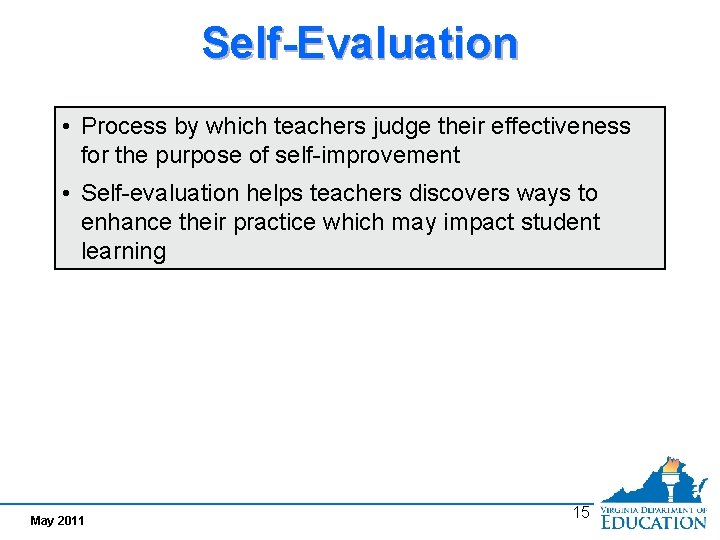
Self-Evaluation • Process by which teachers judge their effectiveness for the purpose of self-improvement • Self-evaluation helps teachers discovers ways to enhance their practice which may impact student learning May 2011 15
Self-Evaluation Example Directions: Teachers should use this form annually to reflect on the effectiveness and adequacy of their practice based on each performance standard. Please refer to the performance indicators for examples of behaviors exemplifying each standard. Teacher’s Name: Teacher D Date: 2/1/11 1. Professional Knowledge The teacher demonstrates an understanding of the curriculum, subject content, and the developmental needs of students by providing relevant learning experiences. Areas of strength: I have a good understanding of the vertical articulation within my content area; I understand how students’ developmental levels impact their readiness to learn certain math concepts. Areas needing work/strategies for improving performance: I’m not sure how to appropriately challenge my gifted students. 2. Instructional Planning The teacher plans using the Virginia Standards of Learning, the school’s curriculum, effective strategies, resources, and data to meet the needs of all students. Areas of strength: I understand the most effective strategies to teach various curricular topics; I plan well ahead of time to make sure I have the necessary resources. Areas needing work/strategies for improving performance: I sometimes neglect to pre-assess students, which makes me less effective than I could be at addressing individual student needs. May 2011 Abbreviated Sample Form for Training Purposes 16
Multiple Data Sources REQUIRED by The Code of Virginia RECOMMENDED in 2011 Guidelines Observations Student Surveys Measures of Academic Progress Portfolios/Document Logs Self-Evaluation May 2011 17