
Documenting Sources for Personal Project Style guide A


- Slides: 23
Documenting Sources for Personal Project
Style guide: A style guide is a published manual that gives guidance on citation and references. Style guides also give advice on spelling, abbreviations, punctuation, and so on. While there are multiple style guides, INDUS suggests using the MLA format.
MLA FORMAT: Typed on white 8. 5“ x 11“ paper Double-spaced 12 pt. Times New Roman (or similar) font Only one space after punctuation All margins set to 1 inch on all sides Indent the first line of paragraphs one half-inch
MLA Format • Have a header with page numbers located in the upper righthand corner • Use italics for titles • Place endnotes on a separate page before the list of works cited
Difference between Citation, Reference and Bibliography Ø A citation is a method of making a reference in the body of an essay, either as an in-text citation or footnote/endnote. Ø Each entry in a bibliography are called a reference Ø An alphabetical list of all the references (sources) utilised in the process of completing the work is called a bibliography.
What to cite? Any ideas that aren’t yours (that you may have summarised, paraphrased, or quoted). These include: Facts, figures, ideas, words, theories, or exact language that another person used in other publications Books, book chapters, articles, web pages, theses, etc. Basic/Common knowledge in a field does not need to be cited.
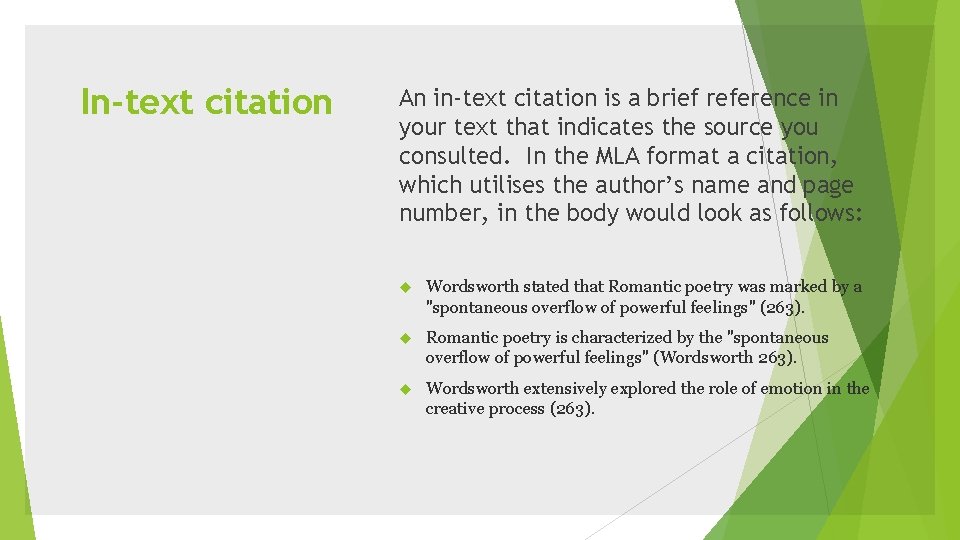
In-text citation An in-text citation is a brief reference in your text that indicates the source you consulted. In the MLA format a citation, which utilises the author’s name and page number, in the body would look as follows: Wordsworth stated that Romantic poetry was marked by a "spontaneous overflow of powerful feelings" (263). Romantic poetry is characterized by the "spontaneous overflow of powerful feelings" (Wordsworth 263). Wordsworth extensively explored the role of emotion in the creative process (263).
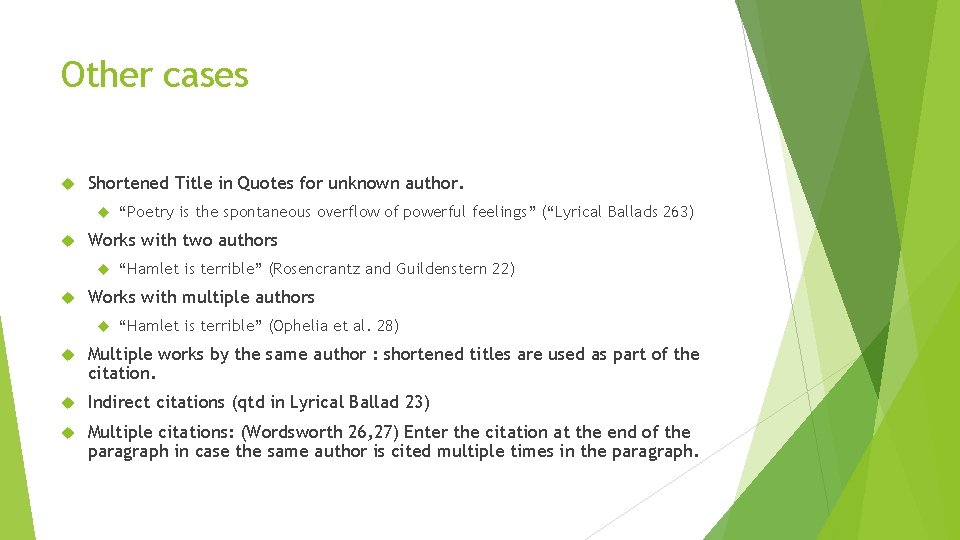
Other cases Shortened Title in Quotes for unknown author. Works with two authors “Poetry is the spontaneous overflow of powerful feelings” (“Lyrical Ballads 263) “Hamlet is terrible” (Rosencrantz and Guildenstern 22) Works with multiple authors “Hamlet is terrible” (Ophelia et al. 28) Multiple works by the same author : shortened titles are used as part of the citation. Indirect citations (qtd in Lyrical Ballad 23) Multiple citations: (Wordsworth 26, 27) Enter the citation at the end of the paragraph in case the same author is cited multiple times in the paragraph.
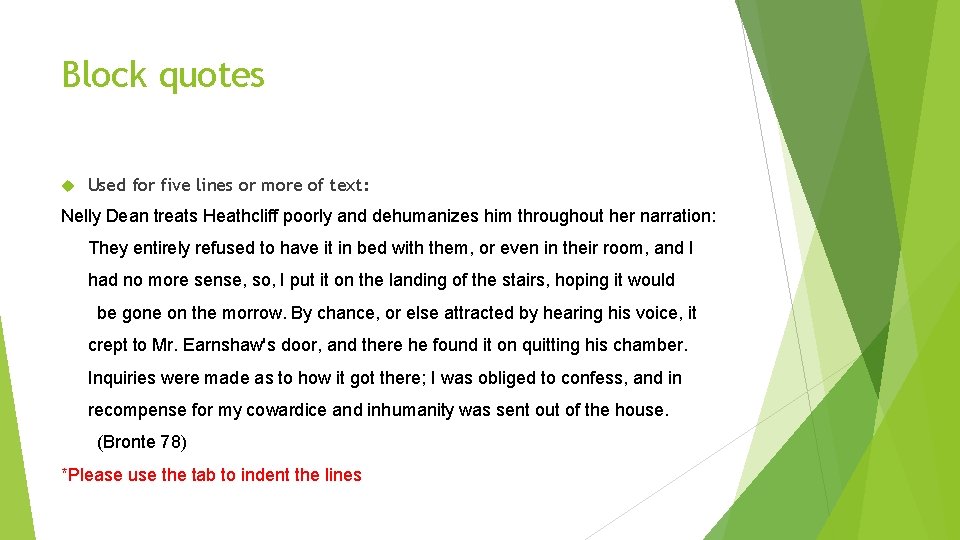
Block quotes Used for five lines or more of text: Nelly Dean treats Heathcliff poorly and dehumanizes him throughout her narration: They entirely refused to have it in bed with them, or even in their room, and I had no more sense, so, I put it on the landing of the stairs, hoping it would be gone on the morrow. By chance, or else attracted by hearing his voice, it crept to Mr. Earnshaw's door, and there he found it on quitting his chamber. Inquiries were made as to how it got there; I was obliged to confess, and in recompense for my cowardice and inhumanity was sent out of the house. (Bronte 78) *Please use the tab to indent the lines
Footnotes/End notes MLA generally discourages the overuse of footnotes/endnotes. They are used for two purposes: Content notes: to provide readers comment, explanation or information that cannot be included without interrupting the flow of the text. Bibliographic notes: To cite several sources or make evaluative comments on your sources. They are indicated in-text using superscript numbers AFTER the punctuation. Please see the below link for further information: https: //style. mla. org/using-notes-in-mla-style/ NOTE: MLA 8 does not specify how to format footnotes.
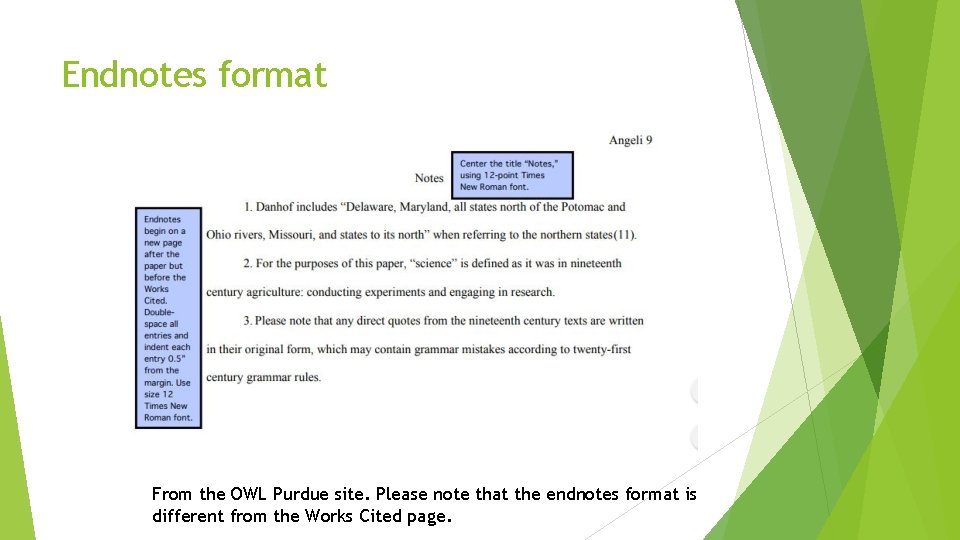
Endnotes format From the OWL Purdue site. Please note that the endnotes format is different from the Works Cited page.
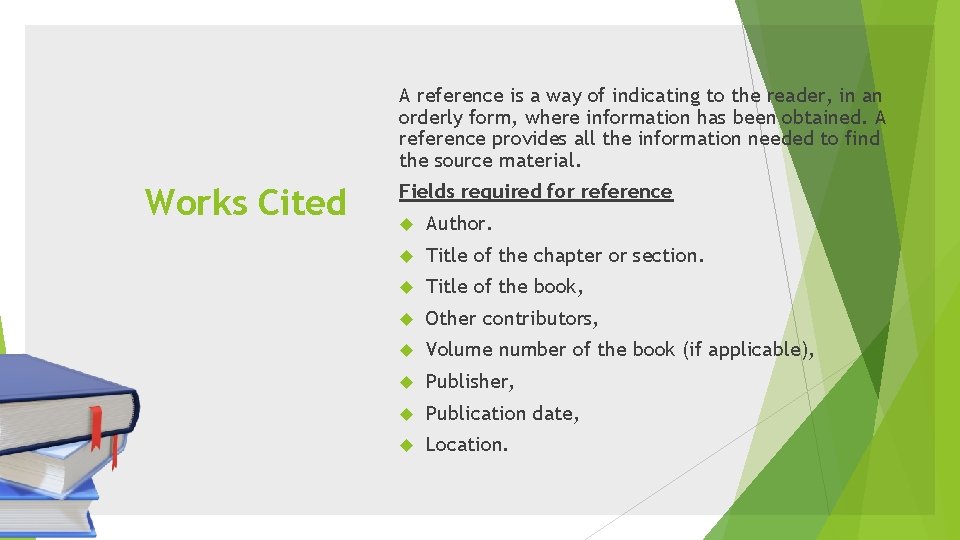
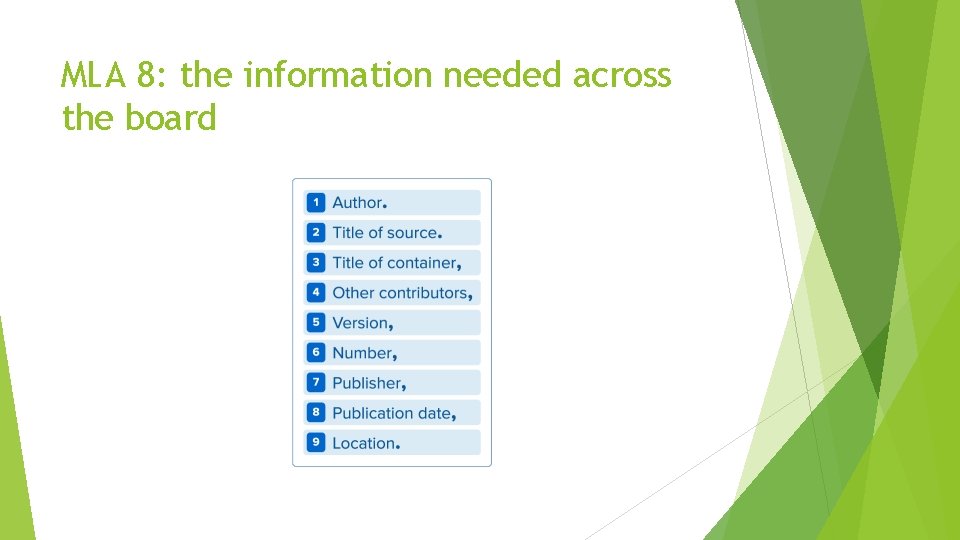
A reference is a way of indicating to the reader, in an orderly form, where information has been obtained. A reference provides all the information needed to find the source material. Works Cited Fields required for reference Author. Title of the chapter or section. Title of the book, Other contributors, Volume number of the book (if applicable), Publisher, Publication date, Location.
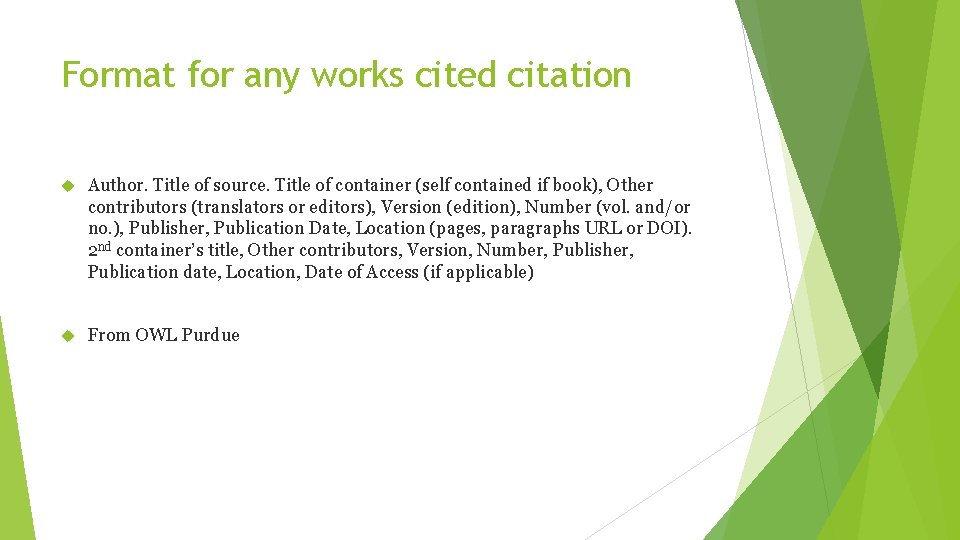
Format for any works cited citation Author. Title of source. Title of container (self contained if book), Other contributors (translators or editors), Version (edition), Number (vol. and/or no. ), Publisher, Publication Date, Location (pages, paragraphs URL or DOI). 2 nd container’s title, Other contributors, Version, Number, Publisher, Publication date, Location, Date of Access (if applicable) From OWL Purdue
MLA 8: the information needed across the board
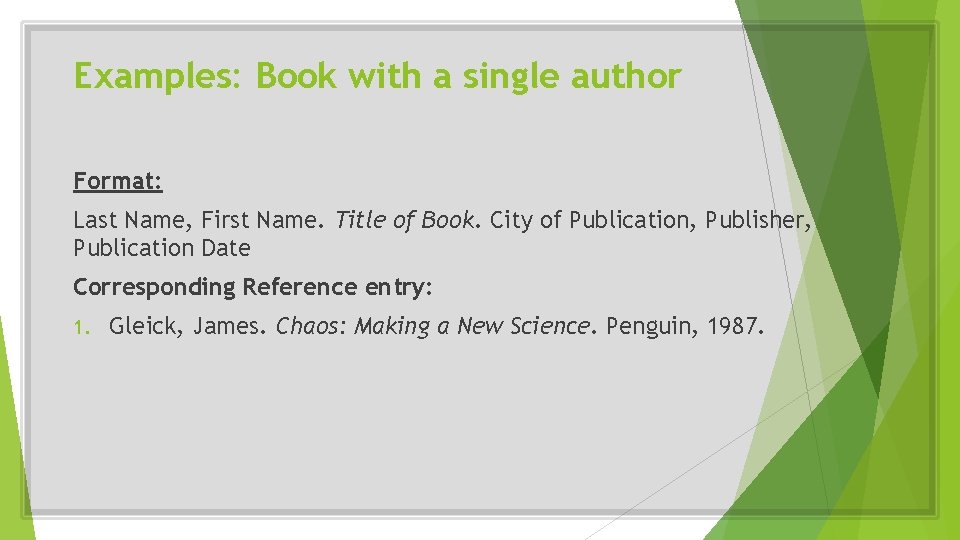
Examples: Book with a single author Format: Last Name, First Name. Title of Book. City of Publication, Publisher, Publication Date Corresponding Reference entry: 1. Gleick, James. Chaos: Making a New Science. Penguin, 1987.
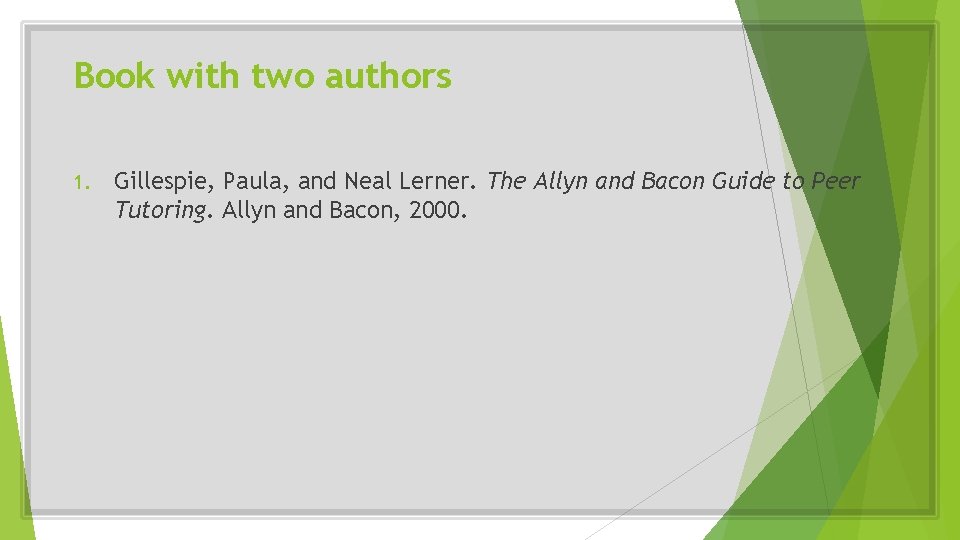
Book with two authors 1. Gillespie, Paula, and Neal Lerner. The Allyn and Bacon Guide to Peer Tutoring. Allyn and Bacon, 2000.
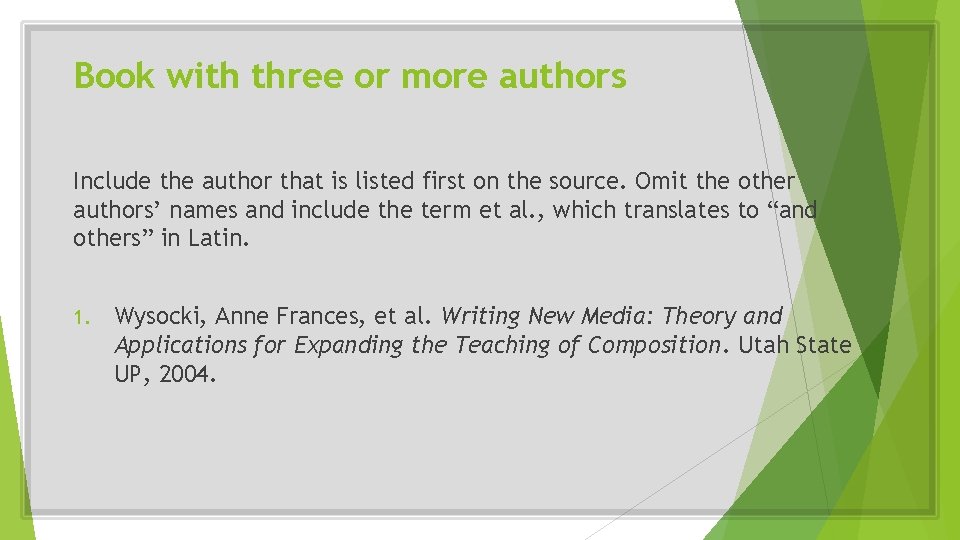
Book with three or more authors Include the author that is listed first on the source. Omit the other authors’ names and include the term et al. , which translates to “and others” in Latin. 1. Wysocki, Anne Frances, et al. Writing New Media: Theory and Applications for Expanding the Teaching of Composition. Utah State UP, 2004.
Other entries for books 1. Please check: https: //owl. purdue. edu/owl/research_and_citation/mla_style/mla_fo rmatting_and_style_guide/mla_works_cited_page_books. html
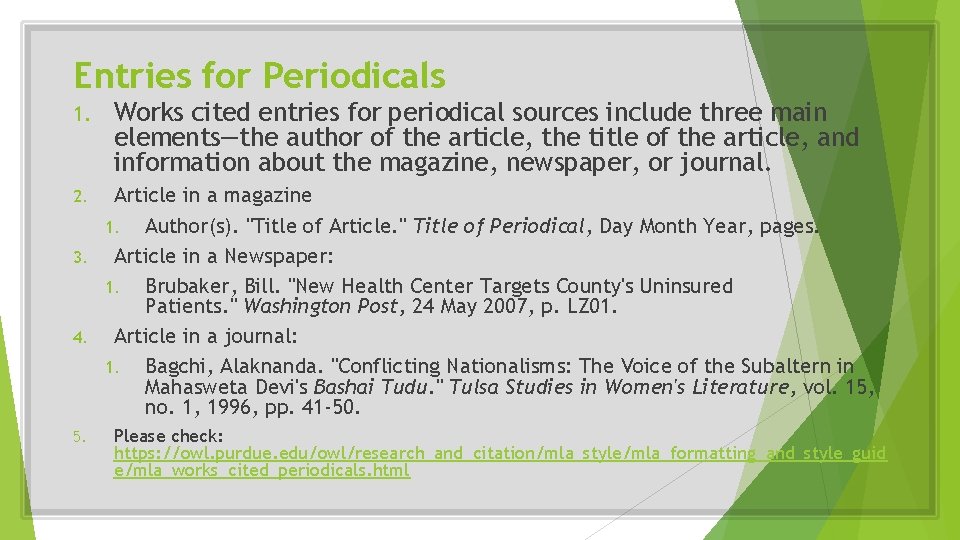
Entries for Periodicals 1. Works cited entries for periodical sources include three main elements—the author of the article, the title of the article, and information about the magazine, newspaper, or journal. Article in a magazine 1. Author(s). "Title of Article. " Title of Periodical, Day Month Year, pages. 3. Article in a Newspaper: 1. Brubaker, Bill. "New Health Center Targets County's Uninsured Patients. " Washington Post, 24 May 2007, p. LZ 01. 4. Article in a journal: 1. Bagchi, Alaknanda. "Conflicting Nationalisms: The Voice of the Subaltern in Mahasweta Devi's Bashai Tudu. " Tulsa Studies in Women's Literature, vol. 15, no. 1, 1996, pp. 41 -50. 2. 5. Please check: https: //owl. purdue. edu/owl/research_and_citation/mla_style/mla_formatting_and_style_guid e/mla_works_cited_periodicals. html
Entries for Electronic sources 1. https: //owl. purdue. edu/owl/research_and_citation/mla_style/mla_fo rmatting_and_style_guide/mla_works_cited_electronic_sources. html
MLA HELP https: //owl. purdue. edu/owl/research_and_citation/mla_style/mla_for matting_and_style_guide/mla_formatting_and_style_guide. html www. easybib. com Microsoft Word Citations (Use the reference feature in Microsoft Word)
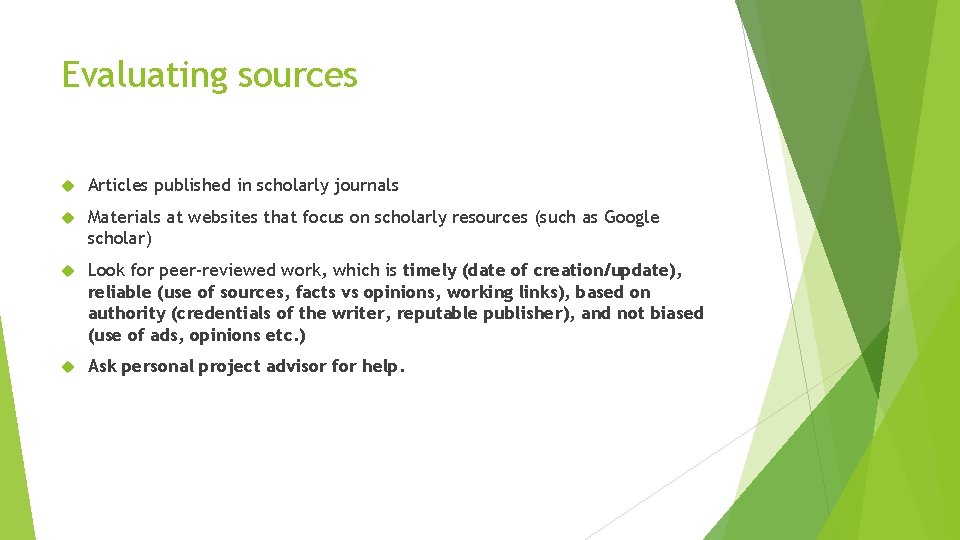
Evaluating sources Articles published in scholarly journals Materials at websites that focus on scholarly resources (such as Google scholar) Look for peer-reviewed work, which is timely (date of creation/update), reliable (use of sources, facts vs opinions, working links), based on authority (credentials of the writer, reputable publisher), and not biased (use of ads, opinions etc. ) Ask personal project advisor for help.
Thank you