
Documenting Research Sources Bibliography Footnotes Purpose of Bibliography

Documenting Research Sources Bibliography & Footnotes

Purpose of Bibliography and Notes To provide basic information to document the sources used in the paper n To enable readers to check the context & facts in your sources n To provide a road map to further study for others with an interest in the topic n To demonstrate careful attention to detail n To give credit to the sources you used n
Comparison n Bibliography – is meant to identify a work in full detail (author, title, etc. ) n Footnote, endnote or parenthetical reference note – primary purpose is to inform the reader of the particular location cited information was taken from in the source
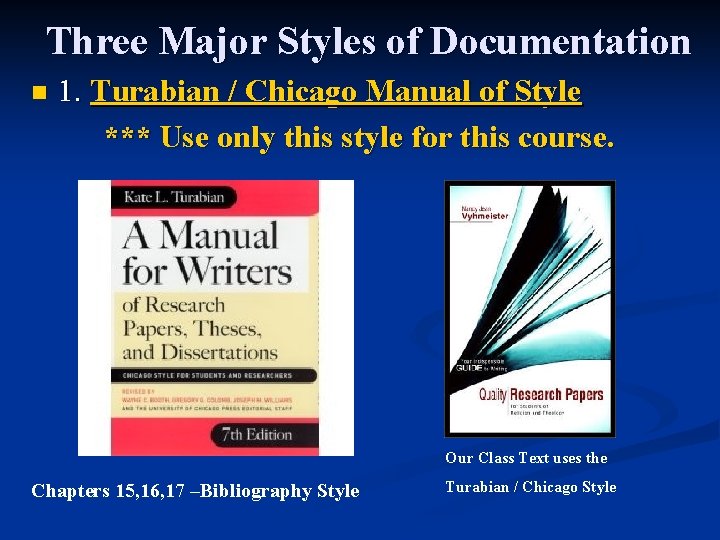
Three Major Styles of Documentation n 1. Turabian / Chicago Manual of Style *** Use only this style for this course. Our Class Text uses the Chapters 15, 16, 17 –Bibliography Style Turabian / Chicago Style

Turabian & Chicago Style n Turabian, Kate L. A Manual for Writers of Term Papers, Theses, and Dissertations. 7 th edition. Chicago: University of Chicago Press, 2007. n The Chicago Manual of Style. 15 th edition, revised and expanded. Chicago: University of Chicago Press, 2003.
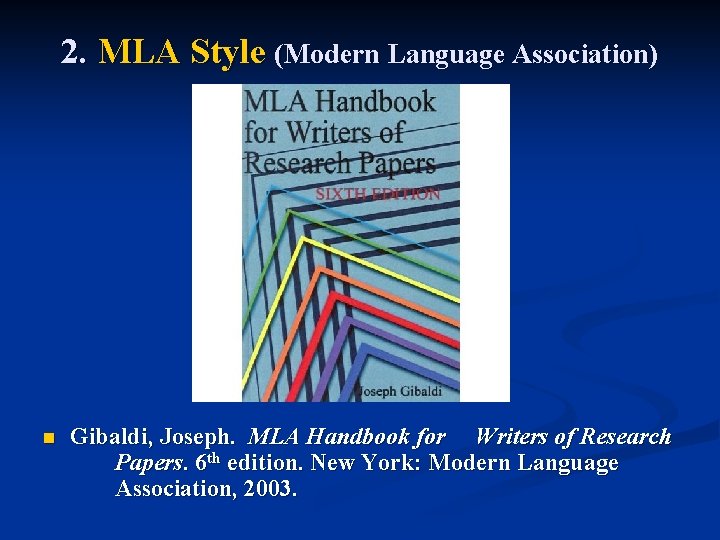
2. MLA Style (Modern Language Association) n Gibaldi, Joseph. MLA Handbook for Writers of Research Papers. 6 th edition. New York: Modern Language Association, 2003.
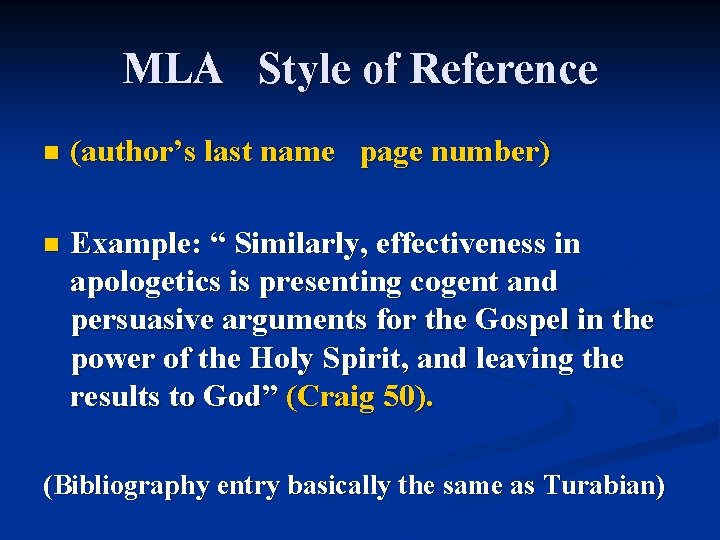
MLA Style of Reference n (author’s last name page number) n Example: “ Similarly, effectiveness in apologetics is presenting cogent and persuasive arguments for the Gospel in the power of the Holy Spirit, and leaving the results to God” (Craig 50). (Bibliography entry basically the same as Turabian)

3. APA Style (American Psychological Association) n American Psychological Association. Publication Manual. 5 th edition. Washington: APA, 2001.
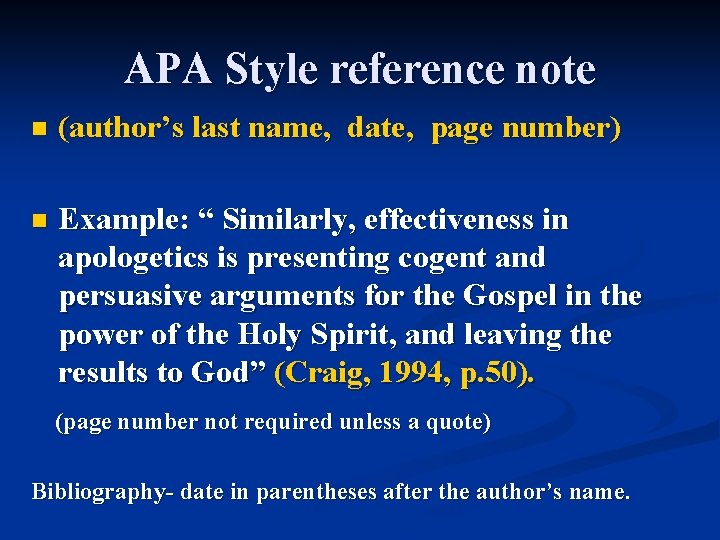
APA Style reference note n (author’s last name, date, page number) n Example: “ Similarly, effectiveness in apologetics is presenting cogent and persuasive arguments for the Gospel in the power of the Holy Spirit, and leaving the results to God” (Craig, 1994, p. 50). (page number not required unless a quote) Bibliography- date in parentheses after the author’s name.
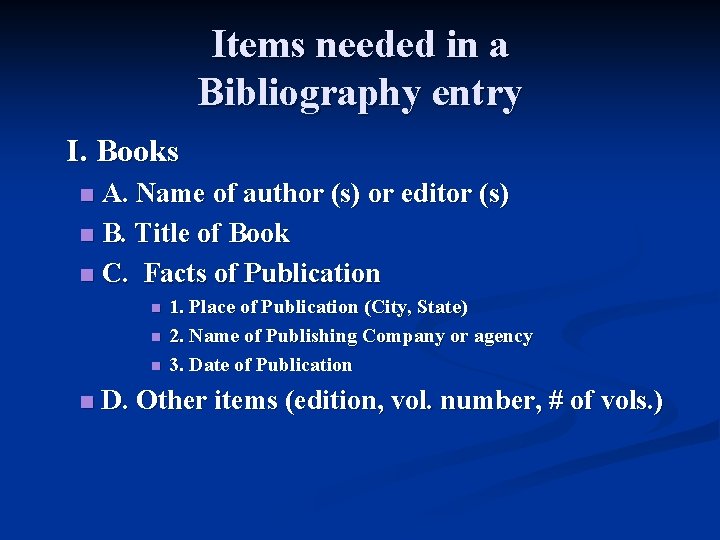
Items needed in a Bibliography entry I. Books A. Name of author (s) or editor (s) n B. Title of Book n C. Facts of Publication n n 1. Place of Publication (City, State) 2. Name of Publishing Company or agency 3. Date of Publication D. Other items (edition, vol. number, # of vols. )
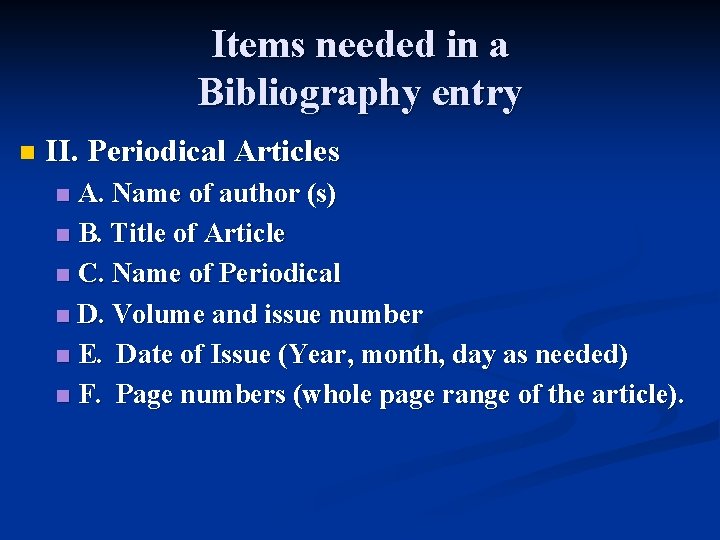
Items needed in a Bibliography entry n II. Periodical Articles A. Name of author (s) n B. Title of Article n C. Name of Periodical n D. Volume and issue number n E. Date of Issue (Year, month, day as needed) n F. Page numbers (whole page range of the article). n
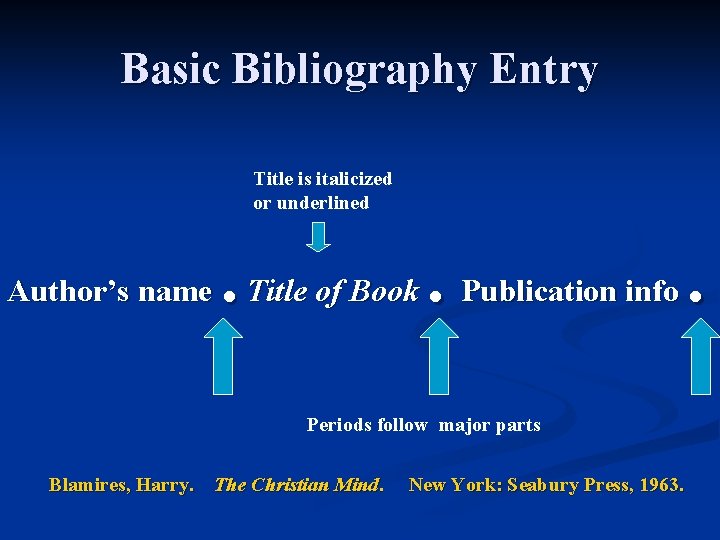
Basic Bibliography Entry Title is italicized or underlined Author’s name . Title of Book. Publication info. Periods follow major parts Blamires, Harry. The Christian Mind. New York: Seabury Press, 1963.
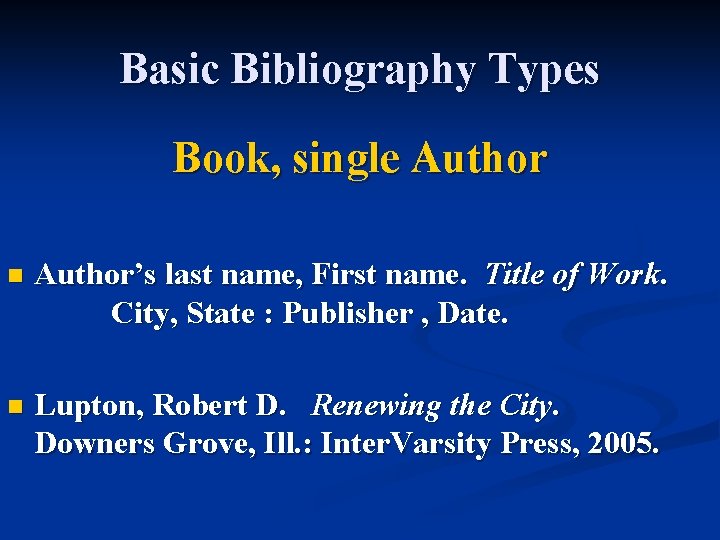
Basic Bibliography Types Book, single Author n Author’s last name, First name. Title of Work. City, State : Publisher , Date. n Lupton, Robert D. Renewing the City. Downers Grove, Ill. : Inter. Varsity Press, 2005.
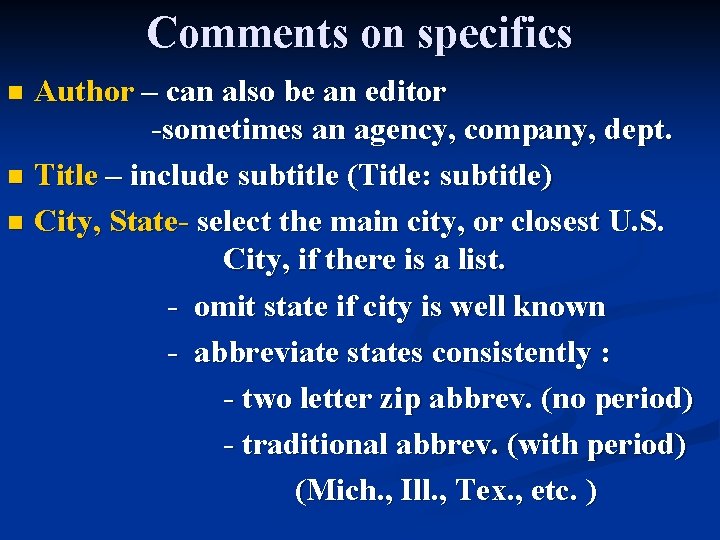
Comments on specifics Author – can also be an editor -sometimes an agency, company, dept. n Title – include subtitle (Title: subtitle) n City, State- select the main city, or closest U. S. City, if there is a list. - omit state if city is well known - abbreviate states consistently : - two letter zip abbrev. (no period) - traditional abbrev. (with period) (Mich. , Ill. , Tex. , etc. ) n
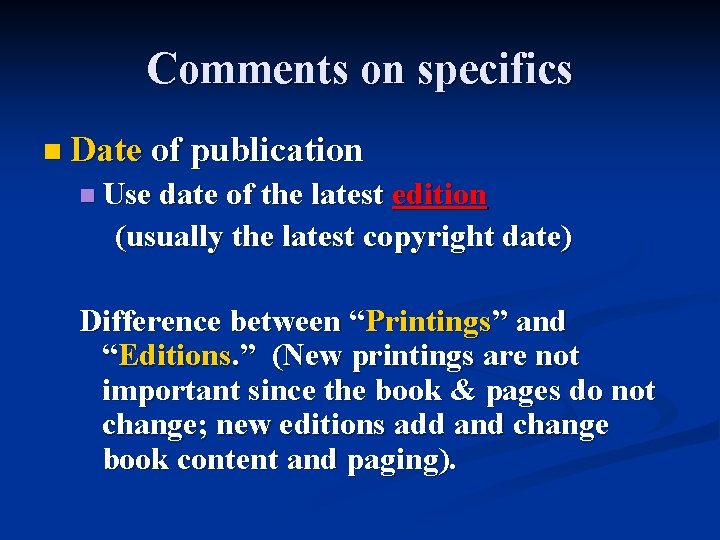
Comments on specifics n Date of publication n Use date of the latest edition (usually the latest copyright date) Difference between “Printings” and “Editions. ” (New printings are not important since the book & pages do not change; new editions add and change book content and paging).
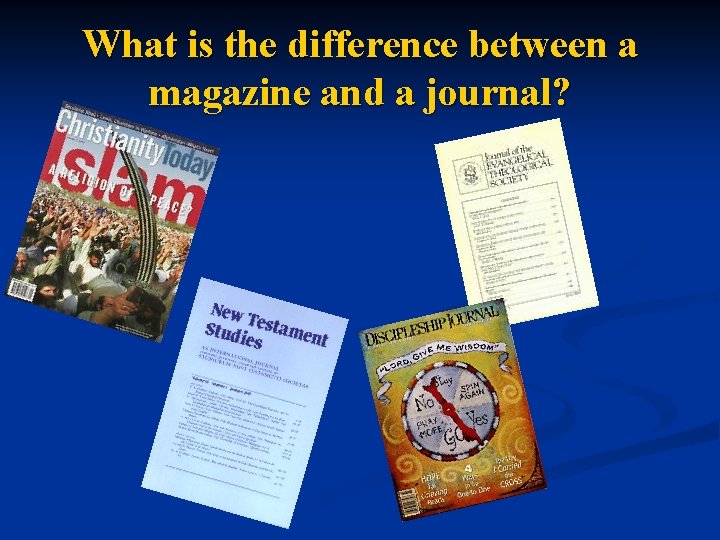
What is the difference between a magazine and a journal?
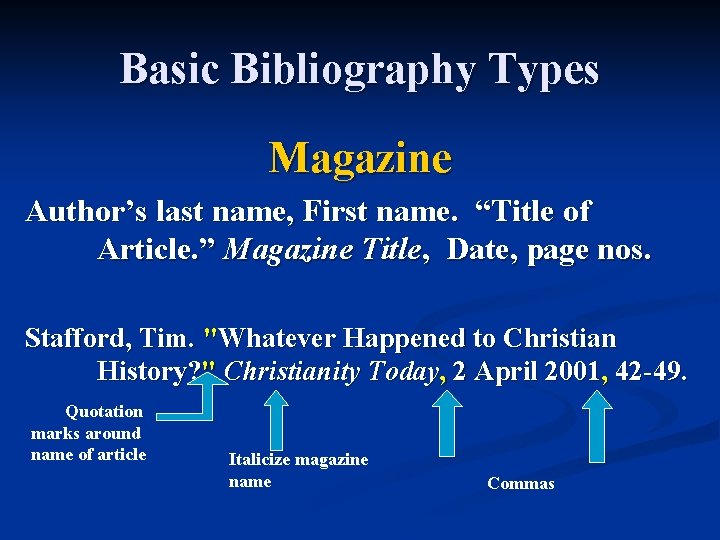
Basic Bibliography Types Magazine Author’s last name, First name. “Title of Article. ” Magazine Title, Date, page nos. Stafford, Tim. "Whatever Happened to Christian History? " Christianity Today, 2 April 2001, 42 -49. Quotation marks around name of article Italicize magazine name Commas
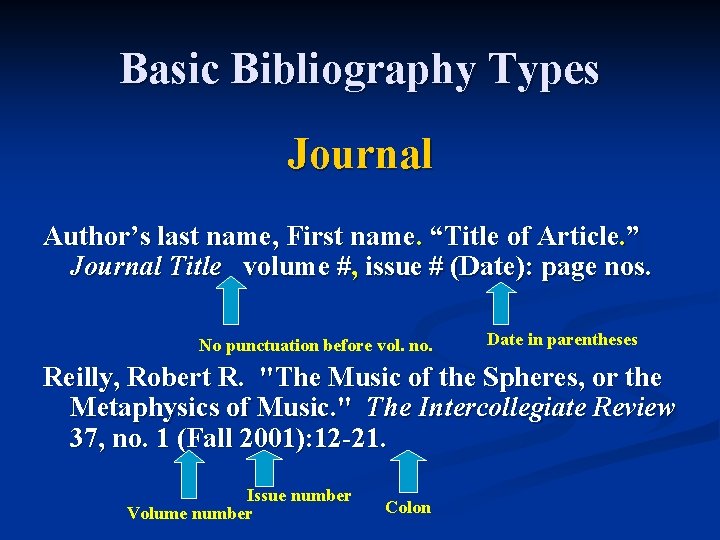
Basic Bibliography Types Journal Author’s last name, First name. “Title of Article. ” Journal Title volume #, issue # (Date): page nos. No punctuation before vol. no. Date in parentheses Reilly, Robert R. "The Music of the Spheres, or the Metaphysics of Music. " The Intercollegiate Review 37, no. 1 (Fall 2001): 12 -21. Issue number Volume number Colon
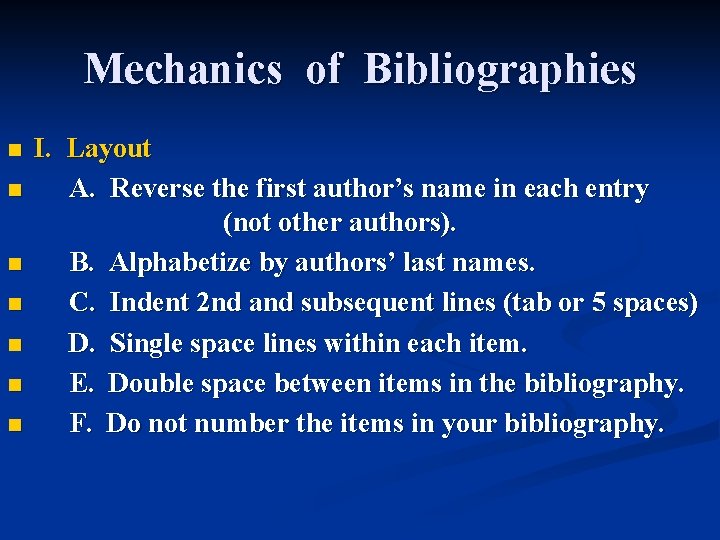
Mechanics of Bibliographies n n n n I. Layout A. Reverse the first author’s name in each entry (not other authors). B. Alphabetize by authors’ last names. C. Indent 2 nd and subsequent lines (tab or 5 spaces) D. Single space lines within each item. E. Double space between items in the bibliography. F. Do not number the items in your bibliography.
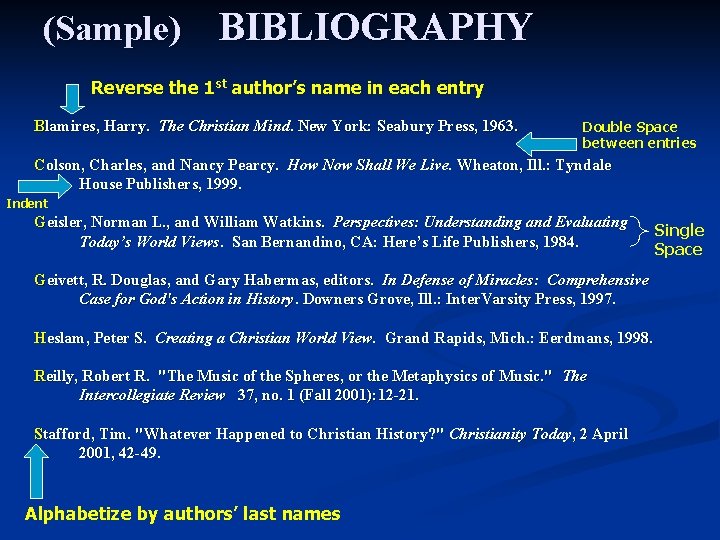
(Sample) BIBLIOGRAPHY Reverse the 1 st author’s name in each entry Blamires, Harry. The Christian Mind. New York: Seabury Press, 1963. Double Space between entries Colson, Charles, and Nancy Pearcy. How Now Shall We Live. Wheaton, Ill. : Tyndale House Publishers, 1999. Indent Geisler, Norman L. , and William Watkins. Perspectives: Understanding and Evaluating Today’s World Views. San Bernandino, CA: Here’s Life Publishers, 1984. Geivett, R. Douglas, and Gary Habermas, editors. In Defense of Miracles: Comprehensive Case for God's Action in History. Downers Grove, Ill. : Inter. Varsity Press, 1997. Heslam, Peter S. Creating a Christian World View. Grand Rapids, Mich. : Eerdmans, 1998. Reilly, Robert R. "The Music of the Spheres, or the Metaphysics of Music. " The Intercollegiate Review 37, no. 1 (Fall 2001): 12 -21. Stafford, Tim. "Whatever Happened to Christian History? " Christianity Today, 2 April 2001, 42 -49. Alphabetize by authors’ last names Single Space
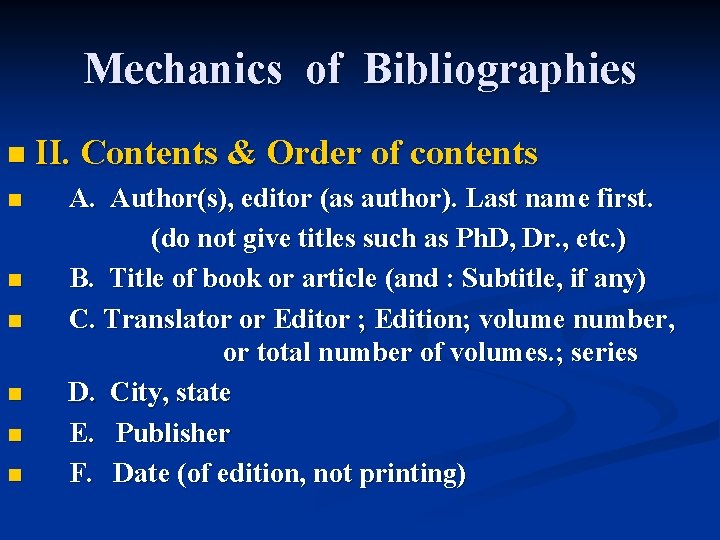
Mechanics of Bibliographies n II. Contents & Order of contents n n n A. Author(s), editor (as author). Last name first. (do not give titles such as Ph. D, Dr. , etc. ) B. Title of book or article (and : Subtitle, if any) C. Translator or Editor ; Edition; volume number, or total number of volumes. ; series D. City, state E. Publisher F. Date (of edition, not printing)
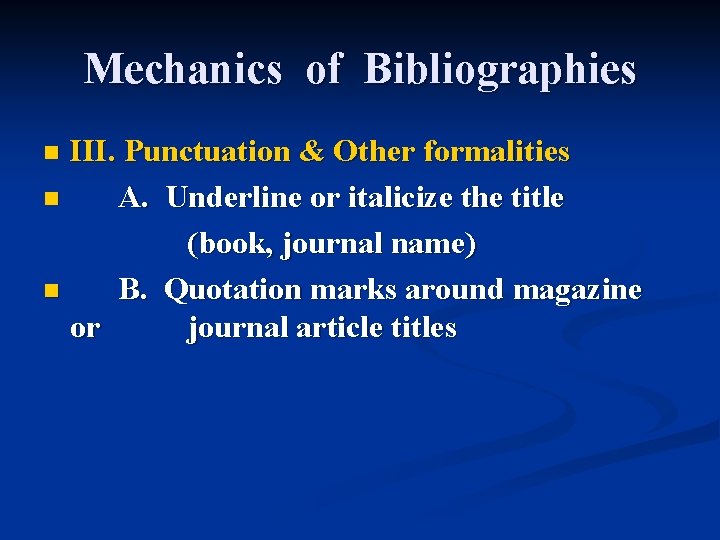
Mechanics of Bibliographies III. Punctuation & Other formalities n A. Underline or italicize the title (book, journal name) n B. Quotation marks around magazine or journal article titles n
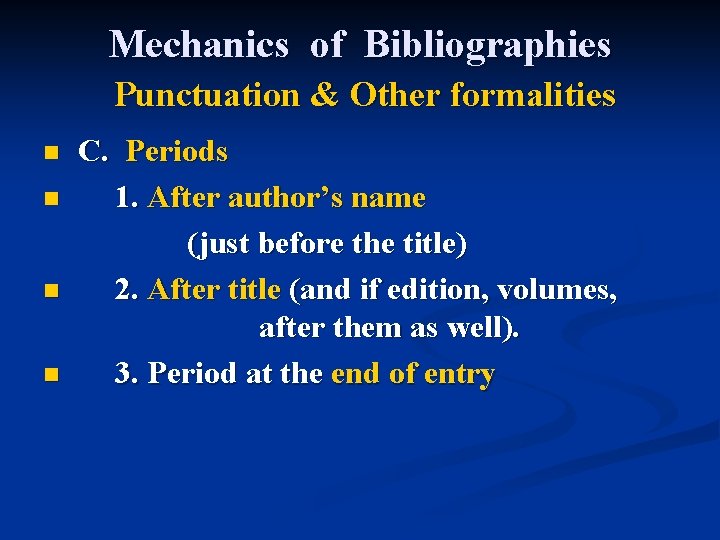
Mechanics of Bibliographies Punctuation & Other formalities n n C. Periods 1. After author’s name (just before the title) 2. After title (and if edition, volumes, after them as well). 3. Period at the end of entry
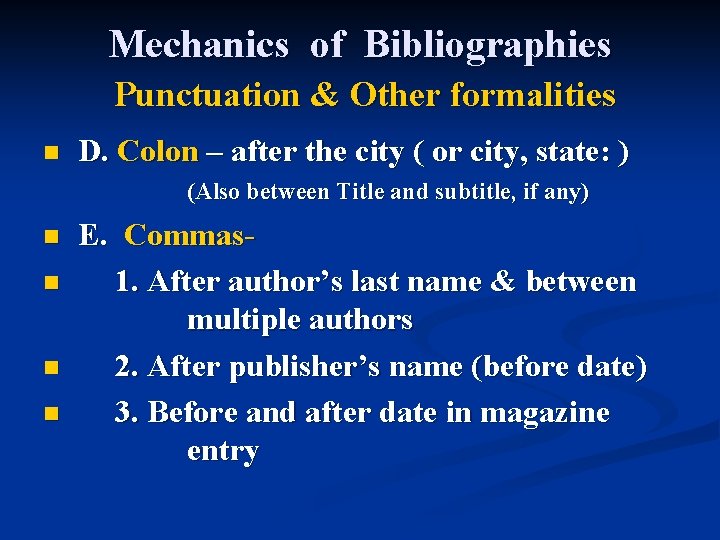
Mechanics of Bibliographies Punctuation & Other formalities n D. Colon – after the city ( or city, state: ) (Also between Title and subtitle, if any) n n E. Commas 1. After author’s last name & between multiple authors 2. After publisher’s name (before date) 3. Before and after date in magazine entry
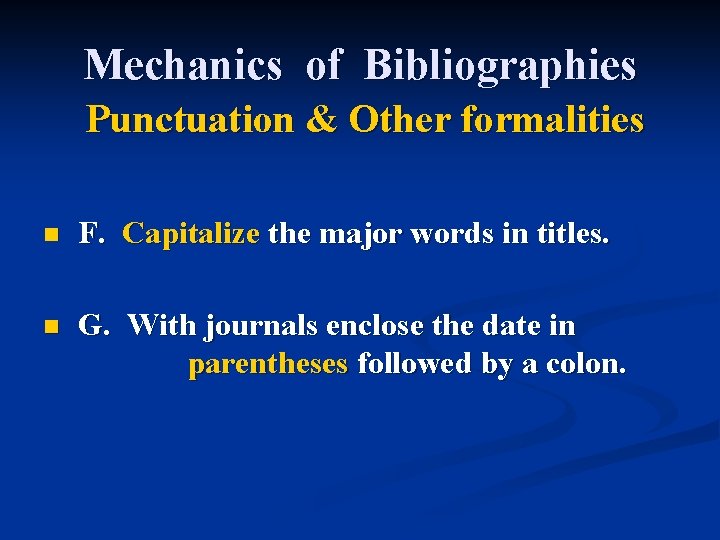
Mechanics of Bibliographies Punctuation & Other formalities n F. Capitalize the major words in titles. n G. With journals enclose the date in parentheses followed by a colon.
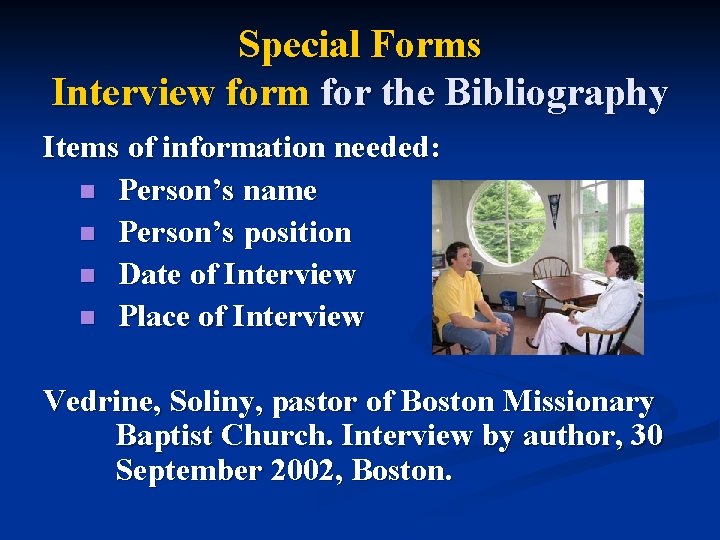
Special Forms Interview form for the Bibliography Items of information needed: n Person’s name n Person’s position n Date of Interview n Place of Interview Vedrine, Soliny, pastor of Boston Missionary Baptist Church. Interview by author, 30 September 2002, Boston.
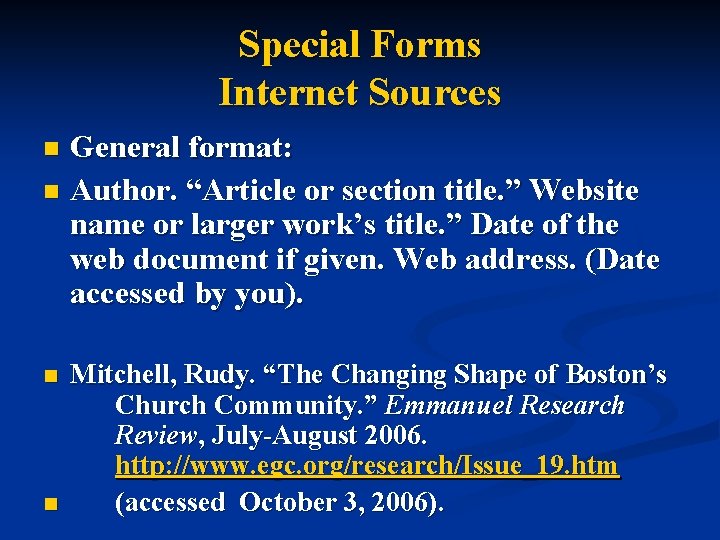
Special Forms Internet Sources General format: n Author. “Article or section title. ” Website name or larger work’s title. ” Date of the web document if given. Web address. (Date accessed by you). n n n Mitchell, Rudy. “The Changing Shape of Boston’s Church Community. ” Emmanuel Research Review, July-August 2006. http: //www. egc. org/research/Issue_19. htm (accessed October 3, 2006).
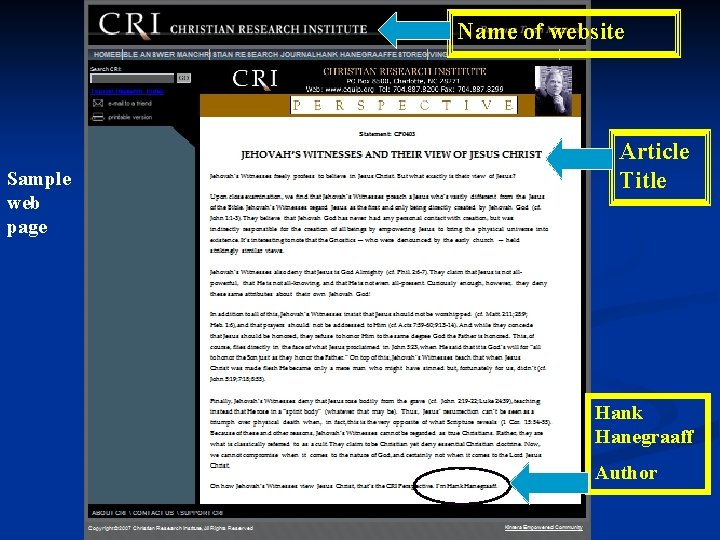
Name of website Sample web page Article Title Hank Hanegraaff Author
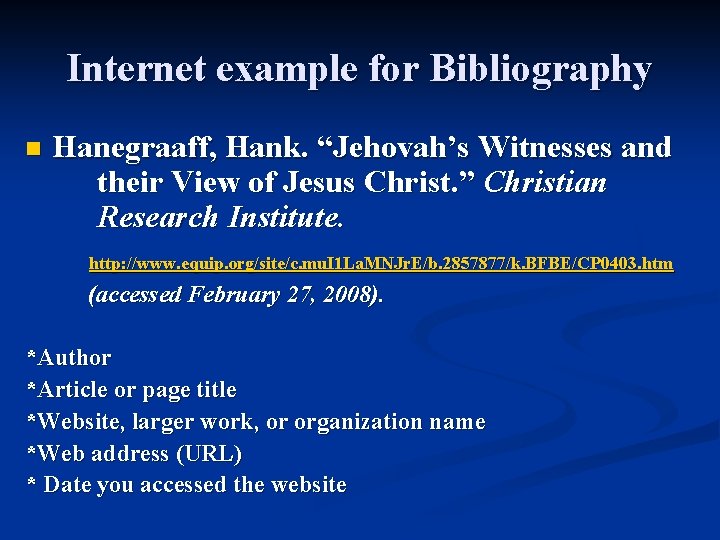
Internet example for Bibliography n Hanegraaff, Hank. “Jehovah’s Witnesses and their View of Jesus Christ. ” Christian Research Institute. http: //www. equip. org/site/c. mu. I 1 La. MNJr. E/b. 2857877/k. BFBE/CP 0403. htm (accessed February 27, 2008). *Author *Article or page title *Website, larger work, or organization name *Web address (URL) * Date you accessed the website
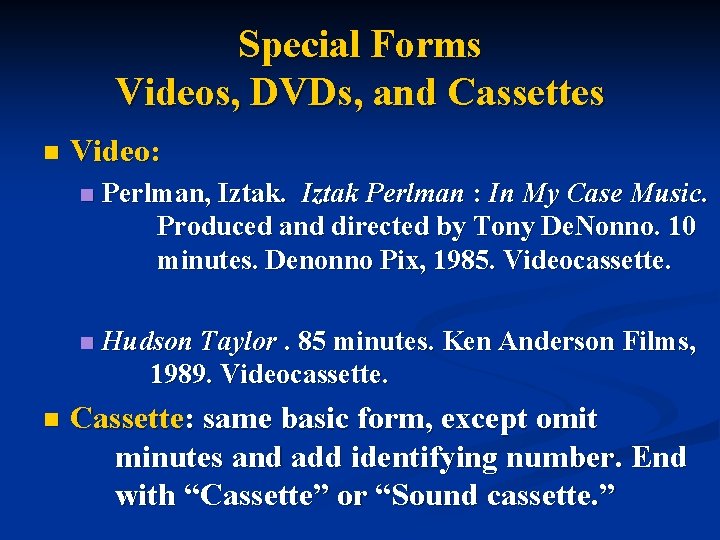
Special Forms Videos, DVDs, and Cassettes n n Video: n Perlman, Iztak Perlman : In My Case Music. Produced and directed by Tony De. Nonno. 10 minutes. Denonno Pix, 1985. Videocassette. n Hudson Taylor. 85 minutes. Ken Anderson Films, 1989. Videocassette. Cassette: same basic form, except omit minutes and add identifying number. End with “Cassette” or “Sound cassette. ”
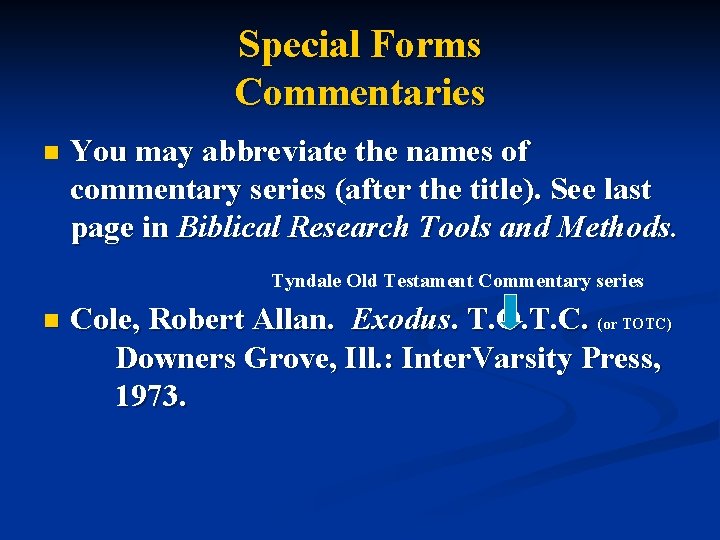
Special Forms Commentaries n You may abbreviate the names of commentary series (after the title). See last page in Biblical Research Tools and Methods. Tyndale Old Testament Commentary series n Cole, Robert Allan. Exodus. T. O. T. C. (or TOTC) Downers Grove, Ill. : Inter. Varsity Press, 1973.
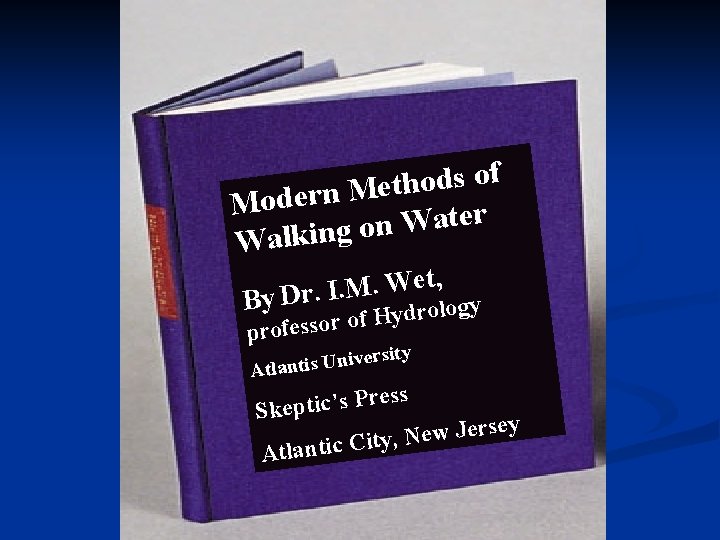
f o s d o h t e M n r e d o M r e t a W n o g n i k l a W , t e W. M. I By Dr. ogy rol d y H f o r o profess rsity e v i n U s i t Atlan ss e r P s ’ c i t p Ske y e s r e J w e y, N t i C c i t n a l At
Dr. I. M. Wet
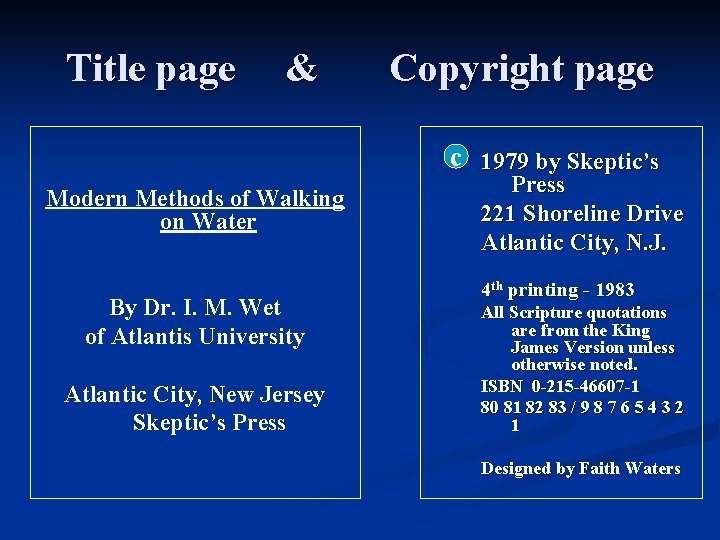
Title page & Copyright page c 1979 by Skeptic’s Modern Methods of Walking on Water By Dr. I. M. Wet of Atlantis University Atlantic City, New Jersey Skeptic’s Press 221 Shoreline Drive Atlantic City, N. J. 4 th printing - 1983 All Scripture quotations are from the King James Version unless otherwise noted. ISBN 0 -215 -46607 -1 80 81 82 83 / 9 8 7 6 5 4 3 2 1 Designed by Faith Waters

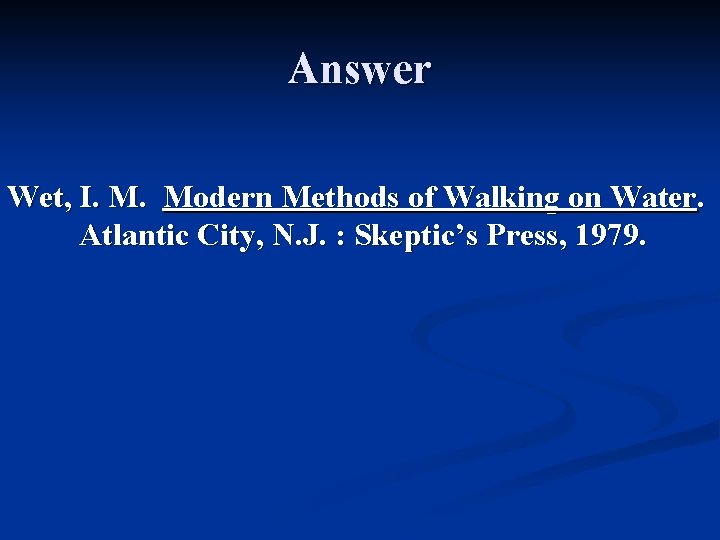
Answer Wet, I. M. Modern Methods of Walking on Water. Atlantic City, N. J. : Skeptic’s Press, 1979.

Book with Two Authors n Noah, William E. , and James Daniel. Life With Animals in Restricted Enclosures. Ararat: Lion’s Den Press, 1999. Daniel in the Lion’s Den

Three authors- example Merk, Jane S. , Ida J. Fogg, and C. Q. Snowe. Meteorologists’ Handbook. Chicago: Alwether and Clere, 1983.
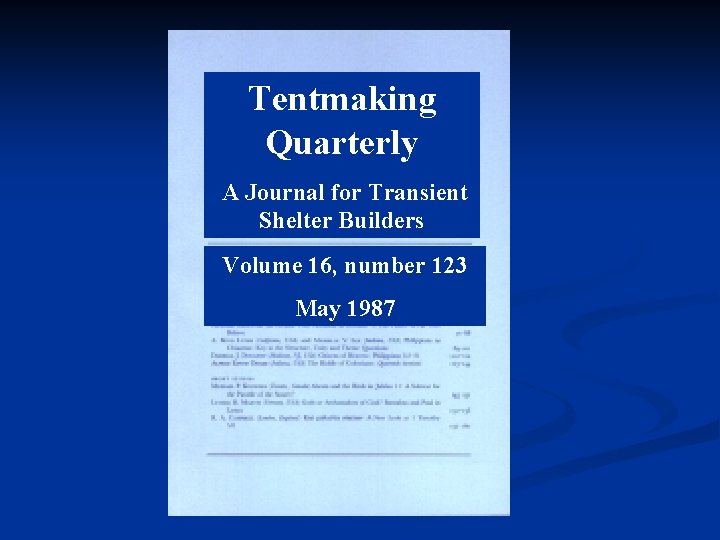
Tentmaking Quarterly A Journal for Transient Shelter Builders Volume 16, number 123 May 1987
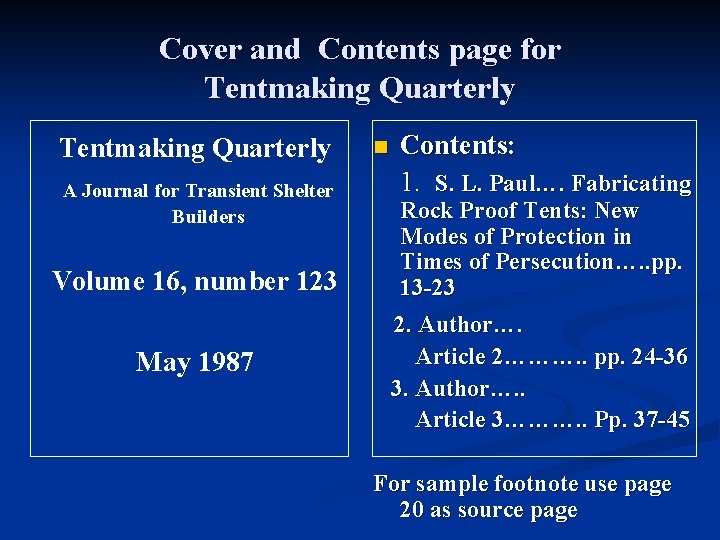
Cover and Contents page for Tentmaking Quarterly A Journal for Transient Shelter Builders Volume 16, number 123 May 1987 n Contents: 1. S. L. Paul…. Fabricating Rock Proof Tents: New Modes of Protection in Times of Persecution…. . pp. 13 -23 2. Author…. Article 2………. . pp. 24 -36 3. Author…. . Article 3………. . Pp. 37 -45 For sample footnote use page 20 as source page

Answer- Journal form n Paul, S. L. “Fabricating Rock Proof Tents: New Modes of Protection in Times of Persecution. ” Tentmaking Quarterly 16 (May 1987): 13 -23.
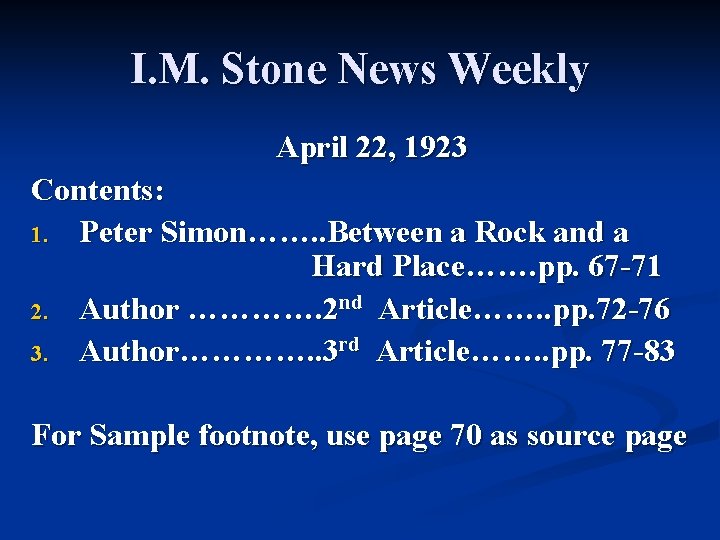
I. M. Stone News Weekly April 22, 1923 Contents: 1. Peter Simon……. . Between a Rock and a Hard Place……. pp. 67 -71 2. Author …………. 2 nd Article……. . pp. 72 -76 3. Author…………. . 3 rd Article……. . pp. 77 -83 For Sample footnote, use page 70 as source page

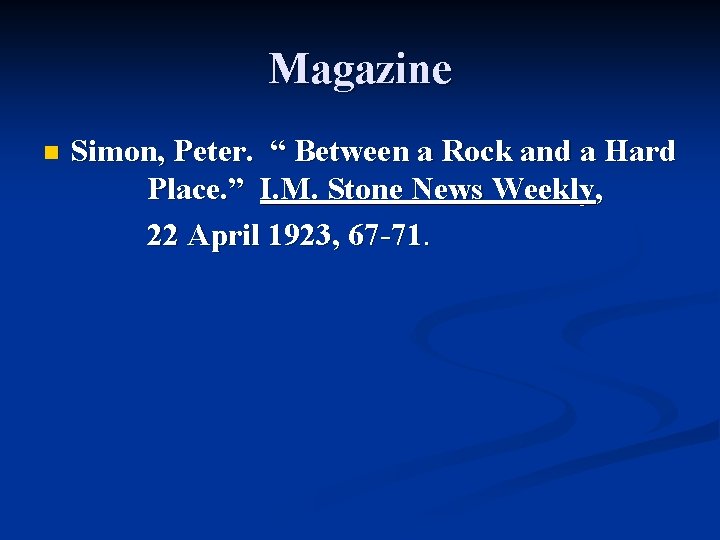
Magazine n Simon, Peter. “ Between a Rock and a Hard Place. ” I. M. Stone News Weekly, 22 April 1923, 67 -71.
Footnotes
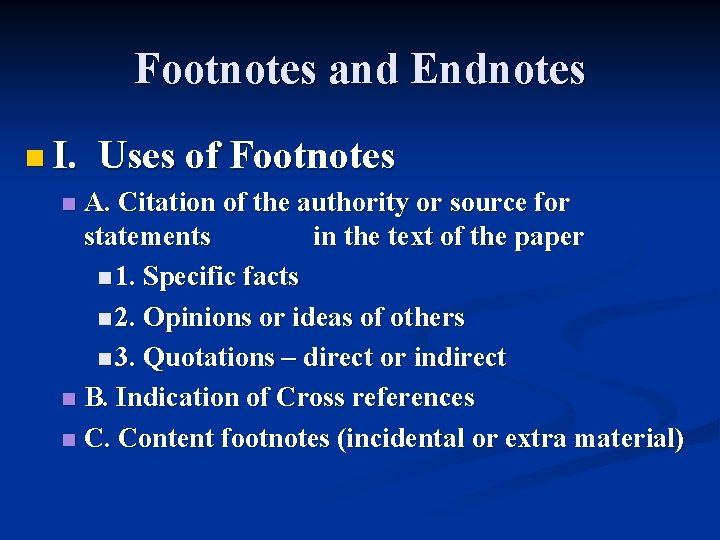
Footnotes and Endnotes n I. Uses of Footnotes A. Citation of the authority or source for statements in the text of the paper n 1. Specific facts n 2. Opinions or ideas of others n 3. Quotations – direct or indirect n B. Indication of Cross references n C. Content footnotes (incidental or extra material) n
Use of Footnotes / Endnotes Quotations n Also paraphrases, summaries, etc. n Ideas, opinions drawn from others n Specific facts which are not common knowledge n
II. Standard First Full Reference Note n The first time a work is mentioned/cited, you should include the full information on the source: The author’s name (not inverted) n Title of the work n Facts of publication n Specific page reference (and volume if needed) n
First name first in footnotes -www. lesjones. com
Standard First Full Reference Note Examples: First Name Last name, Book Title (City, State: Publisher, date), page number(s).
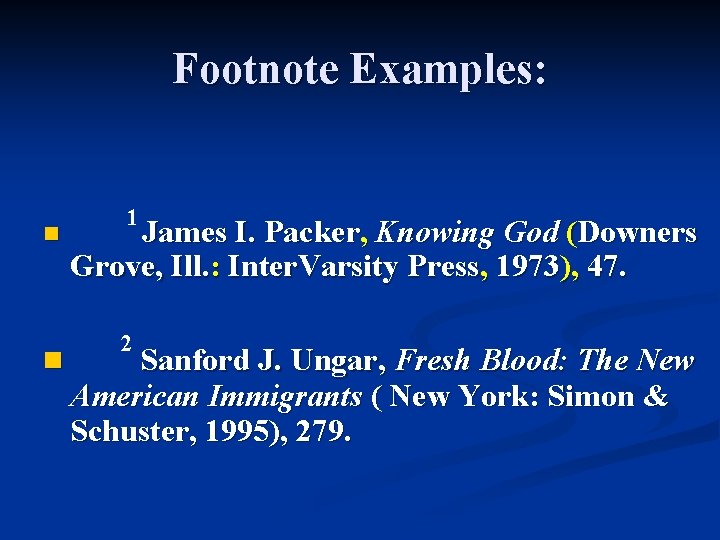
Footnote Examples: n n 1 James I. Packer, Knowing God (Downers Grove, Ill. : Inter. Varsity Press, 1973), 47. 2 Sanford J. Ungar, Fresh Blood: The New American Immigrants ( New York: Simon & Schuster, 1995), 279.
Footnote numbers Insert a footnote number in the text After the passage or quotation it refers to. n Generally place it at the end of a sentence. n With a quotation the number is inserted after the quotation marks. n Note numbers should run continuously through your whole paper n Your program should automatically insert the footnote number superscripted (1/2 space above the line) n
III. Format of Citations: using Word In Microsoft Word – Select “Insert” menu n Then Select “Reference” on drop down menu n Then Select “Footnote” menu item n Set up options: should read -Bottom of Page; Number format -1, 2, 3; Numbering: continuous n Click on “Insert” in menu box n Type your footnote and manually indent 1 st line and italicize the book or periodical title. n (after selecting the Footnote menu item above, n
Footnote format n Lines within a footnote should be single spaced n Unless you have a large number of footnotes, double space between footnotes n Indent the first line of each footnote
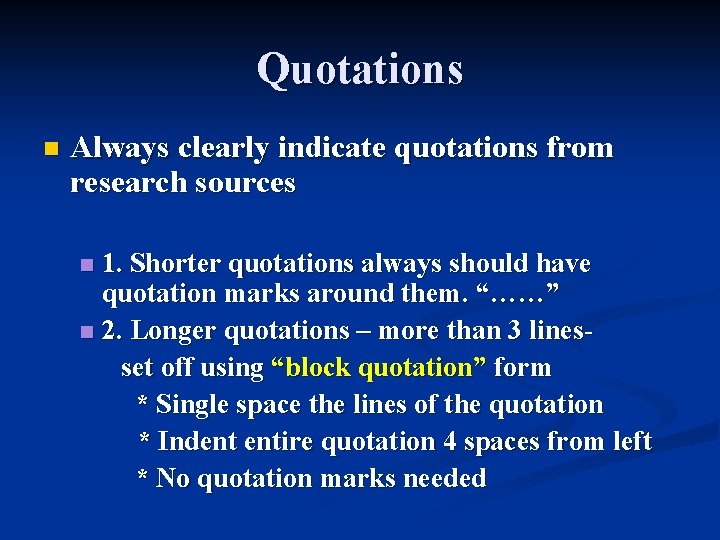
Quotations n Always clearly indicate quotations from research sources 1. Shorter quotations always should have quotation marks around them. “……” n 2. Longer quotations – more than 3 linesset off using “block quotation” form * Single space the lines of the quotation * Indent entire quotation 4 spaces from left * No quotation marks needed n
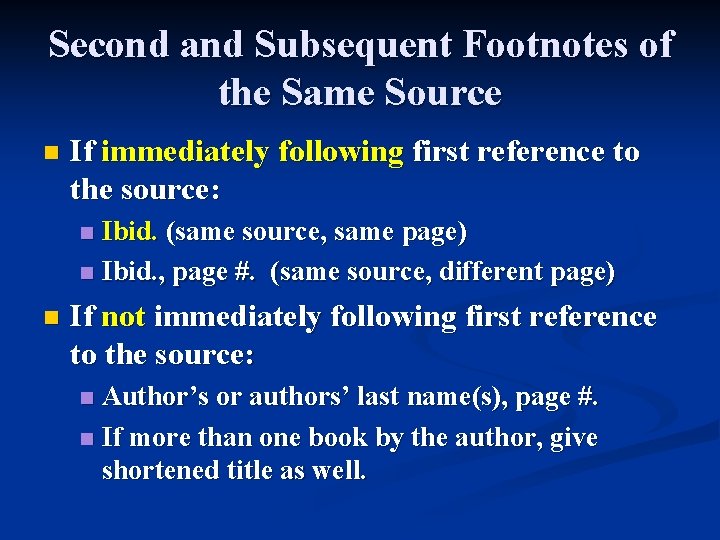
Second and Subsequent Footnotes of the Same Source n If immediately following first reference to the source: Ibid. (same source, same page) n Ibid. , page #. (same source, different page) n n If not immediately following first reference to the source: Author’s or authors’ last name(s), page #. n If more than one book by the author, give shortened title as well. n
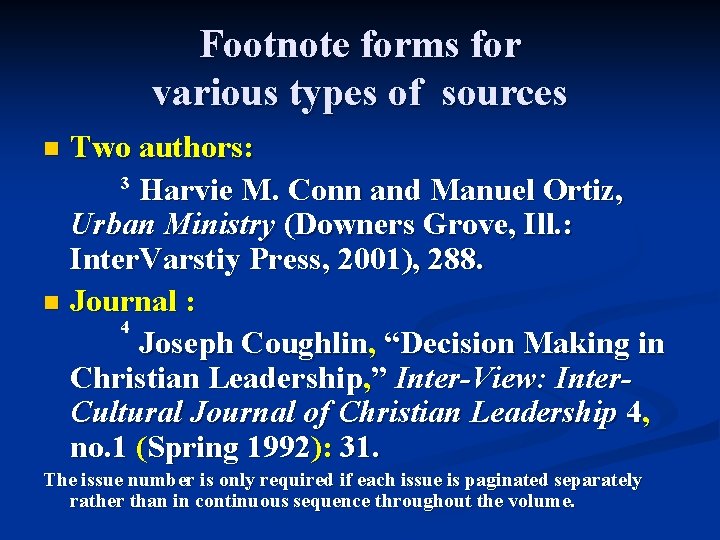
Footnote forms for various types of sources Two authors: 3 Harvie M. Conn and Manuel Ortiz, Urban Ministry (Downers Grove, Ill. : Inter. Varstiy Press, 2001), 288. n Journal : 4 Joseph Coughlin, “Decision Making in Christian Leadership, ” Inter-View: Inter. Cultural Journal of Christian Leadership 4, no. 1 (Spring 1992): 31. n The issue number is only required if each issue is paginated separately rather than in continuous sequence throughout the volume.
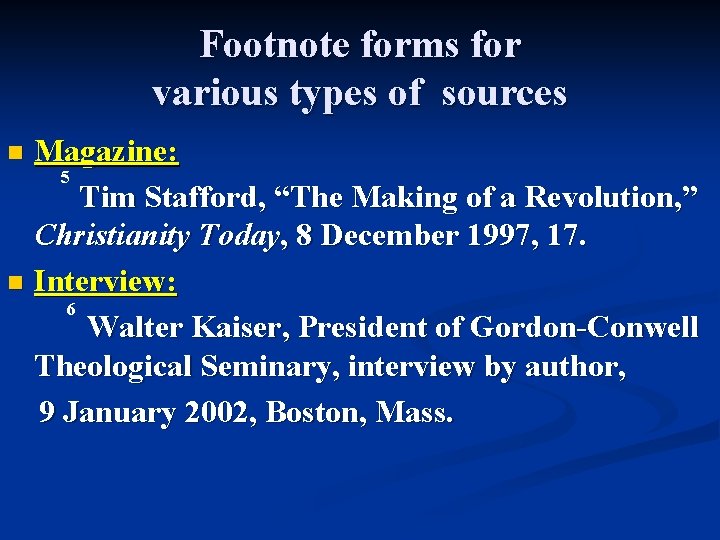
Footnote forms for various types of sources Magazine: 5 Tim Stafford, “The Making of a Revolution, ” Christianity Today, 8 December 1997, 17. n Interview: 6 Walter Kaiser, President of Gordon-Conwell Theological Seminary, interview by author, 9 January 2002, Boston, Mass. n
Footnote forms for various types of sources Documenting Biblical References n Use parentheses in the text for Bible verses n Example: We are reminded that “in the church at Antioch there were prophets and teachers” (Acts 13: 1). n In your first citation, indicate the version of the Bible you will normally use. (in footnote)
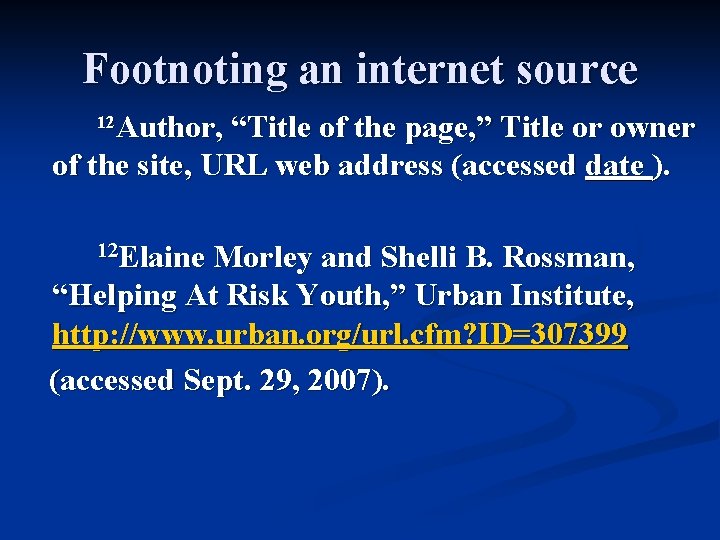
Footnoting an internet source Author, “Title of the page, ” Title or owner of the site, URL web address (accessed date ). 12 12 Elaine Morley and Shelli B. Rossman, “Helping At Risk Youth, ” Urban Institute, http: //www. urban. org/url. cfm? ID=307399 (accessed Sept. 29, 2007).
Footnote Exercises
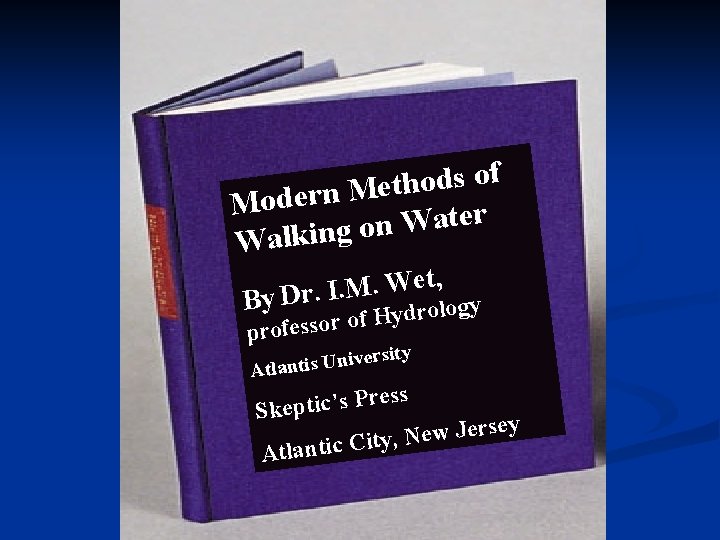
f o s d o h t e M n r e d o M r e t a W n o g n i k l a W , t e W. M. I By Dr. ogy rol d y H f o r o profess rsity e v i n U s i t Atlan ss e r P s ’ c i t p Ske y e s r e J w e y, N t i C c i t n a l At
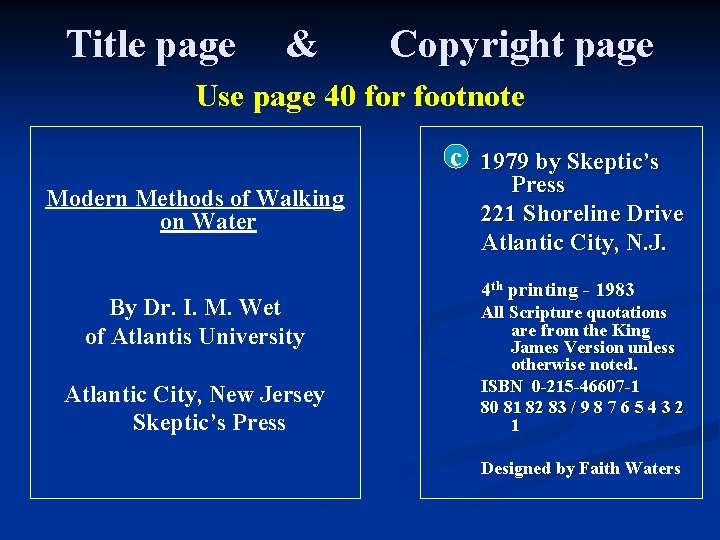
Title page & Copyright page Use page 40 for footnote c 1979 by Skeptic’s Modern Methods of Walking on Water By Dr. I. M. Wet of Atlantis University Atlantic City, New Jersey Skeptic’s Press 221 Shoreline Drive Atlantic City, N. J. 4 th printing - 1983 All Scripture quotations are from the King James Version unless otherwise noted. ISBN 0 -215 -46607 -1 80 81 82 83 / 9 8 7 6 5 4 3 2 1 Designed by Faith Waters

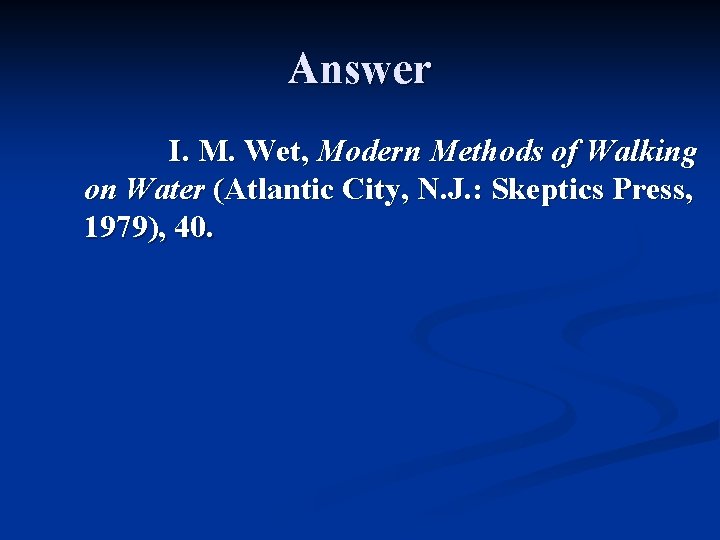
Answer I. M. Wet, Modern Methods of Walking on Water (Atlantic City, N. J. : Skeptics Press, 1979), 40.
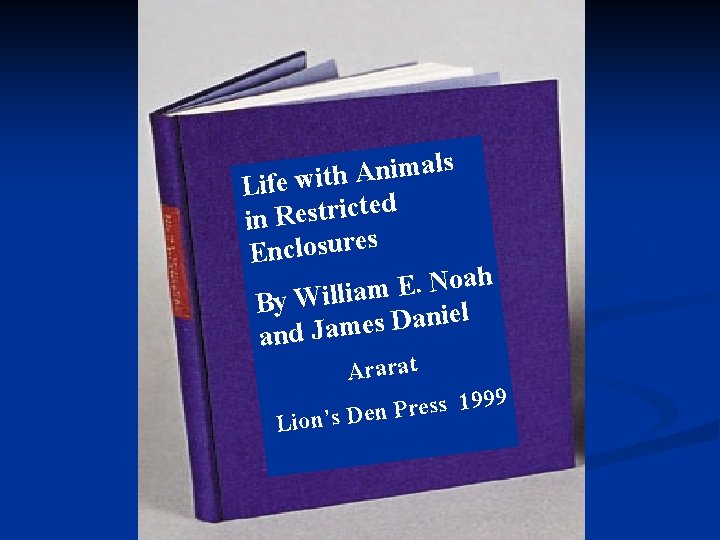
s l a m i n A Life with ed t c i r t s e R in s Enclosure h a o N. E m By Willia l e i n a D s e and Jam Ararat Li 99 9 1 s s e r P on’s Den
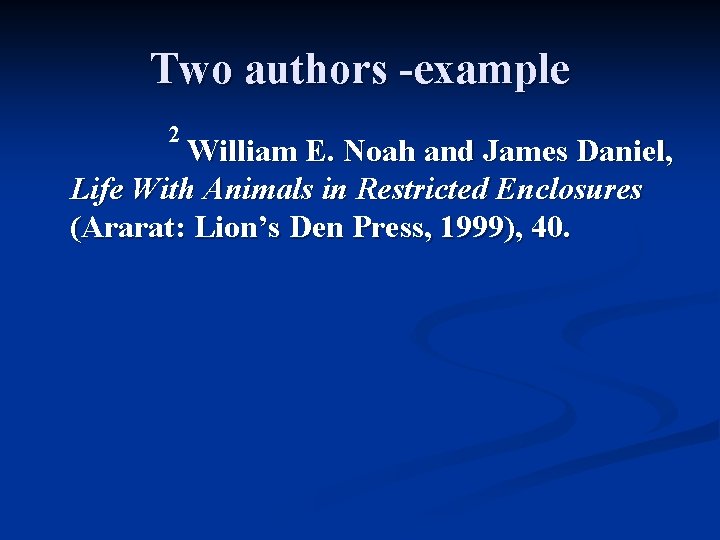
Two authors -example 2 William E. Noah and James Daniel, Life With Animals in Restricted Enclosures (Ararat: Lion’s Den Press, 1999), 40.
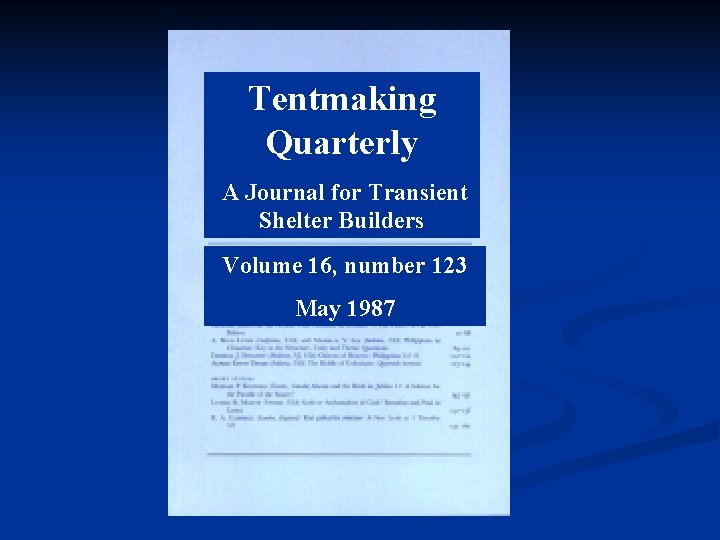
Tentmaking Quarterly A Journal for Transient Shelter Builders Volume 16, number 123 May 1987
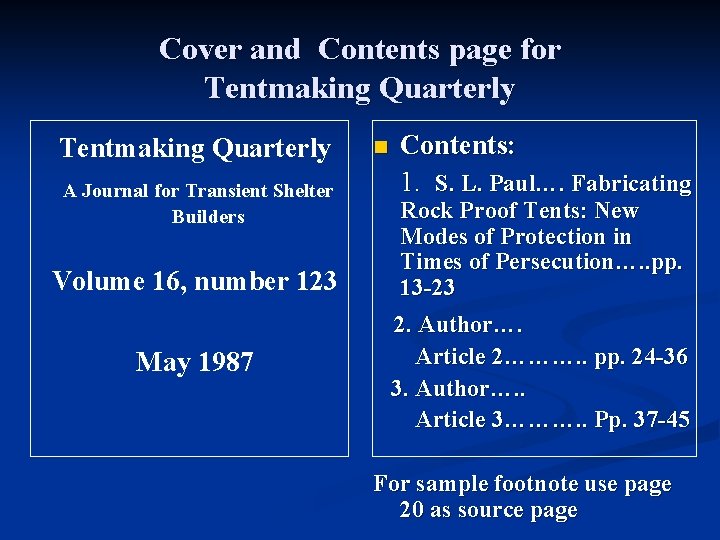
Cover and Contents page for Tentmaking Quarterly A Journal for Transient Shelter Builders Volume 16, number 123 May 1987 n Contents: 1. S. L. Paul…. Fabricating Rock Proof Tents: New Modes of Protection in Times of Persecution…. . pp. 13 -23 2. Author…. Article 2………. . pp. 24 -36 3. Author…. . Article 3………. . Pp. 37 -45 For sample footnote use page 20 as source page

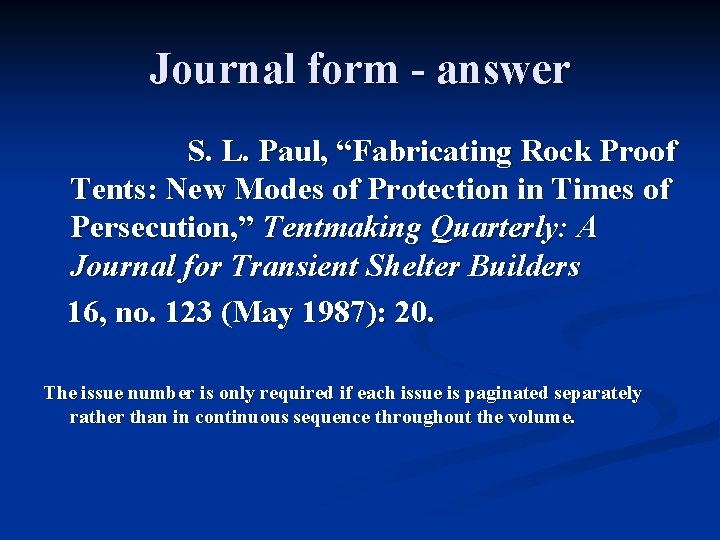
Journal form - answer S. L. Paul, “Fabricating Rock Proof Tents: New Modes of Protection in Times of Persecution, ” Tentmaking Quarterly: A Journal for Transient Shelter Builders 16, no. 123 (May 1987): 20. The issue number is only required if each issue is paginated separately rather than in continuous sequence throughout the volume.
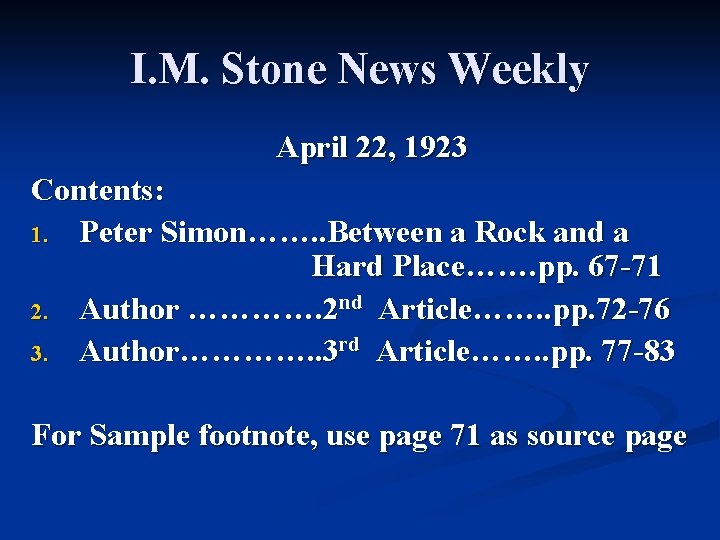
I. M. Stone News Weekly April 22, 1923 Contents: 1. Peter Simon……. . Between a Rock and a Hard Place……. pp. 67 -71 2. Author …………. 2 nd Article……. . pp. 72 -76 3. Author…………. . 3 rd Article……. . pp. 77 -83 For Sample footnote, use page 71 as source page

Magazine form - answer Peter Simon, “Between a Rock and a Hard Place, ” I. M. Stone News Weekly, 22 April 1923, 71.
Three Extremes to Avoid n 1. Few or no footnotes a. Student used sources but didn’t acknowledge them with footnotes (Plagiarism) n b. Little or no research and thus little use of sources – mostly student’s feelings, opinions n 2. Every Sentence footnoted/ no student ideas n 3. Single source over quotation – many long quotations; large portions of paper are quotations from a few sources. n
Remember to Avoid Plagiarism Use footnotes for all quotations n Use footnotes for paraphrases, summaries, etc. n Use footnotes for facts, statistics, and ideas from other people (that are not common knowledge) n
Strategies to Avoid Plagiarism 1 n 1. Place quotation marks around any material taken word for word from another source. n 2. “Paraphrase, but be sure you are not just rearranging or replacing a few words. ” 2 (don’t look at the original when paraphrasing) n 3. Review your paraphrase for accuracy and originality. (not using the same words & phrases) 1”Strategies to Avoid Plagiarism, ” Writing Tutorial Services, Indiana Universtiy, 17 Jan. 2003, http: //www. indiana. edu/~wts/plagiarism. html. 2 Ibid.
- Slides: 80